If you've been searching for the original 2017 Tesla Model X MSRP to benchmark a used purchase, you're likely weighing one of the most polarizing SUVs Tesla ever built against its current market value. The Model X was Tesla's flagship family hauler — complete with Falcon Wing rear doors, a massive panoramic windshield, and Ludicrous Mode acceleration that embarrassed sports cars at stoplights. But nearly a decade later, how does a 2017 Model X hold up as a used EV in 2026?
This guide covers the original pricing, real-world range expectations for aging batteries, charging performance, known issues, and whether this generation still makes financial sense for today's used-EV shoppers.
Original 2017 Tesla Model X MSRP by Trim
When new, the 2017 Model X was positioned as a premium electric SUV with no direct rival. Tesla offered three main battery configurations that year, each with distinct range and performance characteristics. Here's what buyers paid at launch:
| Trim / Battery | Original MSRP (2017) | EPA Range | 0-60 mph | Drivetrain |
|---|---|---|---|---|
| Model X 75D (75 kWh) | $79,500 | 237 mi | 6.0 sec | Dual-Motor AWD |
| Model X 100D (100 kWh) | $96,000 | 295 mi | 4.7 sec | Dual-Motor AWD |
| Model X P100D (100 kWh, Performance) | $134,500 | 289 mi | 2.9 sec (Ludicrous) | Dual-Motor AWD |
Options like the six-seat interior, Enhanced Autopilot, premium audio, and specific wheel sizes could push a well-equipped 100D past $110,000 and a P100D beyond $145,000. Tesla's destination fee added approximately $1,200.
Used Pricing in 2026: What You'll Actually Pay
Depreciation has hit the 2017 Model X hard — which is good news for used buyers but a cautionary tale for anyone planning to resell. As of early 2026, typical asking prices from private sellers and certified dealers fall in these ranges:
- Model X 75D: $18,000–$24,000 (60,000–90,000 miles)
- Model X 100D: $25,000–$35,000 (50,000–80,000 miles)
- Model X P100D: $32,000–$45,000 (40,000–75,000 miles)
Lower-mileage examples and those with documented battery replacements command premiums. Cars with salvage titles or unknown service histories can be found below these ranges but carry substantial risk.
Real-World Range: What to Expect From an Aging Battery
The EPA estimated 237–295 miles depending on trim when new. In 2026, expect a 2017 Model X with an original battery to deliver approximately 185–250 miles of usable range under mixed driving conditions. Battery degradation of 10–18% is typical for NMC cells at this age. Highway driving at 75 mph reduces range an additional 10–15%, and cold-weather operation (below 32°F) can cut range by 25–35% due to cabin heating demands and reduced battery efficiency.
The 2017 Model X uses NMC (nickel manganese cobalt) lithium-ion battery chemistry in both the 75 kWh and 100 kWh packs. NMC offers higher energy density than LFP but is more susceptible to calendar and cycle degradation over time. Tesla's battery management system (BMS) includes a top and bottom buffer — meaning the usable capacity is slightly less than the gross kWh figure — which helps preserve long-term health but doesn't eliminate degradation entirely.
For a 100D that originally delivered 295 EPA miles, a realistic expectation after ~8 years and 70,000 miles is roughly 240–260 miles in mild weather with city/highway mixed driving. The 75D, already range-limited when new, may realistically offer 185–210 miles in daily use.
Before purchasing, request a battery health report from Tesla Service or use the car's energy graph to estimate current degradation. Some 2017 examples have received warranty replacement batteries, which significantly improves both range and resale value.
Charging Speed: DC Fast Charging and Home Level 2
The 2017 Model X uses Tesla's proprietary connector (now being rebranded as NACS across the industry) and can access the full Supercharger network — one of its strongest used-EV advantages.
| Charging Method | Max Power (kW) | Speed / Notes |
|---|---|---|
| Level 1 (120V household) | ~1.4 kW | ~3–4 miles per hour — overnight trickle only |
| Level 2 (240V home, 48A) | ~11.5 kW | ~30–34 miles per hour — full charge in ~8–10 hours |
| DC Fast Charge (V2 Supercharger) | ~120 kW peak | 10–80% in ~40–45 minutes |
| DC Fast Charge (V3 Supercharger) | ~120 kW (limited by vehicle) | No speed advantage over V2 — 2017 hardware caps at ~120 kW |
An important nuance for used buyers: the 2017 Model X cannot take full advantage of Tesla's V3 Superchargers (250 kW peak). Its onboard charge hardware tops out around 120 kW, meaning charging sessions on newer V3 stalls will be no faster than on older V2 stalls. For a 100D, expect a 10–80% session to take roughly 40–45 minutes at a V2 or V3 station. The 75D charges slightly faster in absolute time due to its smaller pack but at a similar peak rate.
For home Level 2 charging, a 48-amp Tesla Wall Connector (or equivalent J1772 station with a Tesla adapter) on a 60-amp circuit provides the best overnight experience. Plan on $500–$1,500 for professional installation depending on your electrical panel's capacity and proximity to the parking spot.
Performance and Drivetrain Specs
| Specification | 75D | 100D | P100D |
|---|---|---|---|
| Battery (usable, approx.) | ~72.5 kWh (NMC) | ~98 kWh (NMC) | ~98 kWh (NMC) |
| Horsepower | ~518 hp | ~518 hp | ~762 hp |
| 0-60 mph | 6.0 sec | 4.7 sec | 2.9 sec (Ludicrous) |
| Top Speed | 130 mph | 130 mph | 155 mph |
| Drivetrain | Dual-Motor AWD | Dual-Motor AWD | Dual-Motor AWD |
| EPA MPGe | 92 MPGe | 100 MPGe | 97 MPGe |
| Efficiency (kWh/100 mi) | ~36 kWh | ~33 kWh | ~34 kWh |
Even by 2026 standards, the P100D's 2.9-second 0-60 time is extraordinary for a seven-passenger SUV. The 100D and 75D remain brisk, and dual-motor AWD provides confident traction in rain and light snow. Air suspension was standard, offering adjustable ride height for rough roads or aerodynamic efficiency at highway speeds.
Cargo, Passenger Space, and Practicality
The Model X was designed around family utility. With five seats, cargo volume reaches 81.5 cu ft behind the front row and 24.6 cu ft behind the second row. The optional third row (six- or seven-seat configurations) reduces cargo space but adds versatility for larger families. Second-row legroom measures approximately 38.4 inches, while the front seats offer 41.2 inches of legroom.
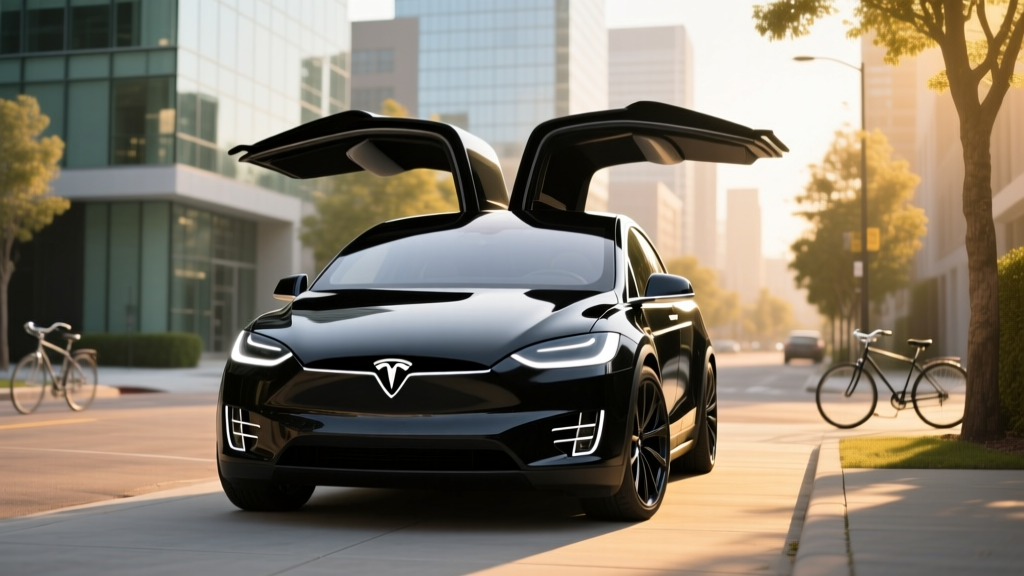
The Falcon Wing rear doors are the Model X's most recognizable feature. They open vertically, making car-seat installation and third-row access easier in tight parking spots — but they also add mechanical complexity and have been a source of reliability complaints (more on that below). The front trunk (frunk) provides approximately 6.5 cu ft of additional storage.
Towing capacity is rated at 5,000 lbs with the factory tow package, making the Model X viable for light trailer and boat duty — a rarity among electric SUVs of its era.
Tax Credits and Incentives for Used Buyers
Because the 2017 Model X is no longer new, it does not qualify for the new-vehicle §30D federal tax credit. However, it may qualify for the used clean vehicle credit (also under §30D, up to $4,000 or 30% of the sale price, whichever is less) if all conditions are met:
- Sale price must be $25,000 or less — this eliminates most 100D and P100D examples but makes many 75D models potentially eligible
- Buyer income caps: AGI must not exceed $75,000 (single), $112,500 (head of household), or $150,000 (joint)
- Vehicle must be at least two model years old — a 2017 qualifies
- Must be purchased from a licensed dealer — private-party sales do not qualify
- The credit can only be claimed once per vehicle VIN — verify the credit hasn't already been used on a prior resale
- Must be purchased for personal use in the United States
This means a 75D purchased from a dealer for $22,000 could yield a $4,000 tax credit, effectively bringing the net cost to $18,000 — a compelling value for a dual-motor AWD electric SUV. Always confirm eligibility with a tax professional before relying on the credit.
Battery and Vehicle Warranty Status
Tesla's original battery and drive unit warranty for the 2017 Model X was 8 years or 150,000 miles (whichever comes first), with a minimum 70% capacity retention threshold. For most 2017 examples in 2026, this warranty has expired by time — though low-mileage examples under 150,000 miles may still have residual coverage.
The basic vehicle limited warranty was 4 years / 50,000 miles and is expired for all 2017 models. This means buyers are responsible for all repair costs unless they purchase an extended warranty or Tesla's approved third-party coverage.
Battery replacement cost for a 2017 Model X, if needed out of warranty, typically ranges from $12,000 to $18,000 at Tesla Service, depending on pack configuration and labor. Some independent EV shops offer refurbished packs for $8,000–$12,000.
Known Issues and Drawbacks
- Supercharger network access — best public charging in the US
- P100D performance is still world-class
- Generous cargo space and optional third row
- Over-the-air updates added features post-purchase
- Falcon Wing doors aid car-seat access in tight spots
- 5,000-lb towing capacity
- Falcon Wing door sensors and actuators are failure-prone
- 120 kW DC fast-charge cap feels slow by 2026 standards
- 75D range is inadequate for road trips with degradation
- No CCS/NACS adapter was native — relies on Tesla connector
- Wind noise and panel gaps were common build-quality complaints
- Out-of-warranty repairs are expensive
- Autopilot hardware (HW2.0/2.5) lacks current FSD capabilities
The Falcon Wing doors deserve specific attention. Their ultrasonic sensors and hydraulic actuators have generated numerous reliability complaints. Repair costs per door can exceed $1,500. Before purchasing, test every door's open/close cycle multiple times and check for sensor errors on the touchscreen.
The 2017 Model X shipped with Tesla's Hardware 2.0 or 2.5 Autopilot computer. While basic Autopilot (adaptive cruise + lane centering — a SAE Level 2 driver-assist system) functions adequately, these units cannot run the latest Full Self-Driving (Supervised) neural networks. Tesla has offered hardware upgrades in some cases, but availability and cost vary. Do not expect current-generation FSD performance from a 2017 vehicle.
How Does It Compare to Used Alternatives?
In the $20,000–$40,000 used-EV SUV market of 2026, the 2017 Model X competes against:
- 2019–2021 Tesla Model Y (Long Range): More efficient, faster charging, simpler doors, similar interior space. Used prices overlap heavily with the 100D. The Model Y is the more rational choice for most buyers.
- 2018–2020 Jaguar I-PACE: Better build quality and styling, but limited public charging options and faster depreciation on parts availability. Range is comparable to the 100D.
- 2021–2022 Ford Mustang Mach-E (Extended Range): Newer, better range, CCS charging, more modern interior. Typically $28,000–$38,000 used. Lacks the Model X's third row and towing capacity.
- 2019–2021 Audi e-tron: Luxurious, quiet, solid build, but lower range (~204–222 mi EPA) and slower DC charging. A comfort-oriented alternative.
Choose the 2017 Model X if: you need a third row, want Falcon Wing doors for car-seat access, value Supercharger access, or want P100D-level performance on a budget.
Choose the Model Y or Mach-E instead if: you prioritize charging speed, lower maintenance risk, modern driver-assist hardware, or don't need three rows of seating.
Who Is the 2017 Model X Best Suited For?
The 2017 Model X makes the most sense for:
- Families needing a third row who want electric and can accept the range and maintenance trade-offs
- Performance enthusiasts who want P100D acceleration at a fraction of its original $134,500 price
- Light towers who need 5,000-lb capacity in an electric SUV
- Budget-conscious Tesla fans who want Supercharger access and a premium badge under $25,000
It is not ideal for:
- Buyers who need reliable daily range above 250 miles (the 75D won't deliver it)
- Anyone uncomfortable with out-of-warranty repair risk on complex hardware
- Road-trip-heavy drivers who want the fastest possible DC charging
Frequently Asked Questions
What was the original 2017 Tesla Model X MSRP?
The 2017 Model X started at $79,500 for the 75D, $96,000 for the 100D, and $134,500 for the P100D — before options and destination charges.
What is the real-world range of a 2017 Model X today?
Expect 185–250 miles depending on the trim, battery degradation, and driving conditions. The 100D typically delivers 240–260 miles in mixed driving; the 75D delivers 185–210 miles. Cold weather reduces these figures by 25–35%.
How fast does the 2017 Model X charge?
It peaks at approximately 120 kW on DC fast chargers (V2 or V3 Superchargers), delivering a 10–80% charge in roughly 40–45 minutes. At home on a 240V Level 2 charger (48A / 11.5 kW), it adds about 30–34 miles of range per hour.
Does a used 2017 Model X qualify for a federal tax credit?
It may qualify for the used clean vehicle credit (up to $4,000) if the dealer sale price is $25,000 or less, the buyer meets income caps, and the credit hasn't been previously claimed on that VIN. Most 100D and P100D examples exceed the price cap. Consult a tax professional and review current IRS rules for used clean vehicles.
Is the 2017 Model X worth buying vs. a used Model Y?
The Model X offers a third row, Falcon Wing doors, and more cargo space. The Model Y offers faster charging, lower repair risk, newer hardware, and better efficiency. If you don't need three rows, the Model Y is generally the smarter used buy.
What are the biggest concerns with a 2017 Model X?
Falcon Wing door reliability, limited DC fast-charge speed (120 kW cap), battery degradation on the 75D, outdated Autopilot hardware, and expensive out-of-warranty repairs are the primary concerns.
How much does a battery replacement cost?
Out-of-warranty battery replacement at Tesla Service runs $12,000–$18,000. Independent EV shops may offer refurbished packs for $8,000–$12,000. Always verify battery health before purchase to avoid this expense.