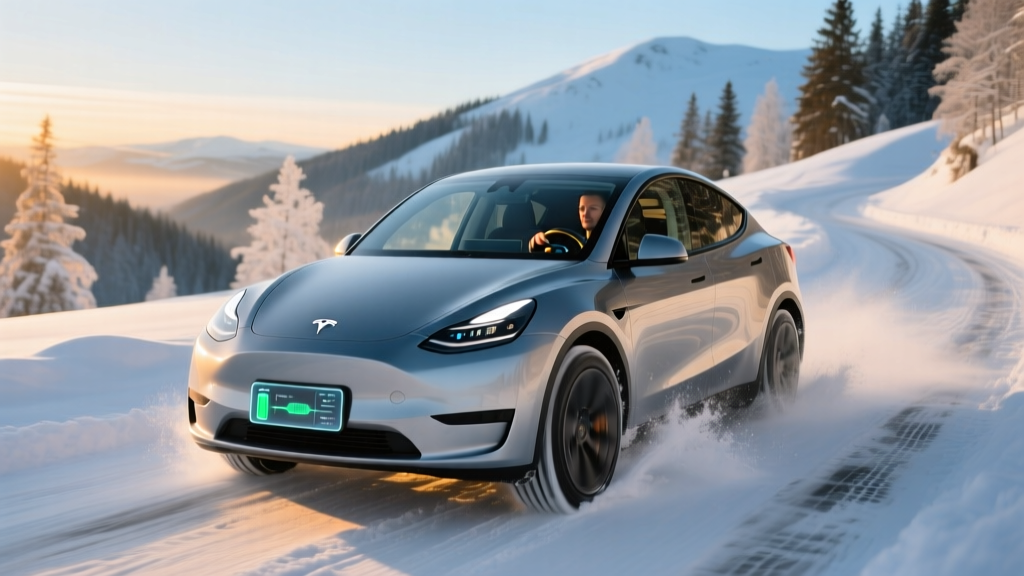
Quick Verdict: Can You Daily-Drive a Tesla in Snow?
Short answer: yes — but with caveats that every cold-climate buyer needs to understand before signing the paperwork. The 2026 Tesla Model Y Long Range AWD remains one of the most capable electric SUVs for winter driving, thanks to its dual-motor all-wheel-drive system, heat pump, and low center of gravity. But "capable" doesn't mean "unaffected." Cold temperatures compress range by 20-30%, winter tires are essentially mandatory below 45°F, and DC fast charging slows when the battery is cold-soaked.
This guide dissects what happens when you take the best-selling EV in America into freezing conditions — the real range numbers, the traction behavior, the charging quirks, and whether a Tesla in snow is a confidence-inspiring daily driver or a source of winter anxiety.
| Spec | Value |
|---|---|
| EPA Range | 320 miles |
| Real-World Winter Range (est.) | 220–260 miles (depending on temp & speed) |
| Battery Capacity | ~75 kWh usable (NMC chemistry) |
| Drivetrain | Dual-Motor AWD |
| Horsepower | 384 hp combined |
| 0–60 mph | 4.8 seconds |
| Max DC Fast Charge | 250 kW peak |
| 10–80% DC Fast Charge | ~25 minutes (warm battery) |
| Level 2 Home Charging | 11.5 kW (~44 mi/hr) |
| EPA Efficiency | 122 MPGe combined (28 kWh/100 mi) |
| Cargo Volume (rear seats up) | 30.2 cu ft |
| Cargo Volume (rear seats folded) | 72.1 cu ft |
| Base MSRP | $48,990 (before incentives) |
| Battery Warranty | 8 years / 120,000 miles |
Real-World Winter Range: What the EPA Sticker Doesn't Tell You
Real-World Expectation (50–70°F, mixed driving): ~275–295 miles
Cold-Weather Range (20–32°F, highway speeds): ~220–260 miles
Extreme Cold (below 0°F, short trips with cabin heating): ~190–220 miles
The EPA's 320-mile estimate for the Model Y Long Range AWD is generated under controlled laboratory conditions that don't replicate a January morning in Minneapolis. According to fueleconomy.gov, the Model Y achieves 122 MPGe combined — excellent for a dual-motor AWD SUV. But efficiency in cold weather tells a different story.
Lithium-ion batteries experience increased internal resistance at low temperatures, reducing the energy available for propulsion. Simultaneously, the cabin heater, seat heaters, battery thermal management system, and defroster all draw power from the same pack. Unlike a gas car — which wastes heat from the engine for free cabin warmth — an EV must generate heat electrically, consuming precious kWh.
The Model Y's standard heat pump (introduced with the 2021 refresh and refined since) significantly mitigates this. Tesla's heat pump scavenges waste heat from the drivetrain and ambient air, operating at a coefficient of performance (COP) of roughly 2.0–3.0 in moderate cold. That means 1 kWh of electrical energy produces 2–3 kWh of thermal energy — far more efficient than resistive heating. But even with a heat pump, expect a 20–30% range reduction at highway speeds in sub-freezing temperatures, based on aggregated owner data and third-party winter testing.
Practical translation: A 320-mile EPA range becomes roughly 240 miles of usable range on a 25°F day at 70 mph. If your daily round-trip commute is 80 miles with a 50-mile buffer for errands and detours, you'll still arrive home with 100+ miles remaining. But a 200-mile one-way trip in deep cold requires mid-route charging planning.
Cold-Weather Charging: Speeds, Preconditioning, and What to Expect
Charging an EV in winter is where preparation separates a smooth experience from a frustrating one. The Model Y's battery management system (BMS) will restrict charge rates when the pack is cold — a protective measure to prevent lithium plating on the anode, which causes permanent degradation.
| Charging Method | Warm Battery (60°F+) | Cold Battery (below 32°F, no preconditioning) |
|---|---|---|
| DC Fast Charge (peak) | 250 kW | 60–120 kW (severely limited) |
| DC Fast 10–80% | ~25 minutes | 40–60+ minutes |
| Level 2 Home (240V / 48A) | 11.5 kW (~44 mi/hr) | 11.5 kW (minimal cold impact at L2) |
| Level 1 (120V / 12A) | ~1.4 kW (~3–5 mi/hr) | ~1.4 kW (negligible in winter) |
The preconditioning workaround: When you navigate to a Supercharger in the Tesla navigation system, the car automatically begins warming the battery en route — typically 15–30 minutes before arrival. This brings the pack into the optimal temperature window for fast charging. If you precondition correctly, you'll see near-peak charge rates even in 10°F weather. If you skip preconditioning (for example, pulling into a non-Tesla CCS charger without navigation routing), expect painfully slow charging until the battery warms itself through use.
At home, Level 2 charging is virtually unaffected by cold because the charge rate is low enough that the BMS can manage thermal conditions without throttling. A Wall Connector on a 60-amp circuit delivers 11.5 kW, adding roughly 44 miles of range per hour. Overnight charging in a garage or driveway reliably tops the pack to 100% by morning — though Tesla recommends daily charging to 80–90% for NMC chemistry to maximize long-term battery health.
Traction and Handling: AWD, Weight Distribution, and Winter Tires
The Model Y's dual-motor AWD system provides independent torque control to front and rear axles, with traction adjustments happening in milliseconds — faster than any mechanical AWD system. The skateboard platform places the battery low and central, giving the Model Y a curb weight of approximately 4,400 lbs with a near-50/50 front-to-rear weight distribution. That mass over the drive axles aids grip, and the low center of gravity reduces body roll compared to most ICE SUVs.
However, all-season tires are the weak link. The Model Y ships from the factory with all-season touring tires (typically Michelin Pilot Sport All-Season or Hankook Ventus S1 evo3 EV) optimized for low rolling resistance and quiet operation. These tires harden significantly below 45°F, losing grip on snow and ice. Multiple owner reports and independent tests confirm that the Model Y's traction control and AWD system are excellent — but they can only work with the grip the tires provide.
The winter tire solution: A dedicated set of winter tires (on separate wheels for easy seasonal swaps) transforms the Model Y's snow performance. With tires like the Michelin X-Ice Snow or Bridgestone Blizzak WS90, braking distances on packed snow drop by 30–40%, and cornering grip improves dramatically. Many cold-climate Tesla owners consider winter tires non-negotiable. Budget roughly $1,200–$1,800 for a set of four winter tires on steel or alloy wheels, plus mounting and balancing twice yearly.
Ground clearance is 6.6 inches — adequate for plowed roads and moderate accumulation, but not designed for deep unplowed drifts. If you regularly face 8+ inches of unplowed snow, the Model Y's clearance may be a limitation compared to a taller SUV or truck.
Pricing, Tax Credits, and Total Cost for Winter Buyers
| Trim | MSRP | Est. Price After §30D Credit |
|---|---|---|
| Long Range AWD | $48,990 | ~$41,490 (if eligible) |
| Performance AWD | $53,990 | ~$46,490 (if eligible) |
The federal EV tax credit under IRS §30D offers up to $7,500 for qualifying new EVs, and as of 2024, buyers can transfer the credit to the dealer at the point of sale for an immediate price reduction. However, eligibility is not universal. Key requirements include:
- MSRP cap: SUVs must have an MSRP at or below $80,000 (both Model Y trims qualify).
- Buyer income cap: Modified AGI must not exceed $150,000 (single), $225,000 (head of household), or $300,000 (married filing jointly).
- Battery sourcing: Critical minerals and battery components must meet phased-in domestic/free-trade sourcing thresholds that tighten annually. Verify current-year compliance on the IRS qualified vehicles list before purchasing.
The Model Y has historically qualified for the full $7,500 credit, but battery-sourcing rules are subject to change. Always confirm eligibility at the time of purchase via the IRS Clean Vehicle Credits page or the point-of-sale verification at Tesla checkout.
Winter ownership add-ons to budget for:
- Winter tire set with wheels: $1,200–$1,800
- Home Level 2 charger (Tesla Wall Connector): ~$475 + $500–$2,000 installation
- Block heater or garage heating: generally not needed (Tesla's thermal management handles cold-soaked starts)
Tech Features That Matter in Winter
Tesla's software stack provides several features that are particularly useful in cold weather:
- Scheduled Departure / Preconditioning: Set a departure time via the app or touchscreen, and the Model Y will warm the cabin, defrost windows, and bring the battery to optimal temperature while still plugged in — drawing power from the grid, not the battery. This preserves your full range for the drive.
- Seat heaters and heated steering wheel: Standard on all trims. Using seat heaters and the steering wheel heater instead of (or in addition to) the cabin heat pump reduces energy consumption, extending range.
- Defrost mode: The Tesla app allows remote defrost, melting ice and snow off the windshield and windows before you leave the house.
- Regenerative braking modulation: In icy conditions, the Model Y can reduce regen braking aggressiveness to prevent rear-wheel slip during deceleration. Navigate to the driving settings to select "Low" regen when roads are slick.
- Autopilot (Level 2 ADAS): Tesla's Autopilot includes adaptive cruise control, lane centering, and automatic emergency braking. In winter, note that lane markings obscured by snow will limit lane-centering functionality. The driver must remain fully engaged at all times — this is a Level 2 driver-assist system, not self-driving.
Notable drawbacks for winter owners:
- The all-glass roof can feel cold in winter, and frost can form on the interior surface in extreme cold without proper preconditioning.
- Door handles are flush-mounted and can freeze shut after freezing rain. Tesla recommends applying a silicone-based lubricant to handle mechanisms before winter.
- The frunk (front trunk) latch can occasionally freeze, though it's less common on recent model years.
- No spare tire — Tesla provides a tire repair kit. In remote winter areas, consider carrying a compact spare or knowing your roadside-assistance coverage.
Who Should (and Shouldn't) Buy a Model Y for Snow Driving
Pros
- Dual-motor AWD with instant traction adjustments
- Heat pump preserves range better than resistive heating
- Preconditioning while plugged in = full range + warm cabin
- Supercharger network reliability in winter corridors
- Low center of gravity and balanced weight distribution
- Over-the-air updates continuously improve thermal management
Cons
- 20–30% range loss in sustained sub-freezing driving
- Factory all-season tires are inadequate for snow/ice
- DC fast charging severely limited without preconditioning
- 6.6" ground clearance limits deep-snow capability
- Flush door handles can freeze shut
- No spare tire included
Best for: Commuters and families in cold-climate cities and suburbs who have access to home Level 2 charging, drive on plowed roads, and are willing to invest in winter tires. The Model Y's combination of AWD, heat pump, and preconditioning makes it an excellent daily driver in places like Denver, Chicago, Boston, and Minneapolis — provided your daily driving fits within the reduced winter range envelope.
Think twice if: You regularly drive 200+ miles one-way in extreme cold without reliable mid-route DC fast charging, face deep unplowed roads routinely, or lack home charging access. In those scenarios, a PHEV with gas-engine backup or a longer-range EV with CCS/NACS compatibility across multiple networks may reduce winter risk.
Model Y vs. Competitors for Winter Driving
How does the Tesla in snow compare to other AWD electric SUVs? The closest competitors include the Hyundai Ioniq 5 AWD, Ford Mustang Mach-E AWD, and Rivian R1S. The Ioniq 5 offers similar range and faster 10–80% charging (18 minutes on 350 kW chargers) but slightly less cargo space. The Mach-E AWD provides comparable range and a more traditional crossover feel. The Rivian R1S offers superior ground clearance (up to 14.9" with air suspension) and quad-motor AWD for serious winter terrain, but starts above $75,000.
The Model Y's edge lies in the Supercharger network's reliability — critical when cold weather compresses range and makes mid-trip charging more likely. Tesla's 50,000+ global Supercharger stalls are consistently operational, whereas third-party CCS networks still report higher downtime rates in many regions.
Frequently Asked Questions
What is the real-world range of the Tesla Model Y in winter?
Expect 220–260 miles in sustained sub-freezing temperatures at highway speeds, down from the EPA's 320-mile rating. Preconditioning while plugged in and using seat heaters instead of max cabin heat can recover 10–20 miles of that loss.
How fast does the Model Y charge in cold weather?
With proper navigation-based preconditioning to a Supercharger, you'll see near-peak 250 kW rates and 10–80% in roughly 25–30 minutes. Without preconditioning, a cold-soaked battery may accept only 60–120 kW, extending 10–80% to 40–60 minutes.
Does the Tesla Model Y qualify for the federal EV tax credit?
The Model Y Long Range AWD at $48,990 and Performance AWD at $53,990 are both under the $80,000 SUV MSRP cap. Buyer income must be under $150K/$225K/$300K thresholds (single/HOH/MFJ), and battery-sourcing requirements must be met. Verify current eligibility on the IRS qualified vehicle list at the time of purchase.
Do I need winter tires on my Tesla?
If you regularly drive in temperatures below 45°F or on snow-covered roads, yes. The factory all-season tires lose significant grip in cold conditions. A dedicated winter tire set transforms braking, cornering, and acceleration traction on snow and ice.
Can I use Autopilot in snow?
Autopilot (Level 2) can function in light snow, but obscured lane markings will disable lane-centering. Automatic emergency braking and adaptive cruise control remain functional. The driver must remain fully attentive and in control at all times — this is not a self-driving system.
How much does home charging cost in winter?
At the U.S. average residential rate of ~$0.16/kWh, fully charging the Model Y's ~75 kWh battery costs roughly $12. Because winter driving consumes more kWh per mile (due to heating and battery resistance), expect your cost per mile to rise from ~$0.04 in summer to ~$0.05–0.06 in winter — still far below gasoline at $0.12–0.18/mile.
Is the Model Y worth buying for snow-belt states vs. competitors?
For most cold-climate buyers who can charge at home and invest in winter tires, the Model Y Long Range AWD offers the best combination of range, charging infrastructure, thermal management, and value in the electric SUV segment. If you need more ground clearance for unplowed roads, the Rivian R1S is superior but significantly more expensive. If you want faster DC charging and don't mind a smaller Supercharger-equivalent network, the Hyundai Ioniq 5 AWD is a strong alternative.