The 2017 Tesla Model S in 2026: What Used Buyers Need to Know
The 2017 Tesla Model S occupies a unique position in the used EV market. It was the last full year of the pre-refresh "classic" interior — a minimalist dashboard dominated by a 17-inch portrait touchscreen, real aluminum trim, and a column-mounted shifter. For 2026 buyers hunting for a premium electric sedan under $25,000, the 2017 Model S offers genuine long-range capability and access to Tesla's Supercharger network, but it also carries battery-degradation risk and an interior that has aged unevenly compared to newer rivals.
This profile covers every 2017 Model S variant (60, 75, 90, 100, and P100D), pairs official EPA range figures with real-world expectations, breaks down charging speeds on both legacy and modern Superchargers, and explains whether any federal tax incentives still apply to a used purchase.
2017 Model S Lineup: Battery Packs, Range, and Efficiency
Tesla offered four main battery configurations for the 2017 model year, all using nickel-cobalt-aluminum (NCA) cathode chemistry in a liquid-cooled pack. There was no LFP option — lithium iron phosphate did not appear in the Model S until the 2023 base trim.
| Trim | Battery (kWh usable) | Drivetrain | EPA Range (mi) | MPGe (combined) | 0-60 mph | HP (est.) |
|---|---|---|---|---|---|---|
| 60 / 60D | ~60 (software-limited 75) | RWD / AWD | 210 / 218 | 104 / 104 | 5.5s / 5.2s | 315 / 328 |
| 75 / 75D | ~75 | RWD / AWD | 249 / 259 | 104 / 104 | 5.5s / 4.2s | 315 / 518 |
| 90D | ~85 (90 kWh nominal) | AWD | 294 | 104 | 4.2s | 518 |
| 100D | ~98 | AWD | 335 | 104 | 4.2s | 518 |
| P100D | ~98 | AWD | 315 | 98 | 2.5s | 762 |
Source: fueleconomy.gov — EPA estimates for 2017 model year.
Real-World Range Expectations
EPA sticker: 210–335 miles depending on trim. In mixed driving, expect 5–10% below EPA on the 75D and 90D. Highway-only trips at 75 mph typically yield 220–240 miles from a 75D and 280–300 from a 100D. In freezing temperatures (below 32°F), range drops 20–30% due to battery heating demands and cabin HVAC load. The 2017 Model S lacks a heat pump (introduced in 2021), so cold-weather efficiency hits are substantial. Plan for ~170 miles from a 75D in January in Minnesota.
The 2017 Interior: Design, Tech, and Where It Shows Its Age
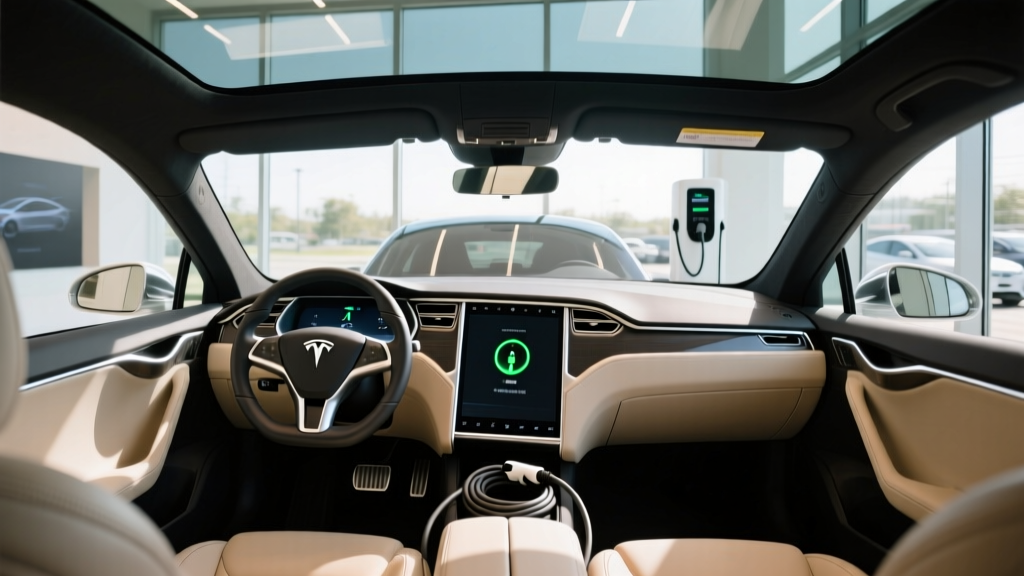
The 2017 Model S cabin was benchmarked against the Mercedes S-Class when it launched, and several elements still hold up: the sweeping 17-inch capacitive touchscreen, available Nappa leather, Alcantara headliner, and genuine wood or carbon-fiber trim. However, the "2017 Tesla Model S interior" search trend reflects both nostalgia and concern — buyers want to know what they're getting into.
What Holds Up
- 17-inch touchscreen: Still larger than most 2026 infotainment displays. Runs Tesla's evolving software, so a 2017 car in 2026 can receive UI updates, though hardware limitations (older MCU1 or early MCU2 computers) affect responsiveness.
- Panoramic glass roof: Standard on most trims; floods the cabin with light and still looks modern.
- Frunk + trunk: Combined cargo space of ~26.3 cu ft (rear trunk) plus ~5.3 cu ft (front trunk), totaling roughly 31.6 cu ft — more than a BMW 5 Series sedan.
- Seating: Available 5-seat or rear-facing third-row jump seats (for small children), making it a 7-seater on paper. Rear legroom measures 35.4 inches.
Where It Falls Short in 2026
- MCU1 (pre-March 2018): Cars built before the MCU2 upgrade have an NVIDIA Tegra 3 processor. The screen is sluggish, lacks a modern web browser, and cannot run the latest Tesla software features. Tesla offered a $1,500–$2,000 MCU2 retrofit — check whether the seller completed it.
- No wireless charging pad: Not available from the factory; aftermarket solutions exist.
- Build quality: Panel gaps, rattling trim, and early seat-bolster wear are well-documented. Inspect door seals and dashboard leather closely.
- Autopilot hardware: 2017 cars shipped with HW2.0 or HW2.5. Neither supports the latest FSD (Supervised) neural-net stack optimally. HW3.0 retrofits were offered but are not universal.
Charging Speeds: Supercharger and Home Level 2
The 2017 Model S charges via Tesla's proprietary connector (the pre-NACS Tesla plug). It can access the entire Supercharger network, including the newer V3 and V4 stalls, but its onboard charge architecture caps peak intake well below modern EVs.
| Charging Method | Max Power (kW) | Rate / Time | Notes |
|---|---|---|---|
| Level 1 (120V outlet) | ~1.4 kW | ~3–4 mi/hr | Emergency/trickle only |
| Level 2 (240V, 48A) | 11.5 kW | ~29 mi/hr | Home Wall Connector or J1772 adapter |
| DC Fast (V2 Supercharger) | ~120 kW peak | 10–80% in ~40 min | Sustained rate drops sharply above 60% SoC |
| DC Fast (V3 Supercharger) | ~120 kW peak | 10–80% in ~40 min | V3 stall capable of 250 kW, but 2017 car is hardware-limited |
| CHAdeMO adapter | ~50 kW | 10–80% in ~80 min | Optional Tesla CHAdeMO adapter; useful on non-Tesla networks |
Charging-curve reality: The 120 kW peak holds only between roughly 10–40% state of charge. By 60%, the rate tapers to ~70 kW, and above 80% it drops below 40 kW. On a road trip, plan stops around 150–200 miles apart in a 75D to stay in the fast-charging sweet spot and avoid the painful taper above 80%.
For home charging, a Tesla Wall Connector on a 60A circuit delivers the full 48A (11.5 kW), replenishing a 75D from empty in roughly 7 hours. Installation typically costs $800–$2,000 depending on panel proximity and whether a 200A service upgrade is needed. Always have a licensed electrician assess your panel before committing.
Performance and Drivetrain
Even by 2026 standards, the 2017 Model S lineup is quick. The P100D's 2.5-second 0-60 mph time was supercar territory in 2017 and remains impressive. Dual-motor AWD variants use independent front and rear motors with no mechanical linkage, providing excellent traction in rain and snow.
The air suspension (standard on most trims) delivers a compliant highway ride but is a known failure point. Replacement air struts cost $1,500–$2,500 per corner at independent shops. Many used examples have already had at least one replacement.
Used Pricing, Tax Credits, and Ownership Costs
As of early 2026, used 2017 Model S pricing varies heavily by trim, mileage, and battery health:
| Trim | Typical Used Price | Federal Used EV Credit (§25E) | Net Cost After Credit |
|---|---|---|---|
| 60 / 60D | $14,000–$18,000 | Up to $4,000 | $10,000–$14,000 |
| 75 / 75D | $17,000–$22,000 | Up to $4,000 | $13,000–$18,000 |
| 90D | $20,000–$25,000 | Up to $4,000 | $16,000–$21,000 |
| 100D | $24,000–$30,000 | Up to $4,000 | $20,000–$26,000 |
| P100D | $30,000–$38,000 | Up to $4,000 | $26,000–$34,000 |
Federal tax credit for used EVs (IRC §25E): The 2017 Model S does not qualify for the new-vehicle §30D credit. However, it may qualify for the Used Clean Vehicle Credit of up to $4,000 (30% of sale price, capped at $4,000). Per IRS rules, requirements include:
- Sale price must be $25,000 or less (this eliminates most 100D and all P100D listings)
- Buyer income caps: $75,000 single / $112,500 head of household / $150,000 joint (MAGI)
- Vehicle must be purchased from a licensed dealer (private-party sales excluded)
- Buyer must not have claimed the used EV credit in the prior 3 years
- The credit is non-refundable (it can reduce your tax liability to zero but won't generate a refund)
Always consult a tax professional and verify current IRS guidance before relying on credit eligibility.
Warranty and Battery Longevity
The original 2017 Model S battery and drive-unit warranty was 8 years / unlimited miles for the 60 and 75 trims, and 8 years / 150,000 miles for the 90D, 100D, and P100D. In 2026, a 2017 vehicle is at or past the 8-year mark, meaning most factory battery warranties have expired or will expire this year.
NCA battery degradation data from owner surveys and Tesla's own impact reports suggest 10–15% capacity loss at 100,000 miles for well-maintained packs. A 75D that started at 259 EPA miles may now deliver 220–230 miles. The 90 kWh pack had a well-documented degradation issue — many 90D owners report 15–20% loss, making the 100D the more reliable long-range choice on the used market.
Out-of-warranty battery replacement for a 2017 Model S costs $12,000–$20,000 at Tesla service centers, depending on whether a remanufactured or new pack is installed. Third-party shops like Electrified Garage or Gruber Motor Company may offer replacements for $8,000–$14,000. Before buying, request a battery health reading from the car's service menu or have a pre-purchase inspection performed.
Pros, Cons, and Who Should Buy
Pros
- 335-mile EPA range (100D) still competitive with 2026 mid-range EVs
- Full Supercharger network access — the most reliable DC fast-charging ecosystem in the US
- Air suspension and spacious cabin make it a genuine road-trip sedan
- Over-the-air updates keep the software relevant
- Frunk + 31.6 cu ft total cargo beats most sedans
- P100D acceleration (2.5s 0-60) remains exotic-car territory
Cons
- MCU1 hardware is slow and limits software features
- 120 kW peak DC charging is slow vs. 2026 EVs (250–350 kW)
- No heat pump — severe cold-weather range loss
- Most factory battery warranties have expired in 2026
- Air suspension and drive-unit repairs are expensive
- HW2.0/2.5 Autopilot hardware cannot run latest FSD effectively
- Build quality inconsistencies (panel gaps, seat wear, rattles)
Best for: Budget-conscious buyers who want long range, Supercharger access, and a premium badge for under $20,000 after credits. The 75D offers the best value. Road-trippers should target the 100D for its 335-mile EPA rating. Avoid the 90D due to known degradation issues.
Skip it if: You need fast DC charging for frequent long trips, want modern ADAS hardware, or cannot absorb a potential $12,000+ battery replacement in the next few years. A used 2021 Model 3 Long Range or a new Chevrolet Bolt with a fresh battery warranty may be smarter for risk-averse buyers.
Frequently Asked Questions
What is the real-world range of a 2017 Tesla Model S?
It depends on trim and battery condition. A healthy 75D delivers roughly 220–240 miles in mixed driving, dropping to ~170 miles in freezing weather. The 100D manages 280–310 miles mixed, or ~220–240 in deep cold. Always check the car's current rated range at 100% charge — it reflects actual battery health.
How fast does the 2017 Model S charge?
On a V2 or V3 Supercharger, it peaks at ~120 kW, charging from 10–80% in about 40 minutes. At home on a 48A Level 2 connector, it adds ~29 miles per hour, fully charging overnight. The car cannot take advantage of V3/V4 stalls' 250+ kW capability.
Does the 2017 Model S qualify for any federal tax credit?
Not the new-vehicle §30D credit. It may qualify for the used-EV credit (§25E) of up to $4,000, but only if the sale price is $25,000 or less, you buy from a dealer, and your income falls under IRS caps. Most 100D and P100D examples exceed the price cap.
Is the 2017 Model S worth buying vs. competitors?
Against a used 2018 Jaguar I-PACE (234 mi EPA, ~$20,000) or a 2019 Audi e-tron (204 mi EPA, ~$22,000), the Model S 75D or 100D wins on range and Supercharger access. However, the Jaguar and Audi offer more modern interiors, better build quality, and CCS charging that works on Electrify America. If you rely on Superchargers for road trips, the Tesla wins. If you prioritize interior refinement, look at the Europeans.
Should I worry about the MCU1 computer?
Yes. MCU1 cars (most 2017 builds) have a noticeably slower touchscreen and miss newer software features. Tesla's MCU2 retrofit costs $1,500–$2,000. Factor this into your budget, or seek a car where the previous owner already completed the upgrade.
What's the biggest risk of buying a 2017 Model S?
Battery and drive-unit failures outside warranty. A replacement battery costs $12,000–$20,000, and a drive unit runs $3,000–$6,000. Get a pre-purchase inspection from a Tesla-qualified independent shop, review the battery health percentage, and budget $2,000–$3,000 annually for potential repairs.