Quick Verdict: A Pioneering Luxury EV Interior, Now at Used-EV Prices
The 2017 Tesla Model S was a watershed moment for electric luxury sedans. It introduced the now-iconic 17-inch portrait touchscreen, minimalist center console, and over-the-air software updates that kept the cabin feeling fresh years after purchase. For 2026 used-EV shoppers, the 2017 Model S remains a compelling proposition — not because its interior rivals today's Mercedes EQS or BMW i7, but because it delivers 200+ miles of range, access to the Supercharger network, and genuine performance at a fraction of its original MSRP. The caveat? Battery health varies widely by example, the pre-2021 interior materials have aged unevenly, and federal tax credit eligibility for used EVs comes with strict income and price caps.
2017 Tesla Model S Spec Sheet: Battery, Range, and Performance by Trim
| Spec | Model S 75 / 75D | Model S 90D | Model S 100D | Model S P100D |
|---|---|---|---|---|
| Battery (usable, est.) | ~72.6 kWh | ~83.5 kWh | ~98 kWh | ~98 kWh |
| Chemistry | NMC (Nickel Manganese Cobalt) | NMC | NMC | NMC |
| EPA Range | 249 mi (75) / 259 mi (75D) | 294 mi | 335 mi | 315 mi |
| Drivetrain | RWD / AWD (Dual Motor) | AWD (Dual Motor) | AWD (Dual Motor) | AWD (Dual Motor, Performance) |
| Horsepower (est.) | 315 hp (75) / 328 hp (75D) | 417 hp | 417 hp | ~762 hp (Ludicrous) |
| 0–60 mph | 4.3s (75) / 4.2s (75D) | 4.2s | 4.2s | 2.5s (Ludicrous Mode) |
| Efficiency (MPGe) | 101 MPGe combined | 104 MPGe combined | 104 MPGe combined | 98 MPGe combined |
| Energy Use | ~33 kWh/100 mi | ~32 kWh/100 mi | ~32 kWh/100 mi | ~34 kWh/100 mi |
| Original MSRP (2017) | ~$69,500 / ~$74,500 | ~$89,500 | ~$94,000 | ~$135,000+ |
| Typical 2026 Used Price | $16,000–$24,000 | $20,000–$28,000 | $25,000–$35,000 | $32,000–$45,000 |
Sources: fueleconomy.gov, Tesla historical spec sheets. Used pricing reflects Q1 2026 market averages and varies by mileage, condition, and battery State of Health.
Real-World Range: What the EPA Sticker Doesn't Tell You
The 2017 Model S predates Tesla's heat pump introduction (which arrived with the refreshed Model S in 2021). That means cabin heating relies on a resistive PTC heater, which draws significant energy from the traction battery in cold weather. If you live in a climate with sustained sub-freezing winters, budget 20–30% range loss versus the EPA sticker. Preconditioning the battery while plugged in — using the Tesla app to warm the cabin and battery before departure — mitigates some of this loss and is essential for preserving range and enabling regenerative braking in cold conditions.
Battery degradation is the other variable. A 2017 Model S with 90,000+ miles may have lost 10–18% of its original capacity depending on charging habits (frequent Supercharging to 100% accelerates degradation in NMC cells). Always request a battery State of Health (SoH) reading before purchase — third-party tools like Tessie or TeslaFi can pull this data. A 100D that originally delivered 335 EPA miles might realistically show 280–300 miles at full charge after eight years and 80,000 miles.
Interior, Cargo, and Technology: The 2017 Cabin Evaluated
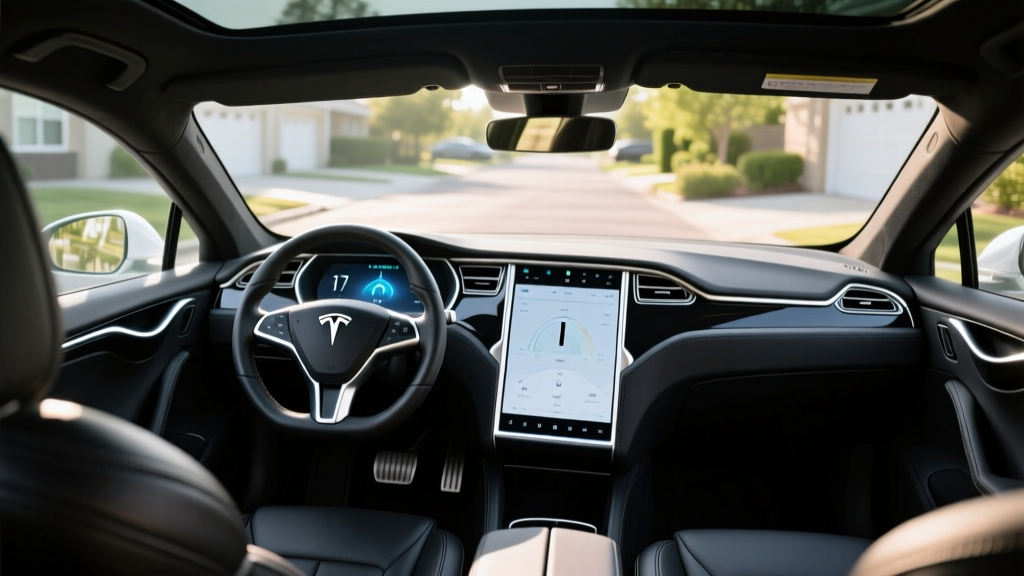
The 2017 Model S interior is defined by its 17-inch vertically oriented touchscreen, which controls virtually every vehicle function — climate, media, navigation, vehicle settings, and (when equipped) Autopilot configuration. There are no physical buttons on the dashboard beyond the hazard light switch and steering wheel controls. This was radical in 2017 and remains distinctive, though some buyers find the lack of tactile climate controls frustrating while driving.
Materials and build quality: The 2017 refresh brought improved materials over the 2012–2015 cars — softer-touch dash materials, redesigned seats with better bolstering, and available premium interior packages with Alcantara headliners and upgraded leather. That said, the 2017 Model S interior does not match the fit-and-finish of contemporary German luxury sedans. Panel gaps, especially around the center console and door cards, were inconsistent. The synthetic leather (Tesla's "vegan" interior option, introduced mid-2017) has held up better than early genuine leather in many owner reports.
Passenger space:
- Front headroom: 38.8 inches
- Front legroom: 42.7 inches
- Rear headroom: 35.4 inches
- Rear legroom: 35.4 inches
- Seating: 5 passengers standard (optional rear-facing third-row jump seats for 7-passenger config in earlier years, largely discontinued by 2017)
Cargo volume:
- Rear trunk: 26.3 cu ft
- Front trunk (frunk): 5.3 cu ft
- With rear seats folded: 58.1 cu ft total
The hatchback-style trunk opening gives the Model S a practical advantage over traditional luxury sedans with conventional trunk lids. The frunk, while modest, accommodates a charging cable bag and a small soft-sided bag.
Notable tech features for 2017:
- 17-inch capacitive touchscreen with navigation
- Over-the-air (OTA) software updates (a major differentiator — many 2017 cars received new features years after purchase)
- Autopilot hardware suite (HW2 or HW2.5 depending on build date; HW2.5 introduced ~Oct 2016 with improved cameras and processing)
- Standard 12-speaker premium audio (upgraded from earlier Ultra High Fidelity system)
- HEPA air filtration with "Bioweapon Defense Mode" (premium interior package)
- Power-folding side mirrors, panoramic glass roof standard
- Keyless entry via key fob; no phone-as-key (that arrived with the 2021 refresh)
Charging Speed: Supercharger and Home Charging Specs
| Charging Method | Max Power (kW) | Rate / Time | Notes |
|---|---|---|---|
| Level 1 (120V household) | ~1.4 kW | ~3–4 miles per hour | Emergency/trickle only; 100+ hours for full charge |
| Level 2 (240V home, NEMA 14-50) | ~11.5 kW (48A onboard charger) | ~34–40 miles per hour | Full charge overnight (~8–10 hours for 100D) |
| Level 2 (Tesla Wall Connector) | ~11.5 kW | ~34–40 miles per hour | Onboard charger limits to 11.5 kW; Wall Connector capable of more |
| DC Fast Charge (Supercharger V2) | ~120 kW peak | 10–80% in ~40–45 min | Pre-2021 Model S limited to V2 speeds; tapers significantly above 70% SoC |
| DC Fast Charge (CHAdeMO adapter) | ~50 kW | 10–80% in ~90+ min | Adapter discontinued by Tesla; some 2017 cars have legacy CHAdeMO support |
Charging curve reality: The 2017 Model S on a V2 Supercharger peaks around 115–120 kW at low State of Charge (10–30%), then tapers progressively. By 60% SoC, you're typically seeing 60–70 kW. Above 80%, speeds drop to 25–35 kW. Plan road-trip stops around 10–80% charges for the fastest throughput. The 2017 Model S cannot access V3/V4 Supercharger speeds (250 kW+) — its architecture predates the electrical and thermal upgrades needed for those charge rates.
Connector note: The 2017 Model S uses Tesla's proprietary connector (now officially NACS). With Tesla opening the Supercharger network to other brands using NACS adapters, 2017 Model S owners retain native plug-and-charge access to the entire Supercharger network — one of the strongest ownership advantages over used CCS-equipped EVs from the same era.
Federal Tax Credit: Does a Used 2017 Model S Qualify?
Under the IRS §25E Used Clean Vehicle Credit, buyers of qualifying used EVs can claim up to $4,000 (or 30% of the sale price, whichever is less). Here's what applies to a used 2017 Model S in 2026:
- ✅ Vehicle sale price must be $25,000 or less — this eliminates most 100D and P100D examples
- ✅ Buyer income cap: $75,000 single / $112,500 head of household / $150,000 joint (modified AGI)
- ✅ Vehicle must be at least 2 model years old (2017 qualifies)
- ✅ Battery capacity must be at least 7 kWh (all Model S variants qualify)
- ✅ Must be purchased from a licensed dealer (private-party sales do not qualify)
- ✅ Credit can be transferred to the dealer at point of sale for an upfront price reduction
- ⚠️ You can only claim the used-EV credit once every 3 years
Practical impact: A 2017 Model S 75 or 75D purchased from a dealer for $22,000 could yield a $4,000 credit (30% of $22,000 = $6,600, capped at $4,000), bringing the effective cost to $18,000. A 100D at $30,000 exceeds the $25,000 sale-price cap and does not qualify. This makes the 75/75D trims the smartest value play for credit-eligible buyers.
Warranty, Battery Longevity, and Ownership Costs
The 2017 Model S originally shipped with the following warranty coverage:
- Basic vehicle warranty: 4 years / 50,000 miles (expired on all 2017 examples by 2021)
- Battery and drive unit warranty: 8 years / 150,000 miles (for 75/75D) or 8 years / unlimited miles (for 90D/100D/P100D) with a minimum 70% capacity retention threshold
As of 2026, most 2017 Model S vehicles are at or beyond the 8-year battery warranty window based on time, though many remain under the mileage limit. If a battery has dropped below 70% State of Health and the car is still within 8 years / 150,000 miles (or unlimited miles for 90D+), Tesla may replace it under warranty — but the time-based expiration means most 2017 cars are now on the owner's dime.
Battery replacement cost: An out-of-warranty Model S battery replacement in 2026 runs approximately $12,000–$20,000 depending on the pack size and whether Tesla installs a new or refurbished unit. Third-party EV battery shops offer remanufactured packs for $8,000–$14,000. This is a critical cost to factor when evaluating a high-mileage 2017 Model S — always get a pre-purchase battery health inspection.
Insurance: Model S insurance premiums remain elevated compared to non-luxury EVs. Expect $1,800–$3,000/year depending on your state, driving record, and coverage level. Tesla's own insurance product (available in select states) sometimes offers competitive rates based on real-time driving data.
Pros, Cons, and Who Should Buy
Pros
- Access to the Supercharger network (NACS native)
- Genuine performance — P100D does 0–60 in 2.5s
- OTA updates keep software current years later
- Hatchback cargo versatility (26.3 cu ft + frunk)
- Low cost per mile when charging at home
- Potential $4,000 used-EV tax credit on 75/75D trims
Cons
- No heat pump — significant cold-weather range loss
- DC fast charge capped at ~120 kW (slow vs. modern EVs)
- Battery warranty largely expired by age
- Interior build quality below German luxury benchmarks
- No phone-as-key; key fob only
- Autopilot HW2/2.5 cannot run current FSD (Supervised) effectively
- Out-of-warranty battery replacement: $12K–$20K
Who this EV suits best:
- The value-minded performance seeker who wants sub-4-second 0–60 times and doesn't need a brand-new car
- The home-charger-equipped commuter with a predictable daily route under 150 miles round-trip (where even a degraded 75 kWh pack suffices)
- The Tesla ecosystem enthusiast who values Supercharger access and OTA updates over cutting-edge interior luxury
Who should look elsewhere:
- Cold-climate buyers without a garage (the lack of a heat pump is a real drawback)
- Road-trippers who prioritize fast DC charging stops (a 2024+ Hyundai Ioniq 5 or refreshed Model S charges 2–3× faster)
- Buyers who need current-generation Autopilot/FSD hardware
2017 Model S vs. Key Used-EV Competitors
At the $18,000–$35,000 used price range in 2026, the 2017 Model S competes against several alternatives:
- 2017–2018 Chevrolet Bolt EV: Cheaper ($10K–$16K), 238-mile EPA range, but no DC fast-charge practicality (50 kW max, CCS), far less performance and cargo space.
- 2018–2019 Tesla Model 3 Long Range: Similar or slightly higher price, 310-mile EPA range, newer interior design, heat pump (2021+), V3 Supercharger capability. The Model 3 is the more pragmatic used Tesla buy for most shoppers.
- 2017–2019 BMW i3 (94 Ah / 120 Ah): City-focused, ~114–153 mile range, quirky interior, far less practical for highway travel.
- 2018–2020 Nissan Leaf Plus: ~226-mile range, CHAdeMO charging (declining network), no active thermal management — battery degrades faster in hot climates.
The 2017 Model S wins on interior space, performance, and Supercharger access. It loses to the Model 3 on charging speed, cold-weather efficiency, and overall value per dollar. If you can stretch to a 2018–2019 Model 3 Long Range, it's generally the stronger used-EV buy — but the Model S offers a larger cabin, hatchback practicality, and the prestige of Tesla's flagship sedan.
Frequently Asked Questions
What is the real-world range of the 2017 Tesla Model S?
The 100D delivers roughly 270–295 highway miles in mild weather and 220–250 in freezing conditions. The 75/75D realistically manages 190–220 highway miles in fair weather. Battery degradation on a 2017 example may reduce these figures by 10–18% depending on prior charging habits and mileage.
How fast does the 2017 Model S charge at home and on the road?
On a Level 2 home charger (240V, 48A), the 2017 Model S adds approximately 34–40 miles of range per hour, reaching a full charge overnight. On DC fast charging, it peaks at ~120 kW on V2 Superchargers, achieving a 10–80% charge in roughly 40–45 minutes. It cannot access V3/V4 Supercharger speeds.
Does a used 2017 Model S qualify for the federal EV tax credit?
It can qualify for the §25E Used Clean Vehicle Credit of up to $4,000, but only if the dealer sale price is $25,000 or less, the buyer meets income caps ($75K single / $150K joint), and the purchase is from a licensed dealer. This makes the 75 and 75D trims the most likely candidates. Verify current rules at irs.gov.
Is the 2017 Model S Autopilot system still functional in 2026?
Yes. Basic Autopilot (Traffic-Aware Cruise Control and Autosteer) continues to function on HW2 and HW2.5 vehicles. However, Tesla's Full Self-Driving (Supervised) — a Level 2 driver-assistance system that requires active driver supervision at all times — has limited capability on HW2/2.5 hardware. Tesla has not committed to bringing the latest FSD neural networks to older hardware. Do not expect the 2017 Model S to receive future FSD feature parity with HW3/HW4 vehicles.
What should I check before buying a used 2017 Model S?
Prioritize: (1) Battery State of Health percentage via TeslaFi or Tessie, (2) remaining battery/drive-unit warranty coverage by VIN and mileage, (3) MCU (Media Control Unit) version — some 2017 cars still have the slower MCU1, which Tesla offered to upgrade to MCU2 for a fee, (4) drive unit whine or replacement history, and (5) suspension condition (air suspension failures are a known cost item on older Model S vehicles, with replacement running $1,500–$3,000 per corner).