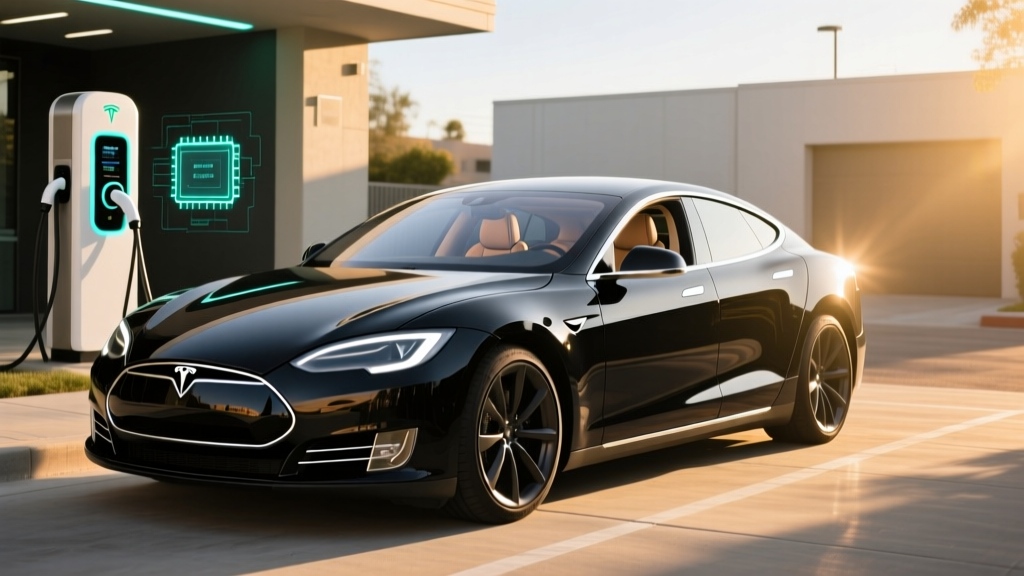
The 2017 Tesla Model S 90D occupies a specific niche in the used EV market: a large luxury sedan with genuine long-range capability, dual-motor all-wheel drive, and access to the Supercharger network — all at a fraction of its original $90,000+ sticker. But buying a nearly decade-old EV requires clear-eyed analysis of battery health, charging limitations, and what ownership actually looks like in 2026.
This review breaks down every number that matters: real-world range, charging speeds, efficiency, and whether the used-EV federal tax credit applies. If you're cross-shopping a used Model S 90D against newer budget EVs or certified pre-owned competitors, the data below will clarify the trade-offs.
2017 Model S 90D: Core Specifications at a Glance
| Spec | Value |
|---|---|
| EPA Range | 294 miles |
| Battery (gross / usable) | 90 kWh / ~85.5 kWh |
| Battery Chemistry | NMC (Nickel Manganese Cobalt) |
| Drivetrain | Dual-Motor AWD |
| Horsepower | 417 hp (combined) |
| 0–60 mph | 4.2 seconds |
| MPGe (combined) | 104 MPGe |
| Efficiency | 32 kWh / 100 mi |
| Max DC Fast Charge | ~120 kW (peak, V2 Supercharger) |
| Level 2 Charge Rate | 11.5 kW (48A) / ~34 mi/hr |
| Cargo Volume | 26.3 cu ft (rear) + 5.3 cu ft (frunk) |
| Original Base MSRP | ~$91,500 (before options) |
| 2026 Used Price Range | $18,000 – $28,000 |
| Battery Warranty (original) | 8 years / 150,000 miles |
Real-World Range: What 294 EPA Miles Actually Means
Real-World Highway (70 mph, moderate temps): ~240–260 miles
Cold Weather (below 32°F, highway): ~190–220 miles
City / Mixed Commute: ~260–280 miles
The EPA rated the 2017 Model S 90D at 294 miles of combined range. That figure was class-leading in 2017 and remains respectable. However, EPA testing uses low average speeds and mild temperatures — conditions that rarely match a real road trip.
In sustained highway driving at 70–75 mph, expect the 90 kWh pack to deliver roughly 240 to 260 miles before hitting a low state of charge. The Model S is a heavy sedan (4,600+ lbs) with a large frontal area, so aerodynamic drag penalizes efficiency at speed more than in smaller EVs. In freezing temperatures, range drops further: battery resistance increases, cabin heating draws significant power (the 2017 model lacks a heat pump, relying instead on resistive HVAC), and regenerative braking is limited until the pack warms up. Plan for 190–220 miles of usable range on a cold winter highway trip.
For city and suburban commuting with frequent regenerative braking opportunities, the 90D gets closer to its EPA sticker — 260 to 280 miles is achievable in mild weather. The key ownership lesson: size your daily needs around 240 miles of reliable range, not 294.
Critically, any used 2017 Model S will have battery degradation. NMC chemistry in this generation typically loses 8–15% of original capacity over 8–9 years depending on charging habits and climate exposure. A unit showing 85–90% State of Health (SoH) on a diagnostic scan is typical. That brings real-world usable range down to roughly 210–240 miles highway for a healthy pack. Always request a battery health reading before purchase — Tesla service centers can pull this, and third-party tools like the TeslaFi app or Scan My Tesla can estimate it via OBD-II.
Charging Speeds: Supercharger Access and Home Charging
| Charging Level | Power | Speed | Notes |
|---|---|---|---|
| Level 1 (120V outlet) | ~1.4 kW | ~4 mi/hr | Emergency only; 24+ hr full charge |
| Level 2 (240V, 48A) | 11.5 kW | ~34 mi/hr | Full charge in ~8.5 hours |
| DC Fast (V2 Supercharger) | Peak ~120 kW | 10–80% in ~38 min | Tapers above 60%; CCS adapter needed for non-Tesla networks |
| DC Fast (V3/V4 Supercharger) | Limited to ~120 kW | 10–80% in ~38 min | Vehicle cannot accept 250 kW; no speed benefit at newer stations |
The 2017 Model S 90D charges at a peak of approximately 120 kW on DC fast chargers. This was fast for its era but is now outpaced by modern EVs charging at 200–350 kW. On a V2 Supercharger (the most common type when this car was new), you'll see a sustained 90–110 kW through the 20–60% SoC window, tapering to 40–50 kW by 80%. A 10–80% session takes roughly 38 minutes — adequate for road trips with planned meal or restroom stops, but noticeably slower than a 2024+ Model S or Hyundai Ioniq 5.
An important 2026 note: Tesla opened the Supercharger network to non-Tesla EVs, but the Model S 90D retains its proprietary Tesla connector. If you want to use Electrify America, EVgo, or other CCS-based networks, you'll need Tesla's CCS adapter (approximately $175–$250) — and even then, the 90D's onboard charge acceptance limits you to ~120 kW regardless of the station's capability.
At home, the 90D's onboard charger supports up to 11.5 kW on a 240V / 48-amp Level 2 circuit (some early-build 2017 units have the optional dual onboard chargers enabling up to 22 kW, but this was rare by 2017). A typical overnight session from 20% to full takes about 7–8 hours. For daily use, charging to 80% (Tesla's recommended daily limit for NMC batteries) takes roughly 5–6 hours — easily handled by any overnight session.
Performance, Efficiency, and Driving Character
The dual-motor AWD powertrain produces 417 horsepower and propels the Model S 90D from 0 to 60 mph in 4.2 seconds. That's quick by any measure, though it trails the P90D and P100D variants (which hit 2.5–2.7 seconds). The instant torque delivery and low center of gravity make the 90D feel eager in passing maneuvers and confident on highway on-ramps.
Efficiency is rated at 104 MPGe combined, which translates to 32 kWh per 100 miles. This is unremarkable by 2026 standards — the lighter, more aerodynamic Lucid Air achieves 130+ MPGe, and even the current Model S Long Range hits 120 MPGe. The 90D's weight (4,647 lbs) and older motor technology explain the gap. At the 2026 national average electricity price of ~$0.17/kWh, fueling costs roughly $5.44 per 100 miles — still significantly cheaper than a comparable gasoline sedan at $12–$15 per 100 miles.
The air suspension (standard on most 90D builds) provides a compliant ride and adjustable ride height, useful for steep driveways or speed bumps. However, air suspension failures are a known issue on 2012–2020 Model S vehicles. Replacement struts cost $1,500–$2,500 per corner at independent shops. Budget for this possibility if the vehicle has over 80,000 miles and the struts haven't been replaced.
Interior, Cargo, and Technology
The 2017 Model S interior was minimalist even by Tesla standards: a 17-inch center touchscreen dominates the dash, with minimal physical buttons. The 2017 refresh added improved materials (synthetic leather, real wood or carbon fiber trim) over earlier models, but panel gaps and creaks are common in high-mileage examples. The large touchscreen controls everything — HVAC, media, navigation, vehicle settings — which some owners love and others find distracting while driving.
Passenger space is generous for a sedan: 42.7 inches of front legroom and 35.4 inches rear. The rear seat fits three adults, though the middle position is compromised by a firm cushion and the floor battery pack raising the seating position. Cargo capacity is a standout: 26.3 cubic feet in the rear hatch area (with seats up) plus a 5.3-cubic-foot front trunk (frunk). Fold the 60/40 rear seats and total cargo volume reaches 58.1 cubic feet — rivaling many SUVs.
Tech highlights:
- Autopilot (basic): Traffic-Aware Cruise Control and Autosteer (SAE Level 2 — requires active driver supervision at all times)
- Enhanced Autopilot (optional): Auto lane change, Navigate on Autopilot, Autopark, Summon
- Full Self-Driving capability (optional purchase, hardware-dependent): Note that FSD on 2017 hardware (HW2 or HW2.5) is significantly less capable than on current HW4 vehicles. Many advanced FSD features may never reach older hardware
- Over-the-air software updates (still receiving security and minor feature updates in 2026)
- Mobile app remote access: climate preconditioning, charging status, location, Sentry Mode (if equipped)
Notable drawbacks: No Apple CarPlay or Android Auto (Tesla uses proprietary infotainment). The MCU1 (Media Control Unit) in some 2017 builds is prone to failure — the eMMC flash memory degrades over time, causing a blank or frozen screen. Tesla has offered a recall-related replacement program for some MCU1 units, but verify whether the specific VIN has been serviced. MCU2 (Intel Atom-based) units, standard in later 2017 builds, are far more reliable and support modern software features.
Pricing, Used Market Value, and Tax Credit Eligibility
The 2017 Model S 90D originally started around $91,500 before options, with well-equipped examples exceeding $110,000. In the 2026 used market, prices have depreciated substantially:
| Condition / Mileage | Typical Price Range |
|---|---|
| 60,000–80,000 mi, good condition | $22,000 – $28,000 |
| 80,000–120,000 mi, average condition | $18,000 – $23,000 |
| 120,000+ mi or needs battery/service | $13,000 – $17,000 |
Does the 2017 Model S 90D qualify for a federal tax credit? Under IRS §25E (the Used Clean Vehicle Credit), you may be eligible for up to $4,000 or 30% of the sale price (whichever is less) when purchasing from a licensed dealer. Key requirements:
- Sale price cap: The vehicle must sell for $25,000 or less. Many 90D examples fall right at or above this threshold — negotiate carefully.
- Buyer income limits: Adjusted gross income must not exceed $75,000 (single), $112,500 (head of household), or $150,000 (joint filing).
- Vehicle age: Must be at least 2 model years old (easily satisfied).
- Dealer sale required: Private-party sales do not qualify. The dealer must report the sale to the IRS at point of sale.
- Battery capacity: Must have at least 7 kWh (the 90D's 90 kWh pack easily qualifies).
- One-time use: You can only claim the used-EV credit once every 3 years.
At a $24,000 purchase price from a qualifying dealer, a buyer meeting income limits could claim $4,000 (30% of $24,000 = $7,200, but capped at $4,000), bringing the effective cost to $20,000. This makes the 90D one of the most range-per-dollar options on the used market — if you qualify.
Note: The §30D new-vehicle credit does not apply to used purchases. Always consult a tax professional and verify current-year rules on IRS.gov before relying on credit eligibility.
Warranty and Long-Term Ownership Costs
The original battery and drive unit warranty on the 2017 Model S 90D was 8 years / 150,000 miles, whichever comes first, with a capacity retention threshold of 70%. As of 2025–2026, most 2017 examples have exceeded the time limit of this warranty. If the vehicle you're considering has under 150,000 miles and was purchased late in the 2017 model year, there may be residual coverage — verify by VIN with Tesla service.
Out-of-warranty battery replacement costs $12,000–$18,000 at Tesla service centers (refurbished pack) or $8,000–$13,000 at independent EV shops using salvaged or aftermarket packs. Drive unit replacements run $4,000–$7,000. These are worst-case scenarios; many 90D packs last 200,000+ miles with 15–20% degradation.
Other ownership cost considerations:
- Insurance: Used Model S premiums average $1,800–$2,600/year depending on state, driver profile, and coverage level. Higher than a comparable Camry, lower than a new Model S.
- Tires: The 90D's weight and torque wear tires quickly. Budget $1,200–$1,800 for a set of quality all-season or touring tires every 25,000–35,000 miles.
- Maintenance: Minimal compared to ICE vehicles — no oil changes, no spark plugs. Cabin air filter ($50–$100), brake fluid flush ($150–$200), and wiper blades are the routine items. Brake pads last 80,000+ miles thanks to regenerative braking.
- Supercharging costs: Free Supercharging was included with some 2017 Model S vehicles ("Free Unlimited Supercharging" transferred with the car for original orders before January 2017). Later 2017 orders received limited free credits or paid Supercharging. Verify the specific VIN's Supercharger status — free unlimited SC adds significant value.
Pros, Cons, and Who Should Buy
Pros
- 294-mi EPA range (240+ real-world) still competitive
- Supercharger network access (most reliable DC network in the US)
- Spacious cabin + massive cargo area (58 cu ft max)
- Strong 4.2-sec 0–60 performance with AWD
- Potential $4,000 used-EV tax credit
- Over-the-air updates keep software current
- Available free unlimited Supercharging on early builds
Cons
- Battery warranty likely expired on most examples
- Slow DC charging (~120 kW peak) vs modern 200+ kW EVs
- No Apple CarPlay / Android Auto
- MCU1 failure risk on early 2017 builds
- Air suspension replacement costs ($1,500–$2,500/corner)
- No heat pump — cold-weather range loss is significant
- Autopilot hardware (HW2/2.5) limits future FSD capability
- Insurance premiums higher than non-luxury EVs
Who the 2017 Model S 90D suits best:
- Budget-conscious luxury seekers who want a spacious, fast sedan with 240+ miles of real range for under $25,000 after credits.
- Commuters with home charging who can exploit cheap overnight electricity and rarely need DC fast charging.
- Occasional road-trippers who value Supercharger network reliability and can plan around 35–40 minute charge stops.
- DIY-minded owners comfortable with potential out-of-warranty repairs and proactive maintenance.
Who should look elsewhere:
- Buyers who need the latest driver-assist technology (consider a 2022+ EV with HW4 or equivalent).
- Those without home charging access — public charging at 120 kW peak gets expensive and time-consuming.
- Anyone risk-averse about out-of-warranty battery or suspension repairs (consider a CPO with warranty, or a newer EV with remaining coverage).
2017 Model S 90D vs. Key Used-EV Competitors
At the $18,000–$28,000 price point, the 90D competes against several used EVs. Here's how it compares on the metrics that matter most:
| Vehicle | EPA Range | DC Charge Peak | 0–60 mph | Cargo (cu ft) |
|---|---|---|---|---|
| 2017 Tesla Model S 90D | 294 mi | ~120 kW | 4.2 sec | 58.1 (max) |
| 2019 Tesla Model 3 Long Range AWD | 310 mi | ~150 kW | 4.4 sec | 23.0 (max) |
| 2020 Chevrolet Bolt EV | 259 mi | ~55 kW | 6.5 sec | 56.6 (max) |
| 2018 Jaguar I-PACE | 234 mi | ~105 kW | 4.5 sec | 51.0 (max) |
The Model 3 Long Range offers more range and faster charging in a smaller, more efficient package — but sacrifices cargo space and ride comfort. The Bolt EV is cheaper but hampered by painfully slow DC charging (55 kW). The I-PACE is a compelling luxury crossover alternative, though with shorter range and a less reliable charging network (CCS-dependent). The 90D's combination of range, cargo space, and Supercharger access remains difficult to beat at this price — if you accept the aging platform risks.
Frequently Asked Questions
What is the real-world range of the 2017 Model S 90D?
Expect 240–260 miles on the highway in mild weather, 260–280 miles in city driving, and 190–220 miles in cold-weather highway use. Degradation (typically 8–15% at this age) further reduces these figures. Plan trips around 200–220 miles of reliable range to maintain a safety buffer.
How fast does the 2017 Model S 90D charge?
On DC fast chargers (Supercharger V2 or equivalent), it peaks at ~120 kW and takes roughly 38 minutes from 10% to 80%. At home on Level 2 (240V, 48A), it charges at 11.5 kW, adding about 34 miles per hour — a full overnight session restores the battery completely.
How much does the 2017 Model S 90D cost after tax credits?
Used prices range from $18,000 to $28,000 depending on mileage and condition. If you purchase from a licensed dealer for $25,000 or less and meet income requirements, the §25E used-EV credit can reduce your effective cost by up to $4,000, bringing the net price to approximately $14,000–$21,000.
Does the 2017 Model S 90D qualify for the federal EV tax credit?
It can qualify for the §25E Used Clean Vehicle Credit (up to $4,000), not the §30D new-vehicle credit. Requirements include: dealer purchase, sale price at or below $25,000, buyer income under $75K/$112.5K/$150K (single/HOH/joint), and you haven't claimed the used credit in the past 3 years. Verify current rules at IRS.gov and consult a tax professional.
Is the 2017 Model S 90D worth buying vs. a newer used EV?
It depends on priorities. If you need maximum cargo space, AWD, strong performance, and Supercharger access for under $25,000, the 90D is hard to beat. If you prioritize modern charging speed, fresh warranty coverage, CarPlay, and the latest driver-assist hardware, a 2020+ Model 3 or a newer compact EV may serve you better despite less interior room.
How long will the 90D battery last?
Tesla's NMC packs from this era typically retain 80–90% capacity at 100,000 miles and can last 200,000+ miles before reaching the 70% degradation threshold. Avoid frequent 100% charges and prolonged storage at high SoC to maximize longevity. A pre-purchase battery health scan is essential.