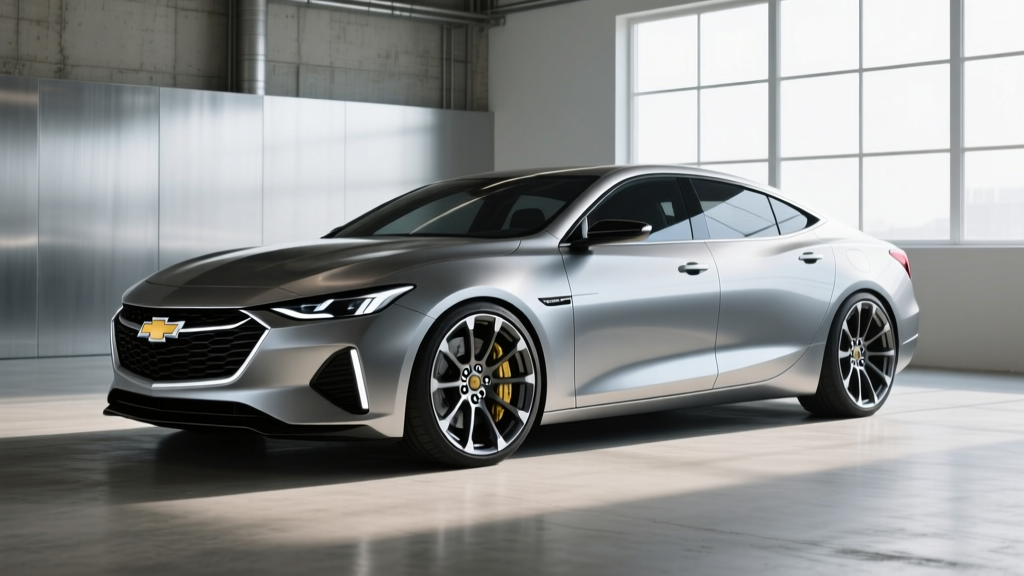
If you've landed here searching for the 2017 Malibu bolt pattern, you're likely shopping for replacement wheels, considering an aftermarket upgrade, or exploring whether Chevy's midsize sedan platform can support an electrified powertrain swap. This guide covers the exact wheel specifications for the 2017 Chevrolet Malibu, explains what the numbers mean for fitment, and digs into a question we're increasingly getting from readers: can the Malibu's architecture accommodate a hybrid or EV conversion?
Before we get into the weeds, a quick scope note: the 2017 Malibu was sold exclusively as a gasoline and hybrid model — it was never a fully electric vehicle. Chevrolet's EV badge in 2017 belonged to the Bolt EV. But with the used-EV conversion market growing and plug-in hybrid swaps becoming a niche hobbyist pursuit, understanding the Malibu's chassis and wheel specifications matters for more than just buying rims.
2017 Malibu Bolt Pattern: The Exact Spec
The 2017 Chevrolet Malibu uses a 5x115 bolt pattern (also expressed as 5x4.53 inches). This means the wheel has five lug holes arranged on a circle with a diameter of 115 millimeters. Here's the full wheel specification breakdown:
| Specification | 2017 Chevy Malibu Value |
|---|---|
| Bolt Pattern (PCD) | 5x115 mm (5x4.53") |
| Center Bore | 70.3 mm |
| Lug Nut Thread Size | M12 x 1.5 |
| Wheel Torque Spec | 100 lb-ft (140 Nm) |
| Stock Wheel Sizes | 16", 17", 18", 19" (trim-dependent) |
| Stock Tire Sizes | 215/60R16, 215/55R17, 245/45R18, 245/40R19 |
| Offset Range (OEM) | +38 to +44 mm |
The 5x115 pattern is shared across several General Motors vehicles, including the Chevrolet Impala (2014+), Cadillac XTS, and Buick LaCrosse. This commonality gives you a wider pool of compatible OEM and aftermarket wheels, but you must always verify center bore and offset — a wheel with the correct bolt pattern but wrong offset can cause suspension wear, rubbing, or hub-centric vibration.
Why Bolt Pattern Matters for EV and Hybrid Conversions
Here's where the EV angle comes in. As enthusiasts explore converting conventional vehicles to electric power — or swapping in hybrid drivetrains from salvaged models — the wheel and hub assembly becomes a critical interface point. Here's why:
- Weight increase: Battery packs add 300-800+ lbs depending on capacity. The wheel hub, bearings, and suspension must handle the increased unsprung and gross vehicle weight.
- Regenerative braking loads: EV drivetrains apply braking torque through the wheels differently than friction brakes, placing different stress patterns on lug studs and rotors.
- Hub motor compatibility: Some aftermarket EV conversion kits use hub-mounted motors, which require specific bolt patterns and center bore dimensions to mate correctly.
- Brake rotor clearance: If you're retaining the Malibu's stock brake calipers or upgrading to larger rotors for the added weight of batteries, wheel barrel clearance becomes as important as the bolt pattern itself.
The 2017 Malibu's Epsilon II platform (shared with the Opel Insignia and Buick Regal of the same era) is reasonably well-suited for conversion projects because of its spacious underbody tunnel and rear floor pan — areas where battery modules can be mounted. However, this is firmly in the realm of custom fabrication, not bolt-in kits.
2017 Malibu Hybrid: The Electrified Option That Actually Existed
Chevrolet did offer a 2017 Malibu Hybrid, and it's worth examining because it represents the most practical "electrified Malibu" you can actually buy on the used market today. The Malibu Hybrid paired a 1.8L direct-injected four-cylinder engine with a two-motor drive unit derived from the second-generation Volt's Voltec system.
| Spec | 2017 Malibu Hybrid |
|---|---|
| Powertrain | 1.8L I4 + 2 electric motors (HEV) |
| Combined Horsepower | 182 hp |
| EPA Combined MPG | 49 MPG (49 city / 43 highway / 46 combined per fueleconomy.gov) |
| Battery | 1.5 kWh lithium-ion (80-cell, 1.5 kWh usable) |
| EV-Only Range | None — conventional hybrid, not a PHEV |
| 0-60 mph | ~7.5 seconds |
| Drivetrain | FWD |
The Malibu Hybrid achieved impressive efficiency for a midsize sedan without requiring plug-in charging. However, its 1.5 kWh battery is far too small for any meaningful electric-only driving — it functions as a traditional hybrid like the Toyota Camry Hybrid, using the battery for low-speed assist and regenerative braking capture.
Can You Convert a 2017 Malibu to Full Electric?
The short answer: technically yes, practically it's extremely difficult and rarely cost-effective. Here's the honest breakdown for anyone considering an EV swap on the Malibu platform:
What a Conversion Requires
- Motor and inverter: A salvaged Tesla drive unit, NetGain Hyper9, or similar AC motor (50-150 kW range for a vehicle of this weight).
- Battery pack: 30-60 kWh of modules (salvaged Nissan Leaf, Chevy Bolt, or Tesla modules) — adding 400-700 lbs.
- BMS and charger: A battery management system, onboard charger (3.3-7.2 kW), and DC fast-charge controller if desired.
- Custom fabrication: Battery boxes, motor mounts, high-voltage cabling, cooling loops, and throttle integration.
- Instrument cluster and HVAC: The stock gauges and climate control rely on CAN bus signals from the original ECU — you'll need a custom controller or aftermarket gauges.
Cost Reality
A competent full EV conversion on a midsize sedan like the Malibu typically runs $15,000-$35,000 in parts and labor, assuming you're sourcing used battery modules and doing some work yourself. Professional turnkey conversions from shops like EV West or Legacy EV can exceed $40,000. For context, a used 2020-2022 Chevrolet Bolt EV with a 259-mile EPA range can be purchased for $12,000-$18,000 on the current market.
The bolt pattern and wheel specs remain the same after conversion, but you'll likely need to upgrade to higher load-range tires and possibly stiffer springs to compensate for battery weight. The 5x115 pattern is common enough that finding heavy-duty rated wheels isn't a barrier.
Wheel and Tire Considerations for Electrified Malibus
Whether you're fitting a Malibu Hybrid, a conversion project, or simply replacing wheels on the stock gas model, these fitment principles apply:
- Stick to the OEM offset range (+38 to +44 mm). Aggressive offsets push the wheel outward, increasing scrub radius and accelerating wheel bearing wear — especially problematic with the added weight of a hybrid or EV battery.
- Use hub-centric rings if your aftermarket wheel's center bore exceeds 70.3 mm. Lug-centric mounting causes vibration at highway speeds.
- Choose tires rated for the vehicle's gross weight. The Malibu Hybrid's curb weight is approximately 3,457 lbs. A conversion adding 500 lbs of batteries pushes gross weight into territory where standard touring tires may not carry adequate load ratings.
- Consider low-rolling-resistance (LRR) tires if maximizing efficiency is your goal. On the Malibu Hybrid, switching from standard all-seasons to LRR tires like the Michelin Energy Saver can recover 1-2 MPG.
2017 Malibu Trim Levels and Stock Wheel Sizes
| Trim | Stock Wheel Size | Tire Size | Powertrain |
|---|---|---|---|
| L (base) | 16" steel | 215/60R16 | 1.5L Turbo I4 |
| LS | 16" alloy | 215/60R16 | 1.5L Turbo I4 |
| LT | 17" alloy | 215/55R17 | 1.5L Turbo I4 |
| Hybrid | 17" alloy | 215/55R17 | 1.8L Hybrid |
| Premier | 18" alloy | 245/45R18 | 2.0L Turbo I4 |
| Premier (optional) | 19" alloy | 245/40R19 | 2.0L Turbo I4 |
All trims share the 5x115 bolt pattern, 70.3 mm center bore, and M12 x 1.5 lug nuts. Wheel interchangeability across trims is straightforward — a Premier owner can mount a set of 17" winter wheels from an LT trim without issue, provided the offset is within range and the tire diameter stays close to stock to avoid speedometer error.
Frequently Asked Questions
Will a 5x114.3 wheel fit a 2017 Malibu?
No. While 5x114.3 (the common Ford/Honda/Nissan pattern) is only 0.7 mm different per stud, this is not a safe or reliable interchange. The lug studs won't seat concentrically, leading to vibration, uneven torque loading, and potential stud failure. Always use 5x115 wheels specifically.
What other GM vehicles share the Malibu's 5x115 bolt pattern?
The 5x115 pattern appears on the 2014-2020 Chevrolet Impala, 2013-2019 Cadillac XTS, 2010-2016 Buick LaCrosse, and 2011-2017 Buick Regal. However, center bore and offset vary — always verify before purchasing.
Does the 2017 Malibu Hybrid qualify for any tax credits today?
No. The federal §30D tax credit applies only to new plug-in electric vehicles (BEVs and PHEVs with at least 7 kWh of battery capacity). The Malibu Hybrid is a conventional HEV with a 1.5 kWh battery and no plug. On the used market, it does not qualify for the used clean vehicle credit either, as that credit requires a plug-in EV or fuel cell vehicle. Per IRS guidelines, conventional hybrids are excluded.
What torque spec should I use for the Malibu's lug nuts?
GM specifies 100 lb-ft (140 Nm) for the 2017 Malibu. Always use a calibrated torque wrench — impact guns frequently over-torque, which stretches studs and warps rotors. Re-torque after the first 50 miles on newly installed wheels.
Is a 2017 Malibu Hybrid worth buying in 2026?
At current used prices ($9,000-$14,000 depending on mileage), the Malibu Hybrid offers strong value as a high-MPG commuter. Its 46 MPG combined rating holds up well against newer hybrids. The main risk is battery longevity — the 1.5 kWh lithium-ion pack is now 8-9 years old. GM warranted the hybrid battery for 8 years/100,000 miles, so most are out of warranty. Replacement cost is approximately $2,000-$3,500 if the pack degrades significantly.