Quick Verdict: A Bargain-Basement EV Commuter
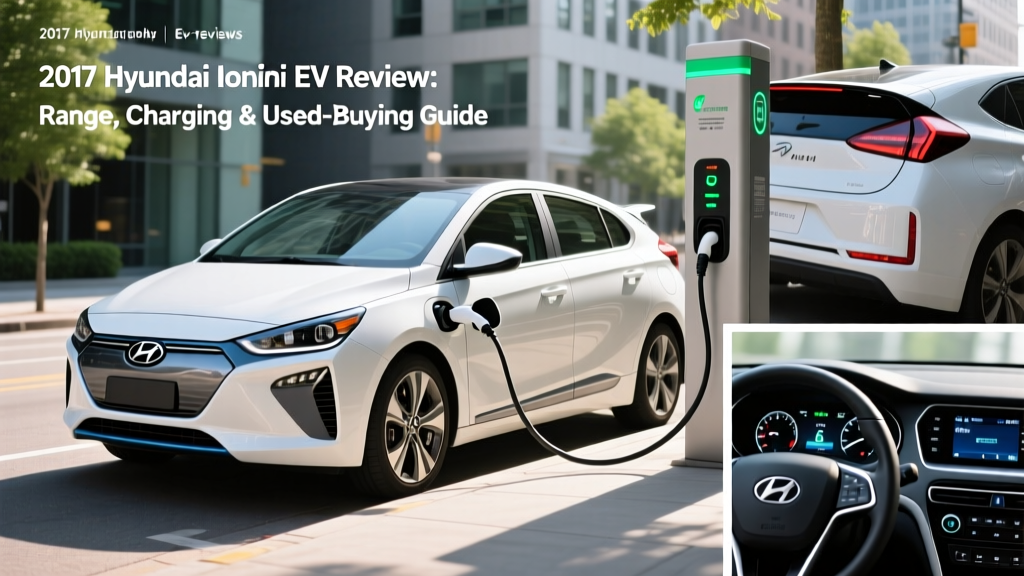
The 2017 Hyundai Ioniq Electric was Hyundai's first dedicated battery-electric vehicle sold in the United States, and it arrived with a clear mission: deliver best-in-class efficiency in an affordable, compact hatchback package. Nearly a decade later, it remains one of the most energy-efficient EVs ever sold in the U.S., with an EPA-rated 136 MPGe combined. But with just 124 miles of EPA-estimated range and a modest 28 kWh battery, the 2017 Ioniq EV is firmly a city-and-suburb commuter — not a road-trip machine.
On the used market in 2026, well-maintained examples typically trade between $9,000 and $14,000 depending on mileage and battery health. For buyers who can charge at home and whose daily driving stays under 80 miles round-trip, it represents one of the cheapest ways to get into a reliable, efficient electric vehicle. For anyone needing highway flexibility or cold-weather range confidence, the limitations are significant.
Range and Efficiency: The Numbers That Still Impress
The 2017 Ioniq Electric carries a 28 kWh lithium-ion polymer battery pack (approximately 28.0 kWh gross, roughly 25.5 kWh usable). Hyundai used NMC (nickel-manganese-cobalt) chemistry in this pack, which offers good energy density for the era but is more susceptible to heat-related degradation than LFP alternatives.
EPA estimate: 124 miles
Real-world expectation: 95–115 miles on mixed highway driving at 65–70 mph; as low as 75–90 miles in sustained cold weather (below 30°F) with cabin heating.
Best-case city driving (mild weather, regen-heavy): 120–135 miles achievable.
The Ioniq EV's efficiency is where it truly shines. The EPA rates it at 136 MPGe combined (150 city / 122 highway), which translates to just 25 kWh per 100 miles. That figure was class-leading in 2017 and remains competitive even against newer EVs. For context, the 2017 Nissan Leaf (30 kWh) managed 107 MPGe combined, and the 2017 Chevrolet Bolt EV (60 kWh) achieved 119 MPGe. The Ioniq achieves more distance per kilowatt-hour than nearly any EV of its era, thanks to its low curb weight (~3,230 lbs), slippery 0.24 Cd drag coefficient, and conservative power delivery.
| Spec | Value |
|---|---|
| EPA Range | 124 miles |
| Battery (gross / usable) | 28 kWh / ~25.5 kWh |
| Chemistry | NMC (nickel-manganese-cobalt) |
| MPGe (city / hwy / combined) | 150 / 122 / 136 |
| Energy consumption | 25 kWh / 100 mi |
| Motor output | 88 kW (118 hp) / 218 lb-ft torque |
| 0-60 mph | ~9.9 seconds |
| Drivetrain | FWD (single-speed reduction gear) |
| DC Fast Charge (max) | ~50 kW (CCS1) |
| Level 2 Charge Rate | 6.6 kW onboard charger |
| Cargo Volume (rear seats up / down) | 19.9 cu ft / 43.5 cu ft |
| Original Base MSRP | $29,500 (before incentives) |
| Typical Used Price (2026) | $9,000–$14,000 |
Charging: Functional but Slow by Modern Standards
Charging is where the 2017 Ioniq EV shows its age most clearly. The car uses a CCS1 (Combined Charging System) connector for DC fast charging and a standard J1772 inlet for Level 1 and Level 2 AC charging.
| Level | Power (kW) | Speed | Notes |
|---|---|---|---|
| Level 1 (120V household) | ~1.2 kW | ~5 mi/hr | Full charge in ~24+ hours |
| Level 2 (240V, 6.6 kW onboard) | 6.6 kW | ~26 mi/hr | 0–100% in ~4.5 hours |
| DC Fast Charge (CCS1) | ~50 kW peak | 0–80% in ~33 min | Tapers significantly above 80% |
The 6.6 kW onboard charger is adequate for overnight home charging — plug in when you get home and the battery will be full well before morning. On a 50 kW DC fast charger, the Ioniq EV can add roughly 80% of charge in about 33 minutes. However, the charge curve tapers steeply above 80% State of Charge (SoC), and 50 kW peak means you will never see the 150–350 kW speeds that modern EVs pull at Electrify America or EVgo stations. Plan road trips around 30-minute DC fast-charge stops every 80–90 miles of actual driving.
Owner tip: The Ioniq EV supports battery preconditioning only passively — there is no dedicated preconditioning toggle as found on newer EVs. In cold weather, DC fast-charge speeds will drop noticeably because the pack cannot warm itself before arriving at the charger. Expect 40–50+ minute charge sessions in freezing temperatures.
Performance and Driving Impressions
The 2017 Ioniq Electric is powered by a single front-mounted permanent-magnet synchronous motor producing 88 kW (118 horsepower) and 218 lb-ft of torque. Power goes exclusively to the front wheels through a single-speed reduction gear — there is no multi-speed transmission.
The 0-60 mph time clocks in at approximately 9.9 seconds, which is leisurely by modern EV standards. The instant torque delivery makes the car feel reasonably peppy around town and in stoplight-to-stoplight driving, but highway merging and steep inclines require planning. Top speed is electronically limited to roughly 103 mph.
Where the Ioniq EV earns its keep is in ride refinement. The suspension tuning is compliant and quiet, cabin noise isolation is above average for the class, and the low center of gravity (battery pack under the rear seat and cargo floor) gives it tidy, predictable handling. Three regenerative braking modes are selectable via steering-wheel paddles, allowing everything from mild coasting to aggressive one-pedal-style deceleration — though it does not come to a complete stop without brake application.
Interior, Cargo, and Technology
The 2017 Ioniq EV was sold exclusively in a single, well-equipped trim level (sometimes referred to as the "Limited" in certain markets). Standard equipment includes:
- 7-inch touchscreen infotainment with Apple CarPlay and Android Auto
- Infinity premium audio system (7 speakers)
- Heated and ventilated front seats, heated steering wheel
- Leather seating surfaces
- Automatic climate control with EV-specific efficiency mode
- Proximity key with push-button start
- LED headlights and taillights
Driver-assistance features include blind-spot detection, rear cross-traffic alert, lane departure warning, and automatic emergency braking with pedestrian detection. Note: these are SAE Level 0–1 warning and intervention systems — there is no adaptive cruise control or lane-centering assist on the 2017 model. The driver is fully responsible for steering and speed management at all times.
Cargo space measures 19.9 cubic feet behind the rear seats and 43.5 cubic feet with the 60/40-split rear seats folded. Passenger room is adequate for four adults, with 42.3 inches of front legroom and 35.2 inches of rear legroom. The battery pack does intrude slightly into the cargo floor height compared to the hybrid Ioniq variant, but the hatchback form factor remains practical for groceries, luggage, and everyday hauling.
Pricing, Tax Credits, and Used-Buying Economics
When new, the 2017 Hyundai Ioniq Electric carried a base MSRP of $29,500 (destination included), making it one of the most affordable EVs on the market. After the then-available $7,500 federal tax credit, plus state incentives in California and other ZEV states, effective prices often fell below $20,000.
Buying a used 2017 Ioniq EV in 2026 may qualify you for the Used Clean Vehicle Credit (IRC §25E) — up to $4,000 or 30% of the sale price (whichever is less), provided:
• Sale price is $25,000 or less
• Buyer's AGI is ≤ $75,000 (single) / $150,000 (married filing jointly)
• Vehicle is at least 2 model years old (the 2017 qualifies)
• Purchased from a licensed dealer
• Credit claimed only once per vehicle VIN
Source: IRS Used Clean Vehicle Credit. Consult a tax professional for eligibility.
As of 2026, typical used-market pricing for the 2017 Ioniq Electric ranges from roughly $9,000 to $14,000, depending on mileage (most examples have 50,000–100,000 miles), condition, and battery State of Health (SoH). At these prices, the used-EV credit can knock up to $4,000 off your tax liability, bringing effective cost as low as $5,000–$10,000 for qualifying buyers.
Battery Warranty, Degradation, and Longevity
Hyundai backed the 2017 Ioniq EV's battery with a strong warranty: 8 years / 100,000 miles (10 years / 100,000 miles in California and other states that adopted the enhanced CARB-emissions warranty). The warranty covers battery capacity loss below approximately 70% of original capacity.
As of 2026, most 2017 Ioniq EVs are either just outside or approaching the end of the 8-year / 100,000-mile battery warranty window. This is a critical buying consideration. Real-world degradation data from owner communities and fleet reports suggests the 28 kWh NMC pack typically retains 85–92% of original capacity at 80,000–100,000 miles under normal use. Vehicles that were frequently DC fast-charged in hot climates (Arizona, Southern California) may show higher degradation.
Before buying used: Request a battery State of Health (SoH) readout from a Hyundai dealer or use an OBD-II dongle with EV-compatible software (such as Car Scanner or EV Notify) to check pack health. A SoH reading below 80% on a 2017 model is a negotiation point — out-of-warranty battery replacement for this generation has been reported in the $5,000–$8,000 range, though full replacements are uncommon.
2017 Ioniq EV vs. Key Used-EV Competitors
In the $9,000–$14,000 used-EV market in 2026, the 2017 Ioniq Electric competes primarily with the 2017–2018 Nissan Leaf (30 kWh), the 2017 Chevrolet Bolt EV, and the 2017–2018 Volkswagen e-Golf.
| Model | EPA Range | Battery | MPGe | DC Fast Charge | Typical Used Price |
|---|---|---|---|---|---|
| 2017 Hyundai Ioniq EV | 124 mi | 28 kWh NMC | 136 | 50 kW CCS | $9K–$14K |
| 2017 Nissan Leaf (30 kWh) | 107 mi | 30 kWh NMC | 107 | 50 kW CHAdeMO | $7K–$11K |
| 2017 Chevrolet Bolt EV | 238 mi | 60 kWh NMC | 119 | 55 kW CCS | $13K–$18K |
| 2017 VW e-Golf | 125 mi | 35.8 kWh NMC | 119 | 50 kW CCS | $10K–$15K |
The Bolt EV is the clear range champion and a better road-trip candidate, but it commands a higher used price. The Leaf is cheaper but suffers from CHAdeMO's declining charging-network support and passive air-cooled battery thermal management (leading to faster degradation in hot climates). The e-Golf is a refined drive but parts availability is a growing concern as VW has exited the model. The Ioniq EV occupies a middle ground: unbeatable efficiency, CCS connector compatibility, and Hyundai's strong reliability reputation — at the cost of the shortest range in the group.
- Best-in-class efficiency (136 MPGe / 25 kWh/100mi)
- CCS1 fast-charging connector (future-proof vs CHAdeMO)
- Well-equipped single trim with premium features standard
- Quiet, refined ride for the price point
- Strong Hyundai reliability record; low maintenance costs
- Eligible for up to $4,000 used-EV tax credit (§25E)
- Only 124 miles EPA range — severely limits road-trip use
- ~50 kW DC fast charge is slow; 33+ min for 10–80%
- No active cruise control or lane-centering assist
- Battery warranty likely expired or nearly expired on most examples
- Cold-weather range can drop to 75–90 miles
- Limited availability on the used market (low production volume)
Who Should Buy the 2017 Hyundai Ioniq Electric?
The 2017 Ioniq EV is best suited for:
- Daily commuters with round-trip drives under 70 miles who can charge at home overnight.
- Second-car households looking for an ultra-efficient EV for errands and local driving while keeping a gas or long-range vehicle for trips.
- Budget-conscious EV buyers who want the lowest possible cost-per-mile in an electric vehicle and don't need long range.
- Warm-climate residents where cold-weather range loss is less of a concern.
It is not well-suited for single-car households that regularly drive more than 80 miles per day, apartment dwellers without reliable home or workplace charging, or anyone in a cold-winter climate who needs range confidence. If your budget can stretch to $14,000–$18,000, the used 2017 Chevrolet Bolt EV's 238-mile range makes it a far more versatile daily driver.
Frequently Asked Questions
What is the real-world range of the 2017 Hyundai Ioniq EV?
The EPA rates the 2017 Ioniq Electric at 124 miles. In real-world mixed driving at highway speeds (65–70 mph), expect 95–115 miles. In cold weather with cabin heating, range can drop to 75–90 miles. City driving with regenerative braking in mild weather can approach or slightly exceed the EPA figure.
How fast does the 2017 Ioniq EV charge?
On a Level 2 home charger (240V), the 6.6 kW onboard charger delivers roughly 26 miles of range per hour, fully charging the battery in about 4.5 hours. On a 50 kW DC fast charger (CCS1), the 10–80% charge takes approximately 33 minutes, with significant tapering above 80% SoC.
Does the 2017 Hyundai Ioniq EV qualify for the federal EV tax credit?
The original $7,500 new-vehicle credit (§30D) is no longer available. However, purchasing a used 2017 Ioniq EV from a licensed dealer in 2026 may qualify for the Used Clean Vehicle Credit (§25E) — up to $4,000 or 30% of the sale price, subject to buyer income limits and the $25,000 maximum sale price cap. See IRS.gov for current rules and consult a tax professional.
Is the 2017 Ioniq EV worth buying vs. a used Bolt EV or Leaf?
If range is your priority, the 2017 Bolt EV (238 miles EPA) is the clear winner and worth the $3,000–$5,000 premium. If you want the cheapest cost-per-mile and a CCS connector (avoiding CHAdeMO's shrinking network), the Ioniq EV's 136 MPGe and low used pricing make it an excellent commuter car — as long as 124 miles of range fits your daily driving pattern.
How long will the 2017 Ioniq EV battery last?
Real-world data suggests the 28 kWh NMC pack retains 85–92% capacity at 80,000–100,000 miles under normal conditions. Hyundai's original battery warranty was 8 years/100,000 miles (10 years in CARB states), meaning most 2017 examples are now at or past the warranty threshold. Budget for potential out-of-warranty battery service ($5,000–$8,000) as a long-term ownership risk, though complete failures are rare.
Sources: EPA Fuel Economy — 2017 Hyundai Ioniq Electric, IRS Used Clean Vehicle Credit (§25E), Hyundai Motor America press archives.