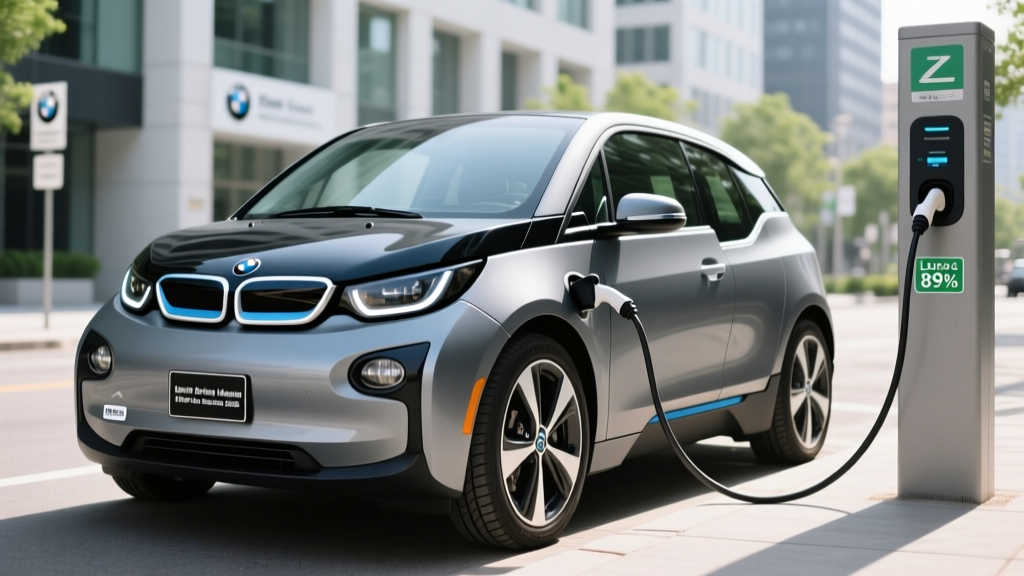
The 2017 BMW i3 occupies a strange corner of the used electric-vehicle market. It's a carbon-fiber-reinforced-plastic city car with a quirky design language, rear-wheel drive, and a battery that was genuinely innovative for its time. If you're shopping for a budget commuter EV in 2026, this model year represents a sweet spot: BMW upgraded the battery to the 94 Ah (33.2 kWh gross) pack, nearly doubling the range of the original 2014-2016 models. But the i3 is not without real limitations — its DC fast-charging speed, modest highway range, and polarizing aesthetics demand honest evaluation before you sign the paperwork.
This review breaks down exactly what the 2017 i3 delivers in range, charging, performance, and ownership economics, including whether it qualifies for the used EV tax credit under IRS §25E rules.
2017 BMW i3 Quick Specs at a Glance
| Specification | 2017 BMW i3 (BEV, 94 Ah) | 2017 BMW i3 REx (Range Extender) |
|---|---|---|
| EPA Electric Range | 114 miles | 97 miles (electric) + ~80 mi (gas) |
| Battery (Gross / Usable) | 33.2 kWh / ~27.2 kWh | 33.2 kWh / ~27.2 kWh |
| Battery Chemistry | NMC (Samsung SDI cells) | NMC (Samsung SDI cells) |
| Motor Output | 170 hp / 184 lb-ft torque | 170 hp / 184 lb-ft torque |
| Drivetrain | Rear-wheel drive (RWD) | Rear-wheel drive (RWD) |
| 0-60 mph | 7.2 seconds | 7.7 seconds |
| DC Fast Charge (Peak) | 50 kW (CCS) | 50 kW (CCS) |
| Level 2 Charge Rate | 7.4 kW | 7.4 kW |
| EPA Efficiency | 129 MPGe (combined) | 111 MPGe (combined, EV mode) |
| Cargo Volume (rear seats up / folded) | 15.1 / 36.0 cu ft | 15.1 / 36.0 cu ft |
| Battery Warranty (Original) | 8 yr / 80,000 mi | 8 yr / 80,000 mi |
| Original Base MSRP | $42,400 | $46,250 |
EPA Range vs. Real-World Driving: What to Actually Expect
EPA Sticker: 114 miles (BEV) / 97 miles electric-only (REx)
Real-World Expectation: In mild city driving at 30-45 mph, expect 110-120 miles from the BEV. On sustained highway trips at 70 mph, plan for 85-95 miles. In freezing temperatures (below 30°F), range drops to approximately 75-90 miles due to cabin heating draw and reduced battery chemistry efficiency. The i3 has no heat pump — it uses resistive heating, which is a significant energy drain in winter.
The 2017 i3's 94 Ah battery was a meaningful upgrade from the original 60 Ah pack (which delivered just 81 miles EPA). At 33.2 kWh gross and roughly 27.2 kWh usable — BMW reserves a buffer to protect longevity — the pack provides adequate range for urban commuting but falls short for anything beyond a tight daily loop. The usable capacity is what matters, and 27.2 kWh is modest by 2026 standards where packs routinely exceed 75 kWh.
The i3's efficiency is genuinely impressive: 129 MPGe combined translates to roughly 26 kWh per 100 miles, or about 3.8 miles per kWh. That efficiency comes from the car's extraordinary lightness — the carbon-fiber passenger cell (which BMW calls "Life Module") keeps curb weight around 2,900 lbs for the BEV. For context, a 2026 Tesla Model Y weighs over 4,300 lbs. Less mass means less energy needed to move, which is why the i3 punches above its battery size in city driving.
According to fueleconomy.gov, the 2017 i3 BEV achieves 129 MPGe combined (137 city / 118 highway). The highway penalty is real: the i3's tall, narrow profile and eco-focused tires create more aerodynamic drag at speed than its EPA combined figure suggests.
Charging Speed: DC Fast, Level 2, and the 50 kW Limitation
Charging is where the 2017 i3 shows its age most clearly. BMW equipped this model year with a 50 kW peak DC fast-charge rate via the CCS1 connector (SAE Combo). That was competitive in 2017 but is a significant bottleneck in 2026, when most new EVs accept 150-350 kW.
| Charging Level | Power | Connector | Speed / Time |
|---|---|---|---|
| Level 1 (120V household) | ~1.4 kW | J1772 | ~5 miles per hour of charging |
| Level 2 (240V home/public) | 7.4 kW | J1772 | ~27 miles per hour; full charge in ~4.5 hours |
| DC Fast Charge | 50 kW peak | CCS1 | 10-80% in approximately 35-40 minutes |
Here's the critical detail most spec sheets omit: the i3's charge curve tapers significantly above 80% state of charge (SoC). The 50 kW peak is only sustained between roughly 10-50% SoC. From 50-80%, the rate drops to approximately 30-35 kW, and above 80% it falls further to under 15 kW. This means a 10-80% session takes 35-40 minutes at a functioning 50 kW station — and longer if the charger is shared or operating below capacity.
For home Level 2 charging, the 7.4 kW onboard charger is perfectly adequate. A full charge from near-empty takes about 4.5 hours, which means you'll wake up to a full battery every morning with a standard Level 2 home setup. Most i3 owners do 90%+ of their charging at home, making the DC fast-charge limitation less painful for daily use — but it does make road trips an exercise in patience.
One practical note: the i3 uses the CCS1 connector, which is being gradually replaced by NACS (Tesla's standard) across the industry in 2025-2026. CCS1 chargers remain widely available at Electrify America, EVgo, and ChargePoint stations, but new installations increasingly favor NACS. CCS1-to-NACS adapters exist, but compatibility varies — verify before relying on one.
Performance and Driving Dynamics
The 2017 i3's electric motor produces 170 horsepower and 184 lb-ft of torque, delivered instantly to the rear wheels. The 0-60 mph time of 7.2 seconds (BEV) doesn't sound thrilling on paper, but the i3's trick is its instant torque delivery and low weight. Around town, it feels significantly quicker than the numbers suggest — the 0-30 mph sprint is genuinely rapid, making it an excellent gap-finder in urban traffic.
The rear-wheel-drive layout and ultra-low center of gravity (batteries mounted beneath the floor) give the i3 surprisingly good handling for a tall hatchback. The steering is quick and direct, and the car's narrow 155/70R19 tires — chosen for low rolling resistance — provide adequate grip in dry conditions. In wet or snowy conditions, those narrow tires are a liability; many i3 owners in cold climates invest in dedicated winter tires.
Regenerative braking is aggressive and well-calibrated. The i3 offers strong one-pedal driving capability: lifting off the accelerator engages substantial regen that can bring the car to a near-stop without touching the brake pedal. This reduces brake wear dramatically — many i3 owners report original brake pads lasting 80,000+ miles.
Interior, Cargo, and Technology
The i3's interior is unlike anything else in BMW's lineup — or the broader auto market. The dashboard uses renewable materials including eucalyptus wood and recycled plastics, giving it an eco-conscious aesthetic that some buyers love and others find odd. Build quality is excellent, as you'd expect from BMW, but the design language is firmly "urban futurism" rather than "luxury sedan."
Passenger space is adequate for four adults but tight for anyone over six feet tall in the rear. Front headroom is generous thanks to the tall roofline, and the front seats are comfortable for long commutes. Rear legroom measures approximately 31.9 inches — enough for average-height adults on shorter trips but cramped for longer journeys.
Cargo volume is the i3's practical weakness: 15.1 cubic feet behind the rear seats and 36.0 cubic feet with the rear seats folded. That's less than a Honda Civic hatchback. The rear doors are rear-hinged "coach doors" (suicide doors), which provide a wide opening but require you to close the front door before the rear can shut — a minor annoyance in tight parking spaces.
The 2017 model year includes BMW's iDrive infotainment system with a 6.5-inch display (10.25-inch with the optional Technology + Driving Assistant package). Apple CarPlay was not available on the 2017 i3 — that arrived with the 2018 refresh. Navigation, Bluetooth, and USB connectivity are standard. The available Driving Assistant package adds forward collision warning, automatic emergency braking, and lane departure warning — useful but basic by 2026 ADAS standards.
Used Pricing and the Federal Used EV Tax Credit (§25E)
As of early 2026, the 2017 BMW i3 trades on the used market for approximately $12,000 to $18,000, depending on mileage, condition, battery state of health (SoH), and whether it's the BEV or REx variant. Well-maintained examples with under 50,000 miles and strong battery health command the upper end of that range.
| Scenario | Estimated Price |
|---|---|
| 2017 i3 BEV, 60k-80k mi, average condition | $12,000 - $14,000 |
| 2017 i3 BEV, 30k-50k mi, good condition | $15,000 - $17,000 |
| 2017 i3 REx, 40k-60k mi, good condition | $14,000 - $17,500 |
| Federal used EV credit (§25E) — if eligible | Up to $4,000 (30% of sale price) |
| Effective price after max credit | As low as ~$8,000 - $13,000 |
Tax credit eligibility is critical to understand. The 2017 i3 is no longer eligible for the new EV tax credit (§30D) since it's a used purchase. However, it may qualify for the federal used clean vehicle credit under IRS §25E, which provides up to $4,000 (30% of the sale price, capped at $4,000). Key requirements per IRS guidelines:
- Sale price must be $25,000 or less — virtually all 2017 i3s qualify
- Buyer income caps: Modified AGI cannot exceed $75,000 (single), $112,500 (head of household), or $150,000 (joint filers)
- Vehicle must be at least 2 model years old — the 2017 qualifies
- Must be purchased from a licensed dealer — private-party sales do not qualify
- Buyer cannot have claimed another used EV credit in the prior 3 years
- The credit is non-refundable and applies to the tax year of purchase
At a $15,000 purchase price, the §25E credit would be $4,000 (30% of $15,000 exceeds the $4,000 cap), bringing the effective cost to $11,000. That's extraordinary value for a carbon-fiber BMW with a proven electric powertrain. Always consult a tax professional to confirm your personal eligibility — rules are subject to change and individual circumstances vary.
Battery Health, Degradation, and Warranty Status
The 2017 i3's 94 Ah NMC battery (manufactured by Samsung SDI) has proven reasonably durable over nearly a decade of real-world use. Based on owner-reported data and fleet averages, expect 8-12% capacity degradation at 60,000-80,000 miles, depending on charging habits and climate exposure. An i3 that was primarily Level 2 charged and kept between 20-80% SoC will show less degradation than one frequently DC fast-charged or regularly parked at 100% in hot climates.
BMW's original battery warranty was 8 years or 80,000 miles, covering defects and capacity loss below approximately 70% of original capacity. For a 2017 model, this warranty has now expired for most vehicles (8 years from the original in-service date). This means battery replacement, if needed, is an out-of-pocket expense. A replacement 94 Ah battery pack from BMW has historically cost $12,000-$16,000 installed — though third-party refurbished options may be available for less. Before purchasing, request a battery state of health (SoH) reading from the dealer or use an OBD-II scanner with BMW-compatible software to check capacity retention.
The i3's relatively small battery is actually a longevity advantage: fewer cells mean less thermal stress during charging, and the car's liquid thermal management system keeps cell temperatures stable. Most 2017 i3s with reasonable maintenance show strong battery health at 70,000+ miles.
Who Should Buy the 2017 BMW i3 — And Who Shouldn't
Pros
- Outstanding city efficiency (129 MPGe combined, 3.8 mi/kWh)
- Ultra-lightweight carbon fiber construction — unique in this price range
- Tight turning radius (32.3 ft) — ideal for urban parking
- Strong regenerative braking enables true one-pedal driving
- Excellent visibility and commanding seating position
- Potential $4,000 used EV tax credit makes it extremely affordable
- Low operating costs — minimal maintenance, no oil changes, brake longevity
Cons
- Limited highway range (~85-95 mi at 70 mph)
- Slow DC fast charging (50 kW peak; 35-40 min for 10-80%)
- Small cargo area (15.1 cu ft) and cramped rear seats
- No Apple CarPlay / Android Auto on 2017 model year
- Narrow tires perform poorly in snow and heavy rain
- Original battery warranty has expired on most examples
- Coach doors are awkward in tight parking spaces
- CCS1 connector may face reduced infrastructure support long-term
Buy the 2017 BMW i3 if: You need an affordable, efficient city commuter for a sub-50-mile daily round trip; you have reliable home Level 2 charging; you value unique design and premium build quality on a tight budget; and you want to leverage the $4,000 used EV tax credit.
Look elsewhere if: You regularly drive more than 80 highway miles in a day; you need frequent DC fast-charging for road trips; you require space for more than two adults comfortably; you live in a region with harsh winters and no garage; or you want modern infotainment with smartphone integration.
How the 2017 i3 Compares to Used EV Competitors
In the $12,000-$18,000 used EV market of 2026, the 2017 i3 competes against several established alternatives:
vs. 2017-2018 Nissan Leaf (40 kWh): The Leaf offers more range (151 miles EPA for the 40 kWh model) and more cargo space, but lacks the i3's premium build quality and uses passive air cooling for the battery, leading to faster degradation in hot climates and rapidgate during repeated DC charging.
vs. 2017-2018 Chevrolet Bolt EV: The Bolt is the range king in this price bracket at 238 miles EPA, and it seats five comfortably. However, it's a conventional steel-bodied hatchback without the i3's carbon-fiber engineering cachet or urban maneuverability. Bolt battery recall history (fire risk, now remediated) should be verified on any used example.
vs. 2017 Volkswagen e-Golf: The e-Golf offers a more conventional driving experience and Golf practicality but with only 125 miles of EPA range — similar to the i3. It's a strong alternative if you prefer a traditional hatchback layout and don't need the i3's ultra-compact footprint.
The i3 wins on city efficiency, turning radius, build uniqueness, and potential tax-credit-adjusted value. It loses on range, charging speed, and practicality to the Bolt and Leaf.
Frequently Asked Questions
What is the real-world range of the 2017 BMW i3?
Expect 110-120 miles in mild city driving, 85-95 miles at sustained highway speeds, and 75-90 miles in freezing temperatures. The EPA rates it at 114 miles combined, but highway driving and cold weather significantly reduce that figure. The range-extender (REx) model adds a 2-cylinder gasoline generator for approximately 80 additional miles of range when the battery depletes.
How fast does the 2017 i3 charge at home and on DC fast chargers?
At home on a Level 2 (240V) charger, the i3 charges at 7.4 kW, adding roughly 27 miles of range per hour and reaching a full charge in about 4.5 hours. On DC fast chargers, it peaks at 50 kW and takes approximately 35-40 minutes for a 10-80% charge. The charge rate tapers significantly above 50% state of charge.
Does the 2017 BMW i3 qualify for any federal tax credit?
Not the new-vehicle §30D credit — that's only for new purchases. However, it may qualify for the used clean vehicle credit (§25E) of up to $4,000, provided you buy from a licensed dealer at a sale price of $25,000 or less, and your income falls below the IRS thresholds ($75k single / $150k joint). Confirm eligibility with a tax professional before purchase.
Is the 2017 i3 a reliable used EV?
Generally yes. The electric powertrain has few moving parts, and BMW's build quality is strong. The main concern is battery state of health — always check SoH before buying. The carbon-fiber body is resistant to rust but expensive to repair if damaged. Parts availability is adequate but can be pricier than mainstream EVs. The REx model adds a small gasoline engine (a 647cc BMW motorcycle twin) that requires standard ICE maintenance: oil changes, fuel filter, and occasional use to prevent fuel degradation.
Should I buy the BEV or the Range Extender (REx) version?
Choose the BEV if you have reliable home charging and a predictable commute under 50 miles round-trip — it's lighter, slightly more efficient, and has fewer maintenance items. Choose the REx if you occasionally need longer range, lack reliable fast-charging infrastructure on your routes, or live in a cold climate where winter range loss is a concern. The REx's gasoline generator eliminates range anxiety at the cost of added weight and maintenance complexity.
What should I inspect before buying a used 2017 i3?
Prioritize: (1) Battery state of health via OBD-II scan — look for 88%+ SoH. (2) Charging port and CCS connector condition — check for corrosion or damage. (3) Service history for any battery-related warranty claims. (4) Tire condition — the OEM 155/70R19 tires are expensive and not always easy to source. (5) If REx, verify the range-extender engine starts and runs cleanly. (6) Check for any outstanding recalls via NHTSA's recall lookup.