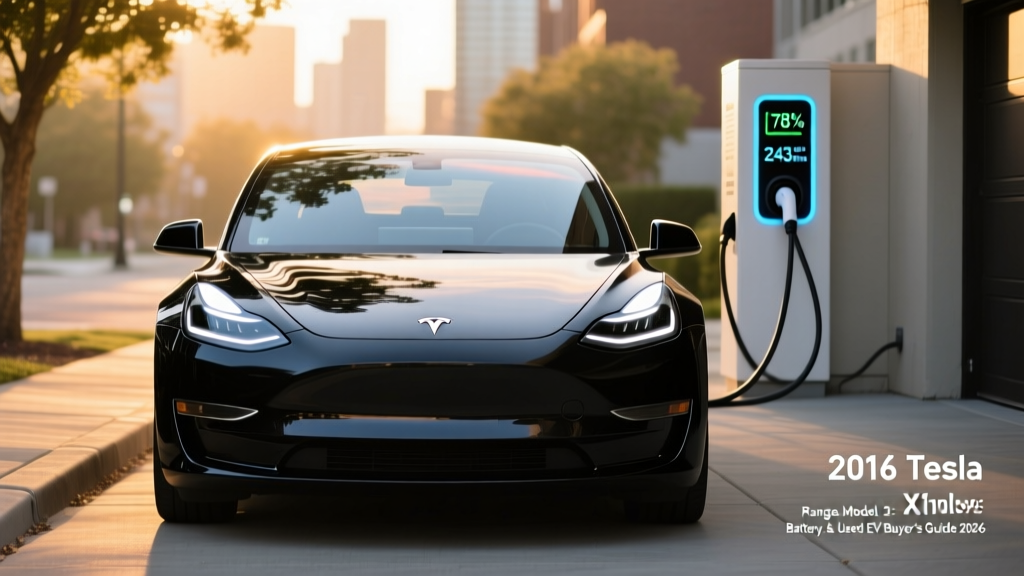
The Tesla Model 3 was first unveiled in March 2016, triggering a wave of $1,000 reservation deposits that reshaped the electric vehicle market. But here's what matters for buyers in 2026: the cars Tesla actually delivered from mid-2017 onward (the first production year) are now aging into the used-EV market at attractive price points. If you're researching the 2016 Tesla Model 3 — whether you mean the reservation-era announcement or the earliest production units — this guide breaks down exactly what these cars offer nearly a decade later, from battery health to real-world range to charging infrastructure compatibility.
This review focuses on the earliest Model 3 production variants (2017–2018 model years, since no customer deliveries occurred in calendar year 2016) and evaluates their viability as used EV purchases in today's market.
What the 2016 Tesla Model 3 Announcement Actually Delivered
Tesla unveiled the Model 3 on March 31, 2016, promising a $35,000 base price, 215+ miles of range, and premium sedan packaging at a mass-market price point. Customer deliveries didn't begin until July 2017, with the first vehicles being the Long Range variant at a higher price. The Standard Range version arrived later and went through multiple pricing and availability changes. For used-car shoppers today, the relevant vehicles are 2017–2019 model-year Model 3 sedans, which have accumulated meaningful mileage data for reliability and battery-degradation analysis.
| Spec | Standard Range Plus | Long Range RWD | Long Range AWD | Performance |
|---|---|---|---|---|
| EPA Range | 220 mi (2019) | 310 mi | 310 mi | 310 mi |
| Battery (usable) | ~50 kWh (LFP in later years) | ~75 kWh (NMC) | ~75 kWh (NMC) | ~75 kWh (NMC) |
| 0-60 mph | 5.1 sec | 4.4 sec | 3.2 sec | |
| Horsepower | ~283 hp | ~283 hp | ~346 hp | ~450 hp |
| Drivetrain | RWD | RWD | Dual-Motor AWD | Dual-Motor AWD |
| MPGe (combined) | 134 MPGe | 130 MPGe | 120 MPGe | 116 MPGe |
| Efficiency | 25 kWh/100mi | 26 kWh/100mi | 28 kWh/100mi | 29 kWh/100mi |
Source: EPA Fuel Economy. Figures reflect original EPA ratings at launch; 2017–2018 Standard Range variants had slightly different ratings.
Real-World Range: What to Expect From an Aging Battery
The Long Range Model 3 carried a 310-mile EPA sticker when new. In 2026, with typical battery degradation of 8–15% over 80,000–120,000 miles, expect a used Long Range to deliver 265–285 miles in mixed driving when new-rated. Real-world highway driving at 70+ mph reduces that further to roughly 230–250 miles. In cold weather (below 32°F), plan for an additional 15–30% reduction, bringing effective range down to 185–215 miles on the highway in winter conditions.
Battery degradation is the central question for any used EV purchase. The early Long Range Model 3 uses an NMC (nickel manganese cobalt) chemistry pack, which historically shows more degradation in the first 30,000 miles before leveling off. Tesla's own data and third-party fleet analyses (including crowdsourced data from TeslaFi and Recurrent Auto) suggest most 75 kWh packs retain 85–92% of original capacity after 100,000 miles. The Standard Range variants that used LFP (lithium iron phosphate) chemistry — primarily introduced in later model years and in the China-built Standard Range — show slower degradation but were not common in the earliest US-market cars.
Key degradation factors to check on a used early Model 3:
- Charge habits: Cars routinely charged to 100% on NMC packs degrade faster than those kept between 20–80% daily.
- Supercharger frequency: Heavy DC fast-charging use correlates with slightly accelerated degradation, though Tesla's thermal management mitigates this significantly.
- Climate: Vehicles in hot climates (Arizona, Texas) may show more degradation than those in temperate regions.
- In-car battery health: Navigate to Settings → Software → Additional Vehicle Information to check the battery's current rated range versus original.
Charging Speed and Infrastructure in 2026
The early Model 3 was notable for its class-leading DC fast-charging capability. Here's how those specs translate to real-world charging sessions on today's infrastructure:
| Charging Level | Max Rate | Real-World Speed | Notes |
|---|---|---|---|
| Level 1 (120V) | ~1.4 kW | ~3–4 mi/hr | Emergency/trickle only |
| Level 2 (240V, 48A) | 11.5 kW | ~37–44 mi/hr | Full overnight charge in 8–10 hrs |
| DC Fast (V3 Supercharger) | 250 kW peak | 10–80% in ~25–30 min | Peak rate only below 40% SoC; tapers significantly above 60% |
| DC Fast (V2 Supercharger) | 150 kW peak | 10–80% in ~35–40 min | Still common at older stations |
| CCS Adapter (non-Tesla DCFC) | Up to 250 kW | Varies by station | Tesla released a CCS adapter; works on Electrify America, EVgo, etc. |
Charging curve reality: The Model 3 Long Range can accept up to 250 kW at a V3 Supercharger, but only at low state-of-charge (typically below 35–40%). Above 60% SoC, the rate drops to roughly 60–80 kW, and above 80% it falls below 30 kW. This means the often-advertised "15-minute charge" only applies to the 10–50% window. A full 10–80% session takes 25–30 minutes at a V3 stall.
Home charging setup: The Model 3's onboard charger supports up to 48 amps (11.5 kW) on Level 2. To achieve this, you need a 60-amp dedicated circuit with a Tesla Wall Connector or equivalent hardwired EVSE. Most early owners report installation costs of $800–$2,000 depending on panel capacity and run length. If your home has a 200-amp panel with available capacity, expect the lower end. Older 100-amp panels may require a $2,000–$4,000 service upgrade — a common gotcha that first-time EV buyers overlook.
The Model 3 uses Tesla's proprietary connector (now designated NACS — North American Charging Standard). As of 2025, Tesla opened the Supercharger network to other brands, and the NACS connector has become the de facto US standard. For early Model 3 owners, this means continued first-party Supercharger access plus the ability to use CCS-equipped public chargers via Tesla's CCS adapter (sold separately, approximately $175–$250).
Performance, Handling, and Drivetrain
Even by 2026 standards, the early Model 3 delivers strong performance. The Long Range AWD's dual-motor setup provides instant torque to all four wheels, with a 4.4-second 0-60 mph time that outpaces most gas-powered sport sedans in its price class. The Performance variant drops that to 3.2 seconds — firmly sports-car territory.
Regenerative braking in the Model 3 is aggressive and effectively enables one-pedal driving in most scenarios. Tesla removed the user-adjustable regen setting in later software updates, locking it to "Standard" (strong) mode. If you're coming from a gas car, plan for a week of adaptation; most owners quickly prefer it.
Drivetrain reliability: The dual-motor AWD and Performance models use an induction motor on the front axle and a permanent-magnet synchronous reluctance motor on the rear. This combination provides strong efficiency and redundancy (the car can drive on either motor alone). Drive-unit failures are uncommon but not unheard of; the 8-year/120,000-mile powertrain warranty covers these for eligible vehicles still within the window.
Interior, Cargo, and Technology
The Model 3's minimalist interior was polarizing at launch and remains so. Everything routes through the 15-inch center touchscreen — there are no physical gauges, no physical buttons for climate or audio. This creates a clean aesthetic but means common adjustments (mirror positioning, glovebox access, wiper speed) require screen taps.
Dimensions and space:
- Cargo volume: 15 cu ft trunk + ~2.1 cu ft frunk (front trunk) — competitive with compact sedans but less than a hatchback
- Rear legroom: 35.2 inches — adequate for adults on shorter trips, tight for taller passengers on long drives
- Front headroom: 40.3 inches (glass roof creates an airy feel despite the low roofline)
- Seating: 5-passenger rated, though the rear middle seat is best for children
Technology and driver assists:
All early Model 3 vehicles shipped with Autopilot hardware, though the capability varies by hardware revision. HW2.5 (common in 2017–2018) supports basic Autopilot (lane centering + adaptive cruise) but is not compatible with the latest Full Self-Driving (Supervised) neural-network features. HW3.0 (introduced mid-2019) is required for current FSD. Tesla has offered hardware upgrades in some cases, but availability is inconsistent.
Autopilot and FSD (Supervised) are SAE Level 2 driver-assistance systems. The driver must remain fully attentive, keep hands on the wheel, and be prepared to take over at any moment. These systems do not make the Model 3 self-driving. Only Level 4 services like Waymo operate without a human driver, and those are limited to specific geofenced areas.
Over-the-air updates: The Model 3 receives OTA software updates that can add features, improve efficiency, and update the UI. In 2026, Tesla continues to support early Model 3 vehicles with updates, though some newer features (like the redesigned UI or advanced dashcam capabilities) may be limited by hardware generation.
Pricing, Tax Credits, and Used-EV Value
The used-EV market for early Model 3 sedans has matured considerably. Here's what you're looking at in 2026:
| Variant | Used Price Range | Federal Used-EV Credit (§25E) | Effective Price |
|---|---|---|---|
| Standard Range Plus (2019) | $16,000–$21,000 | Up to $4,000 (30% of sale price, max $4,000) | $12,000–$17,000 |
| Long Range RWD (2017–2018) | $18,000–$24,000 | Up to $4,000 | $14,000–$20,000 |
| Long Range AWD (2018–2019) | $21,000–$28,000 | Up to $4,000 | $17,000–$24,000 |
| Performance (2018–2019) | $24,000–$32,000 | Up to $4,000 | $20,000–$28,000 |
Federal used-EV tax credit (IRS §25E): The previously owned clean vehicle credit provides 30% of the sale price, up to a maximum of $4,000, for qualifying used EVs. Key eligibility requirements per IRS guidelines:
- Vehicle price cap: Sale price must be $25,000 or less
- Buyer income limits: Modified AGI cannot exceed $75,000 (single), $112,500 (head of household), or $150,000 (joint)
- Vehicle age: Must be at least 2 model years old (all 2016–2019 Model 3s qualify)
- Dealer requirement: Must be purchased from a licensed dealer (private-party sales do not qualify)
- One-time use: Each buyer can claim this credit once every 3 years
Critical note: The §25E used-EV credit is distinct from the §30D new-vehicle credit. If you're buying a new 2026 Tesla Model 3, different rules apply (MSRP cap of $55,000 for sedans, battery-sourcing requirements, income caps). Always consult a tax professional and verify current-year rules on irs.gov before relying on credit eligibility in your purchase decision.
Warranty and Long-Term Ownership Costs
The original Tesla Model 3 warranty package was competitive at launch and remains relevant for used buyers:
- Basic vehicle warranty: 4 years / 50,000 miles (expired on all 2016–2019 vehicles)
- Battery warranty: 8 years / 100,000 miles (Standard Range) or 8 years / 120,000 miles (Long Range and Performance), with a minimum 70% capacity retention threshold
- Drive unit warranty: Same coverage period as battery (8 years / 100k–120k miles)
What this means in 2026: A 2017 Long Range Model 3 with under 120,000 miles may still have active battery and drive-unit warranty through mid-2025 to mid-2027 depending on exact delivery date. A 2018 model could be covered into 2026–2028. Always verify warranty status via the vehicle's VIN through Tesla's service portal before purchasing.
Battery replacement cost: If the pack falls below 70% capacity outside the warranty window, a replacement from Tesla currently runs $12,000–$16,000 including labor for a 75 kWh Long Range pack. Third-party EV battery shops offer refurbished packs for $7,000–$10,000. LFP packs (Standard Range) are somewhat cheaper to replace.
Insurance: Model 3 insurance premiums are typically 15–30% higher than comparable gas sedans due to repair costs and parts pricing. Expect $1,800–$3,200 annually depending on your driving record, location, and coverage level. Tesla Insurance is available in select states and may offer competitive rates for Tesla owners.
Maintenance: EVs eliminate oil changes, spark plugs, and transmission service. Expect to budget for cabin air filter replacement ($100–$200 every 2 years), brake fluid checks, tire rotation, and wiper fluid. Brake pads last significantly longer due to regenerative braking — many Model 3 owners report original pads at 80,000+ miles. Annual maintenance cost: roughly $200–$400.
Pros, Cons, and Who Should Buy
Pros
- Supercharger network access — still the most reliable DC fast-charging network in the US
- Over-the-air updates continue to add features and refinements
- Strong efficiency (25–29 kWh/100mi) keeps charging costs low
- Excellent performance across all trims
- Used prices have dropped significantly, making it one of the best-value used EVs
- Minimal maintenance costs compared to gas vehicles
- Qualifies for the $4,000 used-EV federal credit on many listings under $25K
Cons
- Battery degradation reduces range — expect 265–285 mi on a Long Range that originally rated 310 mi
- Minimalist interior lacks physical controls — not for everyone
- Early HW2.5 vehicles cannot run latest FSD features
- Insurance premiums run 15–30% higher than gas equivalents
- Rear seat is tight for tall adults on long trips
- Ride quality on early models is firm — some find it harsh on rough roads
- No Apple CarPlay or Android Auto — Tesla's proprietary infotainment only
- Panel gaps and build quality on 2017–2018 cars are inconsistent
Who Is the Used Model 3 Best For?
Choose the used Model 3 if: You want access to the Supercharger network for road trips, you value performance and tech-forward design, your daily commute is under 60 miles round-trip, and you can install Level 2 charging at home.
Look elsewhere if: You need maximum cargo space (consider a used Model Y or Hyundai Ioniq 5), you prefer physical buttons and traditional infotainment (try a used Chevrolet Bolt EUV or BMW i4), you regularly carry rear-seat adults on long trips, or you lack home charging access and your area has limited public charging.
Frequently Asked Questions
What is the real-world range of an early Tesla Model 3 in 2026?
A used Long Range Model 3 (originally rated at 310 miles EPA) typically delivers 265–285 miles in mixed driving after accounting for 8–15% battery degradation. Highway driving at 70+ mph drops that to 230–250 miles. In freezing weather, plan for 185–215 miles of effective highway range. The Standard Range Plus (220-mile EPA original) delivers roughly 185–200 miles mixed in 2026.
How fast does the early Model 3 charge at home and on the road?
At home on a Level 2 (240V, 48A) charger, the Model 3 adds roughly 37–44 miles of range per hour, reaching a full charge in 8–10 hours. On a V3 Supercharger (250 kW peak), a 10–80% charge takes approximately 25–30 minutes, though the charge rate tapers significantly above 60% state-of-charge. Older V2 Superchargers (150 kW) add about 5–10 minutes to that session.
Does a used Model 3 qualify for the federal EV tax credit?
Used Model 3 sedans can qualify for the §25E previously owned clean vehicle credit, which provides 30% of the sale price up to $4,000. The vehicle must sell for $25,000 or less from a licensed dealer, and the buyer must meet income caps ($75K single / $150K joint). Verify current-year rules at IRS.gov and consult a tax professional.
Is a used Model 3 worth buying versus competitors like the Bolt or Leaf?
The Model 3's advantages are Supercharger network access, superior efficiency, and strong performance. The Chevrolet Bolt EV/EUV offers more cargo space and a lower entry price but charges far more slowly on DC fast chargers (max 55 kW). The Nissan Leaf uses the aging CHAdeMO connector and lacks active thermal management on its battery. For road-trip capability and long-term software support, the Model 3 remains the stronger used-EV pick in its price range.
What should I inspect before buying a used early Model 3?
Check the battery's current rated range (Settings → Software → Additional Vehicle Information), review service history for drive-unit or battery replacements, verify remaining battery warranty via VIN, inspect suspension components (control arm bushings wear around 60,000–80,000 miles), test all cameras and Autopilot functionality, and confirm the hardware generation (HW2.5 vs. HW3.0) if FSD capability matters to you. A pre-purchase inspection at a Tesla Service Center costs roughly $200–$300 and is strongly recommended.
Can I charge a Model 3 at non-Tesla charging stations?
Yes. Tesla sells a CCS adapter that allows Model 3 vehicles to use Electrify America, EVgo, ChargePoint, and other CCS-equipped public DC fast chargers. The adapter costs approximately $175–$250. For Level 2 public chargers, the Tesla Mobile Connector includes a J1772 adapter in the kit. NACS (Tesla's connector) is now the industry standard, so compatibility is only expanding.
Editorial note: The 2016 Tesla Model 3 refers to the vehicle's announcement and reservation period. Customer deliveries began in July 2017. This review covers 2017–2019 model-year vehicles as the earliest available used examples. All specifications reflect original EPA and manufacturer data; individual vehicle condition and battery health will vary. Verify tax credit eligibility with a qualified tax professional and current IRS guidance.