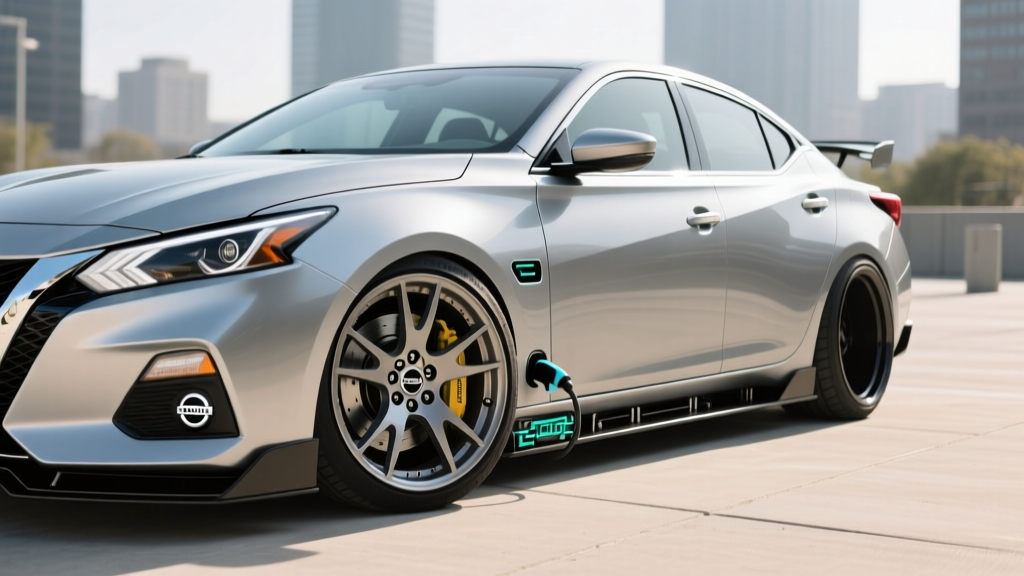
Why the 2016 Nissan Altima Bolt Pattern Matters for EV Projects
If you're researching the 2016 Nissan Altima bolt pattern, you likely fall into one of two camps: you're shopping for aftermarket wheels and need exact fitment data, or you're evaluating a used Altima as a candidate for an electric-vehicle conversion project. Either way, getting the wheel specs right is non-negotiable — a mismatched bolt pattern, center bore, or offset can mean vibration, bearing wear, or a wheel that simply won't mount.
The 2016 Altima (part of Nissan's fifth-generation L33 platform, 2013–2018) shares its underpinnings with several other Nissan and Infiniti models, which opens up a decent selection of compatible OEM and aftermarket wheels. But the specifics matter. Below, we break down every dimension you need, then address the EV-conversion angle that's becoming increasingly relevant as hobbyists and small shops repurpose mid-size sedans into battery-electric commuters.
2016 Nissan Altima Bolt Pattern: Exact Specifications
The 2016 Nissan Altima uses a 5-lug bolt pattern measuring 5x114.3 mm (also written as 5x4.5 inches). This is one of the most common bolt patterns in the Japanese and Korean automaker world, shared with vehicles like the Honda Accord, Toyota Camry (certain years), Hyundai Sonata, Kia Optima, and the Nissan Maxima and Rogue.
| Specification | Value |
|---|---|
| Bolt Pattern (PCD) | 5 x 114.3 mm (5 x 4.5 in) |
| Center Bore | 66.1 mm |
| Thread Size (Lug Nut) | M12 x 1.25 |
| OEM Wheel Diameter | 16" (Base/S) to 18" (SL/SR) |
| OEM Wheel Width | 6.5" (16") / 7.0" (17") / 7.5" (18") |
| OEM Offset Range | +40 mm to +45 mm |
| Lug Nut Torque Spec | 80 lb-ft (108 Nm) |
| OEM Tire Size (16" wheel) | 215/60R16 |
| OEM Tire Size (17" wheel) | 215/55R17 |
| OEM Tire Size (18" wheel) | 235/45R18 |
Center bore note: The 66.1 mm hub bore is critical. If you're fitting aftermarket wheels with a larger bore (common with many universal-fit options), you'll need hub-centric rings to avoid vibration at highway speed. Skipping rings forces the lug studs to center the wheel — a shortcut that causes wobble and premature stud fatigue.
Compatible Wheels Across Nissan and Other Brands
Because 5x114.3 is so widely used, your wheel-swap options are extensive. However, bolt pattern alone doesn't guarantee fitment. You must also match or accommodate the center bore, offset, and brake-caliper clearance.
Nissan models sharing 5x114.3 and 66.1 mm bore:
- 2013–2018 Nissan Altima (L33)
- 2016–2023 Nissan Maxima
- 2015–2020 Nissan Murano
- 2013–2019 Nissan Pathfinder (verify center bore — some years differ)
- 2013–2019 Nissan Sentra (SR/turbo trims with 17"+ wheels)
- Various Infiniti Q50, Q60, and QX50 model years
Non-Nissan models on 5x114.3 (center bore may differ — rings likely required): Honda Accord (2013+), Hyundai Sonata (2011+), Kia Optima/K5, Toyota Camry (2012+ with 5-lug), Lexus ES/IS, Mazda6 (2014+). Always verify center bore and offset before purchasing.
The EV-Conversion Angle: Altima as a Donor Platform
Here's where this topic intersects with the electric-vehicle world. The 2016 Nissan Altima is a popular candidate for DIY and small-shop EV conversions for several reasons:
- Lightweight curb weight: Approximately 3,100–3,250 lbs depending on trim, which helps maximize range from a given battery pack size.
- Spacious engine bay: The 2.5L QR25DE inline-four and 3.5L VQ35DE V6 are compact enough that removing them leaves generous room for a motor, controller, and DC-DC converter.
- Strong aftermarket support: Suspension, brake, and wheel components are plentiful and affordable.
- Low acquisition cost: Clean-title 2016 Altimas run $6,000–$10,000 on the used market as of early 2026, keeping project budgets manageable.
Weight Ratings and Load Considerations for Wheel Selection
Whether you're keeping the Altima gas-powered or converting it, wheel load rating matters. Each wheel must support at least one-quarter of the vehicle's gross axle weight rating (GAWR), plus a safety margin.
| Trim / Configuration | Curb Weight (lbs) | Min. Per-Wheel Load Rating |
|---|---|---|
| 2.5 Base (16" wheels) | ~3,102 | ~950 lbs (with margin) |
| 2.5 SL (17" wheels) | ~3,180 | ~975 lbs |
| 3.5 SR (18" wheels) | ~3,254 | ~1,000 lbs |
| EV conversion (est. +700 lbs battery) | ~3,800–3,950 | ~1,200 lbs minimum |
Most quality 17" and 18" aftermarket wheels in the 5x114.3 pattern carry load ratings of 1,300–1,500 lbs, which provides ample margin even for converted vehicles. Avoid lightweight "flow-formed" or "forged" wheels marketed for track use unless they explicitly state a load rating sufficient for your build weight — some ultra-light wheels are rated below 1,100 lbs per corner.
Practical FAQ: Bolt Pattern, Fitment, and EV Build Questions
Can I put Tesla wheels on a 2016 Nissan Altima?
No, not without adapters. Tesla Model 3 and Model Y use a 5x114.3 bolt pattern, which matches the Altima — but Tesla's center bore is 64.1 mm, while the Altima's hub is 66.1 mm. This means a Tesla wheel would not be hub-centric on the Altima. You could use 66.1-to-64.1 mm hub-centric rings (a common size), but you must also verify offset: Tesla Model 3 wheels are +40 mm, which falls within the Altima's acceptable range. Model S and Model X use a 5x120 bolt pattern and are incompatible.
What lug nuts do I need for aftermarket wheels?
The 2016 Altima uses M12 x 1.25 thread-pitch lug nuts. OEM nuts are conical (tapered) seat. If your aftermarket wheels require a different seat type (ball-seat or flat-seat), purchase matching lug nuts — never force a conical nut into a ball-seat wheel. For EV conversions with higher torque output from the electric motor, some builders upgrade to ARP-style studs, but the M12 x 1.25 specification should be maintained.
Does changing wheel size affect an EV conversion's range?
Yes, significantly. Moving from 16" to 18" wheels typically adds 8–15 lbs of unsprung weight per corner and increases rolling resistance if you fit wider tires. In EV conversions, builders report a 5–10% range reduction when upsizing two wheel inches and fitting 235-width rubber vs. the OEM 215. Stick with low-rolling-resistance (LRR) tires in the OEM size if range is your priority.
What is the correct lug nut torque for the 2016 Altima?
Nissan specifies 80 lb-ft (108 Nm) for all 2016 Altima trims. Always torque in a star pattern and re-check after the first 50 miles on new wheels. Over-torquing can stretch studs and warp brake rotors; under-torquing risks wheel separation.
Where can I verify my specific Altima's wheel specs?
Check the driver-side door jamb sticker for the OEM tire/wheel size and recommended tire pressure. For engineering-level confirmation, reference Nissan's official owner's manual portal or consult the Tire Rack wheel fitment guide, which maintains a verified database of bolt patterns, offsets, and center bores by vehicle year and trim.
Key Takeaways for Wheel Buyers and EV Converters
The 2016 Nissan Altima's 5x114.3 bolt pattern, 66.1 mm center bore, M12 x 1.25 lug threads, and +40 to +45 mm offset are well-documented and widely compatible with OEM and aftermarket wheels from Nissan, Infiniti, Honda, Hyundai, and Toyota lineups. For EV conversions, prioritize wheel load ratings above 1,200 lbs per corner to account for battery weight, maintain the OEM offset range to preserve steering geometry, and choose low-rolling-resistance tires to protect your electric range. Always use hub-centric rings when fitting wheels with a bore larger than 66.1 mm, and torque all lug nuts to 80 lb-ft in a star pattern.