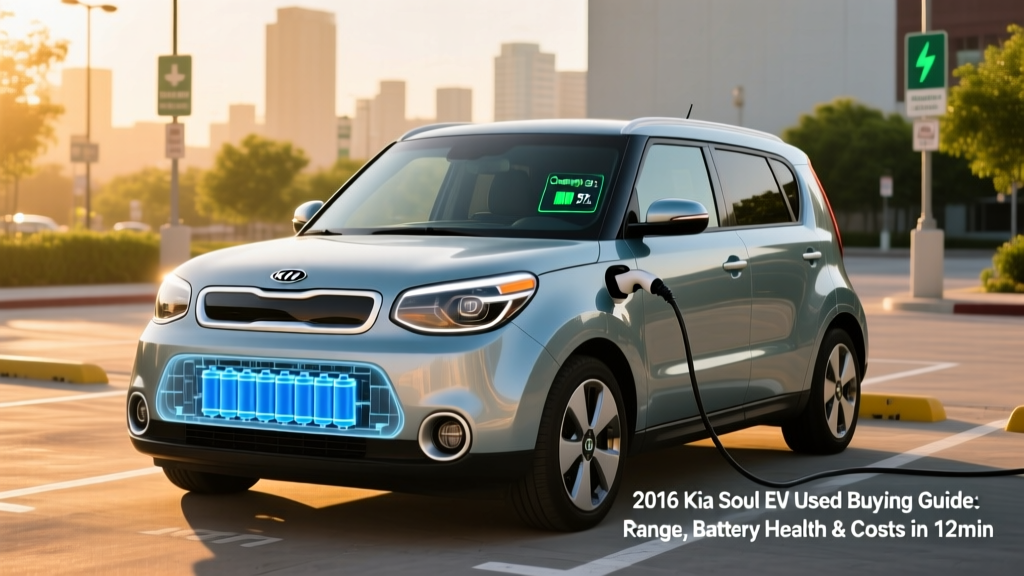
If you're looking at a used 2016 Kia Soul EV in 2026, here's the quick verdict: it's a budget-friendly city commuter with roughly 70–85 miles of real-world range today, assuming moderate battery degradation. At used prices between $7,000 and $11,000, it can be a solid second car or urban runabout — but only if your daily driving stays under 60 miles round-trip, you have access to Level 2 home charging, and you live in a mild climate. It is not a road-trip vehicle, and its CHAdeMO DC fast-charging connector is increasingly orphaned as the industry standardizes on NACS. Let's unpack the numbers so you can decide with eyes open.
Quick Answer: Is the 2016 Kia Soul EV Worth Buying in 2026?
Yes, if: you need an affordable city EV, drive under 60 miles daily, can charge at home on Level 2, and live in a temperate climate.
No, if: you need highway range, rely on public DC fast charging, live in extreme cold, or want modern ADAS features.
2016 Kia Soul EV: Original Specs vs. 2026 Reality
The 2016 Kia Soul EV launched with a 27 kWh lithium-ion polymer (NMC chemistry) battery pack and an EPA-estimated 93 miles of range. Kia rated the motor at 109 horsepower and 210 lb-ft of torque, good for a 0–60 mph time of approximately 11.2 seconds. Efficiency came in at 105 MPGe combined (31 kWh/100 miles) per fueleconomy.gov.
But that was a decade ago. Every lithium-ion battery degrades with time, heat, and charge cycles. By 2026, a 10-year-old Soul EV battery pack will typically retain between 75% and 88% of its original capacity, depending on climate exposure, charging habits, and mileage. That puts real-world range at approximately 70 to 85 miles in mixed driving — and potentially as low as 50–60 miles in freezing temperatures or sustained highway speeds above 70 mph.
| Spec | Original (2016) | Estimated 2026 Reality |
|---|---|---|
| Battery capacity (usable) | 27 kWh | ~20–24 kWh (degraded) |
| EPA range | 93 miles | 70–85 miles (real-world) |
| Motor output | 109 hp / 210 lb-ft | Unchanged |
| 0–60 mph | ~11.2 sec | ~11.2 sec (no degradation) |
| DC fast charge (peak) | 50 kW (CHAdeMO) | 50 kW (CHAdeMO — limited stations) |
| 10–80% DC charge time | ~33 minutes | ~25–30 min (smaller degraded pack charges faster) |
| Level 2 charge rate | 6.6 kW | 6.6 kW |
| Level 2 full charge time | ~4.5 hours | ~3.5–4 hours (degraded pack) |
| Efficiency | 105 MPGe / 31 kWh/100mi | ~95–105 MPGe (varies) |
Real-World Range Expectations
EPA sticker: 93 miles (new, 2016).
2026 real-world: Expect 70–85 miles in mild weather city driving. Highway cruising at 70+ mph drops this to ~55–65 miles. Sub-freezing temperatures with cabin heat can cut range to 50–60 miles. The Soul EV uses a resistive PTC heater, not a heat pump, so cold-weather efficiency takes a significant hit.
Battery Health: What to Check Before You Buy
Battery State of Health (SoH) is the single most important factor when evaluating any used EV, and it's especially critical for a 10-year-old pack. Here's what you need to know:
- Ask for a battery health report. Many Kia dealers can pull a State of Health reading via the OBD-II diagnostic port. Some third-party tools like Leaf Spy (adapted for Kia/Hyundai protocols) or services like Recurrent Auto can also estimate SoH.
- Look for 75%+ SoH. A pack below 75% capacity (under ~20 kWh usable) will struggle to deliver 60 miles of range in real conditions.
- Check for warranty coverage. Kia originally warranted the Soul EV battery for 10 years/100,000 miles against defects and capacity loss below a specified threshold. By 2026, most 2016 models have aged out of this warranty unless mileage is low. Confirm with a Kia dealer using the VIN.
- Inspect charging history. Frequent DC fast charging and habitual 100% SoC storage accelerate NMC degradation. Ask the seller about their charging habits.
- Watch for cell imbalance. If the dashboard range estimate fluctuates wildly or the car shuts down unexpectedly at low SoC, individual cells may be failing — a costly repair.
Battery replacement for the 2016 Soul EV is not trivial. A refurbished or new pack typically costs between $5,000 and $9,000 including labor, which can exceed the vehicle's value. This is why SoH verification before purchase is non-negotiable.
Charging the 2016 Soul EV in 2026: The CHAdeMO Problem
The 2016 Soul EV charges through three methods:
| Level | Connector | Power (kW) | Miles Added per Hour | Notes |
|---|---|---|---|---|
| Level 1 (120V) | J1772 | ~1.2 kW | ~4 mi/hr | Emergency/trickle only; 20+ hr full charge |
| Level 2 (240V) | J1772 | 6.6 kW | ~22 mi/hr | Best for daily home charging; ~4 hr full charge |
| DC Fast | CHAdeMO | 50 kW peak | ~150 mi/hr (peak) | 10–80% in ~30 min; declining station availability |
The CHAdeMO challenge: In 2026, the North American charging landscape has overwhelmingly standardized on NACS (Tesla's connector, now adopted by Ford, GM, Hyundai, Rivian, and others) and CCS1. CHAdeMO — once supported by Nissan, Mitsubishi, and Kia — has been effectively abandoned by Electrify America and most new station deployments. While existing CHAdeMO stations still operate in many metro areas, their numbers are shrinking, and new installations rarely include CHAdeMO cables.
This means you should plan to rely primarily on home Level 2 charging for the Soul EV. If you can install a 240V Level 2 charger at home (a 6.6 kW unit costs roughly $400–$700 for the hardware, plus $500–$1,500 for electrician installation depending on panel capacity), daily charging becomes effortless: plug in overnight, wake up to a full battery.
If you live in an apartment without charging access or rely heavily on public DC fast charging, the Soul EV's CHAdeMO dependency becomes a serious practical limitation. Consider this carefully before purchasing.
Cost Breakdown: Buying, Charging, and Owning
Let's compare the real costs of owning a used 2016 Kia Soul EV versus a comparable used gas-powered subcompact (e.g., a 2016 Honda Fit) over a 5-year ownership period assuming 8,000 miles driven annually.
| Cost Category | 2016 Kia Soul EV | 2016 Honda Fit (Gas) |
|---|---|---|
| Purchase price (avg. used) | $9,000 | $11,500 |
| Federal used EV tax credit (§25E)* | −$4,000 | $0 |
| Net purchase cost | $5,000 | $11,500 |
| Fuel/energy (5 yrs, 40,000 mi) | $2,200 (electricity @ $0.14/kWh) | $4,800 (gas @ $3.40/gal, 33 MPG) |
| Maintenance (5 yrs) | $800 (tires, cabin filter, brake fluid) | $2,800 (oil, filters, brakes, spark plugs) |
| Insurance (5 yrs avg.) | $5,500 | $5,000 |
| Battery replacement risk reserve | $2,000 (set aside) | $0 |
| Total 5-year cost | $15,500 | $24,100 |
*The §25E used EV credit provides 30% of the sale price up to $4,000 for qualifying used EVs sold by a dealer, subject to buyer income caps ($75K single / $150K joint) and a $25,000 max vehicle sale price. Confirm current eligibility at irs.gov. The credit is claimed at point of sale or on your tax return. A $9,000 Soul EV qualifies for the full $2,700 (30% of $9,000) or up to $4,000 if the dealer sale price is structured accordingly — consult a tax professional.
The Soul EV's operating costs are dramatically lower: electricity at $0.14/kWh costs roughly 4.4 cents per mile versus the Fit's 10.3 cents per mile on gas. Maintenance savings are substantial — no oil changes, no transmission fluid, and regenerative braking extends pad life significantly. However, EV insurance premiums tend to run 10–15% higher, and the battery-replacement risk is a real financial consideration for a 10-year-old pack.
EV vs. Gas: Who Should Buy the 2016 Soul EV?
| Factor | 2016 Soul EV | Gas Subcompact (e.g., Honda Fit) |
|---|---|---|
| Daily range | 70–85 mi (real-world) | 350+ mi |
| Refuel/recharge time | 4 hr (Level 2) / 30 min (DC) | 5 min (gas station) |
| Cost per mile (energy) | ~$0.044 | ~$0.103 |
| Home "refueling" | Yes — plug in overnight | No — must visit gas station |
| Road trip practicality | Poor (range + CHAdeMO) | Excellent |
| Cold-weather range loss | 25–35% reduction | Minimal |
| Maintenance burden | Very low | Moderate |
| Cargo space | 24.4 cu ft (rear seats up) | 16.6 cu ft |
The Soul EV wins on operating cost, home convenience, and cargo space (the boxy design yields excellent interior volume). It loses on range flexibility, cold-weather performance, and road-trip viability. This is a purpose-built urban commuter, not a do-everything vehicle.
Common Misconceptions About the 2016 Soul EV
| Myth | Fact |
|---|---|
| "It still gets 93 miles of range." | That was EPA-rated when new. A 10-year-old degraded pack delivers ~70–85 miles in practice, less in cold or highway driving. |
| "I can charge it at any public fast charger." | The Soul EV uses CHAdeMO, which is increasingly rare. Most new DC stations use NACS or CCS1 only. |
| "The battery will need immediate replacement." | Not necessarily. Many 2016 packs retain 75–88% SoH. Get a diagnostic before buying — some packs are in good shape. |
| "It qualifies for the $7,500 new EV tax credit." | No. The §30D new-vehicle credit doesn't apply. However, the §25E used EV credit may provide up to $4,000 when purchased from a dealer. |
| "EVs need no maintenance at all." | The Soul EV still needs tire rotations, cabin air filter changes, brake fluid checks, coolant service, and 12V battery replacement. It's lower maintenance, not zero. |
| "Any electrician can install a home charger." | You need a licensed electrician to assess your panel capacity. A 6.6 kW Level 2 charger draws ~28 amps continuous, requiring a 40-amp circuit. Older homes may need a panel upgrade ($1,000–$3,000). |
Decision Framework: Is the 2016 Kia Soul EV Right for You?
If / Then Buying Guide
- If your daily round-trip commute is under 60 miles and you can install Level 2 charging at home → The Soul EV is a strong budget pick.
- If you live in a mild climate (rarely below 32°F) → Range degradation from cold won't be a dealbreaker.
- If you need a second car for errands and school runs → The Soul EV's cargo space and low running costs make it ideal.
- If you plan to road-trip or drive more than 80 miles daily → Look at a newer, longer-range EV or keep a gas car for longer trips.
- If you live in an apartment without charging access → The CHAdeMO limitation makes public charging unreliable. Consider a newer EV with NACS/CCS access, or a hybrid.
- If the battery SoH reads below 75% on a diagnostic → Walk away unless the price reflects a $6,000+ battery replacement.
- If you live in extreme cold (regularly below 10°F) → Expect 50–60 miles of range. This may not be enough — consider a PHEV instead.
Pre-Purchase Checklist
- Get a battery SoH diagnostic from a Kia dealer or qualified EV technician.
- Verify remaining powertrain/battery warranty via VIN at a Kia dealer.
- Confirm the onboard charger works at full 6.6 kW (test at a public Level 2 station).
- Test DC fast charge at a CHAdeMO station — confirm the car accepts charge and doesn't throw errors.
- Check for open recalls at nhtsa.gov/recalls using the VIN.
- Inspect tires, brakes, suspension, and the 12V auxiliary battery (often overlooked in EVs).
- Verify your home electrical panel can support a 40-amp circuit for Level 2 charging.
Frequently Asked Questions
What is the real-world range of a 2016 Kia Soul EV in 2026?
With typical battery degradation (75–88% SoH), expect 70–85 miles in mild-weather city driving. Highway driving at 70+ mph reduces this to roughly 55–65 miles. In freezing temperatures with cabin heat, plan on 50–60 miles. The original 93-mile EPA rating no longer applies to a decade-old battery.
Can I still find CHAdeMO charging stations in 2026?
Yes, but availability is declining. Most new DC fast-charging deployments use NACS or CCS1. Legacy Electrify America and EVgo stations in some regions still have CHAdeMO connectors, but they're not being replaced when they fail. Use apps like PlugShare to verify CHAdeMO availability in your area before relying on public fast charging.
Does the 2016 Kia Soul EV qualify for any tax credits?
It does not qualify for the §30D new-vehicle credit. However, if you purchase from a licensed dealer and meet income requirements (under $75,000 single / $150,000 joint AGI), you may qualify for the §25E used clean vehicle credit — 30% of the sale price up to $4,000. The vehicle must be sold for $25,000 or less. Always confirm with a tax professional before relying on credit eligibility.
How much does it cost to charge a 2016 Soul EV at home?
Charging a degraded ~22 kWh usable pack from empty to full on Level 2 at the US average of $0.14/kWh costs approximately $3.08. That's roughly 4 cents per mile — compared to about 10 cents per mile for a 33-MPG gas car at $3.40/gallon. Over 8,000 miles per year, home charging saves roughly $470 annually versus gas.
What should a first-time EV buyer know about the 2016 Soul EV?
Three things: (1) Home Level 2 charging is essential — don't buy this car without it. (2) Battery health is everything on a 10-year-old EV; get a diagnostic before purchase. (3) This is a city car, not a road-trip car. Plan your driving around its real-world range, not the EPA sticker from 2016. If those constraints work for your lifestyle, the Soul EV offers excellent value with low running costs.
Is the 2016 Soul EV battery covered by warranty?
Kia's original EV battery warranty was 10 years/100,000 miles. For a 2016 model, that coverage expired at the end of 2025 (or at 100,000 miles, whichever came first). Some low-mileage examples may still have residual coverage — check with a Kia dealer using the VIN. If the warranty has expired, you're responsible for any battery repair or replacement costs.
How does the 2016 Soul EV compare to a used Nissan Leaf from the same era?
Both use CHAdeMO and have similar range (the 2016 Leaf with a 30 kWh pack was rated at 107 miles EPA). The Soul EV offers more cargo space (24.4 vs. 24.0 cu ft), slightly better battery thermal management, and a more upright seating position. The Leaf had broader CHAdeMO infrastructure support historically. In 2026, both face the same CHAdeMO obsolescence challenge. Choose based on which specific vehicle has better battery health and lower mileage.
Sources: fueleconomy.gov — 2016 Kia Soul EV, IRS §25E Used Clean Vehicle Credit, NHTSA Recall Lookup.