The 2016 Chevrolet Bolt EV was a watershed moment for affordable electric vehicles. When it debuted for the 2017 model year (announced and previewed throughout 2016), it delivered 238 miles of EPA-estimated range at a sub-$37,500 starting price — a combination that undercut every rival except Tesla's forthcoming Model 3. Nearly a decade later, the Bolt EV remains one of the most popular used EVs on the market, and for good reason: it is practical, efficient, and still surprisingly capable for daily driving. But buying a nearly decade-old EV requires careful scrutiny of battery health, charging limitations, and ownership economics. This guide covers everything a 2026 used-car shopper needs to know.
2016 Chevy Bolt EV: Core Specifications
| Spec | Value |
|---|---|
| EPA Range | 238 miles |
| Battery (Usable) | 60 kWh (NMC lithium-ion, LG Chem) |
| Motor | 150 kW (200 hp), 266 lb-ft torque |
| Drivetrain | Front-wheel drive (FWD) |
| 0-60 mph | ~6.5 seconds |
| Max DC Fast Charge | 50 kW (CCS1) |
| 10-80% DCFC Time | ~70 minutes (est.) |
| Level 2 Charge Rate | 7.2 kW (25 miles/hr) |
| Level 1 (120V) | ~1.2 kW (~4 miles/hr) |
| EPA Efficiency | 119 MPGe combined (28 kWh/100 mi) |
| Cargo Volume | 16.9 cu ft (rear seats up) / 56.6 cu ft (folded) |
| Rear Legroom | 36.5 inches |
| Curb Weight | 3,563 lbs |
| Battery Warranty (Original) | 8 years / 100,000 miles (≥60% capacity) |
| Original Base MSRP | $37,495 (LT) / $43,995 (Premier) before incentives |
Real-World Range: What the EPA Sticker Doesn't Tell You
EPA Estimated: 238 miles
Real-World Highway (70 mph, mild weather): ~200–215 miles
Real-World City/Suburban: ~230–250 miles (regen braking recovers energy)
Cold Weather (below 32°F, cabin heat on): ~165–190 miles (20-30% loss)
The Bolt EV's 238-mile EPA rating was class-leading in 2016-2017 and still holds up respectably today. However, real-world results depend heavily on driving conditions. The Bolt's single-speed reduction gear and front-wheel-drive layout mean highway efficiency drops noticeably above 65 mph — there is no second gear to optimize cruising. In our experience and aggregated owner reports, expect roughly 200-215 miles on a flat highway at 70 mph in moderate temperatures.
City driving is where the Bolt shines. Aggressive regenerative braking (especially in "L" mode or with the steering-wheel regen paddle) can push range to 250+ miles in stop-and-go traffic. According to fueleconomy.gov, the Bolt achieves 126 MPGe city but only 109 MPGe highway — a gap that reflects this regen advantage.
Cold weather is the Bolt's Achilles heel. Unlike newer EVs with heat-pump HVAC systems, the Bolt uses resistive cabin heating, which draws heavily from the 60 kWh battery. In sub-freezing temperatures, expect a 20-30% range reduction. Preconditioning the battery while plugged in helps, but the Bolt lacks the sophisticated battery thermal preconditioning found in Tesla or Hyundai's latest platforms.
Charging Speeds: The Bolt's Biggest Limitation in 2026
Charging is where the 2016-era Bolt EV shows its age most clearly. The DC fast-charging architecture maxes out at approximately 50 kW via its CCS1 connector — a figure that was competitive in 2017 but falls far behind today's 150-350 kW capable vehicles.
| Charging Level | Power (kW) | Miles of Range Added per Hour | Notes |
|---|---|---|---|
| Level 1 (120V household) | ~1.2 kW | ~4 miles/hr | Emergency/trickle only |
| Level 2 (240V home/public) | 7.2 kW | ~25 miles/hr | Full charge in ~9 hours |
| DC Fast Charge (CCS1) | 50 kW peak | ~160 miles/hr (at peak) | 10-80% in ~70 min; tapers significantly above 80% |
Understanding kW vs kWh: kW (kilowatts) measures charging power — how fast energy flows into the battery. kWh (kilowatt-hours) measures battery capacity — how much total energy the battery stores. The Bolt's 60 kWh battery charged at 50 kW peak would theoretically fill in 72 minutes, but real-world charge curves slow the rate as the battery approaches full.
The Bolt's DC charging curve is notably flat and slow by modern standards. It sustains roughly 40-46 kW from 10-50% state of charge, then tapers to 30 kW and below as it passes 60%. A 10-80% session takes approximately 65-75 minutes at a properly functioning 50 kW CCS station. For road trips, this means planning 45-60 minute stops every 150-180 miles — workable, but noticeably slower than a Hyundai Ioniq 5 or Tesla Model 3.
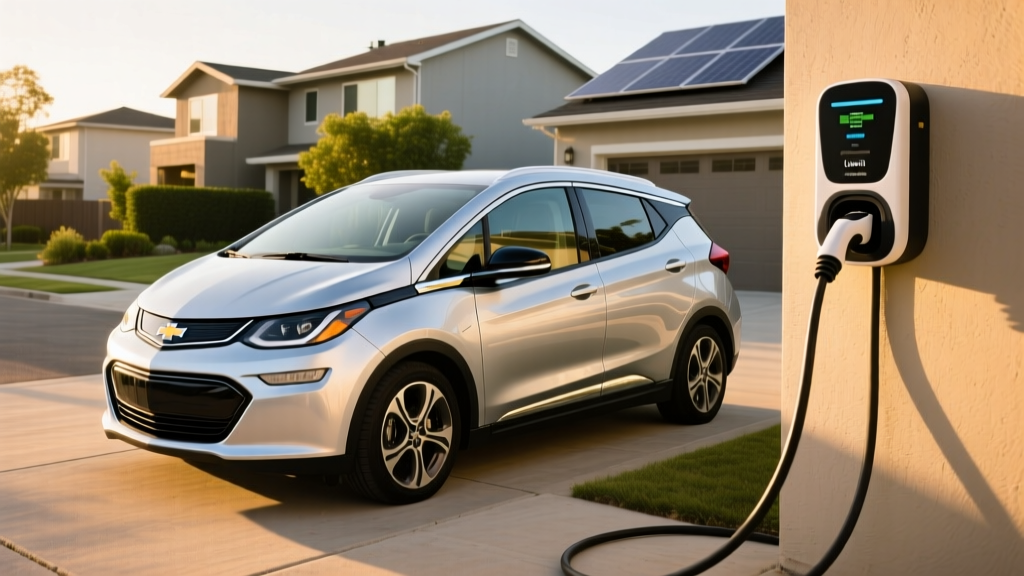
Level 2 home charging at 7.2 kW is perfectly adequate for overnight replenishment. A full 0-100% charge takes about 9 hours, meaning you can easily wake up to a full battery every morning with a standard 240V/32A home charger installation. For daily commuting, this is all you need.
Performance, Efficiency, and Daily Drivability
The Bolt EV's 200-horsepower, front-mounted permanent-magnet electric motor delivers 266 lb-ft of instant torque to the front wheels. The 0-60 mph time of approximately 6.5 seconds feels brisk in everyday driving, with confident highway merging and responsive city acceleration. There is no all-wheel-drive option — this is strictly a FWD hatchback.
Efficiency remains a strong suit. At 119 MPGe combined (28 kWh per 100 miles), the Bolt ranks among the most efficient EVs ever sold. For context, charging at the national average electricity rate of ~$0.16/kWh (as of early 2026) means roughly $0.045 per mile — about one-third the per-mile fuel cost of a comparable 30 MPG gas car at $3.50/gallon.
Ride quality is firm but composed, with a relatively low center of gravity thanks to the under-floor battery pack. The steering is light and precise, making the Bolt easy to park and maneuver in urban environments. At 3,563 lbs, it is lighter than most modern EVs, which contributes to both its efficiency and its nimble feel.
Interior Space, Tech, and Notable Drawbacks
The Bolt EV is a subcompact hatchback that punches well above its weight in interior volume. With 16.9 cubic feet of cargo space behind the rear seats and 56.6 cubic feet with the 60/40 split rear seats folded, it rivals compact SUVs for utility. Rear legroom of 36.5 inches is generous enough for adult passengers on longer trips.
The 2017 model year features a 10.2-inch touchscreen infotainment system with Apple CarPlay and Android Auto, a 8-inch driver information display, and available 4G LTE Wi-Fi hotspot. Higher-trim Premier models add leather seats, a Bose premium audio system, heated front and rear seats, and a surround-view camera.
Driver-Assistance Features: The Bolt offers forward collision alert, lane keep assist, lane departure warning, and rear cross-traffic alert. These are SAE Level 0-1 warning and intervention systems — not adaptive cruise control or any form of hands-free driving. The driver must remain fully engaged at all times.
- Slow DC charging: 50 kW peak makes road trips time-consuming vs. modern 150+ kW EVs.
- No battery thermal preconditioning for DCFC: Cold batteries charge even slower in winter.
- Resistive cabin heating: Significant range loss in cold weather vs. heat-pump equipped EVs.
- CCS1 connector: As the industry shifts to NACS (Tesla's connector), CCS public charging availability may decline long-term, though adapters exist.
- Battery recall history: The 2017-2019 Bolt EV was subject to a major battery recall (fire risk from manufacturing defects). Verify recall completion before purchasing.
Battery Health, Warranty, and the Recall Factor
The Bolt EV uses a 60 kWh (usable) NMC (nickel-manganese-cobalt) lithium-ion battery pack supplied by LG Chem. NMC chemistry offers high energy density — which is how GM fit 238 miles of range into a compact hatchback — but it is more sensitive to heat and high state-of-charge stress than LFP (lithium iron phosphate) chemistry used in some newer EVs.
Original battery warranty coverage was 8 years / 100,000 miles, guaranteeing the battery would retain at least 60% of original capacity. For a 2017 model year vehicle, this warranty expired in 2025 by time (though some high-mileage examples may still be within the 100,000-mile limit). Out-of-warranty battery replacement costs have historically ranged from $14,000 to $16,000, though refurbished packs may be available for less.
Critical — Battery Recall: In 2021, GM issued a recall for 2017-2019 Bolt EVs due to potential battery cell manufacturing defects that could cause fires, particularly when charging to full or in hot conditions. GM replaced defective battery modules and, in many cases, entire packs. According to NHTSA, all affected vehicles should have been remedied. Before purchasing any 2017 Bolt EV, verify via the VIN at nhtsa.gov/recalls that the recall work was completed. Vehicles with replaced packs may actually have better long-term battery health than those that narrowly avoided the defect.
For ongoing battery health monitoring, request a State of Health (SoH) reading from a Chevrolet dealer or use an OBD-II scanner with EV-compatible software (such as Torque Pro with the appropriate PID set). Most well-maintained Bolt packs from this era show 85-92% SoH after 7-9 years, depending on climate and charging habits.
Pricing, Used Market Values, and Tax Credit Eligibility
The 2017 Chevy Bolt EV originally started at $37,495 for the LT trim and $43,995 for the Premier trim, before any federal or state incentives. In 2026, used Bolt EVs from the 2017 model year typically trade between $10,000 and $16,000 depending on mileage, condition, trim, and battery health — making them one of the most affordable entry points into EV ownership.
| Trim | Original MSRP | 2026 Used Range | After Used EV Credit (§25E) |
|---|---|---|---|
| LT | $37,495 | $10,000–$13,500 | As low as ~$6,000–$9,500 |
| Premier | $43,995 | $13,000–$16,000 | As low as ~$9,000–$12,000 |
Federal Tax Credits — Important Distinctions:
- §30D New EV Credit: The $7,500 new-vehicle credit is no longer available for the Bolt EV, as it was discontinued after the 2023 model year. The current-generation Bolt EV (if reintroduced) would need to meet 2026 battery-sourcing, critical-mineral, MSRP ($55,000 cap for sedans/hatchbacks), and buyer income limits ($150K single / $300K joint) per IRS §30D rules.
- §25E Used EV Credit: This is the relevant credit for 2026 buyers. The used clean vehicle credit offers 30% of the sale price, up to $4,000, for qualified used EVs purchased from a licensed dealer. Eligibility requirements include: sale price ≤$25,000, buyer income ≤$75K single / $150K joint, model at least two years old, and purchased from a dealer (private-party sales do not qualify). A $12,000 Bolt EV purchased from a dealer could net a $3,600 credit, effectively bringing the net cost to ~$8,400.
- ✓ Vehicle MSRP (sale price) ≤ $25,000
- ✓ Buyer AGI ≤ $75,000 (single) or $150,000 (joint)
- ✓ Purchased from a licensed dealer (not private party)
- ✓ Vehicle is at least 2 model years old
- ✓ Vehicle has not been claimed for the used credit in a prior year (after 2022)
- ✓ Credit = 30% of sale price, max $4,000
Consult a tax professional for personal eligibility. Rules per IRS §25E.
2016 Chevy Bolt EV vs. Key Used-EV Competitors
| Spec | 2017 Chevy Bolt EV | 2017 Nissan Leaf (30 kWh) | 2017 VW e-Golf | 2017 Tesla Model 3 (Long Range) |
|---|---|---|---|---|
| EPA Range | 238 mi | 107 mi | 125 mi | 310 mi |
| Battery | 60 kWh NMC | 30 kWh | 35.8 kWh | 75 kWh |
| DC Fast Charge | 50 kW (CCS) | 50 kW (CHAdeMO) | 50 kW (CCS) | ~170 kW (NACS) |
| 0-60 mph | 6.5 sec | ~9.5 sec | 9.6 sec | 5.1 sec |
| 2026 Used Price (est.) | $10K–$16K | $7K–$10K | $9K–$12K | $16K–$22K |
| Cargo (cu ft) | 16.9 / 56.6 | 23.6 / 30.0 | 22.8 / 52.7 | 15.0 / 64.0 |
The Bolt EV's closest 2017 competitors — the Nissan Leaf and VW e-Golf — offer dramatically less range (107 and 125 miles respectively). The Tesla Model 3 Long Range beats the Bolt on range and charging speed but commands a significant price premium on the used market. For pure value-per-mile-of-range, the Bolt EV remains difficult to beat in the 2026 used market.
- 238-mile EPA range — still competitive for daily use
- Excellent efficiency (119 MPGe / 28 kWh/100 mi)
- Spacious hatchback cargo area (56.6 cu ft max)
- Strong value on the used market ($10K–$16K)
- Eligible for up to $4,000 used EV tax credit (§25E)
- Peppy 200 hp motor, 6.5-sec 0-60
- Apple CarPlay / Android Auto standard
- 50 kW DC charging is painfully slow by 2026 standards
- No battery thermal preconditioning for fast charging
- Resistive cabin heater = major cold-weather range loss
- Battery recall history (verify completion)
- Battery warranty likely expired (8yr/100K from 2017)
- CCS1 connector in a shifting charging landscape
- No adaptive cruise control or advanced ADAS
Who Should Buy a 2016/2017 Chevy Bolt EV?
- You need an affordable commuter EV with 200+ miles of real range
- You can charge at home overnight (Level 2) and rarely road-trip
- You want hatchback cargo versatility without SUV pricing
- You qualify for the §25E used EV credit (income ≤$75K single, dealer purchase ≤$25K)
- You live in a mild climate where cold-weather range loss is manageable
- You frequently take 200+ mile road trips (the 50 kW charging will frustrate)
- You live in extreme cold climates (20-30% winter range loss is significant)
- You need all-wheel drive or towing capability
- You want the latest ADAS or hands-free driving features
- You prefer the NACS (Tesla) charging ecosystem
Frequently Asked Questions
What is the real-world range of the 2016/2017 Chevy Bolt EV?
The EPA rates it at 238 miles. In real-world driving, expect 200-215 miles at highway speeds in mild weather, 230-250 miles in city driving with regenerative braking, and 165-190 miles in sub-freezing temperatures due to resistive cabin heating and battery chemistry limitations.
How fast does the Bolt EV charge at home and on DC fast chargers?
At home on a 240V Level 2 charger, it charges at 7.2 kW, adding about 25 miles of range per hour (full charge in ~9 hours). On a DC fast charger, it peaks at approximately 50 kW via CCS1, taking roughly 65-75 minutes for a 10-80% charge. This is the Bolt's weakest attribute by 2026 standards.
How much does a used 2017 Bolt EV cost in 2026, and can I get a tax credit?
Used 2017 Bolt EVs typically sell for $10,000-$16,000 depending on trim and condition. The §30D new-vehicle credit no longer applies. However, the §25E used EV credit may provide up to $4,000 (30% of sale price) if you buy from a dealer, the sale price is ≤$25,000, and your income is within limits ($75K single / $150K joint).
Is the 2017 Bolt EV worth buying vs. a used Tesla Model 3 or Nissan Leaf?
For value, yes. The Bolt offers more than double the Leaf's range at a similar price point, and it is $5,000-$8,000 cheaper than a comparable used Model 3. However, the Model 3 charges significantly faster (~170 kW vs. 50 kW), has access to the Supercharger network (with a NACS adapter), and offers more advanced driver-assistance features. Choose the Bolt for budget; choose the Model 3 for road trips and tech.
Does the 2017 Bolt EV qualify for the federal EV tax credit?
Not the new-vehicle §30D credit — that applies only to new purchases. The relevant credit is §25E (used clean vehicle), which offers up to $4,000 for qualified buyers purchasing from a dealer. Verify current rules at irs.gov and consult a tax professional, as income caps and dealer requirements apply.
What should I check before buying a used 2017 Bolt EV?
Verify that the battery recall (NHTSA campaign 21V650000) was completed by running the VIN at nhtsa.gov/recalls. Request a battery State of Health (SoH) reading — aim for ≥85%. Check for any remaining powertrain warranty coverage. Inspect the CCS charge port for damage. And confirm your home electrical panel can support a 240V/32A Level 2 charger installation (budget $500-$2,000 for equipment and electrician work).