Quick Verdict: A Pioneer Showing Its Age
The 2015 Tesla Model X was the first electric SUV to prove that a battery-powered family hauler could be desirable, fast, and practical. Launched in late 2015 as a 2016 model-year vehicle, it introduced the world to Falcon Wing rear doors, a massive panoramic windshield, and dual-motor all-wheel drive in a three-row package. A decade later, the original Model X occupies a unique space in the used EV market: it offers genuine utility and Supercharger network access at a fraction of its original six-figure price, but it also carries the maintenance realities of an early-production luxury EV.
If you are shopping for a 2015 Tesla Model X in 2026, you need clear-eyed data on battery degradation, real-world range, charging practicality, and total ownership cost. This guide breaks down every number that matters.
2015 Tesla Model X Specification Overview
| Specification | Model X 90D | Model X P90D |
|---|---|---|
| EPA Range (original) | 250 miles | 250 miles |
| Battery Capacity | 90 kWh (usable ~85 kWh) | 90 kWh (usable ~85 kWh) |
| Battery Chemistry | NMC (Nickel Manganese Cobalt) | NMC (Nickel Manganese Cobalt) |
| Drivetrain | Dual-Motor AWD | Dual-Motor AWD |
| Horsepower | ~518 hp combined | ~532 hp (762 hp w/ Ludicrous) |
| 0–60 mph | 4.8 seconds | 3.8 sec (3.2 sec Ludicrous) |
| MPGe (combined) | 92 MPGe | 89 MPGe |
| Energy Consumption | ~36 kWh/100 mi | ~38 kWh/100 mi |
| Max DC Fast Charge | ~120 kW (Supercharger V2) | ~120 kW (Supercharger V2) |
| Level 2 Charge Rate | ~11.5 kW (48A) | ~11.5 kW (48A) |
| Seating | 5, 6, or 7 passengers | 5, 6, or 7 passengers |
| Cargo (behind 3rd row) | 26.6 cu ft | 26.6 cu ft |
| Cargo (all seats folded) | 88.1 cu ft | 88.1 cu ft |
| Original Base MSRP | ~$80,000 | ~$110,000+ |
| Typical 2026 Used Price | $18,000–$28,000 | $22,000–$35,000 |
Real-World Range: What the EPA Number Doesn't Tell You
EPA Estimated Range (new): 250 miles (90D and P90D)
Real-World Expectation in 2026: Expect 190–220 miles on a full charge in mixed driving, assuming moderate battery degradation. Highway driving at 70+ mph drops this to roughly 170–195 miles. In freezing temperatures (below 30°F), plan for 150–180 miles of usable range.
The 2015 Model X 90D earned a 250-mile EPA rating when new. That figure was impressive for a 5,000+ pound SUV in 2015, but three factors compress it in real-world 2026 ownership:
Battery degradation. The 90 kWh NMC pack in these early vehicles has typically lost 12–20% of its original capacity after 10 years and 100,000–150,000 miles. Tesla's battery management system includes a top and bottom buffer, so the degradation curve tends to flatten after the initial 5–8% drop in the first couple of years. Still, a 2015 Model X with 130,000 miles might show 200–215 miles at 100% state of charge on a good day.
Aerodynamics and weight. The Model X is a large, heavy vehicle with a tall frontal area. At highway speeds, energy consumption climbs sharply — expect 38–42 kWh/100 miles on the interstate, compared to the EPA-rated 36 kWh/100 miles in mixed driving. This is the single biggest range killer on road trips.
Cold-weather losses. NMC chemistry loses efficiency in freezing temperatures. Without preconditioning the battery (plugging in and warming it before departure), winter range can drop 25–35%. The 2015 Model X does not have a heat pump — it uses resistive cabin heating, which draws significant energy from the pack.
Charging Speed: DC Fast and Home Level 2
| Charging Level | Power / Rate | Speed (approx.) | Notes |
|---|---|---|---|
| Level 1 (120V outlet) | ~1.4 kW | 3–4 miles/hour | Emergency/trickle only |
| Level 2 (240V, 48A) | ~11.5 kW | 29–32 miles/hour | Home Wall Connector; full charge ~8–9 hours |
| Level 2 (240V, 32A) | ~7.7 kW | 19–21 miles/hour | Common portable/mobile connector setup |
| DC Fast (Tesla Supercharger V2) | Up to 120 kW peak | 10–80% in ~40–45 min | Peak rate only below 50% SoC; tapers significantly above 80% |
| DC Fast (CCS adapter, V3 Supercharger) | Up to ~150 kW (limited by vehicle) | 10–80% in ~35–40 min | 2015 Model X hardware limits sustained rate |
The 2015 Model X uses Tesla's proprietary connector (pre-NACS standardization). With Tesla's CCS adapter or at Supercharger stalls, it can accept DC fast charging, but its onboard charge hardware caps the practical rate well below modern EVs.
DC fast charging reality. The 90 kWh pack can accept a peak of roughly 120 kW at a V2 Supercharger, but only when the battery is warm and at a low state of charge (below 40–50%). The charge curve tapers hard above 60% SoC, dropping to 40–50 kW, and slows to a trickle above 90%. A realistic 10–80% session takes 40–45 minutes. At a V3 Supercharger (250 kW stalls), the 2015 Model X cannot take advantage of the higher rate — the vehicle's battery management and pack architecture limit sustained charging to roughly 120–140 kW at best.
Home Level 2 charging. With a Tesla Wall Connector on a 60-amp circuit (48 amps continuous), the onboard charger delivers up to 11.5 kW, adding roughly 30 miles of range per hour. A full charge from near-empty takes about 8–9 hours — perfectly practical for overnight charging. If your home electrical panel supports only a 40-amp circuit (32 amps continuous), expect about 7.7 kW and roughly 20 miles per hour of charging.
Important note on Supercharger access. As of 2026, Tesla has opened the Supercharger network to non-Tesla EVs via the NACS standard, but the 2015 Model X uses the legacy Tesla connector and retains full, unrestricted Supercharger access natively. No adapter is needed at Tesla stalls. This remains a significant ownership advantage for road trips.
Performance and Driving Dynamics
Even by 2026 standards, the 2015 Model X is quick. The 90D's dual-motor AWD powertrain delivers roughly 518 horsepower and a 4.8-second 0–60 mph time. The P90D with Ludicrous Mode drops that to 3.2 seconds — genuinely supercar-rivaling acceleration from a seven-seat SUV.
The dual-motor setup provides confident all-weather traction, and the low center of gravity (battery pack under the floor) keeps body roll surprisingly controlled for a vehicle this tall. However, the 2015 Model X is heavy — roughly 5,200–5,400 lbs depending on configuration — and you feel that mass in corners and during emergency braking.
Ride quality was a common criticism at launch. Early Model X vehicles had suspension tuning that some owners described as floaty over highway expansion joints while being firm over sharp bumps. Tesla issued several suspension updates and service campaigns over the years, so a well-maintained example may have improved components.
Interior, Tech, and Standout Features
The 2015 Model X interior centers on a 17-inch touchscreen that controls nearly every vehicle function — climate, navigation, media, vehicle settings, and even the glovebox release. The digital instrument cluster is a second screen behind the steering wheel. In 2026, the infotainment system still functions, but it runs older Tesla software and lacks the processing speed and interface refinement of current-generation Tesla vehicles. Over-the-air updates have kept it functional, but don't expect the latest UI features.
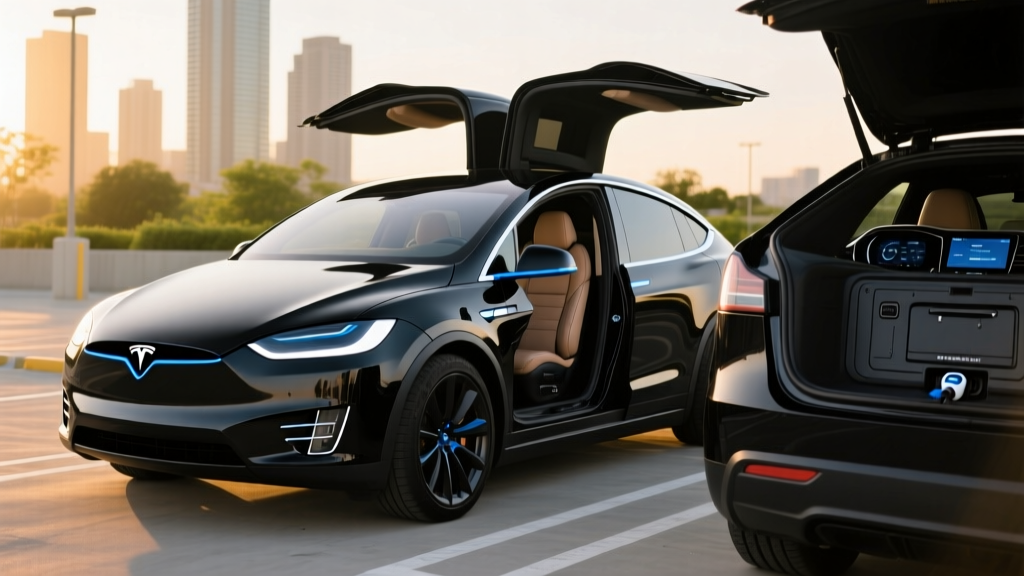
Falcon Wing doors. The signature rear doors open vertically with articulating hinges and ultrasonic sensors to avoid nearby obstacles. They provide excellent access to the second and third rows in tight parking spaces. However, they are mechanically complex — early-production units had well-documented issues with seals, alignment, and sensor glitches. Many of these were addressed under warranty, but verify door operation carefully when inspecting a used example.
Panoramic windshield. The "Big Sky" windshield extends over the front seats, creating an open, airy cabin feel. It includes an adjustable sunshade.
Driver assistance. The 2015 Model X shipped with Hardware 1 (HW1) for Autopilot. This is a first-generation system offering basic adaptive cruise control and lane-keeping. It is an SAE Level 2 driver-assist system — the driver must remain fully engaged with hands on the wheel and eyes on the road at all times. HW1 does not support Tesla's Full Self-Driving (Supervised) capability, and it cannot be upgraded to current hardware. This is a significant limitation compared to newer Teslas.
HEPA air filtration. The optional "Bioweapon Defense Mode" uses a massive HEPA filter and positive cabin pressure to filter outside air. It remains one of the most effective cabin air filtration systems in any production vehicle.
Used Pricing, Tax Credits, and Ownership Cost
| Cost Factor | Details |
|---|---|
| Typical Used Price (2026) | $18,000–$35,000 depending on trim, mileage, and condition |
| Federal Used EV Tax Credit (§25E) | Up to $4,000 (30% of sale price, max $4,000) for qualified used EVs priced at or below $25,000 |
| Eligible Models | Only 90D examples priced at $25,000 or less qualify; P90D typically exceeds the cap |
| Income Caps (§25E) | $75,000 single / $112,500 head of household / $150,000 joint filers |
| Vehicle Requirements | Must be at least 2 model years old, purchased from a dealer, under $25,000 sale price |
| New EV Tax Credit (§30D) | Not applicable — the 2015 Model X is no longer sold new |
The federal new-vehicle EV tax credit (§30D) does not apply to the 2015 Model X since it is no longer available new. However, the used clean vehicle credit (§25E) may apply if you purchase a qualifying example from a licensed dealer for $25,000 or less. The credit equals 30% of the sale price, up to a maximum of $4,000. Income caps apply, and the vehicle must be at least two model years old — which the 2015 Model X easily satisfies.
Insurance costs. Expect higher-than-average premiums. The Model X's original MSRP, aluminum body panels, and specialized repair requirements keep insurance rates elevated even on a used vehicle. Quotes of $2,000–$3,500 annually are common depending on your driving record and location.
Maintenance considerations. The 2015 Model X has no engine oil, spark plugs, or transmission fluid to change. However, budget for drive unit (motor) inspections, coolant system service, brake fluid flushes, cabin air filter replacement, and — critically — potential Falcon Wing door mechanism repairs. Tire costs are significant: 20- or 22-inch tires on a heavy AWD SUV wear quickly, and a set of four can cost $1,200–$2,000.
Battery Warranty and Long-Term Degradation
Tesla's original battery and drive unit warranty for the 2015 Model X was 8 years or 150,000 miles (whichever comes first), with a minimum 70% capacity retention threshold. As of 2026, most 2015 Model X vehicles have exceeded the time limit (8 years from 2015/2016 delivery). Those with fewer than 150,000 miles may still have residual warranty coverage through late 2026 or early 2027 if delivered in late 2016 — check the specific in-service date.
NMC battery packs from this era typically show 12–20% degradation at 100,000–150,000 miles. The degradation curve is front-loaded: most loss occurs in the first 30,000–50,000 miles, after which the rate slows considerably. Owners who regularly charged to 100% and frequently used DC fast charging may see higher degradation. Those who charged to 80–90% daily and used Level 2 home charging predominantly tend to be on the lower end of the degradation range.
If the battery falls below 70% capacity while still under warranty, Tesla will repair or replace it to bring it above the threshold. Out-of-warranty battery replacement for a 90 kWh pack typically costs $12,000–$20,000 depending on whether a new, remanufactured, or used pack is installed.
Pros, Cons, and Who Should Buy
Pros
- Genuine three-row SUV utility with up to 88.1 cu ft of cargo space
- Supercharger network access for road trips (no adapter needed)
- Strong dual-motor AWD performance (4.8 sec 0–60 for 90D)
- Falcon Wing doors offer excellent rear-row access in tight spaces
- HEPA cabin filtration is best-in-class
- Over-the-air updates have kept software functional through 2026
- Potential $4,000 used EV tax credit on sub-$25,000 examples
Cons
- Real-world range of 170–220 miles is modest by 2026 standards
- DC fast charging is slow compared to modern EVs (~40–45 min 10–80%)
- Falcon Wing door mechanisms are expensive to repair out of warranty
- HW1 Autopilot is outdated and cannot be upgraded to current hardware
- No heat pump — cold-weather range loss is significant
- Insurance and tire costs remain high for a used vehicle
- Early-production build quality issues (panel gaps, rattles, seal leaks)
- Battery warranty likely expired or expiring on most examples
Best for: Budget-conscious families who want a spacious electric SUV with Supercharger road-trip capability and can accept a ~200-mile real-world range. The 90D with five- or six-seat configuration and moderate mileage (80,000–120,000 miles) represents the best value. If your daily commute is under 60 miles round-trip and you have home Level 2 charging, the range limitation is manageable.
Look elsewhere if: You need 300+ miles of range, fast DC charging for frequent long road trips, current-generation driver-assist technology, or minimal maintenance risk. A used 2020+ Model X or a newer EV SUV like the Hyundai Ioniq 5, Kia EV9, or Rivian R1S may better suit those needs.
Frequently Asked Questions
What is the real-world range of a 2015 Tesla Model X in 2026?
Expect 190–220 miles in mixed driving on a fully charged battery with moderate degradation. Highway driving at 70+ mph reduces this to roughly 170–195 miles. In freezing weather, plan for 150–180 miles. The original EPA rating was 250 miles, but battery aging, aerodynamic drag, and cold-weather losses compress the usable range significantly.
How fast does the 2015 Model X charge at home and on the road?
At home on a Level 2 Wall Connector (48A/11.5 kW), it adds roughly 30 miles of range per hour, with a full charge taking about 8–9 hours. On DC fast charging (Tesla Supercharger V2), the 10–80% session takes approximately 40–45 minutes, with the charge rate tapering significantly above 60% state of charge. It cannot take full advantage of V3 Supercharger 250 kW stalls due to hardware limitations.
Does the 2015 Tesla Model X qualify for any federal tax credit?
It does not qualify for the new-vehicle §30D credit since it is no longer sold new. However, if you buy a qualifying example from a licensed dealer for $25,000 or less and your income is within the caps ($75,000 single / $150,000 joint), you may be eligible for the §25E used clean vehicle credit — up to $4,000 (30% of the sale price). Verify eligibility with a tax professional, as rules and dealer requirements apply.
Is the 2015 Model X worth buying vs. competitors?
Against a used 2018–2020 Jaguar I-PACE, the Model X offers more cargo space, Supercharger access, and faster acceleration, but the I-PACE has a more refined interior. Compared to a used 2019–2021 Audi e-tron, the Model X has more range but slower DC charging and a less polished cabin. The Model X's main advantage is the Supercharger network and Tesla's OTA update ecosystem. Its main risk is out-of-warranty repair costs on complex components like Falcon Wing doors and early-production drive units.
What are the most expensive repairs on a used 2015 Model X?
Battery replacement ($12,000–$20,000 out of warranty) and drive unit replacement ($5,000–$8,000) are the largest potential expenses. Falcon Wing door actuator or hinge repairs can run $2,000–$4,000 per door. Touchscreen replacement (MCU1 failure) costs roughly $1,500–$2,500. Always request service records and consider a pre-purchase inspection at a Tesla Service Center before buying.
Can the 2015 Model X's Autopilot be upgraded to Full Self-Driving?
No. The 2015 Model X shipped with Hardware 1 (HW1), which does not support Tesla's Full Self-Driving (Supervised) software. FSD requires HW3 or later. There is no official upgrade path from HW1 to current hardware. The HW1 system provides basic adaptive cruise control and lane-keeping — an SAE Level 2 driver-assist feature that requires full driver engagement at all times.
Does the 2015 Model X have a frunk (front trunk)?
Yes. The front trunk provides approximately 5.3 cu ft of storage — enough for a charging cable bag, groceries, or a small carry-on. Combined with the 26.6 cu ft behind the third row and up to 88.1 cu ft with all seats folded, total cargo capacity is generous for the class.