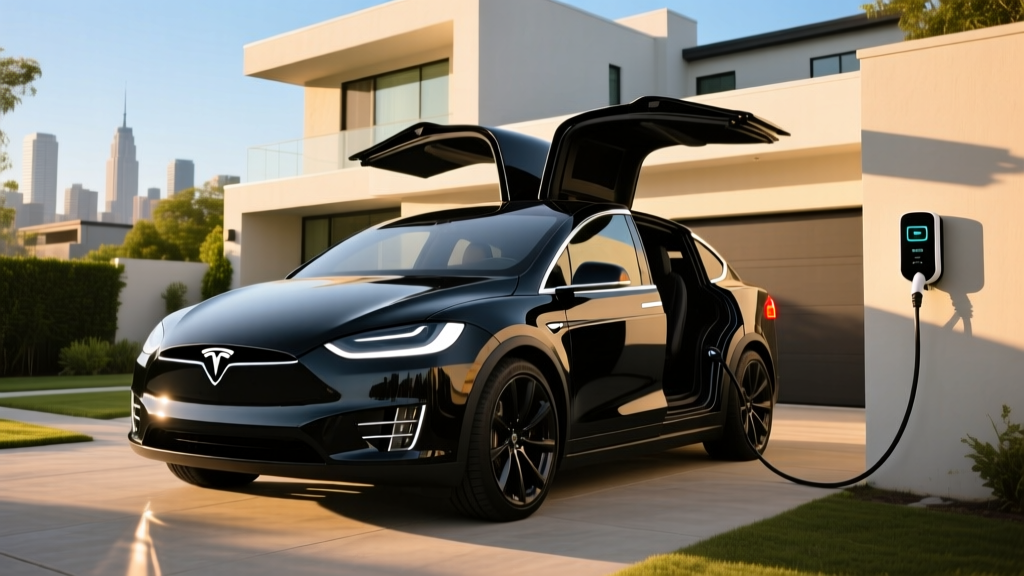
The 2015 Tesla Model X was the first electric SUV to prove that a three-row family hauler could ditch gasoline without sacrificing performance. Launched in late 2015 as a 2016 model-year vehicle, it introduced the world to Falcon Wing rear doors, a panoramic windshield, and dual-motor all-wheel drive in a package that could hit 60 mph in under four seconds. Now, over a decade later, early Model X examples have flooded the used-EV market at tempting prices. But buying a decade-old luxury EV requires clear eyes on battery health, charging speeds, and ownership costs.
This review dissects the original 2015 Tesla Model X — the 90D and P90D variants — with 2026 ownership realities: degraded batteries, expired warranties, Supercharger network changes, and the used-EV federal tax credit. If you are cross-shopping a used Model X against a newer Hyundai Ioniq 5 or Ford Mustang Mach-E, this is the data you need.
2015 Tesla Model X Specifications at a Glance
| Spec | 90D | P90D (Ludicrous) |
|---|---|---|
| EPA Range (original) | 250 miles | 250 miles |
| Battery Capacity | 90 kWh (usable ~85 kWh) | 90 kWh (usable ~85 kWh) |
| Battery Chemistry | NMC (Nickel Manganese Cobalt) | NMC |
| Drivetrain | Dual-Motor AWD | Dual-Motor AWD |
| Horsepower | ~417 hp combined | ~532 hp (Ludicrous mode) |
| 0–60 mph | 4.8 seconds | 3.2 seconds |
| Max DC Fast Charge | ~120 kW (Supercharger V2) | ~120 kW (Supercharger V2) |
| Level 2 Charge Rate | ~11.5 kW (48A) | ~11.5 kW (48A) |
| Efficiency | 92 MPGe / 36 kWh/100mi | 89 MPGe / 38 kWh/100mi |
| Cargo (behind 3rd row) | 21.8 cu ft | 21.8 cu ft |
| Cargo (max, seats folded) | 88.1 cu ft | 88.1 cu ft |
| Seating | 5, 6, or 7 passengers | 5, 6, or 7 passengers |
| Original MSRP | ~$80,000 | ~$132,000 |
| 2026 Used Price (est.) | $18,000–$28,000 | $22,000–$35,000 |
Real-World Range: What the EPA Sticker Doesn't Tell You
Highway driving at 75 mph typically nets 85–90% of EPA range: ~160–190 miles from a degraded pack.
Cold-weather impact (below 32°F): Expect an additional 20–30% range reduction due to cabin heating and increased battery resistance. A 200-mile degraded pack could drop to 140–155 miles in freezing highway conditions.
The 90 kWh NMC pack in the 2015 Model X was one of Tesla's largest at the time, but NMC chemistry is more susceptible to calendar degradation than the LFP batteries Tesla uses in current base models. Owners who habitually charged to 100% and let the car sit in hot climates will see the high end of that degradation range. Before buying, request a battery health report via the Tesla app or a third-party diagnostic tool like Tesla's built-in State of Health readout.
According to fueleconomy.gov, the original 2016 Model X 90D achieved 92 MPGe combined. That efficiency figure remains valid for the vehicle, but degraded battery capacity means fewer total miles per charge, not worse efficiency per mile driven.
Charging Speeds: Supercharger and Home Level 2
The 2015 Model X predates Tesla's V3 and V4 Supercharger architecture. It charges at a peak of roughly 120 kW on V2 Superchargers — respectable for its era but noticeably slower than modern EVs pulling 250+ kW.
| Charging Level | Power | Speed (Miles Added) | Notes |
|---|---|---|---|
| Level 1 (120V outlet) | ~1.4 kW | ~3–4 miles/hour | Emergency/trickle only |
| Level 2 (240V, 48A) | ~11.5 kW | ~29 miles/hour | Full charge in ~8–9 hours |
| DC Fast (Supercharger V2) | Peak ~120 kW | ~170 miles in 30 min | 10–80% in ~40 minutes |
| DC Fast (CCS adapter) | Peak ~120 kW | Similar to V2 SC | Requires Tesla CCS adapter |
The charge curve on the 90 kWh pack tapers noticeably above 60% State of Charge. You will see peak speeds of ~120 kW only between roughly 10–40% SoC; by 80%, the rate drops to under 40 kW. This means a 10–80% session takes approximately 40 minutes — plan road-trip stops accordingly.
For home charging, the 2015 Model X supports up to 48 amps on a Level 2 circuit, requiring a 60-amp dedicated breaker. At 11.5 kW, a fully depleted pack replenishes in about 8 to 9 hours. This is adequate for overnight charging but slower than the 19.2 kW capability in newer EVs. Note: Tesla switched from its proprietary connector to NACS for newer vehicles, but the 2015 Model X uses the original Tesla connector, which is now the basis for the NACS standard. Non-Tesla Superchargers opening to other brands use CCS1, so you will need Tesla's CCS adapter for Electrify America or EVgo stations.
Performance, Drivetrain, and Driving Dynamics
The dual-motor all-wheel-drive system in the 2015 Model X was a benchmark for electric SUVs. The 90D delivers 417 combined horsepower and a 4.8-second 0–60 mph time — still quick by any measure. The P90D with Ludicrous mode drops that to 3.2 seconds, making it one of the fastest SUVs ever built at the time.
Driving dynamics are a mixed bag. The Model X is heavy — over 5,000 pounds — and that mass is noticeable in corners. The air suspension provides a comfortable ride on highways but can be firm over sharp bumps. Steering is precise but numb compared to a BMW X5 or Porsche Cayenne. Where the Model X excels is straight-line acceleration, low center of gravity from the floor-mounted battery, and the instant torque that makes merging and passing effortless.
The regenerative braking system is strong enough for one-pedal driving in most conditions, though it lacks the adjustable regen levels found in Hyundai and Kia EVs. Lift off the accelerator, and the car decelerates firmly — you will rarely need the friction brakes in city driving.
Falcon Wing Doors, Interior, and Cargo Practicality
The defining feature of the first-generation Model X remains its Falcon Wing rear doors. These double-hinged gullwing doors open upward and outward, with ultrasonic sensors to detect overhead and lateral obstacles. In theory, they make loading children into car seats easier in tight parking spots. In practice, early examples were plagued by sensor errors, slow open/close times (6–8 seconds), and water leaks around the seals.
Interior quality was a common criticism of the 2015 Model X. Panel gaps, creaking trim, and a minimalist dashboard dominated by a 17-inch touchscreen drew comparisons to a $30,000 car wearing a $100,000 price tag. The 17-inch portrait screen controlled virtually every vehicle function — HVAC, media, navigation, suspension height — with no physical backup buttons. This was innovative but polarizing, and the hardware (MCU1) is now sluggish by 2026 standards. Some owners have paid for the MCU2 upgrade ($1,500–$2,500) for faster response and updated software support.
Cargo space is generous: 21.8 cubic feet behind the third row and 88.1 cubic feet with both rear rows folded. The front trunk (frunk) adds approximately 6.0 cubic feet. Legroom measures 41.2 inches up front, 36.9 inches in the second row, and a tight 32.7 inches in the third row — best suited for children on short trips.
Tech, Autopilot, and Driver Assistance
Tesla Autopilot and Enhanced Autopilot in the 2015 Model X are SAE Level 2 driver-assistance systems. The driver must remain fully engaged, hands on the wheel, and eyes on the road at all times. This is not self-driving. Full Self-Driving (FSD) capability was not available on 2015 hardware — vehicles with HW1 (first-generation Autopilot hardware) cannot run modern FSD software.
The 2015 Model X shipped with Hardware 1 (HW1) Autopilot, which provides basic adaptive cruise control and lane-keeping. This system is functional but rudimentary compared to Tesla's current HW4 suite. Crucially, HW1 vehicles cannot receive over-the-air upgrades to Enhanced Autopilot or FSD. If advanced driver assists matter to you, verify whether the vehicle has been retrofitted with HW2.5 or later (a costly and uncommon procedure).
The infotainment system supports Bluetooth audio and USB media but lacks Apple CarPlay and Android Auto — a notable omission even in 2015. Navigation uses Tesla's built-in maps with real-time traffic. Over-the-air updates continue for safety-critical functions, but feature additions for HW1 vehicles have largely ceased.
Used Pricing, Tax Credits, and Ownership Costs
As of early 2026, a 2015 Tesla Model X 90D with 80,000–120,000 miles typically lists between $18,000 and $28,000 depending on condition, battery health, and options. The P90D commands $22,000 to $35,000. These prices represent a steep depreciation from original MSRPs of $80,000–$132,000.
| Cost Factor | 90D (est.) | P90D (est.) |
|---|---|---|
| Used Market Price | $18,000–$28,000 | $22,000–$35,000 |
| Federal Used EV Credit (§25E) | Up to $4,000 | Up to $4,000 |
| Estimated Price After Credit | $14,000–$24,000 | $18,000–$31,000 |
| Annual Insurance (avg.) | $2,200–$3,000 | $2,500–$3,500 |
| Annual Electricity (12k mi) | ~$650–$900 | ~$680–$950 |
The IRS §25E used clean vehicle credit offers up to $4,000 (or 30% of the sale price, whichever is lower) for qualifying used EVs. To qualify, the vehicle must be purchased from a licensed dealer for $25,000 or less, and the buyer must meet income caps ($75,000 single / $150,000 joint filers). The Model X 90D often falls within the $25,000 price cap; the P90D may exceed it, disqualifying the credit. Always confirm eligibility with your tax professional, as IRS rules are subject to change.
Note: The new-vehicle §30D credit of up to $7,500 does not apply to used purchases. The §25E used credit is the relevant incentive here.
Battery Warranty, Degradation, and Replacement Costs
Tesla's original battery and drive unit warranty for the 2015 Model X was 8 years or 150,000 miles (whichever came first), with a minimum 70% capacity retention guarantee. As of 2026, every 2015 Model X has exceeded the 8-year time limit. Only examples under 150,000 miles might still carry residual warranty coverage — and even then, only if Tesla has not voided it due to salvage title, unauthorized modifications, or improper charging practices.
If the battery falls below 70% State of Health while still within warranty, Tesla will repair or replace it. Out of warranty, a 90 kWh battery replacement runs approximately $14,000 to $20,000 including labor, based on current Tesla service center pricing. Third-party EV battery shops may offer refurbished packs for $10,000–$14,000.
To maximize remaining battery life, follow NMC best practices: charge to 80–90% for daily use, avoid prolonged storage above 90% or below 20%, and use DC fast charging sparingly (it accelerates degradation modestly). Preconditioning the battery before Supercharger sessions — automatic when navigating to a Supercharger — improves charge speed and reduces stress on the cells.
Biggest Pros and Cons
- Standard dual-motor AWD with excellent traction
- Spacious three-row cabin with 88 cu ft max cargo
- Access to Tesla Supercharger network (with adapter for CCS)
- Strong straight-line performance (3.2s 0–60 in P90D)
- Over-the-air software updates for safety features
- Frunk adds practical front cargo space
- Battery degradation reduces range to 188–213 mi
- Falcon Wing doors prone to leaks and sensor issues
- HW1 Autopilot cannot upgrade to modern FSD
- Interior build quality below luxury-SUV expectations
- No Apple CarPlay or Android Auto
- Expensive out-of-warranty battery replacement ($14K–$20K)
- Insurance premiums above EV average
Who Should Buy the 2015 Tesla Model X?
Not ideal for: High-mileage commuters needing 250+ reliable miles daily, buyers who prioritize cutting-edge driver-assist tech, or those without access to home charging (public charging at this range is inconvenient).
Key competitors to cross-shop: Used 2018–2020 Jaguar I-PACE (better interior, shorter range), 2019–2021 Audi e-tron (more refined, slower charging), or a newer two-row EV like the 2023 Hyundai Ioniq 5 if third-row seating is negotiable.
Frequently Asked Questions
What is the real-world range of a 2015 Tesla Model X in 2026?
With a 10-year-old NMC battery, expect 188–213 miles on a full charge under ideal conditions. Highway driving at 75 mph reduces that to roughly 160–190 miles. In freezing temperatures, plan for as little as 140–155 miles. Always check the specific vehicle's battery State of Health before purchasing.
How fast does the 2015 Model X charge at home and on road trips?
At home on a 240V Level 2 charger (48A), the Model X adds approximately 29 miles per hour, fully charging in 8–9 hours. On Tesla V2 Superchargers, it peaks at ~120 kW, achieving a 10–80% charge in roughly 40 minutes. The charge curve tapers significantly above 60% SoC.
Does the 2015 Model X qualify for any federal tax credit?
It may qualify for the IRS §25E used EV credit of up to $4,000, provided the dealer sale price is $25,000 or less and the buyer's income is under $75,000 (single) or $150,000 (joint). The new-vehicle §30D credit does not apply to used purchases. Confirm eligibility with a tax professional.
Is the 2015 Model X worth buying versus newer used EVs?
If you need three rows of seating, Supercharger access, and can accept the maintenance risk of Falcon Wing doors and an aging battery, the Model X offers strong value at $18,000–$28,000. However, a 2019+ Audi e-tron or Jaguar I-PACE will offer better interior quality and more predictable reliability. If you only need two rows, a newer Ioniq 5 or Mach-E provides better range, faster charging, and remaining factory warranty.
Can the 2015 Model X use non-Tesla Superchargers?
Yes, with Tesla's CCS Combo 1 adapter (sold separately for ~$250). The 2015 Model X uses Tesla's proprietary connector, which is now the NACS standard, but most non-Tesla DC fast chargers use CCS1. The adapter enables access to Electrify America, EVgo, and other CCS networks.
What should I inspect before buying a used 2015 Model X?
Prioritize: battery State of Health (request a Tesla diagnostic report), Falcon Wing door seal condition and sensor function, air suspension operation (listen for compressor noise), MCU version (HW1 vs upgraded HW2.5), and service history for drive unit or battery replacements. A pre-purchase inspection at a Tesla Service Center costs roughly $200–$300 and is strongly recommended.