The 2015 Tesla Model S remains one of the most consequential electric vehicles ever built — the car that proved a luxury sedan could run on electrons alone and out-accelerate most gas rivals. But nearly a decade into its life cycle, the cabin design, software, and battery performance tell a very different story than the sticker price once did. This review dissects the 2015 Tesla Model S interior, pairs it with the real-world range and charging data used-EV buyers need, and weighs whether this pioneer still earns a spot in your garage in 2026.
Quick Verdict: The 2015 Model S in Today's Used EV Market
If you're shopping a used 2015 Model S, you're likely looking at prices between $14,000 and $28,000 depending on mileage, battery health, and trim. The cabin still feels spacious and futuristic by sedan standards, but material quality and infotainment hardware show their age against a 2026 Hyundai Ioniq 6 or Tesla's own refreshed Model S. The real question isn't whether the interior holds up — it's whether the 85 kWh battery pack still delivers usable range and whether the used-EV federal tax credit applies to your purchase.
EPA sticker: 265 miles (85 kWh RWD), 234 miles (85 kWh AWD/P85D)
Real-world expectation in 2026: 190–230 miles highway at 70 mph; 160–190 miles in cold weather (below 32°F). Battery degradation of 10–18% over 11 years is typical for NMC packs of this era, so plan around 210–225 usable miles on a full charge in moderate conditions.
2015 Tesla Model S Interior: Design, Space, and Tech
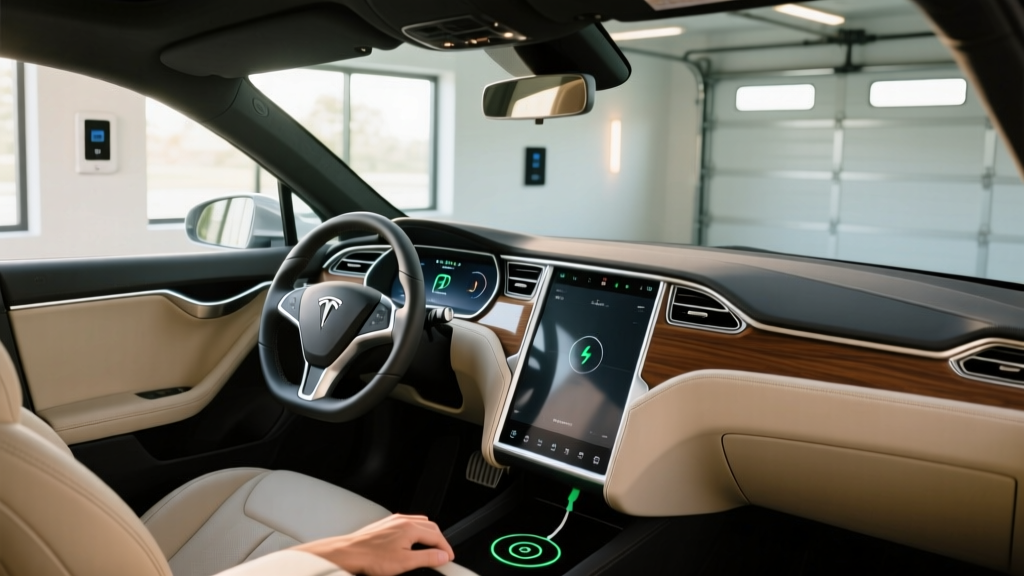
The 2015 Model S interior centers on a 17-inch portrait touchscreen that controls nearly every vehicle function — climate, media, navigation, suspension height, and regenerative braking settings. In 2015, this was revolutionary. In 2026, the screen resolution and processor speed feel dated compared to the Ryzen-powered MCUs in newer Teslas, and the absence of a dedicated instrument cluster beyond a small digital driver display is a reminder of how far EV cabins have come.
Cabin Dimensions and Cargo
The Model S rides on a 116.5-inch wheelbase and offers generous interior volume for a full-size luxury sedan:
- Front headroom: 38.8 inches
- Front legroom: 42.7 inches
- Rear headroom: 35.3 inches
- Rear legroom: 35.4 inches
- Cargo volume (rear hatch): 26.3 cu ft
- Frunk (front trunk): 5.3 cu ft
- Total cargo: 31.6 cu ft — more than many midsize SUVs
The rear hatch design makes loading bulky items easy, and the flat floor (no transmission tunnel) gives the middle rear passenger usable foot space. The optional rear-facing third-row seat (for small children) was available on 2015 models, adding a 5+2 seating configuration that no competitor matched at the time.
Material Quality and Build
The 2015 interior uses synthetic leather (Tesla called it "Ultra White" or black), genuine wood or carbon fiber trim, and soft-touch plastics on the dash upper. Door panels and lower trim use harder plastics that haven't aged as gracefully. Some owners report seat bolsters wearing smooth after 80,000+ miles, and the headliner material can sag in high-mileage examples. Build quality varied — panel gaps and minor rattles were common complaints on 2013–2015 Model S vehicles.
Infotainment and Software
The 2015 Model S originally shipped with MCU1 (NVIDIA Tegra 3). Most surviving examples have been upgraded to MCU2 (Intel Atom E3950) via Tesla's retrofit program, which enables modern features like Netflix/YouTube streaming, Sentry Mode dashcam, and faster map rendering. If the car you're evaluating still has MCU1, budget roughly $2,000–$2,500 for the MCU2 upgrade to keep the software experience functional in 2026.
Autopilot hardware on 2015 models is HW1 (Mobileye EyeQ3), which supports basic adaptive cruise control and lane-keeping. This system does not support Tesla's current FSD (Supervised) software — it's limited to what Tesla calls "Basic Autopilot." This is an SAE Level 2 driver-assistance system requiring full driver engagement at all times.
2015 Model S Autopilot (HW1) provides adaptive cruise and lane-centering assist. The driver must remain fully attentive, keep hands on the wheel, and be prepared to take over instantly. This is not self-driving capability.
Battery, Range, and Efficiency Data
The 2015 Model S was offered with three battery configurations:
| Trim | Battery (usable kWh) | Chemistry | EPA Range | MPGe (combined) | kWh/100 mi |
|---|---|---|---|---|---|
| Model S 70 | ~67 kWh | NMC | 240 mi | 101 MPGe | 33 |
| Model S 85 | ~81 kWh | NMC | 265 mi | 95 MPGe | 35 |
| Model S P85D | ~81 kWh | NMC | 253 mi | 93 MPGe | 36 |
All 2015 packs use NMC (nickel manganese cobalt) lithium-ion chemistry. NMC offers higher energy density than LFP but is more sensitive to sustained high SoC and extreme temperatures. Expect 10–18% capacity loss after 11 years and 100,000+ miles, based on aggregated owner data from Tesla forums and fueleconomy.gov.
Efficiency of 33–36 kWh/100 miles is competitive even by 2026 standards for a full-size luxury sedan. The Model S's low drag coefficient (0.24 Cd) and large battery remain advantages on highway road trips.
Charging Speed: DC Fast, Level 2, and Level 1
The 2015 Model S uses Tesla's proprietary connector (now called NACS). With the industry-wide adoption of NACS as the North American standard, this car can charge at any Tesla Supercharger and, with adapters, at most CCS-equipped public stations.
| Charging Level | Max Power (kW) | Miles Added per Hour | 10–80% Time |
|---|---|---|---|
| Level 1 (120V, 12A) | ~1.4 kW | ~3–4 mi/hr | N/A (days) |
| Level 2 (240V, 40A single charger) | ~10 kW | ~28–30 mi/hr | ~7–8 hours |
| Level 2 (240V, dual charger option) | ~20 kW | ~58–60 mi/hr | ~3.5–4 hours |
| DC Fast (Tesla Supercharger V2) | ~120 kW peak | ~300+ mi/hr (peak) | ~40–45 min |
| DC Fast (Supercharger V3/V4) | ~120 kW (car-limited) | ~300+ mi/hr (peak) | ~40–45 min |
Charging curve reality: The 2015 Model S peaks near 120 kW only below 30% SoC. Above 50%, the rate tapers significantly — you'll see 60–80 kW in the mid-range and as low as 20–30 kW above 85%. Plan road-trip stops around the 10–80% window; charging from 80–100% at a Supercharger can add 25+ minutes for only ~40 miles of range.
Home charging note: Most 2015 Model S vehicles have a single onboard charger (10 kW). The dual-charger option (20 kW) was a $3,600 upgrade when new and is relatively rare. A standard 240V/48A home wall connector will deliver the full 10 kW, adding roughly 28 miles per hour of charging — enough to replenish a full day's driving overnight.
Performance: 0–60, Horsepower, and Drivetrain
| Trim | Drivetrain | Horsepower | 0–60 mph | Top Speed |
|---|---|---|---|---|
| Model S 70 | RWD (single motor) | 315 hp | 5.2 sec | 140 mph |
| Model S 85 | RWD (single motor) | 362 hp | 5.4 sec | 130 mph |
| Model S 85D | AWD (dual motor) | 383 hp | 4.8 sec | 155 mph |
| Model S P85D | AWD (dual motor, Performance rear) | 691 hp (combined) | 3.2 sec | 155 mph |
The P85D's "Ludicrous Mode" (introduced mid-2015 as an option, standard on later P85D builds) was the first production sedan to hit 60 mph in the low 3-second range. Even without Ludicrous, the P85D's instant torque delivery and dual-motor AWD traction make it remarkably quick. The base 70 and 85 trims are more sedate but still out-accelerate most V6 luxury sedans from the era.
Used Pricing and Federal Tax Credit Eligibility
As of early 2026, used 2015 Tesla Model S pricing breaks down roughly as follows:
| Trim / Condition | Typical Used Price | §30D Used-EV Credit Eligible? | Price After Max Credit |
|---|---|---|---|
| Model S 70 (80k–120k mi) | $14,000–$18,000 | Yes, if dealer-qualified & income caps met | As low as ~$10,000 |
| Model S 85 (60k–90k mi) | $18,000–$23,000 | Yes, if dealer-qualified & income caps met | As low as ~$14,000 |
| Model S P85D (50k–80k mi) | $22,000–$28,000 | Yes, if dealer-qualified & income caps met | As low as ~$18,000 |
The IRS §30D used-EV credit offers up to $4,000 or 30% of the sale price (whichever is lower) for qualifying used electric vehicles. Key requirements for 2026:
- Sale price cap: $25,000 or less
- Buyer income cap: $75,000 single / $112,500 head of household / $150,000 joint filers (modified AGI)
- Vehicle age: Must be at least 2 model years old (2015 qualifies)
- Dealer requirement: Must be purchased from a licensed dealer who reports the sale to the IRS
- Battery capacity: At least 7 kWh (all 2015 Model S trims qualify)
- Point-of-sale transfer: Credit can be applied at purchase, reducing your out-of-pocket cost immediately
Critical note: The $25,000 sale price cap means higher-mileage Model S 70 and 85 examples are the most likely to qualify. P85D models priced above $25,000 do not qualify for the credit. Always verify current IRS rules at irs.gov before finalizing a purchase, as regulations may shift.
Warranty and Battery Longevity
The original 2015 Model S warranty coverage was:
- Battery & drive unit: 8 years / unlimited miles (85 kWh) or 8 years / 125,000 miles (70 kWh)
- New vehicle limited warranty: 4 years / 50,000 miles
As of 2026, all 2015 Model S vehicles are past the 8-year battery warranty window. This means any battery replacement or drive-unit repair is an out-of-pocket expense. Tesla's current out-of-warranty battery replacement for a Model S 85 runs approximately $14,000–$18,000 including labor. Third-party EV battery rebuild shops offer refurbishment for $8,000–$12,000 in some markets.
What to check before buying: Request the car's battery State of Health (SoH) reading, accessible via the Tesla service menu or third-party tools like TeslaFi. A healthy 2015 85 kWh pack should show 82–90% SoH. Anything below 78% means noticeably reduced range and potential replacement risk within a few years.
Pros and Cons: The Honest Scorecard
Pros
- Class-leading cargo space (31.6 cu ft total) with hatchback versatility
- NACS connector — full access to Tesla Supercharger network without adapters
- Over-the-air software updates still adding features in 2026
- P85D acceleration (3.2 sec 0–60) remains thrilling
- Low 33–36 kWh/100 mi efficiency for its size
- Potential $4,000 used-EV tax credit lowers entry price
- Air suspension provides adjustable ride height and comfort
Cons
- Battery warranty expired — $14k+ replacement risk
- MCU1 hardware (if not upgraded) limits modern infotainment features
- HW1 Autopilot cannot run FSD (Supervised); limited to basic cruise + lane-keep
- DC fast charging peaks at ~120 kW — slower than modern 250+ kW EVs
- Real-world degraded range of ~200 miles may cause highway range anxiety
- Interior material quality below German luxury rivals of the same era
- No heat pump — resistive cabin heater reduces cold-weather range significantly
Who Should Buy the 2015 Model S?
Choose the 2015 Model S if:
- You want a spacious luxury EV sedan under $20,000 with Supercharger access
- Your daily commute is under 80 miles round-trip (leaving comfortable battery buffer)
- You value cargo versatility (rear hatch + frunk) for gear, groceries, or pets
- You qualify for the $4,000 used-EV credit, bringing effective price near $10,000–$14,000
- You accept the battery replacement risk and budget for it
Look elsewhere if:
- You need 300+ miles of reliable range for frequent road trips
- You want modern ADAS features (automatic emergency braking, blind-spot monitoring) — HW1 Autopilot lacks these
- You live in a very cold climate where the resistive heater will cut range by 25–35%
- You want the latest infotainment speed and screen resolution
Frequently Asked Questions
What is the real-world range of a 2015 Tesla Model S in 2026?
Expect 190–230 miles on the highway at 70 mph in moderate weather, and 160–190 miles in freezing temperatures. The original EPA rating of 265 miles (85 kWh) assumed a new battery; 10–18% degradation is typical at this age.
How fast does the 2015 Model S charge at home and on the road?
At home on a 240V Level 2 charger, the single-charger Model S adds about 28–30 miles per hour (10 kW). On a Tesla Supercharger, it peaks at ~120 kW below 30% SoC, reaching 10–80% in roughly 40–45 minutes. Charging above 80% tapers sharply.
Does the 2015 Tesla Model S qualify for the federal EV tax credit?
It can qualify for the §30D used-EV credit of up to $4,000, but only if the sale price is $25,000 or less, the buyer meets income caps ($75k single / $150k joint), and the purchase is through a licensed dealer who reports to the IRS. Private-party sales do not qualify.
Is the 2015 Model S worth buying vs. a newer used EV?
For the price ($14k–$28k), the 2015 Model S offers space, performance, and Supercharger access that's hard to match. However, a used 2020–2022 Tesla Model 3 Long Range (~$22k–$30k) offers similar range, faster charging (250 kW), HW3 Autopilot, and remaining battery warranty. If you need sedan space and cargo room, the Model S wins; if you want modern tech and warranty coverage, the Model 3 is the safer bet.
What are the biggest ownership costs to budget for?
Beyond the purchase price, budget for: potential battery replacement ($14k–$18k if SoH drops below 75%), MCU2 upgrade ($2k–$2.5k if not yet done), air suspension repair ($1,500–$2,500 per corner if struts fail), and higher-than-average insurance premiums for older luxury EVs.
Can the 2015 Model S use non-Tesla chargers?
Yes. With a NACS-to-CCS adapter (sold by Tesla and third parties), the 2015 Model S can charge at Electrify America, EVgo, and other CCS-equipped networks. However, charging speed is still limited by the car's ~120 kW DC fast-charge ceiling.