The 2015 Tesla Model S was a watershed vehicle — the first long-range luxury EV to prove that battery-electric drivetrains could compete with German sedans on performance, space, and daily usability. More than a decade later, used examples are flooding the secondary market at tempting prices. But before you buy, you need an honest assessment of what this car offers today: its cabin materials, its aging tech, its real-world range and charging speeds, and the ownership economics in 2026.
This review covers the 2015 Model S in depth — interior quality, powertrain specs, charging capability, and whether it still makes sense as a used EV purchase against modern competitors.
2015 Tesla Model S Interior: Materials, Layout, and Tech
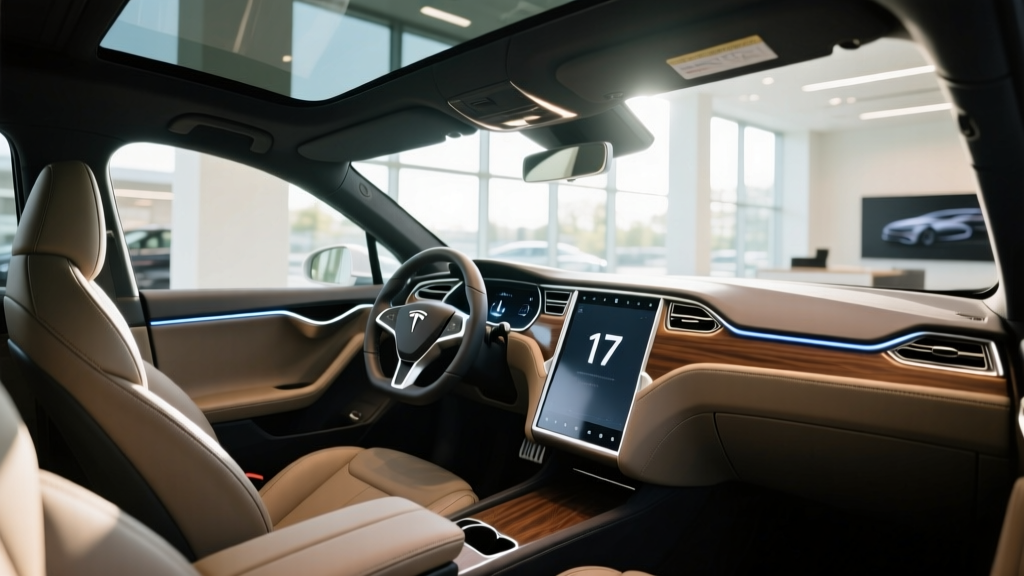
The 2015 Model S interior was defined by one dominant feature: a 17-inch portrait-oriented touchscreen that replaced nearly all physical controls. In 2015, this was revolutionary. In 2026, it still looks dramatic, but the hardware behind it matters enormously.
MCU1 vs. MCU2: Early 2015 Model S vehicles shipped with the first-generation Media Control Unit (MCU1), powered by an NVIDIA Tegra 3 processor. This unit is noticeably slow by modern standards — map rendering lags, app switching is sluggish, and it does not support Tesla's modern infotainment features like Netflix, YouTube, or the Sentry Mode dashcam viewer. Tesla offered an MCU2 upgrade (Intel Atom-based) for roughly $2,000–$2,500, and some used examples will have had this performed. Always confirm which MCU is installed before purchasing.
Materials and build quality: The 2015 Model S offered two interior tiers. Base models featured synthetic leather (Tesla called it "Ultra White" or black) with a soft-touch dashboard. The optional "Next Gen" seats (introduced mid-2015) added improved bolstering and available Nappa leather. Fit and finish on 2015 cars is inconsistent — panel gaps on the dashboard and door cards vary, and some owners report rattles developing over time, particularly in the rear parcel shelf and center console area.
Instrument cluster: Unlike modern Teslas, the 2015 Model S retains a dedicated 12.3-inch digital instrument cluster behind the steering wheel, showing speed, range, navigation directions, and media info. Many owners prefer this to the Model 3/Y's everything-on-one-screen approach.
Steering wheel and controls: The 2015 wheel has physical scroll wheels and buttons — a contrast to the haptic controls on refreshed models. It's conventional and functional.
Range, Battery, and Efficiency by Trim
The 2015 Model S was offered in three main battery configurations. Here's the full breakdown:
| Trim | Battery (kWh usable) | Chemistry | EPA Range | Efficiency (kWh/100mi) | Drivetrain |
|---|---|---|---|---|---|
| Model S 70D | ~67 kWh | NMC (NCA cathode variant) | 240 mi | 32 | AWD (Dual Motor) |
| Model S 85 | ~81 kWh | NMC/NCA | 265 mi | 35 | RWD |
| Model S P85D | ~81 kWh | NMC/NCA | 253 mi | 36 | AWD (Dual Motor) |
EPA estimates assume mixed driving at moderate temperatures. For a 2015 Model S in 2026, expect the following:
- Highway (70 mph, 75°F): ~200–220 mi for the 85 kWh model; ~180–195 mi for the 70D
- Cold weather (30°F, highway): ~150–175 mi — a 25–35% reduction is normal for NMC chemistry without a heat pump (the 2015 Model S uses resistive cabin heating)
- Battery degradation: Most 2015 examples have 100,000–180,000 miles. Expect 10–18% capacity loss depending on charging history. A car that was new at 265 mi EPA may now deliver 215–240 mi when new-equivalent, before weather adjustments.
Always request a battery health report or use third-party tools like TeslaFi or Scan My Tesla (via OBD-II adapter) to check State of Health (SoH) before purchase.
The 2015 Model S does not have a heat pump — it relies on a resistive PTC heater for cabin warmth and battery preconditioning. This means cold-weather range loss is more pronounced than on 2021+ Teslas with heat-pump thermal management. Budget an extra 25–30% range reduction in freezing conditions versus the EPA sticker.
Charging Speeds: DC Fast Charge and Home Level 2
Charging capability is one area where the 2015 Model S shows its age most clearly. Here's what to expect:
| Charging Level | Max Power (kW) | Rate / Time | Connector |
|---|---|---|---|
| Level 1 (120V household) | ~1.4 kW | ~3–4 mi/hr | J1772 adapter (included) |
| Level 2 (240V home/public) | 10 kW (single charger) or 20 kW (twin chargers option) | ~29 mi/hr (10 kW) or ~58 mi/hr (20 kW) | Tesla connector / J1772 adapter |
| DC Fast Charge (Supercharger) | ~120–140 kW peak | 10–80% in ~40–50 minutes | Tesla proprietary (NACS) |
| CHAdeMO DC Fast (with adapter) | ~50 kW | 10–80% in ~90 minutes | CHAdeMO (adapter ~$400) |
Key charging notes for 2026 buyers:
- The 2015 Model S uses Tesla's proprietary connector (now called NACS). It charges natively at Tesla Superchargers, which remain the most reliable DC fast-charging network in the U.S. per Tesla's Supercharger network page.
- For non-Tesla public chargers (Electrify America, EVgo, ChargePoint CCS stalls), you'll need a CCS-to-NACS adapter. Tesla began selling these for older vehicles, but compatibility with the 2015 Model S's older charge-port firmware can be inconsistent. Verify adapter support with Tesla before relying on CCS networks.
- The DC fast-charging curve peaks around 120–140 kW at low state of charge (10–25%) and tapers significantly above 60%. The 10–80% time of 40–50 minutes is considerably slower than modern 800V architectures (Hyundai Ioniq 5, Porsche Taycan) that achieve 10–80% in 18 minutes.
- The optional "Twin Chargers" configuration (20 kW Level 2) was a $3,500 option new and is valuable for home charging — it cuts overnight charge time in half. Confirm whether a used example has single or twin chargers.
Performance: 0–60, Horsepower, and Drivetrain
| Trim | 0–60 mph | Horsepower | Torque (lb-ft) | Drivetrain | Top Speed |
|---|---|---|---|---|---|
| Model S 70D | 5.2 sec | 328 hp (combined) | 325 | AWD (Dual Motor) | 140 mph |
| Model S 85 | 5.4 sec | 362 hp | 325 | RWD | 130 mph |
| Model S P85D | 3.2 sec (Insane Mode) | 691 hp (combined) | 687 | AWD (Dual Motor) | 155 mph |
The P85D's 3.2-second 0–60 time was extraordinary in 2015 and remains quick by any standard. However, Tesla has since surpassed it with the Plaid models (1.99 sec), and competitors like the Porsche Taycan Turbo S (2.4 sec) and Lucid Air Sapphire (1.89 sec) have moved the goalposts.
The 70D and 85 are more relevant for most used buyers. Both deliver smooth, linear acceleration with instant torque — the hallmark EV experience. The dual-motor AWD system on the 70D and P85D provides confident traction in rain and light snow, though the car's 4,600–4,900 lb curb weight is noticeable in tight corners.
Interior Space, Cargo, and Practicality
The 2015 Model S is a full-size liftback sedan, and its packaging remains one of its strongest selling points:
- Rear cargo (seats up): 26.3 cu ft
- Rear cargo (seats folded): 58.1 cu ft
- Front trunk (frunk): 5.3 cu ft — useful for groceries or a charging cable bag
- Total cargo volume: 63.4 cu ft — more than most midsize SUVs
- Rear legroom: 35.4 inches
- Front legroom: 42.7 inches
- Seating: 5 passengers standard; optional rear-facing third-row jump seats (2 small children) were available, bringing total capacity to 7. These are rarely equipped and not recommended for anything beyond short, low-speed trips due to minimal crash protection in the rear hatch area.
The liftback hatch is enormously practical — it opens wide, and the load floor is flat with seats folded. This is genuinely usable cargo space, not a shallow sedan trunk.
Pricing, Tax Credits, and Used-EV Economics in 2026
The 2015 Model S is no longer eligible for the new-vehicle federal tax credit under IRS §30D rules, which apply only to new vehicles. However, buyers may qualify for the Used Clean Vehicle Credit (IRS §25E), which offers up to $4,000 or 30% of the sale price (whichever is less) for qualifying pre-owned EVs.
| Item | Details |
|---|---|
| Used market price range (2026) | $14,000–$28,000 depending on trim, mileage, condition, and battery health |
| §25E Used EV Credit (max) | $4,000 or 30% of sale price, whichever is lower |
| §25E income caps | $75,000 single / $112,500 head of household / $150,000 joint (MAGI) |
| §25E vehicle price cap | $25,000 sale price or less |
| §25E dealer requirement | Must purchase from a licensed dealer (private-party sales excluded) |
| §25E prior-claim rule | The specific VIN must not have been claimed for the used-EV credit previously |
Practical example: A 2015 Model S 85 with 120,000 miles selling at a dealer for $22,000 would qualify for $4,000 (30% of $22,000 = $6,600, but capped at $4,000). Net cost: $18,000. A buyer earning $160,000 jointly would not qualify due to the income cap.
Important caveats: The §25E credit is non-refundable — you must have sufficient federal tax liability to claim it. It can be transferred to the dealer at point of sale as an instant discount (new for 2024+). Always confirm eligibility with a tax professional and verify the VIN hasn't been previously claimed via the IRS portal. Rules referenced here reflect current IRS §25E guidance and are subject to legislative change.
Driver Assistance and Safety Tech
The 2015 Model S was available with Tesla's first-generation Autopilot hardware (Hardware Suite 1, or HW1), introduced in late 2014 and standard on most 2015 production. This system includes:
- Single forward-facing camera (Mobileye EyeQ3-based)
- 12 ultrasonic sensors
- Forward radar
- Traffic-Aware Cruise Control and Autosteer (lane centering)
Tesla Autopilot on the 2015 Model S is an SAE Level 2 driver-assistance system. It provides combined longitudinal (speed) and lateral (steering) support, but the driver must remain fully engaged — hands on or near the wheel, eyes on the road. It is not autonomous or "self-driving." HW1 does not support Tesla's current Full Self-Driving (Supervised) software; that requires HW3 or later, which most 2015 vehicles cannot be upgraded to.
- Autosteer is limited to 45 mph on non-divided roads (raised to higher speeds only on divided highways with a center barrier)
- No stop-light or stop-sign recognition
- No automatic lane changes (must be manually initiated)
- Lane-keeping is less confident on faded markings or construction zones
- No Summon or Smart Summon functionality
Safety ratings: The 2015 Model S earned a 5-star overall rating from NHTSA and was an IIHS Top Safety Pick (though it did not earn Top Safety Pick+ due to headlight ratings and lack of front crash prevention testing at the time).
Warranty and Long-Term Ownership Considerations
| Coverage | Terms | Status in 2026 |
|---|---|---|
| Basic Vehicle | 4 years / 50,000 miles | Expired on all examples |
| Battery & Drive Unit | 8 years / unlimited miles (85 kWh); 8 years / 125,000 miles (70D) | Expired or expiring on most examples by end of 2023–2024 |
Battery replacement cost: Out of warranty, a refurbished 85 kWh battery pack from Tesla costs approximately $13,000–$18,000 installed (2026 pricing). Third-party EV repair shops offer rebuilt packs for $8,000–$12,000. This is the single biggest financial risk of buying a 2015 Model S.
Drive unit failures: The large rear drive unit on the 85 and P85D is known to develop bearing noise or complete failure between 80,000–150,000 miles. Replacement costs $4,000–$7,000 out of warranty. The smaller front drive unit on dual-motor cars is less failure-prone but not immune.
Air suspension: The optional air suspension (standard on most P85Ds, optional on 85) is a maintenance item. Air struts typically require replacement at 80,000–120,000 miles at $1,500–$2,500 per corner. Many owners convert to aftermarket coil springs (e.g., Unplugged Performance or EV-Sport) for $3,000–$4,000 as a permanent fix.
MCU1 failure: The original Tegra 3 MCU is prone to eMMC memory chip failure, which can cause a black screen and loss of all vehicle controls (HVAC, glovebox, charging settings). Tesla offered a free recall repair for certain VINs, but many have already been addressed. Budget $1,500–$2,500 for an MCU2 upgrade if still on HW1.
Pros, Cons, and Verdict
Pros
- Massive cargo capacity (63.4 cu ft total) with liftback practicality
- Supercharger network access — the most reliable DC fast-charging ecosystem
- Strong straight-line performance, especially P85D (3.2 sec 0–60)
- Ride quality and cabin quietness still competitive with luxury sedans
- Over-the-air updates still delivered (though limited on HW1)
- Used-EV tax credit (§25E) can reduce purchase price by up to $4,000
Cons
- DC fast charging peaks at ~120–140 kW — slow vs modern 250–350 kW vehicles
- No heat pump — significant cold-weather range loss (25–35%)
- MCU1 hardware is outdated; many infotainment features unavailable
- Battery and drive unit warranty expired; replacement is $8,000–$18,000
- Air suspension is a costly maintenance item
- HW1 Autopilot is rudimentary; no FSD upgrade path
- CCS adapter compatibility is inconsistent for non-Tesla chargers
Who Should Buy a 2015 Tesla Model S in 2026?
Choose the 2015 Model S if:
- You want a spacious luxury EV sedan for under $25,000 and primarily drive in moderate climates
- Your daily commute is under 100 miles round-trip, and you have home Level 2 charging
- You value Supercharger access for occasional road trips and accept 40–50 minute charge stops
- You're mechanically inclined or budget $3,000–$5,000 for first-year repairs (suspension, MCU, drive unit)
Look elsewhere if:
- You live in a cold climate and need reliable 250+ mile range year-round
- You want modern driver-assist features (FSD, automatic lane changes, stop-sign recognition)
- You need fast DC charging for frequent road trips (consider a 2022+ Ioniq 5 or Model 3 instead)
- You cannot absorb a potential $10,000–$18,000 battery replacement
Frequently Asked Questions
What is the real-world range of the 2015 Tesla Model S?
The EPA-rated range is 240 miles (70D), 265 miles (85 RWD), or 253 miles (P85D). In real-world highway driving at 70 mph, expect 200–220 miles from the 85 kWh model. In freezing weather, that drops to 150–175 miles due to resistive heating and battery chemistry limitations. Account for 10–18% degradation on a 10-year-old battery.
How fast does the 2015 Model S charge?
On a Tesla Supercharger, it peaks at roughly 120–140 kW, achieving a 10–80% charge in approximately 40–50 minutes. At home on a 240V Level 2 charger with the standard single onboard charger (10 kW), you'll add about 29 miles per hour — a full charge takes 8–10 hours. Twin-charger-equipped cars (20 kW) cut that in half.
Does the 2015 Tesla Model S qualify for any tax credit?
It does not qualify for the new-vehicle §30D credit. However, if you buy from a licensed dealer for $25,000 or less and your income falls under IRS caps ($75K single / $150K joint), you may claim the §25E Used Clean Vehicle Credit of up to $4,000. The VIN must not have been previously claimed under §25E.
Is the 2015 Model S worth buying vs competitors?
Against a used 2017–2019 Chevrolet Bolt EUV (~$15,000, 238 mi EPA, slower but cheaper to maintain) or a used 2018–2020 Tesla Model 3 Long Range (~$20,000, 310 mi EPA, HW3/FSD-capable, 250 kW charging), the 2015 Model S wins on cargo space and ride comfort but loses on charging speed, range, tech, and warranty risk. The Model 3 is the safer financial bet for most buyers. The Model S makes sense if you specifically need a large luxury sedan with hatchback utility at a low entry price.
What are the biggest ownership risks?
Battery replacement ($13,000–$18,000 out of warranty), drive unit failure ($4,000–$7,000), and air suspension overhaul ($6,000–$10,000 all four corners) are the major financial risks. Buy with a pre-purchase inspection from a Tesla-experienced independent shop, and budget a $5,000 contingency for first-year repairs.
Can the 2015 Model S use Tesla's Full Self-Driving software?
No. The 2015 Model S with HW1 Autopilot hardware cannot run FSD (Supervised). Tesla's FSD requires Hardware 3 (HW3) or later, and there is no official upgrade path from HW1 to HW3 for the 2015 Model S. You are limited to basic Autosteer and Traffic-Aware Cruise Control.