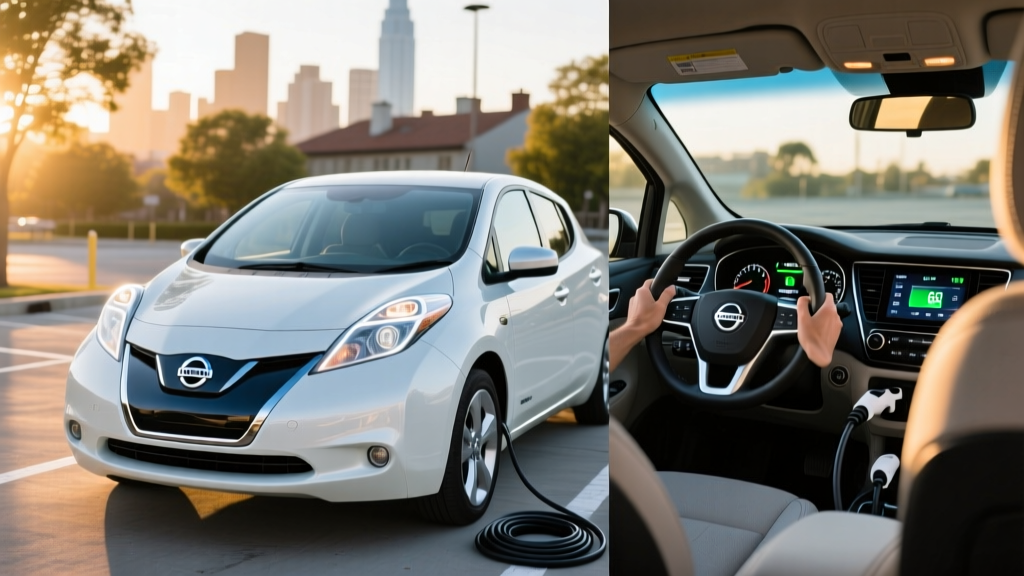
The 2015 Nissan Leaf holds a unique place in electric vehicle history. As one of the first mass-market EVs to reach American driveways in meaningful numbers, it proved that battery-electric commuting was viable for everyday drivers. Now, more than a decade later, thousands of these cars populate the used-EV market at bargain prices — often between $4,000 and $9,000 depending on mileage and battery condition. For budget-conscious shoppers exploring their first EV, the 2015 Leaf remains a practical commuter with important caveats around range, battery degradation, and charging infrastructure.
This review breaks down everything a used-EV buyer needs to know: real-world range expectations, charging speeds across all levels, battery health indicators, ownership costs, and how it compares to newer alternatives. Whether you're evaluating a Leaf on a dealer lot or a private-party listing, the data below will help you decide if this pioneering EV still earns a spot in your garage.
2015 Nissan Leaf Specifications at a Glance
| Specification | 2015 Nissan Leaf S | 2015 Nissan Leaf SV / SL |
|---|---|---|
| EPA Range | 84 miles | |
| Battery Capacity (Total / Usable) | 24 kWh total / ~21.3 kWh usable | |
| Battery Chemistry | NMC (Lithium Manganese Oxide cathode) | |
| Motor Output | 80 kW (107 hp), 187 lb-ft torque | |
| 0–60 mph | ~11.5 seconds | |
| Drivetrain | FWD, single-speed reduction gear | |
| EPA Efficiency (Combined) | 114 MPGe / 30 kWh per 100 mi | |
| DC Fast Charge (CHAdeMO) | 50 kW peak | |
| Level 2 Charge Rate | 6.6 kW (22 miles/hr) | |
| Level 1 Charge Rate (120V) | 1.4 kW (~5 miles/hr) | |
| Cargo Volume | 24.0 cu ft (rear seats up), 30.0 cu ft (folded) | |
| Seating | 5 passengers | |
| Original MSRP (2015) | $29,010 | $32,700 (SV) / $35,690 (SL) |
| Used Price Range (2026) | $4,000–$9,000 | |
| Federal Tax Credit (Used, §25E) | Up to $4,000 (30% of sale price, with income caps) | |
| Battery Warranty (Original) | 8 years / 100,000 miles (capacity loss below 9 bars) | |
Real-World Range: What the EPA Sticker Doesn't Tell You
The EPA rated the 2015 Nissan Leaf at 84 miles of combined range when new. That figure was based on a full battery and ideal conditions. In practice, real-world range varies significantly based on driving style, climate, and terrain.
Real-World Expectations:
- City commuting (mild weather): 75–85 miles — the Leaf excels in stop-and-go traffic where regenerative braking recovers energy.
- Highway driving (65–70 mph): 60–70 miles — higher speeds increase aerodynamic drag, which this boxy hatchback suffers from significantly.
- Cold weather (below 32°F): 50–65 miles — the Leaf lacks a heat pump and relies on resistive cabin heating, which can consume 20–35% of battery capacity in winter. The 2015 model year introduced an optional cold-weather package on SV/SL trims with heated seats and a heated steering wheel, which reduces HVAC load somewhat.
- Hot weather (above 95°F, AC running): 70–78 miles — less impactful than cold, but sustained AC use still draws meaningful energy.
For context, the average American commute is roughly 16 miles each way, according to U.S. Census data. A healthy 2015 Leaf can handle that round trip comfortably in most conditions. But drivers with longer commutes, frequent highway segments, or harsh winters should carefully evaluate whether this range envelope works for their daily routine.
Charging Speeds: CHAdeMO, Level 2, and the Infrastructure Shift
The 2015 Leaf uses the CHAdeMO DC fast-charging standard — a connector that was once widely available but has been largely superseded by CCS and, more recently, NACS (the Tesla Supercharger standard). This is a critical consideration for any used Leaf buyer in 2026.
| Charging Level | Power (kW) | Connector | Speed (mi/hr) | 0–80% Time | Notes |
|---|---|---|---|---|---|
| Level 1 (120V household) | 1.4 kW | J1772 | ~5 mi/hr | ~17 hours | Trickle charge; overnight top-up only |
| Level 2 (240V home) | 6.6 kW | J1772 | ~22 mi/hr | ~4 hours (0–100%) | Requires dedicated 240V circuit; 30A minimum recommended |
| DC Fast Charge | 50 kW peak | CHAdeMO | ~80–100 mi/hr (to 80%) | ~30 minutes (0–80%) | Rate tapers sharply above 80%; passive battery cooling limits repeated fast charges |
DC Fast Charging Reality
The 2015 Leaf's 50 kW CHAdeMO peak charge rate was competitive in 2015 but is slow by modern standards. Most current EVs accept 150–350 kW on DC fast chargers. At 50 kW, a depleted Leaf reaches 80% in roughly 30 minutes under ideal thermal conditions. However, the Leaf uses passive air cooling for its battery pack — no liquid thermal management. This means:
- Successive fast charges in hot weather cause "Rapidgate": Battery temperatures climb, and the car's software progressively throttles charge speeds to protect the cells. A second fast charge in the same day may peak at only 20–30 kW.
- Charge taper above 80%: Charging from 80–100% on DC can take as long as the 0–80% portion. Plan to unplug at 80% on road trips.
- CHAdeMO infrastructure is shrinking: Electrify America, EVgo, and ChargePoint have progressively retired CHAdeMO connectors in favor of CCS and NACS. Before buying, check your local charging networks on PlugShare to confirm CHAdeMO availability in your area.
Home Charging Setup
The 2015 Leaf's 6.6 kW onboard charger (standard on SV and SL trims; the base S trim originally shipped with a 3.3 kW charger, though many were upgraded) is well-suited to overnight home charging. A full Level 2 session adds roughly 22 miles of range per hour, replenishing the battery from empty in about 4 hours. For a typical commuter driving 35–40 miles daily, a nightly Level 2 session is more than adequate.
Home Level 2 installation typically requires a licensed electrician to run a dedicated 240V/30A circuit. Installation costs range from $500 to $2,000+ depending on panel capacity, run length, and local permit fees. The 2015 Leaf includes a portable Level 1 trickle-charge cord (120V), which can serve as a backup but is impractical as a primary charging solution.
Battery Health: The Single Most Important Factor
When evaluating a used 2015 Leaf, battery condition matters more than mileage, exterior wear, or trim level. The Leaf's 24 kWh NMC battery pack is now 11 years old, and every pack has experienced some degree of capacity loss. Nissan's original battery warranty guaranteed the pack would retain at least 9 out of 12 capacity bars (roughly 70% of original capacity) for 8 years or 100,000 miles. That warranty has now expired for most 2015 models.
How to Check Battery Health
The Leaf's dashboard displays a row of capacity bars on the far right of the instrument cluster. A new battery shows 12 bars. Each lost bar represents roughly 6–8% capacity reduction:
- 12 bars: Excellent — over 93% capacity retained. Uncommon but possible on low-mileage, garage-kept examples.
- 11 bars: Good — 85–93% capacity. Expect 70–78 miles real-world range.
- 10 bars: Fair — 78–85% capacity. Expect 60–70 miles.
- 9 bars or fewer: Significant degradation — below 78% capacity. Range drops to 55–65 miles or less in mixed driving. Budget for potential battery replacement.
For a more precise reading, use the free LeafSpy app with an OBD-II Bluetooth dongle. LeafSpy reports State of Health (SoH) as a percentage, individual cell voltages, battery temperature, and charge cycle count. A SoH reading above 80% is generally considered acceptable for daily commuting.
Battery Replacement Costs
If the battery has degraded beyond practical use, replacement options include:
- Nissan OEM replacement: $6,500–$9,000 installed (24 kWh pack). Some dealers offer refurbished packs at lower cost.
- Aftermarket/upgraded packs: Several specialist shops offer 40 kWh or even 62 kWh pack upgrades using cells from newer Leafs, extending range to 150+ miles. Costs range from $10,000 to $18,000.
- Used pack from a salvage vehicle: $2,000–$4,000, but condition is uncertain.
Given that a well-maintained 2015 Leaf costs $5,000–$8,000 on the used market, a $7,000+ battery replacement rarely makes economic sense unless the rest of the car is in exceptional condition.
Performance and Driving Experience
The 2015 Leaf's 80 kW (107 hp) AC synchronous motor delivers 187 lb-ft of torque to the front wheels through a single-speed reduction gear. The instant torque characteristic of electric motors makes the Leaf feel peppier than its 11.5-second 0–60 time suggests — around-town acceleration from 0–30 mph is brisk and responsive. However, power falls off noticeably above 50 mph, and highway merging requires planning.
The Leaf's ride quality is comfortable and compliant, tuned for urban comfort rather than sporty handling. Steering is light and numb, and the narrow low-rolling-resistance tires prioritize efficiency over grip. Regenerative braking is moderate — the Leaf offers a "B" mode on the shift lever that increases regen for one-pedal-style driving in city traffic, but it won't bring the car to a complete stop like newer EVs with stronger regen systems.
NVH (noise, vibration, harshness) is reasonable at city speeds, but wind and tire noise become prominent above 60 mph. The absence of engine noise makes road noise more noticeable than in a comparable gasoline car.
Interior Space and Practicality
The Leaf's hatchback body style provides genuine utility:
- Cargo volume: 24.0 cu ft behind the rear seats; 30.0 cu ft with the 60/40 rear bench folded. The cargo area is flat and usable, though the battery pack slightly raises the load floor.
- Rear legroom: 33.3 inches — adequate for adults on shorter trips but tight for taller passengers.
- Front headroom: 40.9 inches — generous, thanks to the tall roofline.
- No frunk: The Leaf has no front trunk; the motor and electronics fill the space under the hood.
Technology and Safety Features
The 2015 Leaf's technology reflects its era. The center stack features a 7-inch touchscreen (on SV and SL trims; the base S uses a smaller 4.3-inch display) with navigation, Bluetooth, and a USB port. Apple CarPlay and Android Auto were not available on the 2015 model year — they were introduced for 2016. The SL trim adds a Bose premium audio system, LED headlights, and a quick-charge port (CHAdeMO).
Driver Assistance
The 2015 Leaf offers minimal driver-assistance technology by current standards:
- Around View Monitor: A 360-degree camera system (SL trim) that remains useful for tight parking.
- No automatic emergency braking, lane-keeping assist, or adaptive cruise control. These features were not part of the Leaf's safety suite until later generations.
The 2015 Leaf earned a Top Safety Pick rating from the IIHS with "Good" ratings in moderate overlap front, side, roof strength, and head restraint tests. The NHTSA awarded it 4 out of 5 stars overall. However, it lacks the active safety systems that are now standard on nearly every new vehicle.
Pricing, Tax Credits, and Total Ownership Cost
Used Market Pricing (2026)
| Trim | Original MSRP | Used Price Range (2026) | After Used-EV Credit (est.) |
|---|---|---|---|
| S (base) | $29,010 | $4,000–$6,500 | $2,800–$4,550 |
| SV | $32,700 | $5,000–$7,500 | $3,500–$5,250 |
| SL | $35,690 | $6,000–$9,000 | $4,200–$6,300 |
Federal Used-EV Tax Credit (§25E)
The 2015 Leaf is not eligible for the new-vehicle §30D credit (which applies only to new purchases). However, it may qualify for the federal used-EV tax credit under IRS §25E, which provides up to $4,000 or 30% of the sale price, whichever is lower. Key eligibility rules:
- Income caps: Modified adjusted gross income must not exceed $75,000 (single), $112,500 (head of household), or $150,000 (joint). See current rules at IRS.gov.
- Vehicle price cap: Sale price must be $25,000 or less — virtually all used 2015 Leafs qualify.
- Model year requirement: The vehicle must be at least two model years old — the 2015 Leaf qualifies.
- Dealer requirement: Must be purchased from a licensed dealer (not a private party) to claim the credit.
- One-time use: The credit can only be claimed once per VIN within a 3-year period.
- Non-refundable: The credit reduces your tax liability but does not generate a refund if you owe less than the credit amount.
For a $6,000 used Leaf SV purchased from a qualifying dealer, the credit would be $1,800 (30% of $6,000), bringing the effective cost to $4,200 — making it one of the cheapest ways to enter EV ownership in 2026.
Ongoing Ownership Costs
- Electricity: At the U.S. average of ~$0.16/kWh, fully charging the 24 kWh battery costs roughly $3.84, yielding a fuel cost of approximately $0.045 per mile. Compare this to a 30 MPG gas car at $3.30/gallon: $0.11 per mile.
- Insurance: Typically $80–$140/month depending on state and driver profile — generally lower than newer, more expensive EVs.
- Maintenance: Minimal. No oil changes, no transmission fluid, no spark plugs. Brake wear is reduced due to regenerative braking. Budget for cabin air filter, wiper blades, and tire rotation.
- Registration: Some states impose additional EV registration fees ($50–$225/year) to offset lost gas-tax revenue.
Who Should Buy a 2015 Nissan Leaf?
- You need a dirt-cheap EV for a short daily commute (under 35 miles round trip).
- You have reliable access to Level 2 home charging.
- You live in a mild climate where cold-weather range loss is manageable.
- You want a second car for errands and local driving.
- You're comfortable monitoring battery health via LeafSpy and planning around range limitations.
- Your commute exceeds 40 miles one way or includes significant highway driving.
- You live in a region with harsh winters and no garage parking.
- You need DC fast charging for road trips — CHAdeMO availability is declining.
- You want modern driver-assistance features (AEB, lane-keeping, adaptive cruise).
- You need Apple CarPlay or Android Auto for smartphone integration.
2015 Nissan Leaf vs. Key Used-EV Competitors
At similar price points, several alternatives deserve consideration:
- 2015–2017 Fiat 500e: Similar range (~84 miles EPA), but a much smaller 2-seat hatchback. Fun to drive but less practical. Uses CCS (on later models) or CHAdeMO depending on year.
- 2016–2018 Chevrolet Bolt EV (used, 2017+): 238 miles EPA, 60 kWh battery, CCS charging, significantly more range and modern tech. Priced higher ($10,000–$16,000) but dramatically more capable.
- 2013–2017 BMW i3 (BEV): 81–114 miles EPA depending on year, unique carbon-fiber construction, premium interior. More expensive to maintain and repair.
- 2018+ Nissan Leaf (second generation): 150 miles (40 kWh) or 226 miles (62 kWh), modern interior, ProPILOT Assist. Priced $12,000–$20,000+ used but a generational leap in capability.
For buyers whose budget stretches to $12,000+, the second-generation Leaf or a used Bolt EV offers vastly superior range, faster charging, and modern safety tech. The 2015 Leaf's advantage is purely price — it remains the cheapest path to four-door EV ownership.
Pros and Cons
- Extremely affordable used pricing ($4,000–$9,000)
- Low operating costs — cheap electricity, minimal maintenance
- Comfortable ride, easy to drive and park
- Practical hatchback cargo area (24 cu ft)
- 6.6 kW Level 2 charging is adequate for overnight home use
- Eligible for up to $4,000 used-EV tax credit (§25E)
- Proven reliability for drivetrain and electronics
- 84-mile EPA range is limiting — real-world often lower
- CHAdeMO fast-charging standard is being phased out
- Passive battery cooling causes Rapidgate on repeated fast charges
- Significant battery degradation expected at 11 years old
- No Apple CarPlay, Android Auto, or modern infotainment
- No driver-assistance features (AEB, lane-keeping, adaptive cruise)
- Original battery warranty has expired for most examples
- Resale value is poor and declining
Frequently Asked Questions
What is the real-world range of the 2015 Nissan Leaf?
The EPA rated it at 84 miles combined when new. In real-world driving, expect 75–85 miles in mild city conditions, 60–70 miles on the highway, and as little as 50–65 miles in cold weather below freezing. Battery degradation further reduces these figures — a Leaf showing 10 capacity bars may deliver only 60–70 miles in mixed driving.
How fast does the 2015 Leaf charge?
On DC fast charge (CHAdeMO), it peaks at 50 kW and reaches 80% in approximately 30 minutes under ideal conditions — though passive battery cooling limits repeated sessions. On Level 2 (240V), the 6.6 kW onboard charger adds about 22 miles per hour, fully charging in roughly 4 hours. On a standard 120V outlet (Level 1), expect about 5 miles per hour — roughly 17 hours for a full charge.
Does the 2015 Nissan Leaf qualify for the federal EV tax credit?
Not the new-vehicle §30D credit. However, it may qualify for the used-EV credit under §25E: up to $4,000 or 30% of the sale price (whichever is lower). You must purchase from a licensed dealer, meet income caps ($75K single / $150K joint), and the sale price must be under $25,000. The credit is non-refundable. Consult a tax professional and check current rules at IRS.gov.
Is the 2015 Leaf worth buying vs. a newer EV?
It depends on budget and use case. If you need the cheapest possible EV for a short commute and have home charging, the 2015 Leaf is hard to beat on price. If your budget allows $12,000+, a second-generation Leaf (2018+), Chevy Bolt, or Hyundai Kona Electric offers dramatically more range, faster charging, and modern safety features. The 2015 Leaf is a budget commuter, not a primary vehicle for most households.
How do I check the battery health before buying?
Check the capacity bars on the dashboard — 12 bars is ideal, 9 or fewer indicates significant degradation. For a precise assessment, use the LeafSpy app with an OBD-II dongle to read State of Health (SoH) percentage, individual cell voltages, and charge cycle count. Avoid any Leaf with an SoH below 75% unless the price reflects an imminent battery replacement.
Can I road-trip in a 2015 Nissan Leaf?
Technically yes, but it requires extensive planning. With 60–84 miles of range and a CHAdeMO connector, you'll need to stop every 50–70 miles at a compatible fast charger. CHAdeMO stations are increasingly rare on major highway corridors. The Leaf's passive battery cooling also means charge speeds will slow on hot days or after multiple stops. Most owners use the Leaf strictly as a commuter and local errand vehicle.
What are common problems with the 2015 Leaf?
The most significant issue is battery degradation, which is accelerated by frequent DC fast charging, hot climates, and consistently charging to 100%. The 12V auxiliary battery (a standard lead-acid battery that powers accessories) is a common failure point — if it dies, the car won't start even if the main traction battery is full. Brake calipers can seize from lack of use due to heavy regenerative braking. The onboard charger (OBC) on some units has failed, requiring a $1,500–$2,500 replacement.
Final Verdict: A Budget EV Commuter With Clear Boundaries
The 2015 Nissan Leaf is not a car you buy for what it can do — it's a car you buy for what it costs. At $4,000–$9,000, potentially reduced further by the §25E used-EV credit, it remains the most affordable four-door electric vehicle on the used market. For a short-commute driver with home charging and realistic expectations, it delivers quiet, smooth, zero-tailpipe-emission transportation at pennies per mile.
But the limitations are real. The 84-mile EPA range (often less in practice), declining CHAdeMO infrastructure, aging battery packs, and lack of modern safety and infotainment features place the 2015 Leaf firmly in the "budget commuter" category. If your needs extend beyond a 35-mile daily round trip, or if you live in a cold climate, the math quickly favors spending more on a second-generation Leaf, Chevy Bolt, or another modern used EV.
Before buying, always verify battery health with LeafSpy, confirm CHAdeMO charger availability in your area, and factor in the potential cost of battery replacement within your ownership horizon. With the right expectations and the right example, the 2015 Leaf can still be a smart, frugal choice for EV-curious drivers taking their first electric step.