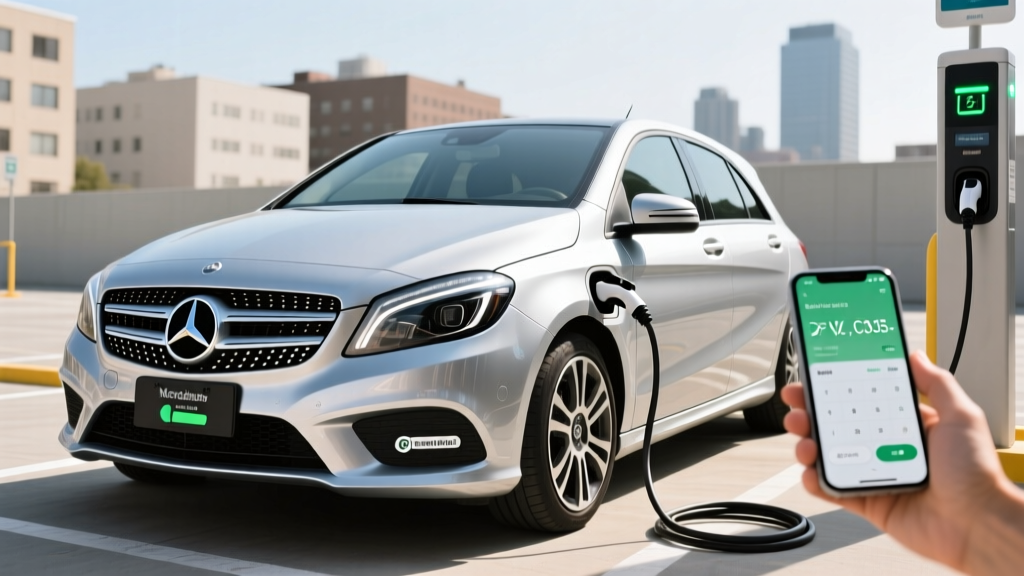
If you're researching a used 2014 Mercedes B-Class Electric Drive, here's the quick answer: it's a short-range, luxury-branded city commuter with an EPA-estimated 87 miles of range, a 28 kWh usable battery (36 kWh gross), and no DC fast charging. In 2026, expect to pay roughly $7,000–$12,000 on the used market depending on mileage and condition. It works well as a second car for errands and commutes under 40 miles round-trip if you can charge at home overnight. It does not work as a primary vehicle for highway road trips, cold-climate drivers without garage parking, or anyone without reliable Level 2 home charging access.
Quick Verdict: Who Should Buy This Car?
Buy it if: You need an affordable, comfortable electric second car for city/suburban driving under 50 miles daily, have Level 2 home charging, and live in a mild climate.
Skip it if: You need over 100 miles of range, drive in extreme cold regularly, rely on public DC fast charging, or want modern ADAS features like adaptive cruise or lane-centering.
Range, Battery, and Efficiency: The Numbers That Matter
The 2014 B-Class Electric Drive was Mercedes-Benz's first mass-market battery electric vehicle sold in the United States, built on the same platform as the gasoline B-Class hatchback. Under the floor sits a lithium-ion battery pack supplied by Tesla (yes, that Tesla — this was part of a pre-2020 powertrain supply agreement between Daimler and Tesla). The pack holds 36 kWh gross, with approximately 28 kWh usable capacity buffered to protect longevity.
| Specification | Value |
|---|---|
| EPA Range | 87 miles |
| Real-World Range (mild weather, mixed driving) | 70–85 miles |
| Real-World Range (highway 70 mph or cold below 30°F) | 50–65 miles |
| Battery Gross / Usable | 36 kWh / ~28 kWh |
| Battery Chemistry | NMC (nickel manganese cobalt) |
| EPA Efficiency | 84 MPGe combined (40 kWh/100mi) |
| Motor Output | 177 hp (132 kW), 228 lb-ft torque |
| 0–60 mph | 7.9 seconds |
| DC Fast Charging | Not available (AC only) |
| Level 2 AC Charge Rate | 7.2 kW (240V, 30A) |
| Level 2 Charge Time (0–100%) | ~3.5–4 hours |
| Level 1 AC Charge Rate | 1.4 kW (120V, 12A) |
| Level 1 Charge Time (0–100%) | ~20+ hours |
| Original MSRP (2014) | $41,450 (before incentives) |
| 2026 Used Market Price | $7,000–$12,000 |
| Battery Warranty (original) | 8 years / 100,000 miles (expired or expiring) |
Real-World Range Reality Check
The EPA sticker says 87 miles. In practice, owners report 70–85 miles in moderate temperatures with mixed city/highway driving. At sustained 70 mph highway speeds, expect closer to 60–65 miles. In winter conditions below 30°F without a preconditioned battery, range can drop to 50–55 miles — a 35–40% reduction typical of NMC packs without a heat pump (this car uses resistive cabin heating, which draws heavily from the traction battery).
Charging: The Biggest Limitation for Modern Buyers
The most critical thing to understand about the 2014 B-Class Electric Drive in 2026 is that it has no DC fast charging capability whatsoever. There is no CCS port, no CHAdeMO port, no NACS port. The car charges exclusively on AC power via a J1772 connector.
This means you cannot use any public DC fast charger — the Electrify America, Tesla Supercharger, EVgo, or ChargePoint DC stations that dominate highway corridors are completely inaccessible to this vehicle. Every charge must happen on Level 1 (standard 120V outlet) or Level 2 (240V home or public AC station).
| Level | Power | Miles Added per Hour | Use Case |
|---|---|---|---|
| Level 1 (120V household) | 1.4 kW | ~3–4 miles/hr | Overnight top-up only; full charge takes 20+ hours |
| Level 2 (240V home/public) | 7.2 kW | ~20–22 miles/hr | Primary charging method; full charge in ~3.5 hours |
| DC Fast Charging | N/A | N/A | Not supported — car has no DC inlet |
What this means practically: A Level 2 home charger is essentially mandatory. On a standard 120V outlet, you'd need to plug in for 10+ hours just to recover 40 miles of range — barely enough for daily driving. If you install a 240V/32A home Level 2 station (typically $500–$1,500 for equipment plus $800–$2,500 for electrician installation, depending on panel proximity and permit requirements), you can fully recharge overnight and start each day with a full ~80-mile battery.
Public Level 2 chargers at grocery stores, workplaces, and parking garages can supplement, but at 7.2 kW, you're adding roughly 20 miles per hour parked — useful for errands but not for road trips.
Cost Breakdown: Purchase, Charging, Maintenance, and Insurance
One of the strongest arguments for the used 2014 B-Class Electric Drive in 2026 is the low acquisition cost combined with minimal running expenses. Here's how the numbers stack up against a comparable used gas hatchback (we'll use a 2014 Mercedes B250 gas model as a baseline comparison).
| Cost Category | B-Class Electric Drive | B250 Gasoline (28 MPG combined) |
|---|---|---|
| Used Purchase Price (2026) | $9,500 (avg) | $11,000 (avg) |
| Fuel / Electricity (annual) | $375 (at $0.15/kWh, 40 kWh/100mi) | $1,140 (at $3.20/gal, 28 MPG) |
| Annual Maintenance | $300–$500 (no oil, fewer moving parts) | $800–$1,200 (oil, filters, spark plugs, belts) |
| Insurance (annual avg) | $1,400–$1,800 | $1,200–$1,600 |
| Estimated 5-Year Total Cost | $19,500–$24,000 | $26,000–$31,000 |
Key takeaways from the cost data:
- Fuel savings are real: At national average electricity rates of $0.15/kWh (per EIA data), you'll spend roughly $375/year to drive 10,000 miles. The gas B250 at 28 MPG combined and $3.20/gallon costs $1,140 — a savings of ~$765/year on energy alone.
- Maintenance is lighter: No oil changes, no transmission fluid, no spark plugs, no exhaust system. Brake pads last significantly longer due to regenerative braking doing most of the deceleration work. Budget $300–$500/year for tires, cabin air filter, wiper fluid, and the occasional 12V battery replacement.
- Insurance is slightly higher: EVs generally carry 10–15% higher insurance premiums due to repair cost structures. Get quotes before purchasing.
- Federal tax credit: The §30D new EV credit does not apply to this vehicle (it's used and was originally sold in 2014). The used EV credit (§25E, up to $4,000) has specific requirements — the vehicle must have a sale price of $25,000 or less (this car qualifies), and buyer income must fall under IRS caps ($75,000 single / $150,000 joint for 2026). Verify current IRS §25E rules before purchase, as the credit may be claimed at point of sale through a registered dealer.
Compared to Modern Budget EVs: Is This Still Worth It?
The 2014 B-Class Electric Drive competes in the used market against other early-era EVs and newer budget models. Here's how it stacks up against alternatives a buyer might cross-shop in 2026:
| Model | EPA Range | DC Fast Charge? | Used Price (2026) | Best For |
|---|---|---|---|---|
| 2014 Mercedes B-Class ED | 87 mi | No | $7,000–$12,000 | Luxury feel, city commuting |
| 2017 Nissan Leaf (30 kWh) | 107 mi | Yes (CHAdeMO, 50 kW) | $8,000–$13,000 | More range, DC charging |
| 2018 Chevy Bolt EV | 238 mi | Yes (CCS, 55 kW) | $13,000–$18,000 | Best range per dollar |
| 2019 VW e-Golf | 125 mi | Yes (CCS, 50 kW) | $12,000–$16,000 | Refined driving, moderate range |
The B-Class Electric Drive's advantage is its Mercedes interior quality, quiet ride, and strong torque delivery. Its disadvantages are equally clear: the lowest range of any competitor, zero DC fast charging, and a battery warranty that has either expired or is expiring in 2026 (the original 8-year/100,000-mile coverage began at the car's in-service date in 2014).
Common Misconceptions — Fact vs. Fiction
| Myth | Fact |
|---|---|
| "It's a Tesla underneath because Tesla supplied the battery." | Tesla supplied the battery pack and powertrain components under a Daimler partnership, but the motor, software, and vehicle integration are Mercedes-Benz. You cannot charge at Tesla Superchargers, and Tesla service centers will not work on it. |
| "87 miles of range is enough for anyone's commute." | The average US one-way commute is ~16 miles (per Census Bureau data), but that's an average — many commuters drive 30–50+ miles each way. Add detours, climate control, and cold-weather losses, and 87 EPA miles becomes 55–65 real miles in winter. Know your actual daily mileage before buying. |
| "I can use public fast chargers on road trips." | This car has no DC fast charging port. You are limited to Level 2 AC charging at 7.2 kW. A "road trip" in this car means planning 3–4 hour stops at Level 2 destinations. It is not a highway touring vehicle. |
| "The battery will need replacement and cost $15,000+." | NMC batteries from this era typically degrade 15–25% over 10 years/100,000 miles. Many 2014 B-Class ED owners report 70–80% state of health (SoH) at ~80,000 miles, meaning ~60–70 miles of real range. A full pack replacement from Mercedes would cost $10,000–$15,000+, but third-party repair shops can sometimes replace individual modules for $2,000–$5,000. Get a pre-purchase battery health check. |
| "It qualifies for the $7,500 federal EV tax credit." | The §30D new-vehicle credit does not apply. The §25E used-EV credit may provide up to $4,000 if purchased through a registered dealer at $25,000 or less, subject to buyer income caps. Confirm eligibility on IRS.gov before purchase. |
What First-Time EV Buyers Must Know Before Purchasing
If the 2014 B-Class Electric Drive would be your first electric vehicle, here are the ownership realities that don't appear in listings:
1. Home charging is non-negotiable. Without a 240V Level 2 home charger, this car is impractical. Level 1 (120V) charging adds only 3–4 miles per hour — you'd need to plug in for 15+ hours to recover a full charge. Budget $1,500–$3,000 for a quality Level 2 home station and professional installation (a licensed electrician should assess your panel capacity; a 200-amp service panel is usually sufficient, but older homes with 100-amp panels may need an upgrade costing $1,500–$3,000 additional).
2. Get a battery health report before purchase. Ask the seller or a Mercedes dealer to pull the battery state of health (SoH) percentage. Anything below 75% SoH means you're looking at roughly 50–55 miles of real-world range — factor that into your daily needs and negotiating position. Third-party EV inspectors (like those from Recurrent or local EV-specialty shops) can provide independent assessments.
3. Plan for cold-weather range loss. This car lacks a heat pump — it uses resistive electric heating for the cabin, which draws directly from the traction battery. In temperatures below 30°F, expect 30–40% range reduction. Preconditioning (warming the car while still plugged in) mitigates this somewhat, but the B-Class Electric Drive's preconditioning options are limited compared to modern EVs.
4. Tires and the 12V battery still need maintenance. EVs are not maintenance-free. The 12V auxiliary battery (which powers lights, infotainment, and door locks) typically lasts 3–5 years and costs $150–$250 to replace. Tires wear faster on EVs due to instant torque and heavier curb weight (~3,900 lbs for this model); budget $600–$900 for a set of four every 30,000–40,000 miles.
5. Resale value will be modest. Short-range early EVs from 2014 have limited buyer pools. Expect to sell this car for $4,000–$7,000 in a few years depending on battery health and mileage. Buy it for utility, not as an investment.
Decision Framework: Should You Buy the 2014 B-Class Electric Drive?
Use This Checklist to Decide
Choose the 2014 B-Class Electric Drive if:
- Your daily round-trip driving is under 50 miles (including errands, school runs, and detours)
- You have a garage or dedicated parking spot where a Level 2 charger can be installed
- You live in a mild-to-moderate climate (rarely below 25°F)
- This will be a second or third household vehicle, not the primary car
- You value a quiet, refined interior and don't need the latest infotainment or ADAS
- You can purchase under $10,000 and budget $1,500–$3,000 for home charger installation
- You've verified the battery SoH is above 75% through a pre-purchase inspection
Look elsewhere (consider a used 2018+ Chevy Bolt, 2019+ Nissan Leaf Plus, or 2020+ Hyundai Kona Electric) if:
- Your daily driving exceeds 60 miles or includes regular highway trips over 40 miles one-way
- You live in an apartment or condo without charging access and cannot install a home charger
- You regularly drive in sub-freezing temperatures for months at a time
- This would be your only vehicle and you need road-trip capability
- You want DC fast charging for flexibility on longer drives
- The battery SoH reads below 70% — the remaining range won't serve you reliably
Frequently Asked Questions
Can I charge the 2014 B-Class Electric Drive at a Tesla Supercharger?
No. Despite Tesla supplying the battery pack, the car uses a standard J1772 AC connector only. It has no DC fast-charge port of any kind — not CCS, not CHAdeMO, not NACS. Tesla Superchargers (DC) and all other DC networks are incompatible.
How long will the battery last, and what does replacement cost?
NMC batteries from this era typically retain 70–85% capacity after 100,000 miles or 10 years. The original 8-year/100,000-mile battery warranty has expired or is expiring for all 2014 models by 2026. Full battery replacement through Mercedes-Benz costs $10,000–$15,000+, though independent EV shops can sometimes repair individual modules for $2,000–$5,000. Most owners find the car remains usable with degraded range rather than needing full replacement.
Is the 2014 B-Class Electric Drive safe?
The vehicle earned good crash-test results in its era, with standard stability control, multiple airbags, and Mercedes' typical structural engineering. However, it lacks modern ADAS features — no automatic emergency braking, no lane-keeping assist, no adaptive cruise control. The NHTSA database has historical safety data; check for any open recalls specific to the VIN you're considering.
What's the real cost per mile to drive this car?
At the national average residential electricity rate of ~$0.15/kWh and the car's consumption of 40 kWh per 100 miles (per fueleconomy.gov), you'll pay approximately $0.06 per mile on electricity. A comparable gas car at 28 MPG and $3.20/gallon costs ~$0.11 per mile. That's roughly $500/year savings at 10,000 miles driven.
Does this car have regenerative braking and one-pedal driving?
Yes, it has regenerative braking with selectable levels via paddle shifters behind the steering wheel. The strongest regen setting (D−−) provides significant deceleration when you lift off the accelerator, approaching one-pedal driving in city traffic. However, it does not come to a complete stop on regen alone — you'll still need the brake pedal for final stopping.
Can I tow with the 2014 B-Class Electric Drive?
No. Mercedes-Benz did not rate this vehicle for towing, and the owner's manual explicitly advises against it. With 87 miles of EPA range and no DC fast charging, towing would further devastate range and is not practical or recommended.