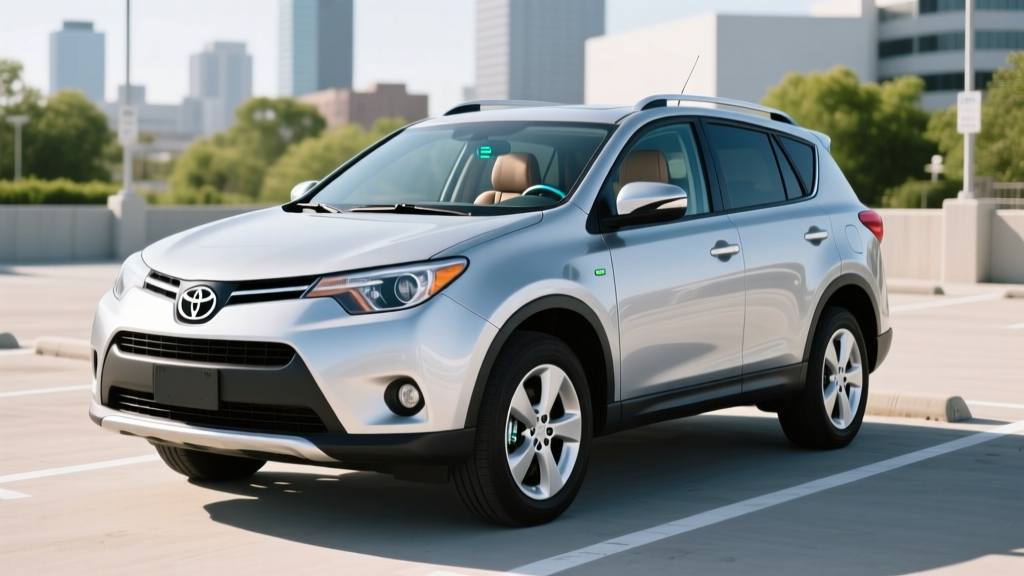
Quick Answer: Is the 2013 Toyota RAV4 EV Worth Buying Used?
The 2013 Toyota RAV4 EV delivers an EPA-rated 103 miles of range from its 41.8 kWh Tesla-sourced lithium-ion battery, charges at a maximum of 10 kW on Level 2 (roughly 4.5 hours from empty), and has no DC fast charging capability. Expect to pay $7,000–$12,000 on the used market in 2026. It qualifies for the federal used-EV tax credit of up to $4,000 under IRS §25E if you meet income caps and the sale price is $25,000 or less. The RAV4 EV is a practical second car or commuter runabout for drivers with home charging, but its 100-mile real-world range, aging battery, and CHAdeMO-less design make it a niche choice. If you drive under 60 miles round-trip daily and can charge at home, it offers extremely low operating costs. If you need road-trip flexibility, skip it.
2013 Toyota RAV4 EV: Core Specs at a Glance
| Specification | Value |
|---|---|
| EPA Range | 103 miles |
| Battery Capacity (usable) | 41.8 kWh (lithium-ion, NMC chemistry) |
| Motor Output | 154 hp (115 kW) |
| 0–60 mph | ~8.6 seconds |
| Top Speed | 85 mph (electronically limited) |
| Level 1 Charging (120V) | 1.4 kW — ~72 hours (full) |
| Level 2 Charging (240V) | 10 kW (40A) — ~5 hours (full) |
| DC Fast Charging | Not available |
| EPA Efficiency | 76 MPGe combined (44 kWh/100 mi) |
| Charge Port | SAE J1772 (Level 2 only) |
| Cargo Volume | 36.4 cu ft (behind rear seats) |
| Original MSRP | $49,500 (before incentives) |
| Used Price (2026 est.) | $7,000–$12,000 |
| Battery Warranty (original) | 8 years / 100,000 miles (expired) |
Toyota partnered with Tesla to develop the RAV4 EV's powertrain. The electric motor and battery pack were sourced from Tesla's early-generation technology, giving this compact SUV a drivetrain that shares DNA with the original Tesla Roadster and early Model S. That heritage matters for parts availability and serviceability — more on that below.
Real-World Range: What to Actually Expect
The EPA rates the 2013 RAV4 EV at 103 miles, but real-world results depend heavily on conditions:
- Ideal (city, mild weather, 65°F): 95–105 miles
- Highway (70 mph sustained): 75–85 miles
- Cold weather (below 32°F, heater on): 60–75 miles
- Aged battery (10–15% degradation typical at 12+ years): Subtract 10–15 miles from all figures above
With a 12-year-old battery, plan for 70–90 miles of usable range in mixed driving. The RAV4 EV lacks a heat pump — it uses resistive cabin heating, which is a significant energy draw in winter.
Used RAV4 EV vs. Gas RAV4: Cost and Efficiency Comparison
Buyers cross-shopping a used 2013 RAV4 EV against a same-year gas RAV4 should understand the fundamental trade-off: lower operating cost vs. range limitation and battery risk. Here's how the numbers stack up.
| Factor | 2013 RAV4 EV | 2013 RAV4 Gas (2.5L FWD) |
|---|---|---|
| Used Purchase Price (2026) | $7,000–$12,000 | $9,000–$14,000 |
| EPA Combined Efficiency | 76 MPGe (44 kWh/100 mi) | 26 MPG combined |
| Fuel/Energy Cost per Mile | $0.04–$0.06 (home charging at $0.14/kWh) | $0.13–$0.15 (gas at $3.50/gal) |
| Annual Fuel Cost (12,000 mi) | $480–$720 | $1,560–$1,800 |
| Annual Maintenance (est.) | $300–$500 | $600–$900 |
| Range | ~80–100 mi (real-world, aged battery) | ~370 mi (15.9-gal tank) |
| Federal Used-EV Credit | Up to $4,000 (§25E) | $0 |
Source: Efficiency data from fueleconomy.gov.
The EV saves roughly $1,000–$1,200 per year in fuel and maintenance. Over five years of ownership, that's $5,000–$6,000 in savings — but only if the battery holds up. A traction battery replacement, should it become necessary, runs $8,000–$14,000 at a specialist, potentially exceeding the vehicle's value.
Charging the 2013 RAV4 EV: What You Need to Know
The RAV4 EV's biggest practical limitation is the absence of DC fast charging. This is a Level 2–only vehicle. You cannot pull up to a Tesla Supercharger, Electrify America, or EVgo station and charge in 20 minutes. Every charge will take hours.
| Charging Level | Power (kW) | Time to Full | Miles Added per Hour |
|---|---|---|---|
| Level 1 (120V household outlet) | 1.4 kW | ~72 hours | ~3 miles |
| Level 2 (240V, 40A circuit) | 10 kW (max) | ~5 hours | ~20 miles |
| DC Fast Charging | N/A — not supported | N/A | N/A |
Home charging is essentially mandatory. Level 1 charging at 3 miles per hour is impractical for daily use — it would take three full days to replenish a depleted battery. A Level 2 home charger on a dedicated 50-amp circuit (delivering 40 amps continuous) is the only viable daily charging strategy.
Level 2 Home Charger Installation Costs
| Item | Cost Range |
|---|---|
| Level 2 charger (40A, J1772 connector) | $200–$600 |
| Electrical permit | $50–$200 |
| Electrician labor (240V/50A circuit run) | $500–$2,000 |
| Electrical panel upgrade (if needed, 200A) | $1,500–$3,500 |
| Total (no panel upgrade) | $750–$2,800 |
| Total (with panel upgrade) | $2,250–$6,300 |
The RAV4 EV uses a standard SAE J1772 connector, which is compatible with every Level 2 home charger on the market — ChargePoint Home Flex, Emporia Vue, Wallbox Pulsar Plus, and others. No adapter is needed for home charging.
Battery Health, Degradation, and Replacement Risk
This is the single most important factor when buying a 12-year-old EV. The RAV4 EV's 41.8 kWh lithium-ion pack (NMC chemistry) was cutting-edge in 2013 but is now well past its original 8-year/100,000-mile warranty. Here's what to expect:
- Typical degradation at 100,000+ miles: 10–20% capacity loss, reducing usable range to 82–93 miles when new-equivalent
- High-degradation scenarios: Some owners report 25–30% loss in hot climates (Arizona, Texas) or with frequent full-charge storage
- Battery replacement cost: $8,000–$14,000 through independent EV shops; Toyota dealer replacement may not be available or economical
- Cell-level repair: Some specialist shops can replace individual modules for $2,000–$4,000, but availability is limited
Before purchasing, insist on a battery health diagnostic. Ask the seller for the current usable kWh capacity or have a qualified EV technician perform a State of Health (SoH) assessment. A pack reading below 33 kWh (roughly 80% SoH) should significantly reduce the price or disqualify the vehicle.
Common Misconceptions About the 2013 RAV4 EV
| Myth | Fact |
|---|---|
| "It can use Tesla Superchargers because it has Tesla parts." | False. The RAV4 EV has no DC fast-charge port. It uses J1772 only. Tesla's powertrain components do not include Supercharger compatibility. |
| "The battery will need immediate replacement." | Not necessarily. NMC packs from this era often retain 80–90% capacity at 80,000–100,000 miles if not abused. Get a diagnostic before buying. |
| "It qualifies for the $7,500 new EV tax credit." | False. The §30D new-vehicle credit applies only to new purchases. The RAV4 EV is eligible for the §25E used clean vehicle credit of up to $4,000 (30% of sale price, capped at $4,000). |
| "103 miles of range is enough for everyone." | Context-dependent. The US average daily commute is ~37 miles round-trip, which fits easily. But highway trips, cold weather, and battery aging compress real range to 60–85 miles. |
| "Maintenance is basically free." | Partially true. No oil changes, spark plugs, or transmission fluid. But tires, brakes, cabin air filters, 12V battery, suspension components, and the cooling system still require service. |
Federal Used-EV Tax Credit: Do You Qualify?
The 2013 RAV4 EV can qualify for the IRS §25E Used Clean Vehicle Credit, which provides up to $4,000 (30% of the sale price). Here's the eligibility checklist as of 2026:
- Vehicle sale price: Must be $25,000 or less (easily met — used RAV4 EVs sell for $7,000–$12,000)
- Vehicle age: Must be at least 2 model years old (2013 qualifies)
- Buyer income cap: Modified AGI ≤ $75,000 (single), $112,500 (head of household), $150,000 (joint)
- Dealer requirement: Must purchase from a licensed dealer (private-party sales do not qualify)
- Credit limit: 30% of sale price, max $4,000 — a $10,000 RAV4 EV yields a $3,000 credit
- Claim frequency: Once per buyer every 3 years
- Point-of-sale transfer: Available — the dealer can apply the credit as a down-payment reduction at purchase
Consult a tax professional and review current rules at IRS.gov before purchasing. Income thresholds and dealer-reporting requirements are strictly enforced.
Total Cost of Ownership: 5-Year Breakdown
Assuming a $10,000 purchase price, 12,000 miles/year, home Level 2 charging at $0.14/kWh, and a $3,000 used-EV tax credit:
| Cost Category | 2013 RAV4 EV | 2013 RAV4 Gas (FWD) |
|---|---|---|
| Purchase Price | $10,000 | $11,500 |
| Federal Tax Credit | –$3,000 | $0 |
| Net Purchase Cost | $7,000 | $11,500 |
| Energy/Fuel (5 years) | $3,000 | $8,400 |
| Maintenance (5 years) | $2,000 | $3,750 |
| Insurance (5 years, est.) | $4,500 | $4,000 |
| Home Charger Install (one-time) | $1,500 | $0 |
| Total 5-Year Cost | $18,000 | $27,650 |
The RAV4 EV saves roughly $9,650 over five years — but this assumes no major battery repair. A single battery replacement event ($10,000+) would erase those savings entirely. This is the core risk/reward calculation for any aging EV purchase.
Decision Framework: Should You Buy the 2013 RAV4 EV?
Buy the 2013 RAV4 EV If:
- Your daily round-trip commute is under 60 miles
- You have access to Level 2 home charging (garage or driveway with a 240V circuit)
- This is a second vehicle — you have a gas or hybrid car for longer trips
- You live in a mild climate (minimal winter range loss)
- You can verify battery SoH above 80% before purchase
- You qualify for the §25E used-EV credit (income under caps)
- You want the lowest possible cost-per-mile for local driving
Skip the 2013 RAV4 EV If:
- You need more than 80 miles of reliable daily range
- You rely on street parking with no charging access
- You take regular road trips over 100 miles
- You live in a cold-weather state where winter range drops below 60 miles
- You cannot afford a potential $8,000+ battery replacement
- You want DC fast charging for any reason
- You'd rather spend $15,000–$20,000 on a newer used EV with 200+ mile range (e.g., 2018+ Chevrolet Bolt, 2019+ Nissan Leaf Plus)
Frequently Asked Questions
Can I road-trip in a 2013 RAV4 EV?
Practically, no. Without DC fast charging, every stop requires a multi-hour Level 2 session. A 200-mile trip would require an overnight stop. This is a commuter and errand vehicle, not a road-trip car.
Is the Tesla-sourced powertrain reliable?
The electric motor itself is robust — electric motors have very few moving parts and commonly exceed 200,000 miles. The risk is the battery pack. Tesla's early NMC cells from this era degrade more noticeably than modern chemistries, especially if frequently charged to 100% or exposed to sustained heat.
What happens if the battery fails?
Independent EV repair shops can sometimes replace individual battery modules rather than the full pack, reducing costs to $2,000–$4,000. Full pack replacement runs $8,000–$14,000. Given the vehicle's $7,000–$12,000 value, a full replacement often totals the car economically.
Does the RAV4 EV support regenerative braking?
Yes, but it offers modest regen compared to modern EVs. It does not provide true one-pedal driving. You will still use the friction brake pedal regularly, though brake wear is reduced compared to the gas RAV4.
What should a first-time EV buyer know about this car?
Three things: (1) Home Level 2 charging is non-negotiable — Level 1 is too slow for daily use. (2) Always verify battery health before purchase; range degrades with age and is not reversible without expensive repair. (3) The §25E used-EV credit can knock up to $4,000 off your effective purchase price, but only if you buy from a dealer and meet income limits.
How does the RAV4 EV compare to a 2013 RAV4 Hybrid?
There was no factory RAV4 Hybrid in 2013 (the hybrid launched for the 2016 model year). Compared to a same-year gas RAV4 getting 26 MPG combined, the EV saves roughly $1,000/year in fuel but sacrifices 270+ miles of range and adds battery-degradation risk. A 2016+ RAV4 Hybrid (32–34 MPG combined) splits the difference — better efficiency than gas, no range anxiety, no plug required.