The Rainbow Tesla Cybertruck: What You're Actually Looking At
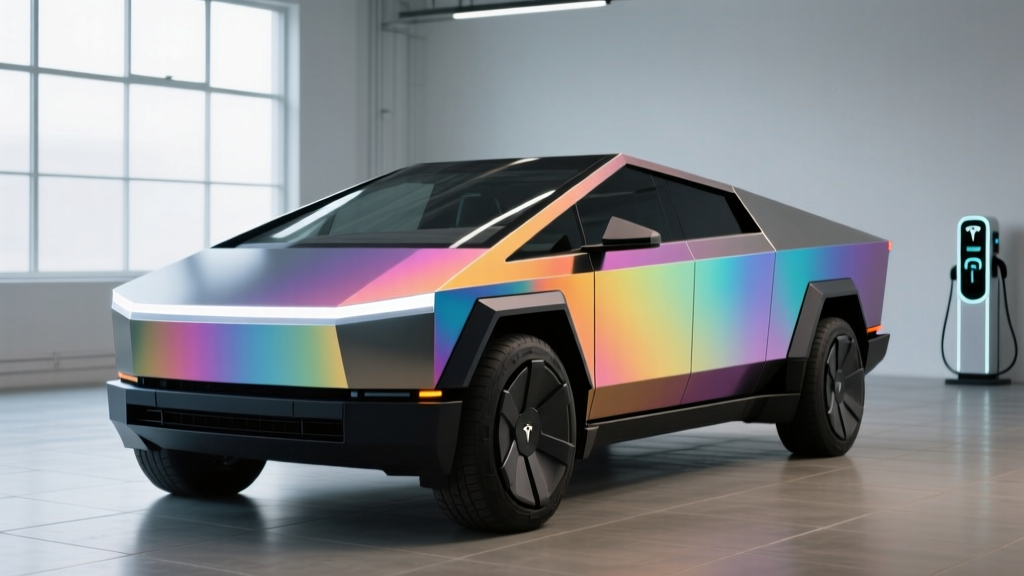
Search "rainbow Tesla Cybertruck" and you'll find a stunning, iridescent electric pickup that shifts from purple to green to gold depending on the light. It's one of the most-shared EV images on social media — and it doesn't exist from the factory. Tesla sells the Cybertruck in exactly one color: unpainted stainless steel. Every chromatic, color-shifting Cybertruck you've seen is wearing an aftermarket vinyl wrap, typically a color-shift or chameleon film from brands like 3M, Avery Dennison, or KPMF.
That doesn't make the rainbow Cybertruck any less real as a vehicle. Underneath that prismatic wrap is the 2026 Tesla Cybertruck AWD — a 600-horsepower, stainless-steel electric pickup with genuine capability and some of the most polarizing design in the automotive industry. This review covers everything you need to know about the truck beneath the wrap, plus what it actually takes (and costs) to turn one into a rolling rainbow.
Full Specifications: 2026 Tesla Cybertruck AWD
| Spec | Cybertruck AWD (Dual Motor) | Cybertruck Cyberbeast (Tri Motor) |
|---|---|---|
| EPA Range | 340 miles | 320 miles |
| Battery (usable) | ~123 kWh (NMC) | ~123 kWh (NMC) |
| Horsepower | 600 HP | 845 HP |
| 0-60 mph | 3.9 seconds | 2.6 seconds |
| Top Speed | 130 mph | 130 mph |
| Max DC Fast Charge | 250 kW (V3 Supercharger) / 350 kW (V4) | 250 kW / 350 kW |
| 10-80% DC Charge | ~28 minutes | ~28 minutes |
| Level 2 Home Charging | 11.5 kW (~44 mi/hr) | 11.5 kW (~44 mi/hr) |
| MPGe (combined) | 70 MPGe | 65 MPGe |
| Efficiency | 48 kWh/100 mi | 52 kWh/100 mi |
| Max Towing | 11,000 lbs | 11,000 lbs |
| Payload | 2,500 lbs | 2,500 lbs |
| Bed Length | 6 ft (72 in) | 6 ft (72 in) |
| Cargo Volume (bed) | 67 cu ft | 67 cu ft |
| Front Trunk (Frunk) | 7.1 cu ft | 7.1 cu ft |
| Rear Legroom | 38.2 in | 38.2 in |
| Curb Weight | ~6,600 lbs | ~6,800 lbs |
| Base MSRP | $81,630 | $101,630 |
| Battery Warranty | 8 yr / 120,000 mi | 8 yr / 120,000 mi |
| Drivetrain Warranty | 8 yr / 120,000 mi | 8 yr / 120,000 mi |
Sources: EPA / fueleconomy.gov, Tesla Cybertruck Specs
Real-World Range: What the EPA Number Doesn't Tell You
Real-world expectations:
• Highway (70-75 mph, moderate weather): ~270–295 miles
• City/mixed driving: ~310–330 miles (regen braking helps in stop-and-go)
• Cold weather (below 32°F): ~220–260 miles (battery heating demand + cabin HVAC)
• Towing (5,000+ lb trailer): ~150–190 miles (aerodynamic drag dominates)
The Cybertruck's angular stainless-steel body is striking, but it's an aerodynamic liability at highway speeds. The brick-like drag coefficient means efficiency drops sharply above 65 mph. In independent real-world highway testing at 70 mph, the AWD model typically delivers 270–295 miles before needing a charge — roughly 15% below the EPA sticker. This is consistent with most large EVs, but the Cybertruck's bluff-body shape makes the penalty slightly worse than a sleeker competitor like the Rivian R1T.
Cold weather compounds the issue. The Cybertruck uses a heat pump for cabin heating (more efficient than resistive heaters), but the massive 123 kWh battery pack still requires significant thermal management energy in freezing temperatures. Expect a 25–35% range reduction in sustained sub-32°F driving. Preconditioning the battery while plugged in — a feature Tesla handles well through the app and scheduled departure settings — recovers some of that loss.
Charging Speed: Home and DC Fast Charging
| Charging Level | Power (kW) | Rate (miles/hr) | Notes |
|---|---|---|---|
| Level 1 (120V household) | ~1.4 kW | ~3 mi/hr | Emergency/trickle only; full charge takes ~90 hours |
| Level 2 (240V / 48A Wall Connector) | 11.5 kW | ~44 mi/hr | Full charge in ~11 hours; ideal for overnight |
| DC Fast (Tesla V3 Supercharger) | 250 kW peak | ~1,000 mi/hr (peak) | 10-80% in ~28 min; charge curve tapers sharply above 80% |
| DC Fast (Tesla V4 Supercharger) | 350 kW peak | ~1,300 mi/hr (peak) | 10-80% in ~22 min; limited V4 station availability in 2026 |
| DC Fast (CCS adapter, non-Tesla) | Up to 250 kW | Varies | Requires Tesla CCS adapter (included); Electrify America, EVgo compatible |
Understanding the charge curve: The "250 kW peak" figure is just that — a peak. The Cybertruck, like all EVs, charges fastest at low states of charge and progressively slows as the battery fills. You'll see peak speeds between roughly 10–40% SoC. From 40–60%, expect ~175–200 kW. Above 80%, the rate drops to ~50–75 kW to protect battery longevity. This is why the 10–80% metric (~28 minutes on V3) is more useful than the peak kW number alone.
At home, a Tesla Wall Connector on a 60-amp circuit delivers 11.5 kW — enough to add ~44 miles of range per hour of charging, or fully replenish the pack overnight in about 11 hours. Installation typically costs $800–$2,000 depending on your electrical panel's capacity and the run distance to your garage or parking spot. If your panel is already near capacity, a 200-amp service upgrade ($1,500–$3,000) may be required.
The Rainbow Wrap: Costs, Process, and What to Know
The color-shift vinyl that creates the "rainbow" Cybertruck effect uses multi-layer interference pigments — the same technology behind chameleon automotive paints. Films like 3M Color Shift Black, KPMF K75547 Chameleon, or Avery Dennison Colorflow shift between 3–5 colors (typically purple, green, gold, and teal) depending on viewing angle and light conditions.
Cost breakdown for a full color-shift wrap on a Cybertruck:
- Material: $1,200–$2,000 (the Cybertruck's angular panels and large surface area require more film than a typical sedan)
- Professional installation: $3,000–$5,500 (the Cybertruck's sharp body lines and panel gaps make installation more labor-intensive)
- Total: $4,200–$7,500 depending on shop, film brand, and coverage level
- Lifespan: 5–7 years with proper care; color-shift films may fade slightly faster than solid-color wraps under intense UV exposure
Critical consideration — stainless steel and wraps: Tesla's 30X cold-rolled stainless steel exoskeleton doesn't corrode, but it also doesn't hold paint well. This is actually an advantage for wrapping — the smooth steel surface provides excellent vinyl adhesion. However, if you ever remove the wrap, the steel underneath will look exactly as it did the day the wrap went on. No paint damage to worry about because there is no paint.
Warranty impact: Wrapping does not void Tesla's battery or drivetrain warranty. However, if wrap installation requires removing body panels or trim and something breaks in the process, Tesla may deny a body-related claim. Use a reputable installer experienced with the Cybertruck's specific panel architecture.
Performance and Driving Dynamics
The Cybertruck AWD's dual-motor setup produces 600 horsepower and launches the 6,600-lb truck to 60 mph in 3.9 seconds. That's legitimately quick — faster than a BMW M3 from a decade ago, in a stainless-steel pickup. The tri-motor Cyberbeast drops that to 2.6 seconds with 845 HP, putting it in supercar territory.
But straight-line speed isn't the whole story. The Cybertruck's steer-by-wire system (Tesla calls it "steer-by-wire" with no mechanical connection between the steering wheel and the wheels) takes genuine adjustment. The yoke-style steering wheel and variable ratio mean parking-lot maneuvers require very little hand movement, while highway driving feels stable. Some drivers adapt within a day; others never fully trust the lack of mechanical feedback.
Ride quality is where the Cybertruck faces its most consistent criticism. The adaptive air suspension offers adjustable ride height (up to 16 inches of ground clearance in Off-Road mode), but the truck's sheer mass and stiff body structure transmit more road imperfections than the Rivian R1T or Ford F-150 Lightning. On smooth highways, it's composed. On broken pavement, you'll feel it.
Pricing, Trims, and Federal Tax Credit Eligibility
| Trim | Base MSRP | §30D Credit Eligible? | Effective Price (if eligible) |
|---|---|---|---|
| RWD (announced, limited availability) | $61,630 | Potentially (under $80K truck cap) | ~$54,130 |
| AWD (Dual Motor) | $81,630 | No (exceeds $80K MSRP cap for trucks) | $81,630 |
| Cyberbeast (Tri Motor) | $101,630 | No (exceeds $80K MSRP cap for trucks) | $101,630 |
The tax credit reality: Under IRS §30D rules, the federal EV tax credit caps at $7,500 for qualifying vehicles. For trucks and SUVs, the MSRP cap is $80,000. The Cybertruck AWD at $81,630 exceeds this threshold by $1,630, making it ineligible for the federal credit as currently configured. The Cyberbeast is well over the cap. Only the base RWD model — if and when it becomes widely available — has a realistic path to credit eligibility, and even then, it must meet battery-sourcing and critical-minerals requirements that shift annually.
Additionally, §30D has buyer income caps: modified adjusted gross income cannot exceed $300,000 (joint filers), $225,000 (head of household), or $150,000 (single). The credit is now available as a point-of-sale transfer to the dealer, reducing your purchase price upfront rather than waiting for tax filing.
Tech, Interior, and Driver Assistance
The Cybertruck's cabin is minimalist even by Tesla standards. An 18.5-inch center touchscreen handles virtually all vehicle functions, infotainment, and navigation. There is no instrument cluster — speed and range information display on the main screen's left edge. A rear 9.4-inch touchscreen serves back-seat passengers. The front yoke steering wheel is standard (a round wheel is available as a no-cost option in 2026).
Notable tech features:
- Bioweapon Defense Mode: HEPA filtration system pressurizes the cabin against outside air
- Powered tonneau cover: Motorized bed cover with integrated LED lighting, rated to support 300 lbs of distributed weight
- V2L (Vehicle-to-Load): 240V outlets in the bed and cabin can power tools, appliances, or even provide limited home backup (up to 11.5 kW output)
- Armor glass: Tesla's laminated "armor glass" is standard, though early-production units had fit issues that Tesla has addressed in 2025+ builds
- Sentry Mode & Dashcam: Integrated multi-camera recording system with no aftermarket hardware needed
Autopilot and FSD (Supervised):
Both Tesla Autopilot (standard) and Full Self-Driving (Supervised) are Level 2 driver-assistance systems. This means the vehicle can manage steering, acceleration, and braking under certain conditions, but the driver must remain fully engaged, eyes on the road, and hands on the yoke at all times. FSD (Supervised) adds features like automatic lane changes, traffic light recognition, and navigation-on-autopilot, but it does not make the Cybertruck self-driving. The driver is legally responsible for all vehicle operation.
FSD (Supervised) costs $8,000 as a one-time purchase or $99/month as a subscription in 2026. Its capabilities have expanded significantly, but it still struggles with construction zones, unmapped roads, and adverse weather. Plan to supervise actively.
How the Cybertruck Compares to Key Rivals
| Metric | Cybertruck AWD | Rivian R1T Dual Motor | Ford F-150 Lightning Lariat |
|---|---|---|---|
| EPA Range | 340 mi | 352 mi (Max Pack) | 320 mi (Ext Range) |
| 0-60 mph | 3.9 sec | 4.5 sec | ~5.0 sec |
| Max Tow | 11,000 lbs | 11,000 lbs | 10,000 lbs |
| DC Fast Charge (peak) | 250–350 kW | 220 kW | 150 kW |
| Base MSRP | $81,630 | $79,900 | $71,990 |
| §30D Credit | No (over cap) | Varies by trim | Yes (select trims) |
| Bed Length | 6 ft | 4.5 ft (54 in) | 5.5 ft (66 in) |
- You prioritize acceleration and DC charging speed over ride comfort
- You want maximum V2L capability for job-site or camping power
- You're a Tesla ecosystem user (Supercharger network, Powerwall integration)
- The stainless-steel exoskeleton aesthetic appeals to you (or you plan to wrap it)
- Off-road capability and ground clearance are top priorities
- You want a more traditional truck interior with premium materials
- Shorter bed length is acceptable (or you spec the gear tunnel)
- Budget matters most — the Lightning starts ~$10K lower
- You want a familiar full-size truck experience with EV benefits
- Ford dealer service accessibility is important in your area
Pros and Cons
- 340-mile EPA range leads the electric truck segment (AWD)
- 250–350 kW DC charging is among the fastest for any production truck
- 11,000-lb towing with integrated trailer brake controller
- V2L output (11.5 kW) can power tools, camping gear, or home backup
- Stainless-steel body is dent-resistant and corrosion-proof
- Steer-by-wire enables tight turning radius (35.4 ft) for a full-size truck
- Supercharger network access (the largest reliable DC network in the US)
- AWD and Cyberbeast trims exceed $80K MSRP cap — no federal tax credit
- Ride quality is firm; road imperfections are more noticeable than rivals
- Steer-by-wire and yoke require significant adaptation
- Panel gaps and build consistency have improved but still draw criticism
- 6-foot bed is shorter than most full-size pickups (F-150: 5.5–8 ft options)
- Non-Tesla DC charging requires CCS adapter and can be slower/unreliable
- Rear visibility is limited; relies heavily on camera feeds
- Insurance premiums run 20–40% higher than comparable gas trucks
Frequently Asked Questions
What is the real-world range of the Tesla Cybertruck?
The EPA rates the Cybertruck AWD at 340 miles. In real-world highway driving at 70 mph, expect 270–295 miles. City driving with regenerative braking can approach 310–330 miles. In sustained cold weather (below 32°F), plan for 220–260 miles. Towing a heavy trailer can cut range to 150–190 miles.
How fast does the Cybertruck charge at home and on the road?
At home on a Level 2 Tesla Wall Connector (11.5 kW / 240V), the Cybertruck gains approximately 44 miles of range per hour, with a full charge taking about 11 hours. On a Tesla V3 Supercharger (250 kW peak), it charges from 10–80% in roughly 28 minutes. V4 Superchargers (350 kW) can reduce that to ~22 minutes, though V4 availability remains limited in 2026.
How much does a rainbow Cybertruck actually cost?
The Cybertruck AWD starts at $81,630 MSRP plus $1,995 destination. A professional color-shift vinyl wrap adds $4,200–$7,500. Total cost for a rainbow-wrapped AWD typically falls between $88,000 and $92,000 before any state or local incentives. The AWD and Cyberbeast trims do not qualify for the $7,500 federal §30D tax credit because they exceed the $80,000 MSRP cap for trucks.
Does the Cybertruck qualify for the federal EV tax credit?
Currently, only the base RWD Cybertruck ($61,630 MSRP) has a realistic path to §30D eligibility, and it must still satisfy battery-sourcing and critical-minerals requirements that change annually. The AWD ($81,630) and Cyberbeast ($101,630) both exceed the $80,000 MSRP cap for trucks and are categorically ineligible. Buyer income caps ($150K single / $300K joint) also apply. Always verify current eligibility on IRS.gov before purchasing.
Is the Cybertruck worth buying over the Rivian R1T or F-150 Lightning?
It depends on your priorities. The Cybertruck leads in DC charging speed, acceleration, and V2L power output. The Rivian R1T is the better off-roader with a more refined interior. The F-150 Lightning is the most affordable and most "normal" truck experience. If Supercharger network access, maximum towing, and head-turning design (especially with a rainbow wrap) matter most, the Cybertruck has no direct rival. If ride comfort, build quality consistency, and federal tax credit eligibility are higher priorities, the Lightning or R1T may serve you better.
Will wrapping the Cybertruck damage the stainless steel body?
No. The Cybertruck's 30X cold-rolled stainless steel has no paint to damage. Vinyl adheres well to the smooth steel surface, and removal leaves the original finish intact. However, ensure your installer is experienced with the Cybertruck's specific panel structure — improper trim removal during wrap installation could damage clips or seals, which Tesla may not cover under warranty.
What is the Cybertruck's battery warranty?
Tesla covers the Cybertruck's battery and drive unit for 8 years or 120,000 miles, whichever comes first. The warranty guarantees the battery will retain at least 70% of its original capacity during that period. If degradation exceeds 30%, Tesla will repair or replace the battery at no cost. The vehicle's basic limited warranty covers 4 years or 50,000 miles.