The 2013 Tesla Model S didn't just launch a company — it proved that a battery-electric sedan could compete with luxury internal-combustion rivals on performance, technology, and desirability. More than a decade later, used examples are hitting the secondary market at tempting prices. But buying a 12-year-old EV requires a very different calculus than buying a new one. This review breaks down what you need to know about the 2013 Model S interior, its aging battery pack, real-world range, charging limitations, and whether it's still a smart buy.
2013 Tesla Model S Interior: Design, Materials, and Technology
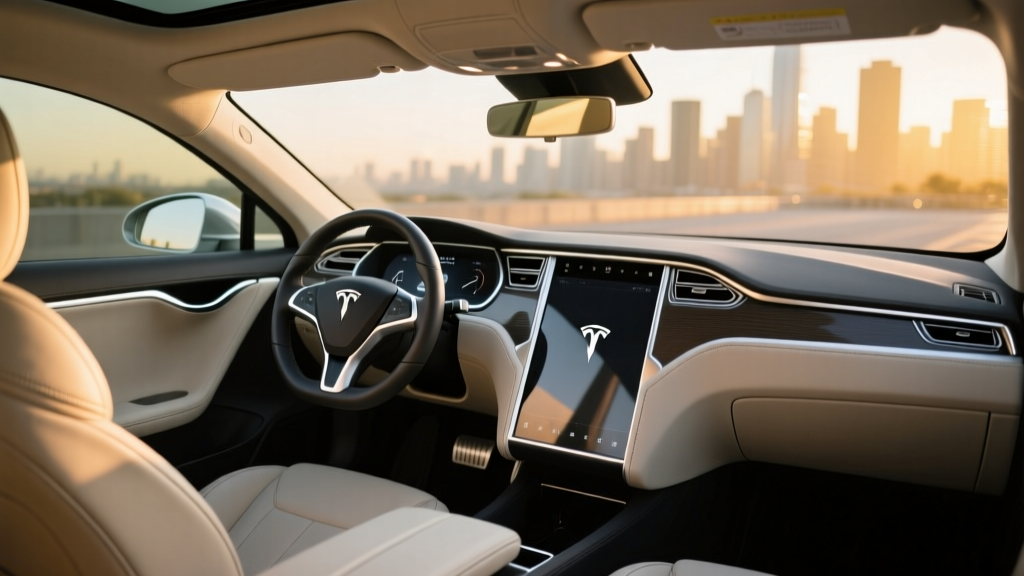
The 2013 Model S interior was a radical departure from traditional luxury sedans. The centerpiece was — and remains — a 17-inch capacitive touchscreen that controls nearly every vehicle function: climate, navigation, media, vehicle settings, and even the glovebox release. This minimalist approach eliminated most physical buttons, creating a clean, futuristic dashboard that influenced virtually every EV that followed.
Material quality was a point of contention even at launch. The 2013 Model S used a mix of premium and cost-cutting materials:
- Seats: Synthetic leather (Tesla's "Ultra White" wasn't available yet; black leatherette was standard, with Nappa leather as an option on later builds)
- Dashboard: Soft-touch materials on upper surfaces, but hard plastics on lower panels and door pockets
- Steering wheel: Leather-wrapped, though early units drew criticism for feel and durability
- Floor console: Glossy piano-black plastic that scratches easily and shows fingerprints
- Headliner: Alcantara-like material on Performance trims, cloth on base models
The instrument cluster is a small 12.3-inch LCD screen behind the steering wheel — configurable but modest compared to modern EV displays. There is no head-up display.
Seating and Passenger Space
The 2013 Model S seats five adults (or optionally seven with rear-facing jump seats in the cargo area — a rare option that Tesla discontinued due to safety regulation changes). Front legroom measures 42.7 inches, with rear legroom at 35.4 inches. Headroom is generous front and rear thanks to the skateboard architecture that places the battery low in the floor.
Cargo Capacity
One of the Model S's enduring advantages is its cargo versatility:
- Rear cargo (seats up): 26.3 cubic feet
- Rear cargo (seats folded): 58.1 cubic feet
- Front trunk (frunk): 5.3 cubic feet
The hatchback-style liftgate makes loading bulky items easier than in traditional sedans. The frunk provides secure, weatherproof storage for charging cables or a small bag.
Battery, Range, and Degradation: The Critical Used-EV Question
The 2013 Model S was offered in three battery configurations. Understanding which pack you're looking at is essential, because degradation and replacement costs vary dramatically.
| Spec | Model S 40 | Model S 60 | Model S 85 |
|---|---|---|---|
| Battery (usable kWh) | ~40 kWh (software-limited 60) | ~60 kWh | ~85 kWh |
| Chemistry | NMC (nickel-manganese-cobalt) | NMC | NMC (Panasonic 18650 cells) |
| Original EPA Range | 139 mi | 208 mi | 265 mi |
| Expected Range Today | 90–115 mi | 150–180 mi | 200–230 mi |
| Drivetrain | RWD | RWD | RWD |
| Horsepower | 302 hp | 302 hp | 362 hp (Performance: 416 hp) |
| 0–60 mph | 6.5 sec | 5.9 sec | 5.4 sec (Perf: 4.2 sec) |
Understanding NMC Degradation in a 2013 Pack
All 2013 Model S variants use NMC (nickel-manganese-cobalt) chemistry in Panasonic 18650 cylindrical cells — the same cell format used in laptops at the time. NMC offers high energy density but is more susceptible to calendar and cycle degradation than the LFP (lithium iron phosphate) chemistry Tesla uses in some modern vehicles.
Based on aggregated owner data from Tesla forums and third-party battery health trackers, a typical 2013 Model S 85 battery has lost approximately 12–20% of its original capacity after 10–12 years. Units that were frequently DC fast-charged, regularly charged to 100%, or exposed to extreme heat (Arizona, Texas) tend to sit at the higher end of that degradation range.
Battery replacement cost: A refurbished 85 kWh replacement pack from Tesla currently runs $12,000–$16,000 installed. Third-party refurbishers may offer repairs for $5,000–$9,000 by replacing individual failed modules, but this is a patch fix — other modules may fail subsequently.
Charging Speeds: Where the 2013 Model S Shows Its Age
Charging technology has advanced dramatically since 2013. The original Model S was engineered for a different era of EV infrastructure, and this is where used buyers feel the most friction.
| Charging Level | Power / Rate | Miles Added per Hour | Notes |
|---|---|---|---|
| Level 1 (120V) | ~1.4 kW | ~3–4 mi/hr | Emergency/trickle only |
| Level 2 (240V, single charger) | 10 kW | ~29 mi/hr | Standard onboard charger |
| Level 2 (240V, dual charger option) | 20 kW | ~58 mi/hr | Rare factory option |
| DC Fast Charge (Supercharger) | Peak ~120 kW | ~170 mi in 30 min | Tapers heavily above 60% |
The Connector Situation: Tesla's Proprietary Port
The 2013 Model S uses Tesla's proprietary connector for both AC and DC charging. This is the same physical connector Tesla later opened as the NACS (North American Charging Standard). In practice, this means:
- Tesla Superchargers: Full access to the Tesla Supercharger network, which remains the most reliable public DC fast-charging network in North America
- Non-Tesla DC fast chargers (CCS/CHAdeMO): The 2013 Model S cannot natively use CCS chargers. A Tesla CCS adapter is required, and early Model S vehicles may need a firmware update or ECU upgrade to support CCS communication — verify with Tesla before purchasing an adapter (~$175)
- Destination charging: Tesla Wall Connectors at hotels and businesses work natively
Real-World Charging Curve Reality
The 2013 Model S 85 peaks at approximately 120 kW at a Supercharger, but only when the battery is preconditioned and between roughly 10–40% State of Charge (SoC). Above 60%, the charge rate drops significantly — a typical 10–80% session takes approximately 55–65 minutes, compared to 25–30 minutes on a modern 800V architecture EV like the Hyundai Ioniq 5 or Porsche Taycan.
For home Level 2 charging on a standard 10 kW onboard charger, a full 0–100% charge takes approximately 9 hours — easily manageable overnight.
Performance and Efficiency
Even by 2026 standards, the 2013 Model S 85 Performance delivers impressive acceleration. Its single rear-mounted AC induction motor produces 416 horsepower and 443 lb-ft of torque, launching the 4,600-pound sedan to 60 mph in 4.2 seconds. The standard 85 manages 5.4 seconds. All variants are rear-wheel drive — Tesla didn't introduce dual-motor all-wheel drive until late 2014.
Efficiency for the 85 kWh model was rated at 89 MPGe combined (38 kWh/100 mi) by the EPA. In real-world mixed driving, expect 34–40 kWh/100 mi depending on speed, temperature, and terrain. Highway driving at 75 mph pushes consumption toward the higher end of that range.
Driver-Assistance Technology: Basic by Modern Standards
The 2013 Model S predates Tesla's Autopilot hardware suite. Vehicles built before September 2014 lack the forward-facing camera, radar, and ultrasonic sensors required for Autopilot. This means:
- No adaptive cruise control
- No lane-keeping assist
- No automatic emergency braking (forward collision warning only, via camera, on some late-2013 builds)
- No blind-spot monitoring
Used Pricing and Total Cost of Ownership
As of early 2026, used 2013 Tesla Model S pricing varies widely based on mileage, battery health, trim level, and condition:
| Variant | Typical Used Price (2026) | Original MSRP (2013) | Key Notes |
|---|---|---|---|
| Model S 40 | $8,000–$12,000 | $59,900 | Rare; very limited range |
| Model S 60 | $11,000–$16,000 | $69,900 | Moderate range; common |
| Model S 85 | $14,000–$22,000 | $79,900 | Best range; most desirable |
| Model S P85 (Performance) | $16,000–$25,000 | $97,900+ | Fastest; air suspension standard |
Federal Tax Credit on Used EVs
Under the IRS §25E used clean vehicle credit, buyers of a used 2013 Model S may qualify for up to $4,000 (or 30% of the sale price, whichever is less). Eligibility requirements include:
- Vehicle must be purchased from a licensed dealer (private-party sales do not qualify)
- Sale price must be $25,000 or less
- Buyer income caps: $75,000 single / $112,500 head of household / $150,000 joint (modified AGI)
- The credit is non-refundable — it can reduce your tax liability to zero but won't generate a refund
- Point-of-sale transfer is available through participating dealers
Since most 2013 Model S examples sell below $25,000, the §25E credit is highly relevant — but only if purchased through a dealer and within income limits.
Warranty Status
Tesla's original warranty on the 2013 Model S was:
- Battery: 8 years / 125,000 miles (85 kWh) or 8 years / 100,000 miles (60 kWh), with no explicit capacity retention guarantee in the original terms
- Drive unit: 8 years / 125,000 miles
- Bumper-to-bumper: 4 years / 50,000 miles
As of 2026, all original factory warranties have expired on every 2013 Model S. Any repair — battery, drive unit, air suspension, touchscreen — is an out-of-pocket expense unless an extended warranty was purchased and remains active (unlikely).
Pros and Cons of Buying a 2013 Model S Today
✅ Pros
- Spacious, practical hatchback sedan with frunk
- Still quick — 4.2 sec 0–60 in P85 trim
- Access to Tesla Supercharger network
- Low purchase price: $10K–$22K typical
- Qualifies for up to $4,000 used EV tax credit
- Over-the-air software updates still supported
- Strong parts availability via Tesla and third parties
❌ Cons
- No Autopilot or modern driver-assist features
- Slow DC fast charging by modern standards (~55–65 min 10–80%)
- Significant battery degradation risk; $12K–$16K replacement
- Out-of-warranty: expensive repairs possible
- Air suspension failures common and costly ($2,000–$4,000 per corner)
- 17-inch touchscreen may be unresponsive or delaminating
- Interior material quality below modern luxury standards
- Higher insurance premiums due to repair costs
Who Should (and Shouldn't) Buy a 2013 Model S
Choose the 2013 Model S 85 if:
- You need an affordable, spacious EV for a commute under 80 miles round-trip with home Level 2 charging
- You want Supercharger access for occasional road trips and accept longer charge stops
- You're comfortable with the risk of out-of-warranty battery or drive-unit repair
- You value hatchback cargo versatility and frunk storage
- You can verify battery SoH above 80% before purchase
Look elsewhere if:
- You need 250+ miles of reliable range without range planning
- You want modern driver-assist features (adaptive cruise, lane-keeping, AEB)
- You lack access to home or workplace Level 2 charging
- You live in a cold climate where range loss will push you below comfortable margins
- You can't budget $3,000–$5,000 for potential repairs in the first year
Frequently Asked Questions
What is the real-world range of a 2013 Tesla Model S 85 today?
Expect approximately 200–230 miles in moderate temperatures with mixed city/highway driving. At sustained highway speeds of 75 mph, range drops to roughly 170–190 miles. In freezing temperatures, add a further 15–25% reduction, bringing real-world winter range to 150–170 miles for a well-maintained pack.
How fast does the 2013 Model S charge at home and on the road?
On a home Level 2 charger (240V), the standard 10 kW onboard charger adds about 29 miles per hour, fully recharging overnight in ~9 hours. On a Tesla Supercharger, peak rate is ~120 kW, but the charge curve tapers heavily — expect a 10–80% session to take 55–65 minutes. CCS adapters are available but require compatibility verification.
Does the 2013 Model S qualify for any federal EV tax credit?
It does not qualify for the new-vehicle §30D credit (the car hasn't been new since 2013). However, it may qualify for the §25E used clean vehicle credit of up to $4,000 if purchased from a licensed dealer for $25,000 or less, and if the buyer meets income caps. Consult a tax professional and review current IRS guidance before relying on this credit.
Is the 2013 Model S worth buying vs. a newer used EV?
It depends on budget and risk tolerance. A 2013 Model S 85 at $16,000–$20,000 offers more space, performance, and Supercharger access than a similarly priced used Nissan Leaf or Chevrolet Bolt. However, a 2018+ Model 3 or a 2020+ Chevrolet Bolt EUV will offer better efficiency, faster charging, modern driver assists, and less battery degradation risk. If you can stretch to $25,000–$30,000, a 2017–2019 Model S (with Autopilot hardware and a newer battery) is a significantly better value.
What are the most common and expensive problems on a 2013 Model S?
The highest-cost failure points are: battery pack degradation or module failure ($5,000–$16,000), air suspension strut failure ($2,000–$4,000 per corner), drive unit replacement ($5,000–$8,000), and touchscreen delamination or MCU failure ($1,500–$3,000). Door handles, window regulators, and 12V battery issues are common but relatively inexpensive to fix.
Can I still get software updates on a 2013 Model S?
Yes — Tesla continues to push over-the-air updates to 2013 Model S vehicles, though feature additions have largely stopped. The vehicle receives security patches, minor UI improvements, and occasional charging-optimization updates. However, features introduced after 2015 (Sentry Mode, theater mode, advanced navigation) are hardware-limited and will never arrive.