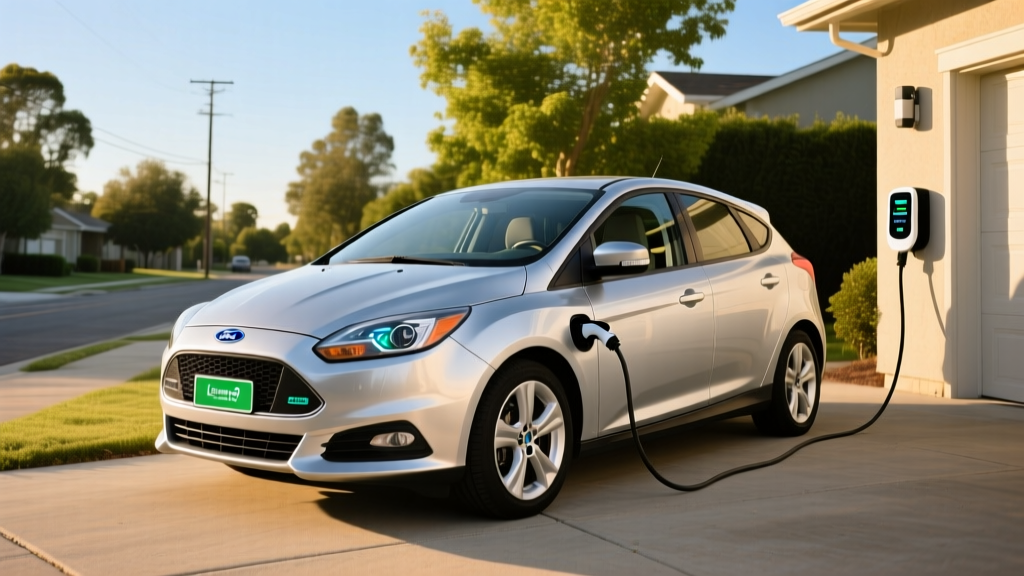
Quick Answer: Is the 2013 Ford Focus Electric Still Worth Buying in 2026?
The 2013 Ford Focus Electric was rated at 76 miles of EPA range when new, powered by a 23 kWh usable lithium-ion battery (liquid-cooled). In 2026, expect 55–68 miles of real-world range depending on battery degradation, climate, and driving style. Used examples sell for roughly $4,500–$7,500. It can still serve as a low-cost city commuter if you have Level 2 home charging and a short daily route — but it is not viable as a sole household vehicle for most drivers. There is no federal tax credit available for this used model under current IRS §30D rules.
2013 Ford Focus Electric: Core Specs at a Glance
| Specification | Value |
|---|---|
| EPA Range (new) | 76 miles |
| Real-World Range (2026, degraded) | ~55–68 miles |
| Battery Capacity (usable) | 23 kWh (liquid-cooled NMC) |
| Onboard Charger | 6.6 kW (Level 2, J1772) |
| DC Fast Charging | Not available |
| Level 2 Charge Time (0–100%) | ~3.5–4 hours |
| Level 1 Charge Time (120V) | ~20 hours |
| Motor Output | 107 kW (143 hp), 184 lb-ft torque |
| 0–60 mph | ~9.2 seconds |
| EPA Efficiency | 105 MPGe combined (32 kWh/100 mi) |
| Original MSRP (2013) | $29,200 (before incentives) |
| Used Price Range (2026) | $4,500–$7,500 |
| Battery Warranty (original) | 8 years / 100,000 miles (expired) |
Battery Health and Degradation: What to Expect After 13 Years
The 2013 Focus Electric uses a 23 kWh usable lithium-ion pack supplied by LG Chem, featuring NMC (nickel-manganese-cobalt) chemistry with a liquid thermal management system. That liquid cooling was a significant advantage over the passive-air-cooled Nissan Leaf of the same era, and it has helped these batteries age more gracefully than many early-2010s EVs.
That said, any 13-year-old NMC pack will have lost capacity. Based on owner reports and typical NMC degradation curves, expect 75–90% State of Health (SoH) depending on climate exposure, charging habits, and mileage. A unit at 80% SoH delivers roughly 60 miles of practical range; one at 90% SoH might still achieve close to the original 76-mile sticker under ideal conditions.
Before buying, insist on a battery health check. A Ford dealer or independent EV shop can pull the SoH reading via OBD-II. If SoH is below 75%, walk away unless the price reflects a near-term battery replacement — which, for this model, can cost $5,000–$8,000 from third-party suppliers, often exceeding the car's value.
Real-World Range Reality Check
EPA (new): 76 miles
2026 real-world (80% SoH, moderate climate): ~55–65 miles
Cold weather (below 32°F, heater on): ~40–50 miles (a 25–35% loss is typical for NMC packs without a heat pump)
Highway driving (70+ mph): ~45–55 miles at sustained speeds
The Focus Electric lacks a heat pump, relying on a resistive cabin heater that draws heavily from the small pack. If your winters are harsh, plan on a significant range penalty.
Charging: Level 2 Only, No DC Fast Charging
This is the most important limitation for modern buyers: the 2013 Focus Electric has no DC fast charging capability. There is no CCS, CHAdeMO, or NACS port. You are limited to:
| Charging Level | Power | Connector | Time (0–100%) | Miles Added per Hour |
|---|---|---|---|---|
| Level 1 (120V household) | ~1.4 kW | J1772 | ~20 hours | ~3–4 mi/hr |
| Level 2 (240V home/public) | 6.6 kW | J1772 | ~3.5–4 hours | ~18–22 mi/hr |
| DC Fast Charge | N/A | Not equipped | N/A | N/A |
The 6.6 kW onboard charger was actually best-in-class for 2013 (the Nissan Leaf offered only 3.3 kW at the time). On a 240V Level 2 circuit, a full charge takes about 3.5–4 hours. But without DC fast charging, road trips are impractical. This car is strictly a home-base commuter.
Home charging requirement: You will need a Level 2 charger installed on a dedicated 240V circuit (typically 30–40 amps). Installation costs range from $500–$1,500 if your electrical panel has capacity, or $1,500–$3,000+ if a panel upgrade is needed. Relying solely on Level 1 (120V) is technically possible given the small battery, but a full charge takes 20 hours — barely enough to replenish a day's driving overnight.
Cost Breakdown: Used Purchase, Charging, and Maintenance
One of the strongest arguments for a used 2013 Focus Electric is its low operating cost. Here is how the numbers stack up against a comparable used gas compact (e.g., a 2013 Ford Focus gasoline model rated at ~30 MPG combined).
| Cost Category | 2013 Focus Electric | 2013 Focus Gasoline (30 MPG) |
|---|---|---|
| Purchase Price (2026 used) | $4,500–$7,500 | $5,000–$8,000 |
| Fuel / Electricity (annual, 10,000 mi) | $350–$550 (at $0.12–$0.18/kWh) | $1,100–$1,350 (at $3.30–$3.70/gal) |
| Annual Maintenance | $200–$400 (no oil, fewer fluids) | $600–$1,000 (oil, filters, belts) |
| Insurance (annual avg) | $900–$1,300 | $800–$1,200 |
| Federal Tax Credit | $0 (used EV credit expired/limited; §30D does not apply to 2013 models) | $0 |
| Estimated 5-Year Total Operating Cost | $7,750–$11,250 | $12,500–$17,250 |
The annual fuel savings of roughly $600–$900 are meaningful, especially given the low purchase price. Over five years, you might save $4,000–$6,000 in combined fuel and maintenance compared to the gas equivalent. However, this assumes no major battery failure — a replacement would erase those savings entirely.
Charging cost math: The Focus Electric consumes about 32 kWh per 100 miles (per EPA data on fueleconomy.gov). At the US average residential rate of ~$0.16/kWh, driving 10,000 miles costs approximately $512 per year — or about 5 cents per mile. Compare that to the gas Focus at 30 MPG and $3.50/gallon: roughly 12 cents per mile.
EV vs Gas vs Hybrid: Decision Framework
| Factor | 2013 Focus Electric | Used Gas Compact | Used Hybrid (e.g., Prius) |
|---|---|---|---|
| Purchase Price | $4,500–$7,500 | $5,000–$8,000 | $7,000–$11,000 |
| Annual Fuel Cost | $350–$550 | $1,100–$1,350 | $700–$900 |
| Range / Refueling | 55–68 mi; 3.5 hr charge | 350+ mi; 5 min fill | 450+ mi; 5 min fill |
| Road Trip Capable? | No | Yes | Yes |
| Maintenance Cost | Low | Moderate | Low–Moderate |
| Battery Risk | High (age, replacement cost) | None | Low (NiMH, proven) |
Should You Buy the 2013 Ford Focus Electric?
Buy it if:
- Your daily round-trip commute is under 40 miles
- You have (or can install) Level 2 home charging
- This is a second car in a multi-vehicle household
- You live in a mild climate (minimal cold-weather range loss)
- The asking price is under $6,000 with verified battery SoH above 80%
Skip it if:
- This would be your only vehicle
- Your commute exceeds 50 miles round-trip
- You lack access to Level 2 charging at home or work
- You live in a region with harsh winters (below-freezing temperatures for weeks)
- Battery SoH is below 75% or unknown
- You need road-trip or highway flexibility
Common Misconceptions About Early Used EVs
| Myth | Fact |
|---|---|
| "The battery will need immediate replacement." | Not necessarily. The liquid-cooled LG Chem pack in the Focus Electric has shown better longevity than air-cooled competitors. Many units retain 80%+ SoH after 10+ years. Always verify with an OBD-II health check before purchasing. |
| "I can use public DC fast chargers on road trips." | False. The 2013 Focus Electric has no DC fast charge port. You are limited to Level 2 (J1772) charging at 6.6 kW. Plan trips within the car's range or use a second vehicle. |
| "Used EVs qualify for the $7,500 federal tax credit." | The current IRS §30D clean vehicle credit applies to new EVs meeting MSRP, income, and battery-sourcing requirements. A separate used-EV credit (up to $4,000) has strict vehicle-age and price caps — verify current eligibility on IRS.gov, as rules for a 2013 model year vehicle are extremely restrictive. |
| "Electricity is always cheaper than gas." | Usually yes at residential rates (~$0.16/kWh), but public Level 2 chargers at $0.30–$0.50/kWh can push per-mile costs close to or above a fuel-efficient hybrid. Home charging is where the savings live. |
| "Maintenance is zero." | EVs skip oil changes and spark plugs, but still require tire rotations, brake fluid checks, cabin air filters, coolant service, and 12V battery replacements. Budget $200–$400/year. |
What a First-Time Used EV Buyer Must Know
If the 2013 Focus Electric is your entry point into EV ownership, here are the practical realities no brochure will tell you:
1. Get the battery checked before purchase. This is non-negotiable for a 13-year-old EV. Ask the seller for a recent SoH report or arrange a pre-purchase inspection at a shop equipped to read EV battery data. The battery is the single most expensive component, and a replacement can total the car.
2. Budget for a Level 2 home charger. A quality Level 2 unit (e.g., ChargePoint Home Flex, Emporia Vue) costs $350–$700 for the hardware. Professional installation by a licensed electrician runs $500–$1,500 for a straightforward 240V/40A circuit — or more if your panel needs an upgrade. Factor this into your total purchase cost.
3. Understand kW vs kWh. This is the most common confusion for new EV owners. kW (kilowatts) measures power — the rate at which energy flows (like water pressure). kWh (kilowatt-hours) measures energy capacity — how much the battery holds (like tank size). The Focus Electric has a 23 kWh battery and charges at up to 6.6 kW.
4. Cold weather will shrink your range. Without a heat pump, the Focus Electric's resistive heater draws 2–4 kW from the battery. In sub-freezing temperatures, expect a 25–35% range reduction. A 60-mile range day becomes a 40-mile range day.
5. Tires wear faster on EVs. The Focus Electric is heavier than its gas sibling due to the battery pack, and instant torque accelerates tire wear. Budget for replacement tires every 30,000–40,000 miles. Low-rolling-resistance EV-specific tires can help preserve range.
6. Insurance may cost slightly more. Some insurers charge higher premiums for EVs due to repair cost assumptions. Shop quotes before purchasing — the difference is usually $50–$150/year, but it varies by provider and state.
The Verdict: A Budget City EV with Clear Boundaries
The 2013 Ford Focus Electric occupies a narrow but real niche in the 2026 used-car market. At $4,500–$7,500, it is one of the cheapest ways to get into a liquid-cooled, Level-2-capable electric vehicle. For a short-commute driver with home charging and a second car for longer trips, it delivers genuine fuel savings and smooth, quiet electric driving.
But the limitations are hard boundaries, not inconveniences: ~60 miles of degraded range, no DC fast charging, no road-trip viability, and a battery that is well past its warranty period. Treat this car as what it is — a budget electric commuter — and it can be a smart, thrifty choice. Expect it to do everything a modern EV does, and it will disappoint.
Frequently Asked Questions
What is the real-world range of a 2013 Ford Focus Electric in 2026?
Expect 55–68 miles in moderate conditions with a battery at 80–90% State of Health. In cold weather (below freezing), that drops to roughly 40–50 miles. Highway driving at 70+ mph also reduces range to approximately 45–55 miles.
Does the 2013 Ford Focus Electric support DC fast charging?
No. The 2013 Focus Electric has only a J1772 port for Level 1 (120V) and Level 2 (240V) AC charging. Maximum charge rate is 6.6 kW on Level 2. There is no CCS, CHAdeMO, or NACS connector.
How long does it take to charge a 2013 Focus Electric at home?
On a 240V Level 2 charger at 6.6 kW, a full 0–100% charge takes approximately 3.5–4 hours. On a standard 120V household outlet (Level 1, ~1.4 kW), a full charge takes around 20 hours.
Can I get a federal tax credit for buying a used 2013 Ford Focus Electric?
Under current IRS rules, the §30D new clean vehicle credit does not apply to used purchases. A separate used clean vehicle credit (up to $4,000 or 30% of sale price) exists for qualified used EVs, but eligibility depends on the vehicle's sale price (must be under $25,000), buyer income limits, and other requirements. Check the latest rules at IRS.gov before counting on this credit.
What does a replacement battery cost for the 2013 Focus Electric?
Third-party replacement battery packs typically cost $5,000–$8,000 including labor, though availability is limited for a 2013 model. Given that used examples sell for $4,500–$7,500, a battery replacement often exceeds the car's value. This is why a pre-purchase SoH check is critical.
How does the 2013 Focus Electric compare to a 2013 Nissan Leaf?
The Focus Electric has less range (76 vs. 75–84 miles EPA for the Leaf, depending on pack size) but offers a key advantage: liquid-cooled battery thermal management versus the Leaf's passive air cooling. In practice, the Focus Electric's battery has degraded more slowly in hot climates. The Leaf, however, had a larger dealer network and more widely available replacement parts. Neither offers DC fast charging in the base 2013 configuration (the Leaf offered an optional CHAdeMO port).
Is the 2013 Focus Electric safe?
The Focus Electric shares its platform with the conventional Focus, which earned an IIHS Top Safety Pick for the 2013 model year with Good ratings in most crash tests. It includes standard stability control, anti-lock brakes, and multiple airbags. It does not include modern ADAS features like automatic emergency braking or lane-keeping assist — those were not common in 2013 compacts.