Quick Verdict: The 2013 Ford Focus Electric
The 2013 Ford Focus Electric is a used-market bargain priced between $4,000–$7,500 in 2026, but its 76-mile EPA range and 23 kWh battery limit it to a strict city-commuter role. It charges slowly by modern standards (peak 43 kW DC fast charging), lacks modern driver-assistance features, and its battery will have degraded 15–25% after 13 years. If you need a cheap, short-range urban runabout and can charge at home overnight, it can work. For highway commuting, road trips, or cold-climate driving, look elsewhere.
What Exactly Is the 2013 Ford Focus Electric?
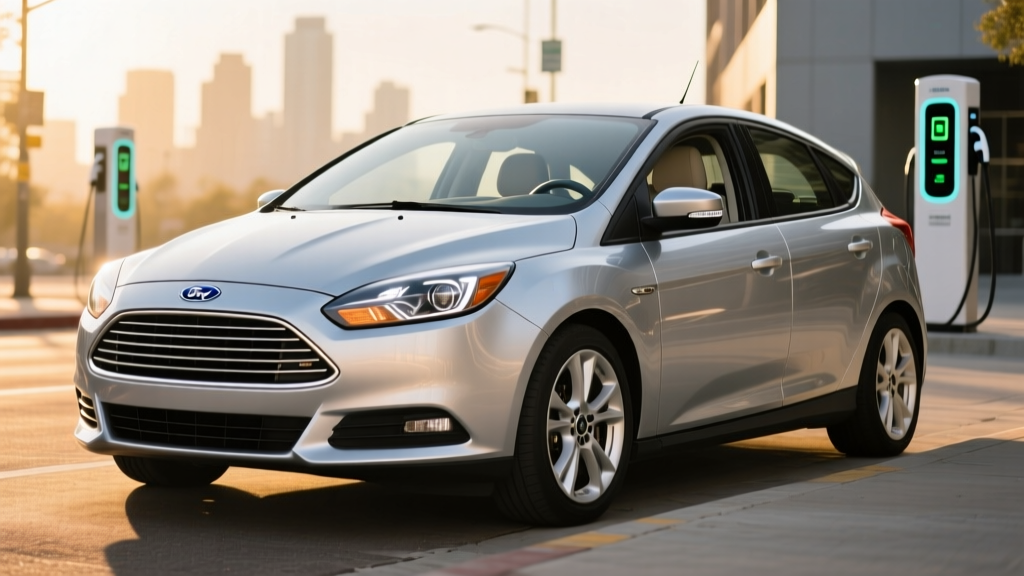
Ford's first mass-market battery electric vehicle was essentially a Ford Focus hatchback with the engine bay converted to house an electric motor and a 23 kWh lithium-ion battery pack (sourced from LG Chem). It was sold from the 2012 through 2018 model years with modest updates. The 2013 model year is significant because it was the first full production year and the one you'll most commonly find on the used market at low prices.
Unlike the compliance-car approach some automakers took, Ford did sell the Focus Electric nationwide, though volumes were always low. The car uses a 107 kW (143 horsepower) permanent-magnet electric motor driving the front wheels through a single-speed reduction gear. It's a competent, if unremarkable, compact hatchback when you set aside its range limitations.
| Specification | Value |
|---|---|
| EPA Range (new) | 76 miles |
| Battery Capacity (total / usable) | 23 kWh / ~19.5 kWh |
| Battery Chemistry | NMC (nickel manganese cobalt) — LG Chem |
| Motor Output | 107 kW / 143 hp / 184 lb-ft torque |
| 0–60 mph | ~9.2 seconds |
| Top Speed | 84 mph (electronically limited) |
| EPA Efficiency | 105 MPGe combined (32 kWh/100 mi) |
| DC Fast Charge (peak) | 43 kW (CHAdeMO connector) |
| Level 2 AC Charge Rate | 6.6 kW onboard charger |
| Level 2 Charge Time (0–100%) | ~3.5–4 hours |
| DC Fast Charge 10–80% (est.) | ~30–35 minutes |
| Cargo Volume | 14.5 cu ft (reduced by battery packaging) |
| Curb Weight | ~3,624 lbs |
| Original MSRP (2013) | $39,200 (before incentives) |
| 2026 Used Market Price | $4,000–$7,500 |
| Battery Warranty (original) | 8 years / 100,000 miles (expired) |
Range Reality Check: EPA Sticker vs. What You'll Actually Get
The 76-mile EPA range was modest even in 2013. In 2026, that figure puts the Focus Electric well below every new EV on sale and most used EVs you'll cross-shop. But the sticker number is only the starting point — real-world range depends heavily on conditions.
Real-World Range Expectations (2013 Focus Electric, 13-Year-Old Battery)
Assuming 15–20% battery degradation (typical for a 2013 NMC pack in 2026):
- Mild weather, city driving (35–45 mph): 55–65 miles usable
- Mixed driving (city + suburban): 50–60 miles usable
- Highway (65–70 mph sustained): 40–50 miles usable
- Cold weather (below 32°F), mixed driving: 35–45 miles usable
- Cold weather + highway: 30–40 miles usable
The Focus Electric uses a liquid-cooled battery pack, which helps longevity but does not include a dedicated battery heat pump for winter preconditioning like modern EVs. Expect significant range loss in freezing temperatures.
For context, a 2026 Chevrolet Equinox EV delivers an EPA-estimated 315 miles of range — roughly four times what you'll get from a degraded 2013 Focus Electric on the highway. The Focus Electric is strictly a local errand and short-commute vehicle.
Charging: Slow by Modern Standards
The Focus Electric's charging capabilities reflect early-2010s technology. Here's what each level looks like in practice:
| Level | Power | Connector | Miles Added Per Hour | Notes |
|---|---|---|---|---|
| Level 1 (120V) | ~1.4 kW | Standard outlet (J1772 cable) | ~4–5 miles/hr | Full charge: ~14–16 hours |
| Level 2 (240V) | 6.6 kW | J1772 | ~20–22 miles/hr | Full charge: ~3.5–4 hours |
| DC Fast Charge | Peak 43 kW | CHAdeMO | ~100+ miles/hr (initial) | 10–80%: ~30–35 min; tapers sharply above 80% |
Critical connector note: The 2013 Focus Electric uses the CHAdeMO DC fast-charging standard. In 2026, the North American charging landscape has overwhelmingly shifted to NACS (the Tesla connector, now the industry standard) and CCS1. CHAdeMO stations are increasingly rare — Electrify America and most newer networks do not support CHAdeMO at all. Before buying, verify that CHAdeMO chargers exist near your regular routes by checking the Alternative Fuels Data Center station locator.
For most owners, this car will be charged exclusively at home on Level 2. A full Level 2 home charging setup (240V, 30-amp circuit) will replenish the small battery overnight in about 4 hours, which is adequate for daily use given the short range.
EV vs. Gas: Cost Comparison for Short-Range Driving
The strongest argument for a used 2013 Focus Electric is economics — specifically, the rock-bottom purchase price and near-zero fuel cost for short trips. Here's how it stacks up against a comparable used gas compact and a used hybrid for a 30-mile daily round-trip commute.
| Cost Factor | 2013 Focus Electric | 2013 Ford Focus (Gas) | 2013 Toyota Prius (Hybrid) |
|---|---|---|---|
| Purchase Price (2026 used) | $5,500 (avg.) | $5,000 (avg.) | $7,500 (avg.) |
| EPA Efficiency | 32 kWh/100 mi | 28 MPG combined | 50 MPG combined |
| Fuel/Energy Cost per Unit | $0.14/kWh (avg. US residential) | $3.30/gallon | $3.30/gallon |
| Annual Fuel/Energy Cost | $336 | $884 | $495 |
| Annual Maintenance (est.) | $350 | $650 | $550 |
| Annual Insurance (est.) | $1,100 | $1,000 | $1,050 |
| Total Annual Operating Cost | $1,786 | $2,534 | $2,095 |
| Annual Savings vs. Gas Focus | $748/year | — | $439/year |
The Focus Electric saves roughly $748 per year in operating costs compared to its gas sibling. Over 5 years of ownership, that's $3,740 in savings — a meaningful return on a $5,500 purchase. However, these savings assume reliable home charging access and a commute that fits within the real-world range. If you need to rely on public DC fast charging (at $0.35–$0.50/kWh), the fuel cost advantage narrows considerably.
Maintenance advantage: The Focus Electric has no engine oil, no transmission fluid, no spark plugs, no timing belt, and no exhaust system. Brake wear is dramatically reduced thanks to regenerative braking. The primary wear items are tires, cabin air filter, wiper blades, brake fluid, and the 12V auxiliary battery. The main financial risk is the traction battery — if it fails out of warranty (which it now is), replacement costs $5,000–$8,000, which would total the vehicle.
Battery Health: The Make-or-Break Factor for a 13-Year-Old EV
Battery degradation is the single most important factor when evaluating any used EV, and it's especially critical for a car with only 76 miles of range to begin with. The Focus Electric's LG Chem NMC pack has held up reasonably well compared to some early EVs (the liquid-cooling system helps), but 13 years of calendar aging is unavoidable.
Common Misconceptions About the 2013 Focus Electric
| Myth | Fact |
|---|---|
| "It qualifies for the $7,500 federal EV tax credit." | False. The IRS §30D credit applies only to new clean vehicles purchased from a dealer. The separate used-EV credit (§25E) offers up to $4,000 or 30% of the sale price (whichever is less) for vehicles priced at $25,000 or less from a dealer. A $5,500 Focus Electric would yield a maximum $1,650 credit, subject to income limits ($75K single / $150K joint). |
| "The battery will need replacing immediately." | Usually false. Most 2013 Focus Electric packs show 75–85% state of health (SoH) after 13 years. That reduces range to 57–65 miles EPA-equivalent. Replacement is only needed if SoH drops below ~60% or cells become unbalanced. |
| "I can fast-charge it anywhere." | False. The CHAdeMO connector is being phased out across North America. Most new DC fast-charging stations use NACS or CCS1 only. Verify CHAdeMO availability in your area before purchasing. |
| "It can handle a 100-mile round trip." | Risky. With a degraded battery, expect 50–65 miles of real-world range. A 100-mile round trip would require a mid-day charge, and finding a working CHAdeMO station is increasingly difficult. |
| "Insurance will be cheaper than a gas car." | Usually false. EV insurance tends to be slightly higher due to battery replacement costs in collision claims. Expect to pay 5–15% more than the gas Focus. |
How to Check Battery Health Before Buying
Before purchasing any 2013 Focus Electric, take these steps:
- Request a battery health report. A Ford dealer can pull the State of Health (SoH) percentage from the vehicle's battery management system. Aim for 75% SoH or higher.
- Perform a full-charge range test. Charge to 100% and note the displayed estimated range. If it reads below 55 miles, the battery has degraded significantly.
- Check for battery-related diagnostic trouble codes (DTCs). An OBD2 scanner or dealer scan tool can reveal cell imbalance or thermal management issues.
- Inspect the battery cooling system. The liquid cooling loop should be free of leaks. Coolant should have been serviced per the maintenance schedule.
- Verify the battery warranty status. The original 8-year/100,000-mile warranty has expired for all 2013 models as of 2021. Any battery failure is an out-of-pocket expense.
Who Should Buy the 2013 Focus Electric — And Who Shouldn't
This car fills a very specific niche. It's not a do-everything vehicle, and pretending otherwise leads to disappointment. Here's a practical decision framework:
Choose the 2013 Focus Electric If:
- Your daily driving is under 40 miles round-trip, mostly city/suburban
- You have reliable Level 2 home charging (garage or driveway with 240V access)
- You live in a mild climate (rarely below 25°F) or accept winter range loss
- You want the lowest possible purchase price for a functional EV
- You're looking for a second car / commuter car, not a primary vehicle
- You have access to CHAdeMO charging for occasional top-ups away from home
- You understand the battery is out of warranty and accept the replacement risk
Look at Other Options If:
- Your commute exceeds 50 miles one-way
- You need to drive in extreme cold regularly (below 20°F)
- You don't have home charging and would rely on public infrastructure
- This would be your only vehicle and you need road-trip capability
- You want modern ADAS features (lane-keeping, adaptive cruise, automatic emergency braking)
- You live in an area with no remaining CHAdeMO chargers
- You can't absorb a potential $5,000–$8,000 battery replacement cost
Used EV Alternatives to Consider
If the Focus Electric's limitations give you pause, several other used EVs from the same era offer trade-offs worth evaluating:
| Model | EPA Range (New) | Battery | DC Connector | 2026 Used Price | Key Advantage |
|---|---|---|---|---|---|
| 2013 Nissan LEAF (24 kWh) | 75 miles | 24 kWh, NMC | CHAdeMO | $3,500–$6,000 | Cheaper; more abundant |
| 2015 Nissan LEAF (30 kWh) | 107 miles | 30 kWh, NMC | CHAdeMO | $6,000–$9,000 | More range |
| 2015 Chevrolet Spark EV | 82 miles | 19 kWh, NMC | CCS (or SAE Combo) | $5,000–$8,000 | CCS connector; 130 kW DC capability (later models) |
| 2013 Fiat 500e | 87 miles | 24 kWh, NMC | No DC fast charge | $5,000–$8,000 | Fun to drive; slightly more range |
| 2016 BMW i3 (60 Ah) | 81 miles | 22 kWh, NMC | CCS | $8,000–$12,000 | CCS; premium build; range extender option |
| 2017 Chevrolet Bolt EV | 238 miles | 60 kWh, NMC | CCS | $12,000–$16,000 | 3x the range; CCS; modern feel |
If your budget can stretch to $12,000–$16,000, a used 2017–2019 Chevrolet Bolt EV is dramatically more capable — 238 miles of range, CCS fast charging (up to 55 kW), and a much more usable vehicle for varied driving patterns. The Bolt is the inflection point where a used EV transitions from "city runabout" to "genuine daily driver."
Home Charging Setup: What You'll Need
Most 2013 Focus Electric owners will charge exclusively at home. Here's a realistic cost breakdown for a Level 2 installation:
| Item | Cost Range |
|---|---|
| Level 2 EVSE (charger unit, 32A/40A) | $200–$500 |
| Electrical permit | $50–$200 |
| Electrician labor (new 240V/40A circuit, ~50 ft run) | $500–$1,500 |
| Panel upgrade (if needed — 100A to 200A service) | $1,500–$3,500 |
| Total (no panel upgrade) | $750–$2,200 |
| Total (with panel upgrade) | $2,250–$5,700 |
Important: The Focus Electric's 6.6 kW onboard charger means you only need a 30-amp circuit to get maximum charge speed. You don't need a 48-amp or 60-amp circuit like newer EVs require. This can lower installation costs. However, installing a higher-capacity circuit (40A or 50A) is smart if you plan to upgrade to a newer EV later. Always hire a licensed electrician and pull permits — unpermitted electrical work can void homeowner's insurance and create fire risk.
Tax Credits and Incentives for Used EVs in 2026
The federal landscape for used EV purchases has changed significantly since this car was new. Here's what applies in 2026:
- Used Clean Vehicle Credit (IRS §25E): Up to $4,000 or 30% of the sale price (whichever is less). For a $5,500 Focus Electric, the maximum credit is $1,650.
- Dealer sale required: The vehicle must be purchased from a licensed dealer — private-party sales do not qualify.
- Income limits: Adjusted gross income must not exceed $75,000 (single), $112,500 (head of household), or $150,000 (married filing jointly).
- Vehicle price cap: The sale price must be $25,000 or less.
- Vehicle age requirement: The vehicle must be at least 2 model years old (the 2013 Focus Electric qualifies).
- Point-of-sale transfer: The credit can be transferred to the dealer at purchase for an immediate price reduction, similar to the new-vehicle credit.
- One-time use per buyer: You can only claim the used-EV credit once every 3 years.
Check current eligibility details on IRS.gov's used clean vehicle credit page, as rules can shift. Also investigate your state and utility incentives — some states offer rebates for used EV purchases or home charger installations that can further reduce your total cost.
Frequently Asked Questions
Is the 2013 Ford Focus Electric safe?
The 2013 Focus Electric earned a 5-star overall safety rating from NHTSA, which is excellent. However, it lacks modern active safety features like automatic emergency braking, lane-departure warning, or adaptive cruise control. In a crash, the battery pack is well-protected, but first responders should be informed it's an EV. The car includes standard front, side, and curtain airbags plus stability control.
How long will the battery last on a 2013 Focus Electric?
Most 2013 Focus Electric packs are showing 75–85% state of health in 2026. With proper care (avoiding prolonged storage at 100% or 0% charge, minimizing DC fast charging, keeping the cooling system maintained), these packs can remain functional to 15–18 years. However, individual cell failures or cooling system neglect can accelerate degradation. Budget for a potential battery replacement ($5,000–$8,000) as a contingency.
Can I road-trip in the 2013 Focus Electric?
Realistically, no. With 50–65 miles of real-world range and CHAdeMO-only DC fast charging (increasingly scarce), intercity travel requires meticulous planning, multiple 30-minute charge stops, and the willingness to risk being stranded if a charger is broken. For road trips, rent a car or use a gas/hybrid vehicle.
What's it like to drive compared to the gas Ford Focus?
The electric Focus is quieter, smoother, and has instant torque from a stop, making it feel peppy around town despite its 9.2-second 0–60 time. The extra ~500 lbs of battery weight is noticeable in corners, and the reduced cargo space (14.5 cu ft vs. 23.8 cu ft in the gas hatchback) is a real compromise. The regenerative braking is moderate — it doesn't offer true one-pedal driving like newer EVs.
Should I get a pre-purchase inspection?
Absolutely. Beyond the standard used-car inspection (suspension, brakes, body, interior), insist on a battery health check that includes SoH percentage, cell voltage spread, and cooling system condition. A Ford EV-certified dealer is the best option for this. The $100–$200 inspection cost is trivial compared to a $7,000 battery replacement surprise.
What about the 12V battery?
Like all EVs, the Focus Electric has a standard 12V lead-acid auxiliary battery that powers lights, infotainment, and computers. If the 12V dies, the car won't start — even if the main traction battery is fully charged. Replace it proactively every 4–5 years, and keep a portable lithium jump-starter in the trunk. A dead 12V battery is the #1 reason EV owners get stranded, not traction battery failure.