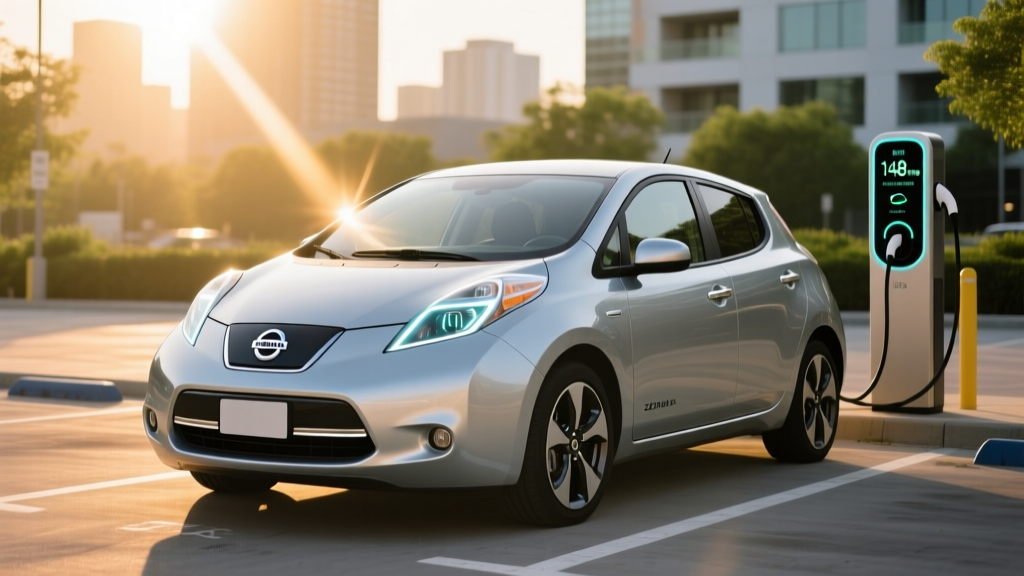
The 2012 Nissan Leaf holds a unique place in electric-vehicle history. As one of the first mass-market, purpose-built battery-electric vehicles sold in the United States, it proved that a practical, zero-tailpipe-emission commuter car was viable for everyday drivers. More than a decade later, the 2012 Leaf remains a common sight on the used-EV market — and a frequent search for budget-conscious buyers exploring their first electric car.
But buying a 14-year-old EV in 2026 requires clear-eyed analysis, not nostalgia. The 2012 Leaf's original 24 kWh battery has almost certainly degraded, its CHAdeMO fast-charging standard has been eclipsed by NACS and CCS, and its 73-mile EPA range was modest even at launch. This review breaks down exactly what you need to know — from real-world range expectations and battery health checks to charging logistics and total cost of ownership — before you hand over cash for a used 2012 Leaf.
2012 Nissan Leaf: Core Specifications at a Glance
| Specification | Value |
|---|---|
| EPA Range (Original) | 73 miles |
| Battery Capacity (Usable) | ~21 kWh usable of 24 kWh total |
| Battery Chemistry | NMC (Lithium Manganese Oxide spinel cathode) |
| Motor Output | 80 kW (107 hp) / 207 lb-ft torque |
| 0–60 mph | ~9.9 seconds |
| Drivetrain | Front-wheel drive (FWD) |
| EPA Efficiency | 99 MPGe combined / 34 kWh/100 mi |
| DC Fast Charge (Max) | ~44 kW peak (CHAdeMO connector) |
| Level 2 Charge Rate | 3.3 kW (6.6 kW optional on SL trim) |
| Cargo Volume | 14.5 cu ft (rear seats up) / 24.0 cu ft (folded) |
| Original MSRP (2012) | $35,200 (SV base) / $37,250 (SL) |
| Used Price Range (2026) | $3,500 – $7,500 depending on battery SoH |
| Battery Warranty (Original) | 8 years / 100,000 miles (capacity loss below 9 bars) |
Real-World Range: What to Actually Expect in 2026
EPA Original Estimate: 73 miles (full battery, new)
Real-World Expectation (Used, 2026): 40–60 miles on a full charge depending on battery State of Health (SoH), ambient temperature, and driving style.
Cold-Weather Impact: Expect 30–40% range loss in sub-40°F conditions due to cabin heating draw and reduced battery chemistry efficiency. A degraded 2012 Leaf may deliver as few as 25–35 miles in winter.
Highway vs. City: City driving with regenerative braking recovers energy; sustained 70 mph highway driving will consume more kWh per mile and reduce range further.
The 2012 Leaf's battery was never large by modern standards. Nissan used a 24 kWh (gross) lithium-manganese oxide (LMO/NMC variant) laminate pack manufactured by NEC. Of that, roughly 21 kWh was usable — Nissan built in a top and bottom buffer to protect longevity. When new, the EPA rated the 2012 Leaf at 73 miles of combined driving range.
That was over a decade ago. Every lithium-ion battery degrades with time, charge cycles, and heat exposure. The 2012 Leaf's air-cooled battery management system (BMS) — Nissan's "passive" thermal approach — is a known weak point. Owners in hot climates (Arizona, Texas, the Southeast) often report significant capacity loss, sometimes dropping to 60–70% State of Health after 8–10 years. Cooler-climate examples tend to fare better, retaining 75–85% SoH.
For a 2012 Leaf at roughly 70% SoH in 2026, you're working with approximately 14–15 usable kWh. At the Leaf's average consumption of 34 kWh per 100 miles, that translates to roughly 41–44 miles of real range in mixed driving. This is a commuter vehicle — not a road-trip car — and buyers need to internalize that limitation before purchasing.
Charging Speeds: CHAdeMO, Level 2, and the Connector Problem
| Charging Level | Power / Rate | Estimated Time (10–80%) | Notes |
|---|---|---|---|
| Level 1 (120V household) | ~1.2 kW | 14–18 hours (full charge) | Trickle charge; adds ~4 miles/hour |
| Level 2 (240V, 3.3 kW onboard) | 3.3 kW | ~5.5 hours (full charge) | Standard SV trim; adds ~12 miles/hour |
| Level 2 (240V, 6.6 kW onboard) | 6.6 kW | ~3.5 hours (full charge) | Optional on SL trim; adds ~23 miles/hour |
| DC Fast Charge (CHAdeMO) | ~44 kW peak | ~30 minutes (0–80%) | Rapid taper above 80%; CHAdeMO infrastructure declining |
The 2012 Leaf uses the CHAdeMO DC fast-charging connector, a Japanese-developed standard that was widely deployed in the early 2010s. The peak DC charge rate is approximately 44 kW — respectable for its era, but far below modern EVs that pull 150–350 kW. A 0–80% charge takes roughly 30 minutes under ideal conditions, though the charge curve tapers significantly above 80% SoC to protect the battery.
Here's the critical concern for 2026 buyers: CHAdeMO public charging infrastructure is shrinking. Electrify America has standardized on CCS, Tesla's NACS connector is becoming the North American standard, and new CHAdeMO installations have nearly ceased. While some legacy CHAdeMO stations remain — particularly along the West Coast and at older Nissan dealership locations — relying on public DC fast charging in a 2012 Leaf is increasingly impractical.
For Level 2 home charging, the base SV trim came with a 3.3 kW onboard charger, while the SL trim offered an optional 6.6 kW charger. If you're installing a home Level 2 station (240V), a 3.3 kW Leaf will fully charge overnight in about 5.5 hours. That's adequate for daily commuting but means you can't quickly "top off" before an unexpected longer trip. Note: kW (kilowatts) measures charging power — the rate of energy delivery — while kWh (kilowatt-hours) measures battery capacity, the total energy stored. These are not interchangeable.
Performance, Efficiency, and Daily Drivability
The 2012 Leaf is powered by an 80 kW (107 horsepower) AC synchronous electric motor driving the front wheels. It produces 207 lb-ft of torque, available instantly from zero RPM — a characteristic that makes the Leaf feel surprisingly peppy around town despite its leisurely 9.9-second 0–60 mph time. In stop-and-go city traffic, the Leaf's one-pedal-driving-like regenerative braking and smooth, silent acceleration remain genuinely pleasant.
The EPA rated the 2012 Leaf at 99 MPGe combined (city: 106 MPGe / highway: 92 MPGe), consuming approximately 34 kWh per 100 miles. That efficiency figure remains competitive with many modern EVs — the Leaf was lightweight (roughly 3,340 lbs) and aerodynamically optimized for its time. At the 2026 national average electricity rate of ~$0.17/kWh, fueling a Leaf costs roughly $5.78 per 100 miles — a fraction of what a comparable gasoline car requires.
However, the Leaf's performance limitations are real. Highway passing power above 60 mph is thin. Top speed is electronically limited to approximately 90 mph. And the absence of active battery thermal management means repeated fast-charging sessions or sustained high-speed driving in hot weather can trigger "turtle mode" — Nissan's power-reduction safeguard to prevent battery overheating.
Interior, Cargo, and Technology
Inside, the 2012 Leaf offers a surprisingly spacious cabin for its compact hatchback footprint. Front legroom measures 42.1 inches and rear legroom 33.5 inches — adequate for adults in both rows. The cargo area provides 14.5 cubic feet behind the rear seats and 24.0 cubic feet with the 60/40 split rear bench folded, making it practical for grocery runs, small furniture, or airport luggage duty.
Technology in the 2012 Leaf reflects its era. The SV trim includes a basic infotainment system with a 4.3-inch display, Bluetooth phone connectivity, and USB input. The SL trim upgrades to a 7-inch touchscreen with navigation, a rearview camera, and a solar panel integrated into the rear spoiler (which trickle-charges the 12V accessory battery, not the main traction pack). There is no Apple CarPlay, Android Auto, adaptive cruise control, or lane-keeping assist — features that became standard in later Leaf generations and competing EVs.
The instrument cluster features a digital "range estimator" display that Nissan owners nicknamed the "Guess-O-Meter" (GOM) for its sometimes erratic range predictions. Learning to interpret actual kWh consumption via the trip computer, rather than trusting the GOM, is an essential skill for any 2012 Leaf owner.
Pricing, Used Market Value, and Tax Credit Eligibility
| Item | Detail |
|---|---|
| Original MSRP (2012 SV) | $35,200 |
| Original MSRP (2012 SL) | $37,250 |
| Typical Used Price (2026) | $3,500 – $7,500 |
| Used EV Federal Tax Credit (§25E) | Up to $4,000 or 30% of sale price (whichever is lower) |
| Credit-Adjusted Cost (Best Case) | As low as ~$0 – $3,500 out of pocket |
The 2012 Nissan Leaf no longer qualifies for the new-vehicle IRS §30D Clean Vehicle Credit — that credit applies only to new purchases. However, it may qualify for the §25E Previously-Owned Clean Vehicle Credit, which offers up to $4,000 or 30% of the sale price, whichever is lower.
To claim the §25E credit, several conditions must be met:
- Sale price cap: The vehicle must sell for $25,000 or less (easily met by any used 2012 Leaf).
- Income limits: Modified adjusted gross income (MAGI) must not exceed $75,000 (single), $112,500 (head of household), or $150,000 (joint filers).
- Dealer requirement: The vehicle must be purchased from a licensed dealer (private-party sales do not qualify).
- Model year requirement: The vehicle must be at least two model years old (easily met).
- First transfer: The credit applies only to the first qualified sale of the vehicle after August 16, 2022 — meaning many 2012 Leafs have already been transferred and the credit may have been claimed on a prior sale. Verify with the selling dealer and consult a tax professional.
- Claim frequency: A buyer can claim the §25E credit only once every three years.
If you find a well-maintained 2012 Leaf for $5,000 from a qualifying dealer and meet the income thresholds, the 30% credit yields $1,500 off your tax bill — bringing your effective cost to $3,500. At a $7,500 purchase, the credit caps at $2,250 (30% of $7,500). Always verify current IRS rules at irs.gov, as credit availability and transfer rules evolve.
Battery Health: The Make-or-Break Factor
When evaluating a used 2012 Leaf, battery State of Health (SoH) is the single most important variable — more consequential than mileage, exterior condition, or trim level. Here's what to check:
The dashboard capacity bars: The 2012 Leaf displays 12 battery capacity bars on the far right of the instrument cluster (distinct from the charge-level bars). A brand-new Leaf showed 12 bars. Each lost bar represents roughly 6.25% capacity degradation. A 2012 Leaf showing 9 bars has lost approximately 18–19% capacity and sits near 81% SoH. Anything below 9 bars (7 or fewer) means the battery has degraded past Nissan's original warranty threshold, and you should expect 50 miles or less of real-world range.
Leaf Spy Pro: This third-party OBD-II app reads the battery management system directly and provides precise SoH percentage, cell voltage variance, and Hx (internal resistance) readings. Any serious 2012 Leaf buyer should either bring a Leaf Spy-compatible dongle to the inspection or request a recent screenshot from the seller. Cell voltage variance above 200 mV between the highest and lowest cells indicates imbalance — a sign of accelerated degradation.
Battery replacement cost: A refurbished 24 kWh replacement pack from Nissan or third-party suppliers typically costs $5,000–$8,500 installed in 2026 — potentially exceeding the vehicle's value. Some owners opt for aftermarket 30 kWh or 40 kWh pack swaps (from later Leaf models), but these require BMS compatibility modifications and are not plug-and-play.
Original warranty status: Nissan's battery warranty covered capacity loss below 9 of 12 bars for 8 years or 100,000 miles. For a 2012 model, that warranty expired no later than 2020. Any battery replacement or repair is now an out-of-pocket expense.
Who Should Buy a 2012 Nissan Leaf — and Who Shouldn't
Choose the 2012 Leaf if:
- Your daily round-trip commute is under 30 miles and you can charge at home every night
- You want the cheapest possible entry point into EV ownership (sub-$4,000 after credit)
- You live in a mild climate where battery degradation has been slower
- You need a second car for errands, school runs, and local driving only
- You have access to a Level 2 home charger or can install one
Look elsewhere if:
- Your commute exceeds 40 miles one way — range anxiety will be constant
- You live in a region with harsh winters — cold weather decimates the Leaf's already limited range
- You need DC fast charging for road trips — CHAdeMO infrastructure is disappearing
- You want modern safety tech (automatic emergency braking, lane-keeping, blind-spot monitoring)
- Battery replacement cost ($5,000–$8,500) would be financially devastating
2012 Nissan Leaf vs. Key Used-EV Alternatives
The 2012 Leaf competes in the used-EV market against several contemporaries and slightly newer models. Here's how it stacks up:
- 2013–2015 Chevrolet Volt (PHEV): Offers 35–38 miles of electric range plus a gasoline range extender, eliminating range anxiety entirely. Used prices: $6,000–$10,000. Better for buyers who occasionally need longer range.
- 2013–2016 Tesla Model S (60/85 kWh): Far more range (200+ miles), Supercharger access, and performance — but used prices start around $12,000–$18,000, and out-of-warranty repair costs can be steep.
- 2016–2018 Nissan Leaf (30 kWh): The refreshed second-generation Leaf offers a 30 kWh battery with 107 miles EPA range, addressing the original's biggest weakness. Used prices: $8,000–$12,000. A significantly better buy if budget allows.
- 2017–2019 Chevrolet Bolt EV: 238 miles EPA range, CCS fast charging, and a 60 kWh battery make the Bolt a far more capable used EV. Prices: $10,000–$15,000. The Bolt is the clear winner for anyone needing real versatility.
Compared to these alternatives, the 2012 Leaf's only compelling advantage is absolute rock-bottom price. If you can acquire one for $3,500–$4,500 (after the used-EV credit) and your needs are strictly local, it's the cheapest way to drive electric. For anything beyond that narrow use case, spending $3,000–$6,000 more on a 2016+ Leaf or a Bolt EV delivers dramatically more range, modern charging, and usable battery life.
Pros and Cons: The Honest Assessment
- Extremely low purchase price (from ~$3,500)
- Cheap to "fuel" — under $6 per 100 miles on electricity
- Smooth, quiet, zero-emission city driving
- Spacious hatchback cargo area for its class
- Eligible for up to $4,000 used-EV tax credit
- Low maintenance (no oil changes, minimal brake wear from regen)
- Severely limited range (40–60 miles real-world used)
- Passive air-cooled battery degrades faster, especially in heat
- CHAdeMO fast-charging infrastructure is declining
- No modern driver-assistance or safety features
- Battery replacement cost can exceed vehicle value
- Slow Level 2 charging (3.3 kW standard)
- No Apple CarPlay / Android Auto
Frequently Asked Questions
What is the real-world range of a used 2012 Nissan Leaf?
Expect 40–60 miles on a full charge in moderate weather, depending on battery State of Health. A well-preserved example at 80% SoH might reach 55–60 miles in city driving. In cold weather (below 40°F), range drops to 25–40 miles. Highway driving at 70+ mph further reduces range. The original EPA sticker of 73 miles applies only to a brand-new battery — no 2012 Leaf on the road today will match that figure.
How fast does the 2012 Leaf charge at home and on DC fast chargers?
At home on a 240V Level 2 charger, the standard 3.3 kW onboard charger adds about 12 miles of range per hour, taking roughly 5.5 hours for a full charge. The optional 6.6 kW charger (SL trim) cuts that to about 3.5 hours. On a CHAdeMO DC fast charger, the Leaf peaks at approximately 44 kW and can reach 80% in about 30 minutes — but CHAdeMO stations are increasingly rare in 2026.
Does the 2012 Nissan Leaf qualify for any federal tax credit?
Not the new-vehicle §30D credit. However, it may qualify for the §25E Previously-Owned Clean Vehicle Credit — up to $4,000 or 30% of the sale price (whichever is lower). Eligibility requires purchase from a licensed dealer, buyer income below IRS thresholds ($75K single / $150K joint), a sale price under $25,000, and that the credit hasn't already been claimed on this specific vehicle's first post-August-2022 sale. Consult a tax professional before relying on this credit.
Is the 2012 Leaf worth buying versus other used EVs?
Only if your budget is strictly under $5,000 and your driving is exclusively local (under 30 miles round-trip). For $3,000–$6,000 more, a 2016+ Nissan Leaf (30 kWh, 107-mile range) or a Chevrolet Bolt EV (238-mile range, CCS charging) offers vastly more capability, modern safety features, and a battery with more usable life remaining. The 2012 Leaf is a budget city runabout — not a primary vehicle.
What should I check before buying a used 2012 Leaf?
Three critical items: (1) Check the 12 battery capacity bars on the dashboard — 9 or more bars is acceptable, 8 or fewer is a red flag. (2) Use the Leaf Spy Pro app with an OBD-II dongle to read precise SoH percentage and cell voltage variance. (3) Verify whether the battery has ever been replaced and get documentation. Also check for rust on the undercarriage, the condition of the charging port door latch (a common failure), and whether the original EVSE (charging cable) is included.
Can I upgrade the 2012 Leaf's battery for more range?
Technically, yes — some specialists offer 30 kWh or 40 kWh pack swaps from later Leaf models. However, these conversions cost $6,000–$10,000+ and require BMS reprogramming and compatibility modifications. Given that the conversion cost exceeds the car's value, it's rarely financially justified. A more practical approach: sell the 2012 Leaf and put the combined funds toward a newer used EV with a larger, healthier battery.