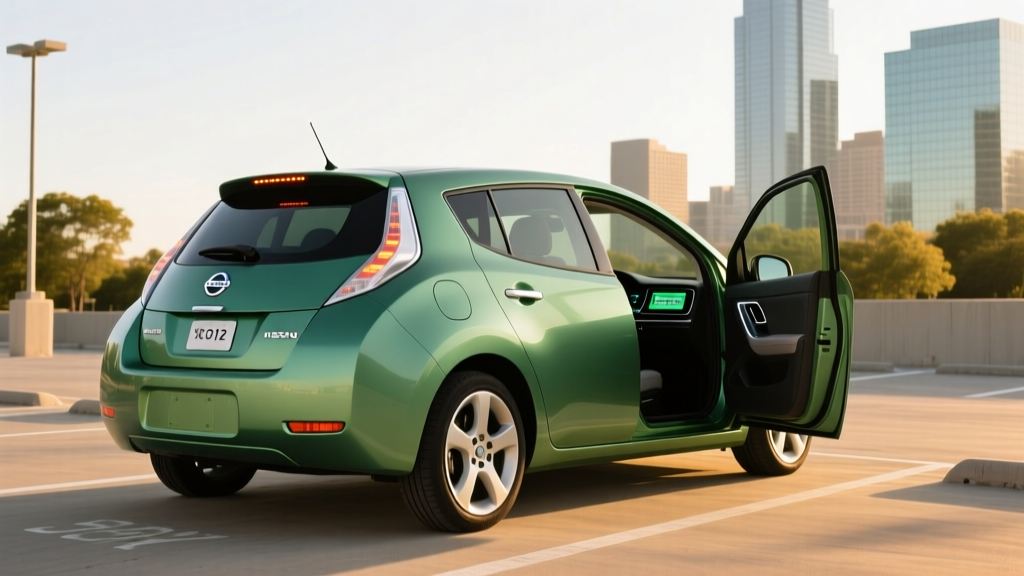
The 2012 Nissan Leaf hatchback was the car that launched the modern mass-market EV era in the United States. More than a decade later, it remains one of the most affordable entry points into electric vehicle ownership — but only on the used market, where examples routinely sell between $4,000 and $8,000. For budget-conscious commuters, second-car seekers, or anyone curious about EV life without a five-figure commitment, the first-generation Leaf demands a closer look. It also demands honesty about what a 14-year-old battery can and cannot do.
This review covers the 2012 Leaf's real-world range, charging infrastructure compatibility, battery degradation realities, and whether it still makes financial sense in 2026. We'll also address the federal tax credit question that trips up many used-EV shoppers.
2012 Nissan Leaf Hatchback: Core Specifications at a Glance
| Specification | 2012 Nissan Leaf (SV/SL) |
|---|---|
| EPA Range (Original) | 73 miles |
| Battery Capacity (Usable) | ~21 kWh usable (24 kWh gross) |
| Battery Chemistry | Lithium Manganese Oxide (LMO) — passive air cooling |
| Motor Output | 80 kW (107 hp), 187 lb-ft torque |
| Drivetrain | Front-wheel drive (FWD), single-speed reduction |
| 0–60 mph | ~9.9 seconds |
| EPA Efficiency | 99 MPGe combined / 34 kWh per 100 mi |
| DC Fast Charge (CHAdeMO) | Up to 50 kW (optional on SV, standard on SL) |
| Level 2 Charge Rate | 3.3 kW onboard charger (6.6 kW optional late 2012) |
| Cargo Volume | 24.0 cu ft (rear seats up), 30.0 cu ft (folded) |
| Original Base MSRP | $35,200 (SV) / $37,250 (SL) before incentives |
| Typical 2026 Used Price | $4,000 – $8,500 depending on battery health |
| Battery Warranty (Original) | 8 years / 100,000 miles (capacity-loss guarantee) |
Real-World Range: What to Actually Expect
Real-World Expectation in 2026: 40–65 miles depending on battery State of Health (SoH), ambient temperature, and driving style. A well-preserved example might still deliver 60+ miles in mild city driving. A degraded pack in winter highway conditions could drop to 35–40 miles.
The 2012 Leaf's original 73-mile EPA rating was modest even at launch. In 2026, the number that matters is the battery's current State of Health. Nissan's passive air-cooled battery pack is the Leaf's Achilles heel — without active liquid thermal management, the 24 kWh LMO cells degrade faster than liquid-cooled competitors, especially in hot climates like Arizona, Texas, or Southern California.
According to data aggregated by Leaf owners on fueleconomy.gov, real-world efficiency hovers around 3.0–3.5 miles per kWh in moderate temperatures. Multiply that by a degraded pack's actual usable capacity (often 14–18 kWh by now) and you get a realistic picture of daily range.
Cold-weather reality check: Lithium-ion batteries lose 20–35% of available capacity below freezing. The 2012 Leaf has a resistive cabin heater (no heat pump), which draws significant power. In 20°F weather with the heater running, expect your already-reduced range to drop by roughly a third. A 55-mile summer range becomes 35–40 miles in a cold snap.
Highway penalty: The Leaf's aerodynamic drag and single-speed gearing mean efficiency drops noticeably above 65 mph. If your commute is predominantly 70+ mph freeway driving, plan for the lower end of the range estimates.
Charging: CHAdeMO, Level 2, and the Infrastructure Problem
| Charging Level | Power / Connector | Estimated Time | Notes |
|---|---|---|---|
| Level 1 (120V household) | ~1.4 kW (J1772) | ~20 hours (empty to full on degraded pack) | Emergency/trickle only; adds ~4–5 mi/hr |
| Level 2 (240V home/public) | 3.3 kW (J1772) | ~6–7 hours (full charge) | Adds ~12–14 mi/hr; overnight charging standard |
| Level 2 (6.6 kW option) | 6.6 kW (J1772) | ~3–4 hours (full charge) | Available on later 2012 builds; adds ~22 mi/hr |
| DC Fast Charge | 50 kW peak (CHAdeMO) | ~30 min (10–80%) | Only if equipped; CHAdeMO stations increasingly rare |
The 2012 Leaf uses the CHAdeMO DC fast-charging standard — the same connector adopted by early Mitsubishi i-MiEV and later Kia Soul EV models. Here's the critical ownership issue in 2026: CHAdeMO infrastructure is disappearing. Electrify America has largely standardized on CCS1, Tesla Superchargers use NACS (now opening to other brands via adapters), and most new public installations favor CCS1 or NACS. CHAdeMO chargers still exist — primarily at older Nissan dealerships and legacy ChargePoint/EVgo stations — but the network is shrinking.
The 50 kW peak DC charge rate was respectable in 2012 but is painfully slow by current standards. Modern EVs routinely accept 150–350 kW. On the Leaf's small, degraded battery, a 50 kW CHAdeMO session will taper quickly as the pack approaches 80% State of Charge (SoC). The charge curve is steep: you might see 40–50 kW initially, dropping to 20 kW by 70% and under 10 kW above 85%.
For most 2012 Leaf owners, Level 2 home charging is the primary refueling method. A standard 30-amp, 240V circuit with a J1772-compatible Level 2 station (such as a used ChargePoint Home or Emporia Vue) will replenish the pack overnight at 3.3 kW. If your Leaf has the optional 6.6 kW onboard charger (introduced on later 2012 production runs), you'll cut charge times nearly in half — worth verifying via the dashboard charge timer screen before purchase.
Battery Degradation: The Single Biggest Risk
Before buying any 2012 Leaf, check the battery health bars on the dashboard. The instrument cluster displays 12 capacity bars — a car showing 10 or fewer bars has experienced measurable degradation. Nissan's original battery warranty guaranteed capacity retention above a specific threshold for 8 years or 100,000 miles. In 2026, every 2012 Leaf is well past that warranty window unless it received a replacement pack.
The 24 kWh LMO (lithium manganese oxide) chemistry used in the 2012 Leaf differs from the NMC (nickel manganese cobalt) and LFP (lithium iron phosphate) chemistries in modern EVs. LMO offered good power density but suffers from faster calendar and cycle degradation, particularly when exposed to heat. The passive air-cooling system provides no active temperature regulation — the pack simply heats up during fast charging or sustained highway driving and cools slowly when parked.
What this means practically: A 2012 Leaf in Phoenix might show 8/12 bars (roughly 65% original capacity), while an identical car in Seattle or Portland might show 10/12 bars (roughly 80%). Climate is the dominant variable. If the previous owner relied heavily on DC fast charging, degradation will be worse — repeated high-rate charging generates heat that accelerates cell wear in an uncooled pack.
Battery replacement cost: A refurbished 24 kWh Leaf pack from a third-party supplier runs $5,000–$7,000 installed. Nissan's own replacement program (when available) historically charged $6,500–$8,500. For a car worth $5,000–$8,000, a battery replacement often exceeds the vehicle's value — a dealbreaker for many buyers unless the pack is in strong health.
Performance, Ride, and Daily Drivability
The 2012 Leaf's 80 kW (107 hp) synchronous electric motor delivers its 187 lb-ft of torque instantly from zero RPM. Around town, this translates to peppy acceleration from stoplights and confident merging up to 45 mph. The 9.9-second 0–60 mph time feels quicker than the number suggests because there's no transmission lag — just a seamless, silent surge.
At highway speeds, the story changes. Above 65 mph, acceleration tapers noticeably, and the Leaf's relatively soft suspension, light steering, and tall hatchback body produce noticeable body roll and wind noise. This is a car engineered for efficiency and urban comfort, not sporty driving.
The regenerative braking system offers two modes: standard "D" mode with moderate regen (allowing coasting) and "B" mode with stronger regen for more aggressive energy recapture. The 2012 Leaf does not offer true one-pedal driving — it will not come to a complete stop via regen alone, unlike later Leaf models or competitors like the Chevrolet Bolt EV. You'll still need the friction brake pedal for final stops.
Ride quality: The Leaf rides on a dedicated EV platform with the battery pack mounted under the floor, giving it a low center of gravity. Ride quality is compliant and quiet at city speeds. The 2,800-lb curb weight (light by modern EV standards) means it feels nimble in parking lots but less planted on the highway than heavier, longer-wheelbase EVs.
Interior, Cargo, and Technology
The 2012 Leaf's interior was surprisingly well-appointed for an early EV. Standard features included:
- Automatic climate control with cabin timer (pre-conditioning while plugged in)
- Push-button start with Intelligent Key
- 6-speaker audio system with USB/AUX input
- Navigation system with 7-inch touchscreen (SL trim)
- Bluetooth hands-free phone and audio streaming
- Rearview camera (standard on all trims)
- CARBON neutral-featured fabric upholstery
The SL trim added the quick-charge CHAdeMO port, LED headlights, a solar panel spoiler (to power the 12V auxiliary system), and a cargo cover. What it did not include by modern standards: Apple CarPlay, Android Auto, adaptive cruise control, lane-keeping assist, or any SAE Level 2 driver-assistance system. The Leaf has basic ABS, traction control, and six airbags — adequate safety for its era, but a generation behind current ADAS-equipped vehicles.
Cargo space: 24.0 cubic feet behind the rear seats expands to 30.0 cubic feet with the 60/40 split rear bench folded. The hatchback design makes loading bulky items easy. However, the battery pack intrudes slightly into the cargo floor, and there is no front trunk (frunk) — the space under the hood houses the power electronics and onboard charger.
Passenger space: Front legroom is generous at 42.5 inches; rear legroom is a tighter 33.3 inches. Two adults fit comfortably in back; three is a squeeze. Headroom is excellent thanks to the tall roofline.
Pricing, Used Market Value, and Tax Credit Reality
| Cost Factor | Details |
|---|---|
| Original MSRP (2012) | $35,200 (SV) / $37,250 (SL) — before $7,500 federal credit |
| Typical Used Price (2026) | $4,000 – $8,500 (private party/dealer) |
| Federal Used EV Tax Credit (§25E) | Up to $4,000 or 30% of sale price (whichever is less) |
| Credit Eligibility Requirements | Sale price ≤ $25,000; buyer income ≤ $75K single / $150K joint; model year ≥ 2013 (2012 model year EXCLUDED) |
| New-Vehicle §30D Credit | Not applicable — vehicle is used and discontinued |
| Estimated Out-of-Pocket | $4,000 – $8,500 (no federal credit available for 2012 model year) |
Here is where many used-EV buyers get confused. The federal Used Clean Vehicle Credit (IRS §25E) offers up to $4,000 on qualifying pre-owned EVs — but the law requires the vehicle to be at least two model years old from the current year, AND the original MSRP must have been under $25,000 when new. The 2012 Leaf's original MSRP of $35,200+ disqualifies it. Additionally, the IRS requires the model year to be at least 2014 for a 2026 purchase under the two-model-year rule, making the 2012 Leaf ineligible on multiple fronts.
For the latest eligibility details, consult the IRS Used Clean Vehicle Credit page — rules and interpretations can shift.
Despite the lack of tax incentives, a $5,000–$7,000 2012 Leaf with a healthy battery remains one of the cheapest ways to drive electric. Factor in zero oil changes, minimal brake wear (thanks to regen), and home charging at $0.12–$0.18/kWh, and the per-mile operating cost is a fraction of any gasoline car.
Who Should Buy the 2012 Nissan Leaf Hatchback?
- Your daily round-trip commute is under 30 miles and you can charge at home
- You live in a mild climate (Pacific Northwest, coastal California) where battery degradation is slower
- You need a second car for errands, school runs, or local commuting
- You want the cheapest possible entry into EV ownership to test the lifestyle
- You can verify battery health (10+ bars) before purchase via a LeafSpy OBD2 reading
- Your commute exceeds 40 miles round-trip
- You live in a hot climate (Arizona, Texas, Southeast) where LMO packs degrade fastest
- You need DC fast charging for road trips — CHAdeMO availability is declining
- You want modern safety features (automatic emergency braking, lane-keeping, blind-spot monitoring)
- You need more than 60 miles of reliable daily range year-round
How It Compares: 2012 Leaf vs. Key Used-EV Alternatives
| Spec | 2012 Nissan Leaf | 2013–2015 Chevy Spark EV | 2012–2014 Mitsubishi i-MiEV | 2017+ Chevy Bolt EV (used) |
|---|---|---|---|---|
| Original EPA Range | 73 mi | 82 mi | 62 mi | 238 mi |
| Battery (kWh usable) | ~21 kWh | ~19 kWh | ~16 kWh | ~57 kWh |
| Thermal Management | Passive air | Liquid cooled | Passive air | Liquid cooled |
| DC Fast Standard | CHAdeMO (optional) | CCS1 (SAE Combo) | CHAdeMO | CCS1 |
| Typical Used Price (2026) | $4,000–$8,500 | $5,000–$9,000 | $4,000–$7,000 | $10,000–$16,000 |
| Best For | Mild-climate commuters | Urban runabouts | Ultra-budget city | Real daily range |
The 2017+ Chevrolet Bolt EV is the clear upgrade pick if your budget allows — its liquid-cooled 60 kWh battery delivers 200+ miles of real-world range, CCS1 charging compatibility, and far better long-term degradation characteristics. But at roughly double the price of a 2012 Leaf, it serves a different buyer.
Among same-era competitors, the Leaf's advantage is parts availability, community knowledge (the Leaf community is enormous and well-documented), and Nissan dealer familiarity with the platform. The Spark EV's liquid cooling gives it a degradation edge, but CCS1 adapters and parts are harder to source. The i-MiEV is even more range-limited and feels less substantial on the road.
Biggest Pros and Cons
- Extremely low purchase price ($4K–$8K) for a functional EV
- Cheap to operate — pennies per mile on home electricity
- Spacious hatchback cargo area (24–30 cu ft)
- Smooth, silent, torque-rich city driving experience
- Massive owner community and aftermarket support (LeafSpy, etc.)
- Simple mechanics — no engine, transmission, or exhaust to maintain
- Pre-conditioning timer lets you warm/cool the cabin on grid power
- Severely limited range, especially with battery degradation (40–65 mi real-world)
- Passive air-cooled battery degrades rapidly in hot climates
- CHAdeMO DC fast-charging network is shrinking in the US
- No modern ADAS features (no AEB, lane-keeping, or blind-spot warning)
- Resistive cabin heater drains range in cold weather
- Battery replacement cost ($5K–$8K) often exceeds vehicle value
- Not eligible for federal used EV tax credit due to original MSRP cap
- Single-speed highway driving feels underpowered above 65 mph
Frequently Asked Questions
What is the real-world range of a 2012 Nissan Leaf in 2026?
Expect 40–65 miles depending on battery health (check the dashboard capacity bars), climate, and driving style. A well-maintained Leaf in a mild climate with 10/12 bars might deliver 60 miles in city driving. A degraded pack in winter highway conditions could drop to 35–40 miles. Always verify State of Health with a LeafSpy Pro OBD2 dongle before purchasing — it reads actual kWh remaining far more accurately than the dashboard bars.
How fast does the 2012 Leaf charge at home and on DC fast chargers?
On a standard 240V Level 2 home charger, the 3.3 kW onboard charger replenishes the pack in roughly 6–7 hours (adding about 12–14 miles of range per hour). Models with the optional 6.6 kW charger cut that to 3–4 hours. DC fast charging via CHAdeMO peaks at 50 kW, reaching roughly 80% in about 30 minutes — but CHAdeMO stations are increasingly rare in 2026.
Does the 2012 Nissan Leaf qualify for any federal tax credit?
No. The IRS §25E Used Clean Vehicle Credit requires the vehicle's original MSRP to have been under $25,000 when new. The 2012 Leaf started at $35,200, which disqualifies it. The newer §30D credit applies only to new vehicle purchases. Some states offer their own used-EV rebates — check your state energy office or the Alternative Fuels Data Center for local incentives.
Is the 2012 Leaf worth buying vs. a newer used EV?
It depends entirely on your budget and use case. At $5,000–$7,000 with a healthy battery, it's an unbeatable deal for a sub-30-mile commuter who can charge at home. If you need more range, highway capability, or modern safety tech, a used 2017+ Chevy Bolt EV ($10,000–$16,000) or a 2018+ Nissan Leaf with the 40 kWh pack ($12,000–$17,000) offers dramatically more capability for roughly double the price.
How do I check the battery health before buying a used 2012 Leaf?
The quickest method is the dashboard capacity bars (12 bars = full health when new; 8 bars ≈ significant degradation). For a precise reading, plug in a LeafSpy Pro OBD2 reader — it shows actual remaining kWh, cell voltage variance, and battery temperature. A pre-purchase inspection at a Nissan dealer can also pull the battery health report. Avoid any Leaf showing fewer than 9 bars unless the price reflects an imminent $5,000+ battery replacement.
Can I install a Level 2 charger at home for a 2012 Leaf?
Yes. Any J1772-compatible Level 2 charging station will work. You'll need a dedicated 240V circuit — typically 30 amps for the 3.3 kW Leaf, or 40–50 amps if you want future-proofing for a next EV. Installation costs range from $500–$2,000 depending on your electrical panel capacity and distance from the panel to the garage. Consult a licensed electrician for a site-specific quote.
Sources: EPA Fuel Economy — 2012 Nissan Leaf, IRS Used Clean Vehicle Credit (§25E), Alternative Fuels Data Center — State Incentives