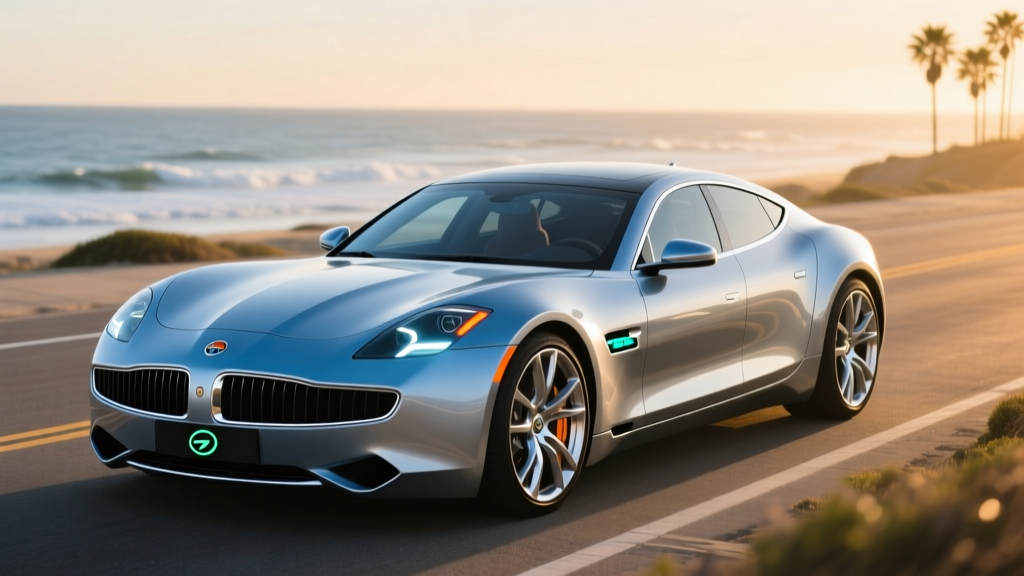
The 2012 Fisker Karma sedan remains one of the most polarizing vehicles in electrified-automotive history. Designed by Henrik Fisker and built by Valmet Automotive in Finland, this extended-range electric vehicle (EREV) promised exotic styling with plug-in efficiency. Over a decade later, it has become a used-market curiosity — but one that demands careful scrutiny before any buyer signs a check. This review dissects every spec that matters in 2026: real-world electric range, charging behavior, battery health risks, and the ownership economics that define this car today.
Quick Verdict: A Design Icon With Serious Caveats
The Karma is not a conventional battery-electric vehicle (BEV). It is a series plug-in hybrid (EREV): two electric motors drive the rear wheels, while a 2.0-liter turbocharged GM Ecotec gasoline engine acts solely as a generator to recharge the battery once the electric range is depleted. That architecture gives it a dual personality — a short-range EV commuter and a gas-burning grand tourer — but neither role is executed to modern standards.
If you are evaluating a 2012 Karma in 2026, you are buying a 14-year-old vehicle with a discontinued battery supply chain, a defunct manufacturer (Fisker Automotive filed for bankruptcy in 2013), and a used-market price typically between $15,000 and $35,000 depending on condition and mileage. The federal EV tax credit is not available on used purchases of this vintage unless the vehicle qualifies under the separate Used Clean Vehicle Credit (§25E), which itself has strict dealer, price, and buyer-income requirements.
Range, Battery, and Efficiency: The Numbers That Matter
| Spec | 2012 Fisker Karma |
|---|---|
| EPA Electric-Only Range | 32 miles |
| EPA Combined Gas Range (EREV mode) | ~230 miles (total ~260 mi combined EV + gas) |
| Battery Capacity (gross / usable) | 20.1 kWh gross / ~18.0 kWh usable |
| Battery Chemistry | NMC (Nickel Manganese Cobalt) — A123 Systems cells |
| MPGe (electric mode) | 54 MPGe (EPA combined) |
| MPG (gas generator mode) | 20 MPG combined (EPA) |
| kWh per 100 miles (EV mode) | 62 kWh/100mi |
| Fuel Tank Capacity | 9.5 gallons |
Real-World Range Reality: The EPA-rated 32 miles of electric range was modest even in 2012. In 2026, expect significantly less from a used Karma. A 14-year-old NMC battery that has not been replaced will likely have degraded 20–40%, yielding a practical electric-only range of roughly 18–26 miles depending on battery health. Highway driving at 70+ mph reduces this further due to the Karma's 5,300-lb curb weight and poor aerodynamic efficiency. Cold-weather testing (below 40°F) can cut electric range by an additional 20–30%, meaning winter commutes may deliver as little as 12–18 electric miles before the gas generator kicks in.
The A123 Systems battery pack was a known weak point even during the Karma's original production run. A123 itself filed for bankruptcy in late 2012, and multiple battery-related recalls were issued. In 2026, any original battery pack is well beyond its expected calendar life. Replacement is extremely difficult: no OEM supply chain exists, and third-party refurbishers charge between $8,000 and $15,000 for a rebuilt pack, if one can be sourced at all. This single factor dominates the used-Karma purchase calculus.
Charging: Slow by Any Modern Standard
| Charging Level | Power (kW) | Connector | 0–100% Time | Miles of EV Range per Hour |
|---|---|---|---|---|
| Level 1 (120V household) | ~1.4 kW | J1772 | ~14–16 hours | ~2–3 mi/hr |
| Level 2 (240V, 32A) | ~3.3 kW (onboard charger limit) | J1772 | ~6–7 hours | ~5–6 mi/hr |
| DC Fast Charge | Not supported | N/A | N/A | N/A |
The Karma's onboard charger maxes out at 3.3 kW on Level 2 — painfully slow by 2026 standards, where most new EVs accept 11–19 kW on Level 2 and 150–350 kW on DC fast charging. The Karma has no DC fast-charge capability whatsoever. This means road-trip charging is impractical; you are limited to overnight home charging or multi-hour stops at public Level 2 stations.
For daily use, a Level 2 home charger will replenish the battery fully overnight, which is adequate for the car's short electric range. But the lack of DC fast charging means this vehicle cannot function as a practical long-distance EV. The gas generator eliminates range anxiety on road trips, but at 20 MPG combined, fuel costs are comparable to a conventional luxury sedan — with none of the refinement.
Performance and Drivetrain
| Performance Spec | 2012 Fisker Karma |
|---|---|
| Drivetrain | Rear-wheel drive (dual rear electric motors) |
| Combined Electric Motor Output | 403 hp / 959 lb-ft torque |
| Gas Generator Engine | 2.0L turbocharged I4 (GM Ecotec LNF), 260 hp |
| 0–60 mph (Sport mode, full battery) | 5.8 seconds (EPA/mfr est.) |
| 0–60 mph (Stealth/EV mode) | 7.9 seconds |
| Top Speed | 125 mph (electronically limited) |
| Curb Weight | 5,300 lbs |
In "Sport" mode, the Karma's dual rear electric motors deliver a combined 403 horsepower and an extraordinary 959 lb-ft of torque, launching the heavy sedan to 60 mph in roughly 5.8 seconds — respectable even by 2026 standards. However, this performance is only available when the battery has meaningful charge. Once the battery depletes and the 260-hp gas generator takes over, acceleration drops noticeably, and the engine's drone under load is a frequent owner complaint.
The Karma uses a single-speed reduction gear — no traditional transmission — which is typical of EVs and EREVs. Regenerative braking is present but not aggressive enough for true one-pedal driving. There is no all-wheel-drive option.
Interior, Cargo, and Technology
| Dimension | Measurement |
|---|---|
| Seating Capacity | 4 passengers |
| Front Legroom | 42.5 inches |
| Rear Legroom | 29.6 inches |
| Cargo Volume (trunk) | 6.9 cubic feet |
| Curb Weight | 5,300 lbs |
| Wheelbase | 124.4 inches |
| Overall Length | 196.7 inches |
The Karma's interior was a mixed bag at launch and has aged unevenly. The dashboard features a distinctive "diamond" design motif with reclaimed wood trim (sourced from sunken logs and wildfire-damaged trees — a genuine sustainability story). However, the infotainment system is a 10.2-inch resistive-touch screen that was sluggish in 2012 and feels archaic in 2026. There is no Apple CarPlay, no Android Auto, no over-the-air updates, and no modern driver-assistance suite.
Rear-seat legroom at 29.6 inches is cramped — worse than many compact sedans — because the battery tunnel runs longitudinally through the center of the car, consuming cabin space. The trunk, at just 6.9 cubic feet, is tiny for a vehicle of this exterior size. The Karma seats only four, not five, due to the same central battery architecture.
Notable tech features (for 2012): solar panel roof (supplemental — powers ventilation and accessories, not traction), eco-friendly interior materials, customizable ambient lighting, and a "Sport/Stealth/Sustain" driving-mode selector. Notable drawbacks: no blind-spot monitoring, no adaptive cruise, no lane-keeping assist, no automatic emergency braking, and no backup camera on early build examples (later 2012 models received one).
Pricing, Tax Credits, and Ownership Economics in 2026
| Price Category | Amount |
|---|---|
| Original 2012 Base MSRP | $96,850 (base) / $109,850 (EcoChic) |
| Original 2012 As-Tested (loaded EcoSport) | ~$112,000–$120,000 |
| 2026 Used Market Range (private party) | $15,000–$35,000 |
| 2026 Used Market Range (dealer, low-mileage) | $28,000–$45,000 |
| Federal §30D New EV Tax Credit | Not applicable (discontinued model, not new) |
| Federal §25E Used Clean Vehicle Credit | Up to $4,000 (if eligible — see rules below) |
The original $7,500 federal tax credit under IRS §30D applied only to new purchases in 2012–2013 and is irrelevant to any 2026 transaction. The Used Clean Vehicle Credit (§25E) may apply if you purchase through a licensed dealer, the sale price is $25,000 or less, your adjusted gross income falls below IRS thresholds ($75,000 single / $112,500 head of household / $150,000 joint), and the vehicle is at least two model years old (which the 2012 Karma satisfies). The credit equals 30% of the sale price, capped at $4,000. Given that most well-maintained Karmas sell above $25,000, qualifying for this credit is difficult but not impossible on project-car or high-mileage examples.
Ownership cost warning: Insurance premiums for the Karma are elevated due to its rarity, repair complexity, and parts scarcity. Expect annual premiums of $2,500–$4,000 depending on your state and driving record. Maintenance is dealer-independent only — the original Fisker dealer network dissolved with the bankruptcy. Any competent independent shop can service the GM-sourced powertrain components, but Karma-specific parts (body panels, interior trim, the A123 battery) are increasingly scarce.
Warranty and Battery Longevity
The original Fisker warranty structure is effectively void:
- New-Vehicle Limited Warranty: 3 years / 36,000 miles — expired circa 2015
- Powertrain Warranty: 5 years / 60,000 miles — expired circa 2017
- High-Voltage Battery Warranty: 5 years / 60,000 miles (with a capacity-retention guarantee of 70% over that period) — expired circa 2017
There is no remaining factory coverage of any kind on a 2012 Karma in 2026. Extended warranties from third-party providers are available but typically exclude the high-voltage battery and electric drive components — the very items most likely to fail. Any battery replacement or refurbishment will be an out-of-pocket expense, and as noted, costs range from $8,000 to $15,000 with uncertain parts availability.
Pros and Cons: Honest Assessment
Pros
- Striking, timeless exterior design — still turns heads in 2026
- Strong straight-line acceleration in Sport mode (403 hp, 5.8s 0–60)
- Zero-emission commuting for short trips (if battery is healthy)
- No range anxiety thanks to gas generator backup
- Solar roof panel is a unique, functional feature
- Depreciation has been steep — entry price far below original MSRP
Cons
- Battery degradation is near-certain on original packs; replacement is costly and parts are scarce
- No DC fast charging — 3.3 kW Level 2 only
- Cramped rear seats (29.6" legroom) and tiny 6.9 cu-ft trunk
- Outdated infotainment with no smartphone integration
- No modern ADAS features (no AEB, no lane-keep, no adaptive cruise)
- Fisker Automotive is defunct — no dealer network, limited parts supply
- 20 MPG in gas mode is poor for a vehicle this expensive to maintain
- Insurance and repair costs are above average for the used price point
Who Should Buy a 2012 Fisker Karma in 2026?
Choose the Karma if: You want a head-turning design statement for short, sunny commutes under 20 miles; you have access to Level 2 home charging; you are mechanically resourceful (or have a specialist shop); and you view the car as a weekend/collector piece rather than a daily driver.
Look elsewhere if: You need practical cargo space, rear-seat usability, modern safety tech, DC fast charging, or reliable daily transportation. A used Chevrolet Volt (EREV), a used Tesla Model S, or a used BMW i3 with range extender will serve daily needs far more competently at similar or lower prices.
Frequently Asked Questions
What is the real-world electric range of the 2012 Fisker Karma?
The EPA rated it at 32 miles electric-only when new. In 2026, with a 14-year-old battery, expect 18–26 miles on a good day and as few as 12–18 miles in cold weather or at highway speeds. If the battery has been professionally refurbished or replaced, you may see figures closer to the original EPA estimate, but verify with a State of Health (SoH) diagnostic before purchase.
How fast does the 2012 Karma charge?
The onboard charger is limited to 3.3 kW on Level 2 (240V), meaning a full charge takes 6–7 hours. On a standard 120V outlet (Level 1), expect 14–16 hours. There is no DC fast-charge port — this car cannot use any public fast-charging station.
Does the 2012 Fisker Karma qualify for any federal tax credit in 2026?
The new-vehicle §30D credit is not applicable. The Used Clean Vehicle Credit (§25E) may provide up to $4,000 if you buy from a licensed dealer at $25,000 or less and meet IRS income thresholds. Most well-maintained Karmas exceed the $25,000 price cap, making eligibility uncommon. Always verify with a tax professional before relying on this credit.
Is the 2012 Karma worth buying vs. competitors?
As a collectible design piece with short-range EV capability, it has niche appeal. As practical transportation, it compares poorly. A used 2017+ Chevrolet Volt offers 53 miles of electric range, DC-level practicality via its more efficient EREV system, and vastly lower maintenance risk. A used Tesla Model S (2015–2017) offers 200+ miles of pure EV range and access to the Supercharger network. The Karma wins only on styling and exclusivity.
What are the biggest risks of owning a 2012 Karma?
Battery failure is the primary risk — an original A123 Systems pack is at or beyond end-of-life, and replacement costs $8,000–$15,000 with uncertain availability. Secondary risks include electrical gremlins (multiple recalls were issued for cooling-fan and battery-module issues), body-panel damage with no easy replacement source, and the general challenge of maintaining a vehicle from a bankrupt manufacturer.
Can I daily-drive a 2012 Fisker Karma?
Technically yes, but it is not advisable as a primary vehicle. The short electric range, slow charging, tiny trunk, cramped rear seats, and high maintenance risk make it better suited as a secondary or weekend car. If your commute is under 20 miles round-trip and you have reliable Level 2 charging at home, the Karma can function as an EV commuter — but always with the gas generator as a safety net.
Sources: EPA fuel economy data via fueleconomy.gov; IRS tax credit rules via irs.gov; NHTSA recall records for Fisker Automotive.