The Pioneer That Started It All — And What It Means in 2026
The 2011 Nissan Leaf holds a unique place in electric-vehicle history: it was the first mass-market, purpose-built battery-electric car sold in the United States. Over a decade later, thousands of these cars remain on the road, circulating on the used market at prices that make them one of the cheapest entry points into EV ownership. But buying a 15-year-old electric car requires a very different calculus than shopping for a new one. Battery degradation, obsolete charging standards, and a 73-mile EPA range mean the 2011 Leaf is a specific tool for a specific job — not a do-everything family car.
This review breaks down exactly what you're getting, what to watch out for, and whether a 2011 Leaf still makes financial sense as a commuter or second car in 2026.
Range, Battery, and the Degradation Reality
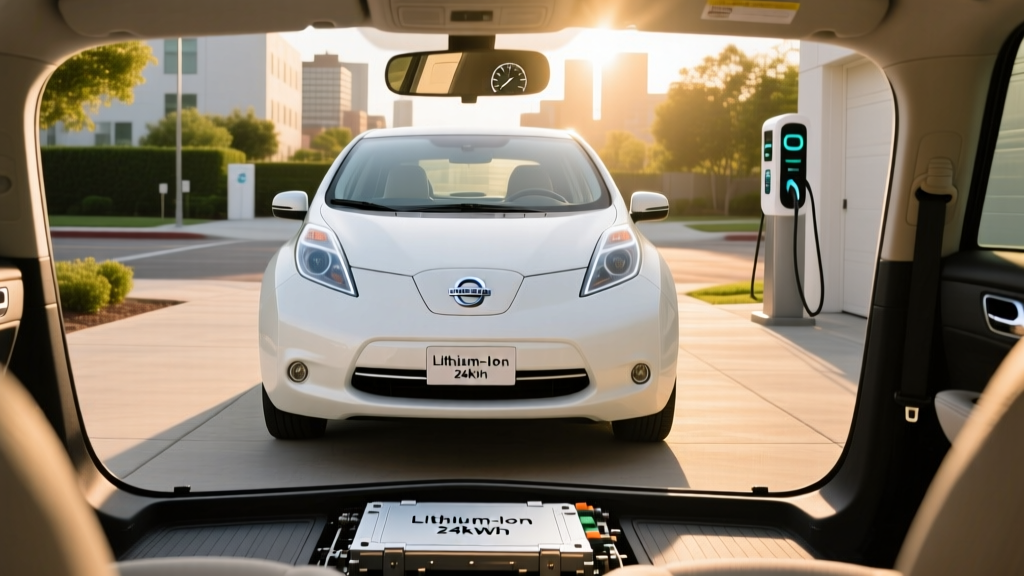
The 2011 Nissan Leaf shipped with a 24 kWh lithium-ion battery pack using lithium manganese oxide (LMO) chemistry — not the NMC (nickel manganese cobalt) or LFP (lithium iron phosphate) chemistries common in modern EVs. Nissan chose LMO for its thermal stability and cost, but this chemistry has proven more susceptible to capacity loss over time, especially in hot climates.
| Spec | Value |
|---|---|
| Battery capacity (original) | 24 kWh total / ~21 kWh usable |
| Battery chemistry | Lithium Manganese Oxide (LMO) |
| EPA estimated range (new) | 73 miles |
| EPA efficiency | 99 MPGe combined / 34 kWh per 100 mi |
| Battery warranty (original) | 8 years / 100,000 miles (capacity loss below ~66.25% triggers replacement) |
Nissan's battery warranty guaranteed the pack would retain at least 9 out of 12 capacity bars (roughly 75% state of health) over the 8-year/100,000-mile warranty period. For a 2011 model, that factory warranty expired in 2019 at the latest. Any remaining battery health is purely a function of how the car was stored, charged, and what climate it lived in.
Checking Battery Health Before You Buy
The Leaf's dashboard displays battery capacity as a series of 12 bars on the right side of the instrument cluster. A car showing 12 bars is exceptionally rare and likely spent its life in a mild climate with careful Level 1/Level 2 charging. Most 2011 Leafs in 2026 show 8–10 bars, indicating 65–85% of original capacity. Cars in Arizona, Texas, or other hot states often show 7–8 bars or fewer.
For a more precise reading, apps like LeafSpy (paired with an OBD-II Bluetooth dongle) can read the battery's actual state of health (SoH) percentage, individual cell voltages, and cycle count. This is the single most important pre-purchase check you can perform.
Charging: CHAdeMO, Level 2, and the Connector Problem
The 2011 Leaf uses the CHAdeMO DC fast-charging standard and a J1772 connector for Level 1 and Level 2 AC charging. This is a critical consideration in 2026, because the North American charging landscape has shifted decisively toward NACS (Tesla's connector, now adopted by Ford, GM, Rivian, and others) and CCS1.
| Level | Connector | Max Power | Charge Time / Rate |
|---|---|---|---|
| Level 1 (120V household) | J1772 | ~1.4 kW | ~16–18 hours (0–100%); ~4–5 mi/hr |
| Level 2 (240V home/public) | J1772 | 3.3 kW (onboard charger limit) | ~7–8 hours (0–100%); ~12–14 mi/hr |
| DC Fast Charge | CHAdeMO | ~47 kW peak | 0–80% in ~30 min (new battery); add ~60 mi in 30 min |
The 2011 Leaf's onboard AC charger is limited to 3.3 kW, meaning even if you plug into a 7.2 kW or 11.5 kW Level 2 station, the car will only accept 3.3 kW. This is a hard hardware limitation — there's no software update or adapter that changes it. A full charge from empty at 3.3 kW takes roughly 7–8 hours.
On DC fast charging, the 2011 Leaf's 47 kW peak (on CHAdeMO) was competitive in 2011 but is slow by 2026 standards. More importantly, CHAdeMO infrastructure is shrinking. Electrify America never adopted CHAdeMO. Many older CHAdeMO stations have been retired or converted. Your best bet for DC fast charging a Leaf in 2026 is finding legacy CHAdeMO stations via PlugShare or the Alternative Fuels Data Center.
Performance, Drivetrain, and Efficiency
The 2011 Leaf is not a performance car, and nobody who's driven one expects it to be. Its 80 kW AC synchronous motor produces 107 horsepower and 207 lb-ft of torque, driving the front wheels through a single-speed reduction gear.
| Spec | Value |
|---|---|
| Motor output | 80 kW / 107 hp / 207 lb-ft torque |
| Drivetrain | Front-wheel drive (FWD), single-speed |
| 0–60 mph | ~9.9 seconds |
| Top speed | ~90 mph (electronically limited) |
| EPA efficiency | 99 MPGe combined (34 kWh/100 mi) |
| Regenerative braking | Standard regen; no true one-pedal mode |
Around town, the Leaf's instant torque makes it feel peppy off the line — 0–30 mph is genuinely brisk. But acceleration above 50 mph tapers noticeably, and highway merging requires planning. The car's curb weight of roughly 3,350 lbs (heavy for a compact hatchback in 2011, light by 2026 EV standards) and narrow 215/50R17 low-rolling-resistance tires prioritize efficiency over grip.
Efficiency is where the Leaf still shines. At 99 MPGe combined (34 kWh per 100 miles), it remains one of the most energy-efficient EVs ever sold. For context, that translates to roughly $0.04–$0.06 per mile on residential electricity at the 2026 national average of ~$0.16/kWh — dramatically cheaper than any gasoline car.
Interior, Cargo, and Daily Practicality
The 2011 Leaf is a five-seat compact hatchback. Interior space is surprisingly generous for its footprint, thanks to the flat floor (no transmission tunnel) and the battery pack's placement beneath the cabin.
| Spec | Value |
|---|---|
| Seating capacity | 5 passengers |
| Front legroom | 42.1 inches |
| Rear legroom | 33.5 inches |
| Cargo volume (rear seats up) | 14.5 cu ft |
| Cargo volume (rear seats folded) | ~30 cu ft (estimated) |
| Curb weight | ~3,350 lbs |
The cabin materials are mostly hard plastics, typical of economy cars in this era. The seats are upholstered in a recycled-fabric cloth that's durable but not luxurious. The center stack features a small color LCD display showing energy flow, range estimation, and a quirky "tree-planting" eco-score graphic. There's no Apple CarPlay, Android Auto, or modern infotainment — just AM/FM/CD, Bluetooth audio streaming, and USB input.
Notable tech for 2011 included standard navigation with EV-specific routing (showing nearby charging stations), a timer function for scheduled charging to take advantage of off-peak electricity rates, and remote climate control pre-conditioning via a smartphone app or key fob (on SL trim). That pre-conditioning feature — which warms or cools the cabin while the car is still plugged in — was ahead of its time and remains genuinely useful for preserving range in extreme weather.
Notable Drawbacks
- No battery thermal management: The battery is passively air-cooled. Hot climates accelerate degradation; cold climates reduce range and charging speed.
- No DC fast charging on base S trim: The entry-level 2011 Leaf S did not include a CHAdeMO port. Only the SV and SL trims had it as standard or optional.
- Weak headlights: The halogen projector headlights are widely criticized as dim. Many owners upgrade to aftermarket LED or HID units.
- No advanced driver assists: No automatic emergency braking, lane-keeping, or adaptive cruise. This is a pre-ADAS-era vehicle.
- Obsolete infotainment: No smartphone integration, small screen, dated navigation maps.
Pricing, Tax Credits, and the Used-EV Credit
When new, the 2011 Nissan Leaf started at $32,780 (SV trim) and $35,200 (SL trim), before any incentives. A $7,500 federal tax credit was available to original buyers under the pre-2023 rules. Those credits are long expired.
In 2026, a used 2011 Leaf typically sells for $4,000–$8,000 depending on mileage, battery health (number of bars), trim level, and regional demand. Cars with 12 bars and under 60,000 miles command the top of that range; cars with 8 or fewer bars and high mileage can dip below $4,000.
- Sale price must be $25,000 or less (virtually all 2011 Leafs qualify)
- Buyer income must be under $75,000 (single) / $150,000 (joint) modified adjusted gross income
- The vehicle must be purchased from a licensed dealer (private-party sales do not qualify)
- The vehicle must be at least 2 model years old (2011 easily qualifies)
- The credit can be transferred to the dealer as a point-of-sale discount
- The buyer cannot have claimed the used-EV credit in the prior 3 years
| Scenario | Price |
|---|---|
| Typical used price (dealer, 9–10 bars) | $5,000–$7,000 |
| Typical used price (private party, 8–9 bars) | $3,500–$5,500 |
| Estimated §25E credit (dealer purchase at $6,000) | ~$1,800 |
| Effective cost after credit | ~$4,200 |
| Battery replacement (if needed, aftermarket/refurb) | $5,000–$8,000 |
Who Should Buy a 2011 Leaf — And Who Shouldn't
The 2011 Leaf is not a general-purpose car in 2026. It's a purpose-built solution for a narrow set of use cases. Here's a practical decision framework:
- You need a dirt-cheap commuter for a sub-30-mile round trip
- You have reliable home Level 1 or Level 2 charging
- You want a second car for errands, school runs, or local commuting
- You live in a mild climate (Pacific Northwest, coastal California, Southeast with garage parking)
- You can buy from a dealer and qualify for the §25E used-EV credit
- You value $0.05/mile "fuel" cost and minimal maintenance
- You need more than 60 miles of reliable daily range
- You live in an area with extreme heat or cold and no garage
- You need DC fast charging for road trips (CHAdeMO is scarce)
- You want modern safety features (AEB, blind-spot, lane-keep)
- You need a primary/only vehicle for a household
- You can't charge at home or work
- The battery shows fewer than 9 bars and you can't budget for replacement
Compared to newer used EVs like the 2016+ Chevy Bolt EV (238-mile range, CCS charging, liquid-cooled battery) or the 2013+ Tesla Model S (200+ mile range, Supercharger network), the 2011 Leaf is strictly a budget play. The Bolt and Model S cost significantly more on the used market but offer far more range, better charging infrastructure compatibility, and active battery thermal management.
Ownership Costs and Maintenance
The 2011 Leaf's greatest strength is its rock-bottom running cost. There's no engine oil, no transmission fluid, no spark plugs, no emissions system. Brake pads last well past 100,000 miles thanks to regenerative braking doing most of the deceleration work. The cabin air filter and tire rotations are essentially the only routine maintenance items.
At the 2026 national average electricity rate of ~$0.16/kWh, fully charging the 24 kWh battery costs roughly $3.50–$4.00, yielding about 50–65 real-world miles. That's approximately $0.06 per mile — compared to $0.14–$0.18 per mile for a 30 MPG gasoline car at $3.50/gallon.
The biggest financial risk is battery replacement. If the pack degrades below usable capacity (typically below 60% SoH, or ~6–7 bars), a replacement or refurbished battery costs $5,000–$8,000 installed. That can exceed the car's entire value. Some aftermarket companies offer refurbished 24 kWh packs or even upgraded 30 kWh and 40 kWh packs from later-model Leafs, but availability and compatibility vary. Factor this risk into your purchase decision.
Pros, Cons, and Final Verdict
- Extremely low purchase price ($4,000–$8,000)
- Best-in-class efficiency: 99 MPGe, $0.05–$0.06/mi
- Near-zero routine maintenance
- Surprisingly roomy cabin and cargo area for its size
- Eligible for up to $1,800–$4,000 used-EV tax credit
- Quiet, smooth electric drivetrain
- Pre-conditioning feature preserves range in weather extremes
- 73-mile EPA range when new; 50–65 miles typical today
- Significant battery degradation, especially in hot climates
- CHAdeMO DC fast charging — shrinking infrastructure
- 3.3 kW Level 2 onboard charger limits home charging speed
- No battery thermal management (passive air cooling only)
- No modern driver-assist features (AEB, lane-keep, etc.)
- Dated infotainment with no smartphone integration
- Battery replacement cost can exceed vehicle value
Verdict: The 2011 Nissan Leaf is a compelling budget EV for a very specific buyer: someone with a short, predictable commute, home charging access, and a mild climate. At $4,000–$8,000 with a potential tax credit bringing the effective cost below $5,000, it's one of the cheapest ways to go electric. But go in with eyes open about the degraded range, the dying CHAdeMO network, and the battery-replacement risk. Check the bars, bring a LeafSpy dongle, and buy from a dealer if you want the tax credit.
Frequently Asked Questions
What is the real-world range of a 2011 Nissan Leaf in 2026?
Expect 50–65 miles in mixed driving with a battery showing 9–10 bars. Highway driving at 70+ mph drops that to 40–55 miles. In freezing weather, plan for 35–50 miles. According to fueleconomy.gov, the original EPA rating was 73 miles when new.
How fast does the 2011 Leaf charge at home and on DC fast chargers?
At home on a standard 120V outlet (Level 1), it adds about 4–5 miles per hour. On a 240V Level 2 charger, it's limited to 3.3 kW, adding about 12–14 miles per hour and taking 7–8 hours for a full charge. DC fast charging on CHAdeMO peaks at ~47 kW, reaching 80% in about 30 minutes — but CHAdeMO stations are increasingly rare.
Does the 2011 Nissan Leaf qualify for any federal tax credit in 2026?
The original $7,500 new-vehicle credit (§30D) is long expired. However, the used clean vehicle credit (§25E) may apply: up to $4,000 (30% of sale price) if you buy from a licensed dealer, your income is under $75,000 single / $150,000 joint, and you haven't claimed the used credit in the past 3 years. See IRS §25E guidelines for full details and consult a tax professional.
Is the 2011 Leaf worth buying vs. a newer used EV?
It depends on budget and use case. If you need a sub-$8,000 commuter with a 30-mile round trip and home charging, the Leaf is hard to beat on cost per mile. If you need more range, DC fast charging on the CCS or NACS network, or modern safety tech, look at a 2017+ Chevy Bolt EV ($10,000–$15,000 used, 238-mile range) or a 2018+ Nissan Leaf (40 or 62 kWh battery, 150–226 mile range, CCS charging on later models).
What should I check before buying a used 2011 Leaf?
Check the battery capacity bars on the dashboard (aim for 9+ bars). Use LeafSpy with an OBD-II dongle to read exact state of health percentage. Verify the car has a CHAdeMO port if you want DC fast charging (base S trim may not). Check for rust on the undercarriage if the car lived in a salt-belt state. Confirm the 12V auxiliary battery is recent — the Leaf's 12V battery is a common failure point that can strand the car even with a healthy traction battery. Finally, test-drive in conditions that match your daily commute, including highway speeds if applicable.
Can I upgrade the battery in a 2011 Leaf?
Yes, but it's complex and expensive. Some specialty shops offer refurbished 24 kWh packs, and there are community-documented swaps using 30 kWh (2016+ Leaf) or even 40 kWh (2018+ Leaf) packs. Costs typically run $5,000–$10,000+ including parts and labor. For most buyers, a battery upgrade isn't economically justified on a car worth $5,000–$8,000 — it's more practical to buy a newer Leaf with a larger battery from the start.