Quick Verdict: The Audi Q4 e-tron 45 in 2026
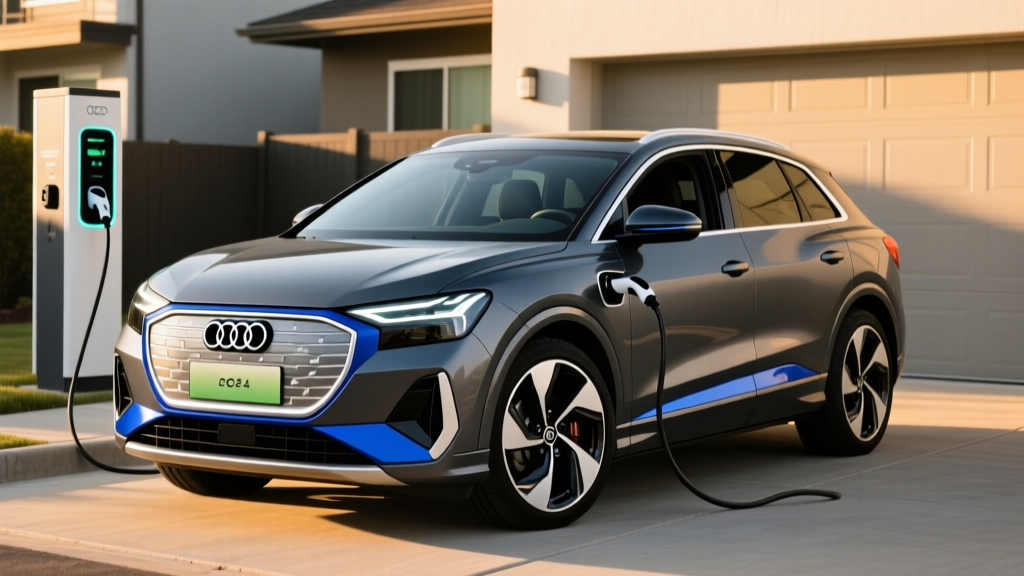
The 2026 Audi Q4 e-tron 45 occupies a specific niche: a premium compact electric SUV that prioritizes ride refinement, cabin quietness, and build quality over maximum range or blistering acceleration. Built on the Volkswagen Group MEB platform alongside the VW ID.4, the Q4 e-tron 45 wraps that architecture in a more polished package with Audi's signature interior materials and design language. For the 2026 model year, the single-motor rear-wheel-drive Q4 e-tron 45 remains the volume seller, offering a practical blend of 265 miles of EPA-estimated range and a starting price that, after potential federal tax credits, competes directly with the Tesla Model Y, Genesis GV60, and BMW iX1.
This is not the EV for buyers chasing 0-60 times under four seconds or 400-mile range stickers. It's the EV for the luxury-curious commuter who wants a serene daily driver with credible road-trip capability and a dealership network that doesn't require a direct-to-consumer leap of faith.
Range, Battery & Real-World Efficiency
The 2026 Audi Q4 e-tron 45 uses an 82 kWh battery pack (77 kWh usable) with NMC (nickel manganese cobalt) chemistry. This is the same MEB-platform pack found in the ID.4 and Skoda Enyaq, though Audi's thermal management tuning and aerodynamic refinements yield slightly different efficiency figures.
EPA Estimated: 265 miles (Q4 e-tron 45 Premium RWD)
Real-World Highway (70 mph, 68°F): ~235–245 miles. The MEB platform's boxy SUV profile creates more aero drag than sleeker competitors, and highway efficiency drops noticeably above 70 mph.
Cold Weather (32°F, mixed driving): ~195–215 miles. Expect 20–25% range loss in freezing conditions without consistent preconditioning. The Q4 e-tron 45 does include a heat pump for 2026, which mitigates cabin-heating energy draw, but battery chemistry still limits output in deep cold.
City/Commuter (stop-and-go, mild weather): 270–285 miles. Regenerative braking in urban driving helps recover energy, and some drivers will exceed the EPA sticker in town.
| Spec | Value |
|---|---|
| EPA Range (RWD) | 265 miles |
| Battery (Usable) | 77 kWh NMC (82 kWh gross) |
| EPA Efficiency | 105 MPGe combined (32 kWh/100 mi) |
| Peak DC Fast Charge | 175 kW |
| 10–80% DC Charge Time | ~28 minutes |
| Level 2 Home Charge Rate | 11 kW (~37 mi/hr) |
| 0–60 mph | 7.3 seconds |
| Horsepower / Torque | 282 hp / 340 lb-ft |
| Drivetrain | Rear-wheel drive (single motor) |
| Cargo (behind rear seats) | 24.8 cu ft |
| Cargo (rear seats folded) | 53.1 cu ft |
| Rear Legroom | 38.5 inches |
| Base MSRP (Premium) | $49,800 + $1,195 destination |
| Battery Warranty | 8 years / 100,000 miles (70% capacity) |
Efficiency lands at a combined 105 MPGe, or roughly 32 kWh per 100 miles, per fueleconomy.gov. That's competitive with the Genesis GV60 but trails the Tesla Model Y Long Range (122 MPGe combined) due to the Audi's heavier curb weight and less aggressive aero.
Charging Speed: DC Fast & Home Level 2
Charging is where the Q4 e-tron 45 shows both its strengths and its MEB-platform limitations. The pack accepts a peak DC fast-charge rate of 175 kW on a compatible CCS1 connector. Audi quotes a 10–80% charge time of approximately 28 minutes under ideal thermal conditions.
| Level | Power | Miles Added Per Hour | Notes |
|---|---|---|---|
| Level 1 (120V) | ~1.4 kW | ~4 mi/hr | Emergency/trickle only; 50+ hr for full charge |
| Level 2 (240V, 48A) | 11 kW | ~37 mi/hr | Full charge in ~7.5 hr; ideal for overnight home |
| DC Fast (peak) | 175 kW | ~230 mi/hr (at peak) | 10–80% in ~28 min; tapers above 80% SoC |
Charging-curve reality check: The 175 kW peak only holds between roughly 10–30% State of Charge. The curve then tapers progressively — expect ~120 kW through 50%, ~80 kW through 70%, and a steep drop above 80% as the battery management system protects the NMC cells. If you regularly charge to 100% on road trips, budget an extra 15–20 minutes for that final 20%. Preconditioning the battery via the MMI navigation system's charging-route planner helps the pack reach optimal temperature for peak charge acceptance.
At home on a properly installed Level 2 charger (240V, 48-amp circuit), the Q4 e-tron 45 charges at up to 11 kW, adding roughly 37 miles of range per hour. A full 0–100% charge takes about 7.5 hours — easily achievable overnight. Most owners will plug in each evening and never touch a public charger for daily driving. For Level 2 installation, budget $800–$2,000 for a quality hardwired charger plus electrician labor, depending on your panel capacity and conduit run.
Performance & Driving Dynamics
The Q4 e-tron 45's single rear-mounted permanent-magnet motor produces 282 horsepower and 340 lb-ft of torque, delivering a 0–60 mph time of 7.3 seconds. That's adequate for confident highway merging and passing but won't win drag races against the Tesla Model Y Long Range (4.8 seconds) or the dual-motor Q4 e-tron 55 (5.0 seconds).
Where the Audi differentiates itself is ride quality. The suspension tuning is noticeably more compliant than the ID.4's, with well-damped responses over rough pavement and expansion joints. Steering is light and precise if somewhat numb — typical for the segment. The cabin is impressively quiet at highway speed, with minimal wind and tire noise intrusion. This is the Q4's party trick: it feels like a more expensive vehicle once you're underway.
Regenerative braking offers multiple modes selectable via steering-wheel paddles, from coasting (no regen) to a moderate one-pedal-driving mode. Audi deliberately chose not to implement aggressive one-pedal regen by default — a decision some EV veterans find frustrating, but one that eases the transition for first-time EV buyers accustomed to conventional brake feel.
Interior, Tech & Cargo Practicality
Step inside and the Q4 e-tron 45 immediately distances itself from its MEB-platform siblings. Materials are a tier above the ID.4: soft-touch surfaces on the dash and door panels, available leather upholstery, and Audi's typical attention to panel-gap precision. The 10.1-inch central touchscreen (11.6-inch on Prestige trims) runs Audi's latest MMI interface, which is responsive and logically organized, though some climate controls remain buried in submenus.
The digital cockpit includes a 10.25-inch driver display with configurable views including range, navigation, and ADAS status. Wireless Apple CarPlay and Android Auto are standard. A head-up display with augmented-reality navigation overlays is available on higher trims — a genuinely useful feature that projects turn arrows onto the windshield in your field of view.
Cargo and passenger space: With 24.8 cubic feet behind the rear seats and 53.1 cubic feet with the 60/40 split rear bench folded, the Q4 e-tron 45 is practical for a compact SUV. Rear legroom measures 38.5 inches — enough for adults on longer trips. There is no frunk (front trunk); the space under the hood houses electronics and the HVAC system. A power liftgate is standard across all trims.
Driver-assist technology: The Q4 e-tron 45 comes with Audi's Adaptive Cruise Assist, which includes stop-and-go cruise, lane centering, and traffic-jam assist. This is an SAE Level 2 system — it requires the driver to maintain hands-on-wheel awareness and does not provide autonomous driving. It's competent on highway commutes but does not match the hands-free capability of GM's Super Cruise or Ford's BlueCruise on mapped highways. Audi does not currently offer a Level 3 or Level 4 system in the Q4 e-tron lineup.
Pricing, Trims & Federal Tax Credit Eligibility
The 2026 Q4 e-tron 45 is available in three trims for the US market:
| Trim | MSRP (incl. destination) | Est. Price After §30D Credit* |
|---|---|---|
| Premium (RWD) | $50,995 | ~$43,495 |
| Premium Plus (RWD) | $54,795 | ~$47,295 |
| Prestige (RWD) | $58,595 | ~$51,095 |
*Estimated prices assume full $7,500 §30D federal tax credit eligibility. Actual credit depends on buyer income, battery sourcing, and MSRP caps. See details below.
Federal EV Tax Credit (§30D) — Key Requirements for 2026:
- MSRP Cap: The Q4 e-tron 45 is classified as an SUV, so the MSRP cap is $80,000. All trims qualify on price.
- Buyer Income Cap: Modified AGI must not exceed $150,000 (single), $225,000 (head of household), or $300,000 (joint). Check your prior-year or current-year MAGI against IRS guidelines.
- Battery Component Sourcing: A percentage of battery components must be manufactured or assembled in North America, and critical minerals must be sourced from the US or a free-trade-agreement partner. Audi's MEB-platform battery sourcing has historically relied on LG Energy Solution cells; verify current-year compliance with your dealer before purchase.
- Point-of-Sale Transfer: For 2026, the §30D credit can be transferred to the dealer at point of sale, reducing your purchase price directly rather than waiting for a tax return credit. The dealer must be IRS-registered for this option.
- Consult a tax professional before relying on the credit — eligibility rules have tightened annually and individual circumstances vary.
An as-tested Premium Plus model with metallic paint, the Black Optic package, and 21-inch wheels landed at approximately $57,400 before incentives — still under the SUV MSRP cap but illustrating how quickly options add up on German luxury vehicles.
How It Compares: Q4 e-tron 45 vs. Key Rivals
The Q4 e-tron 45 competes in the premium compact electric SUV segment against several strong alternatives. Here's how the key numbers stack up:
| Spec | Audi Q4 e-tron 45 | Tesla Model Y LR | Genesis GV60 | BMW iX1 xDrive28 |
|---|---|---|---|---|
| EPA Range | 265 mi | 330 mi | 248 mi | 240 mi |
| Battery (usable) | 77 kWh NMC | 75 kWh NMC | 74 kWh NMC | 64.7 kWh NMC |
| Peak DC Charge | 175 kW | 250 kW | 240 kW | 130 kW |
| 10–80% Time | ~28 min | ~20 min | ~18 min | ~34 min |
| 0–60 mph | 7.3 sec | 4.8 sec (AWD) | 7.3 sec (RWD) | 5.6 sec (AWD) |
| MPGe Combined | 105 | 122 | 95 | 97 |
| Base MSRP | $50,995 | $46,630 | $52,350 | $49,500 |
| Cargo (rear up) | 24.8 cu ft | 30.2 cu ft | 24.0 cu ft | 25.7 cu ft |
Choose the Audi Q4 e-tron 45 if: You value ride comfort, cabin quietness, and premium build quality above raw range and performance. You want a traditional dealership experience with a luxury brand's service network. You commute under 60 miles daily and road-trip occasionally.
Choose the Tesla Model Y if: Maximum range, fastest charging, and access to the Supercharger network are your top priorities. You're comfortable with Tesla's direct-sales model and minimalist interior.
Choose the Genesis GV60 if: You want the most distinctive interior design, fastest DC charging in the segment, and Genesis's strong warranty and complimentary maintenance program.
Choose the BMW iX1 if: You want all-wheel drive standard, sportier handling dynamics, and BMW's iDrive infotainment — but can accept shorter range and slower DC charging.
Ownership Costs & Warranty
Audi provides a competitive warranty package for the Q4 e-tron 45:
- Limited Vehicle Warranty: 4 years / 50,000 miles
- Battery & Powertrain Warranty: 8 years / 100,000 miles (covers battery capacity below 70% of original)
- Complimentary Maintenance: 1 year / 10,000 miles (first scheduled service)
- Roadside Assistance: 4 years / unlimited miles
The 70% capacity retention threshold on the battery warranty is standard for the industry. Independent data from MEB-platform vehicles suggests typical degradation of 5–8% over the first 100,000 miles under normal use — well within the warranty buffer. Avoiding routine DC fast-charging to 100% and minimizing prolonged storage at very low or very high State of Charge will help preserve long-term battery health.
Insurance premiums for the Q4 e-tron 45 tend to run 15–25% higher than equivalent ICE compact SUVs, consistent with EV industry trends. Shop quotes before purchase — rates vary significantly by insurer and region.
Charging cost for a typical commute: at the US average residential electricity rate of ~$0.16/kWh, fully charging the 77 kWh usable battery costs approximately $12.30, yielding roughly 265 miles of range. That's about $0.047 per mile — compared to roughly $0.12–$0.15 per mile for a 25-MPG gas SUV at $3.20/gallon. Annual fuel savings for a 12,000-mile driver: roughly $900–$1,200, depending on local electricity and gas prices.
Pros & Cons at a Glance
- Refined, quiet ride that punches above its price class
- Premium interior materials and build quality
- Practical cargo space and comfortable rear seating
- Heat pump standard for improved cold-weather efficiency
- Eligible for up to $7,500 §30D federal tax credit (verify sourcing)
- Available AR head-up display is genuinely useful
- 265-mile EPA range trails Tesla Model Y by 65 miles
- 175 kW peak DC charging is slower than GV60 and Model Y
- No front trunk (frunk) for additional storage
- One-pedal driving mode is not aggressive enough for some EV drivers
- Options packages add cost quickly
- Driver-assist is competent but not class-leading (no hands-free highway mode)
Frequently Asked Questions
What is the real-world range of the 2026 Audi Q4 e-tron 45?
The EPA rates it at 265 miles. In real-world highway driving at 70 mph in mild weather, expect 235–245 miles. In freezing conditions, plan for 195–215 miles. City commuters with regular regenerative braking may see 270+ miles.
How fast does the Q4 e-tron 45 charge at home and on the road?
On a Level 2 home charger (240V, 11 kW), it adds about 37 miles per hour, fully charging overnight in ~7.5 hours. On a DC fast charger, it peaks at 175 kW and reaches 10–80% in approximately 28 minutes, with a progressive taper above 80%.
Does the 2026 Q4 e-tron 45 qualify for the $7,500 federal EV tax credit?
It can, but eligibility depends on your income (AGI caps apply), the vehicle's MSRP (under the $80,000 SUV cap — all trims qualify), and battery component/critical-mineral sourcing compliance. Audi's MEB battery sourcing should be verified with your dealer for the current production batch. The credit can be applied at point of sale through an IRS-registered dealer. Always confirm with a tax professional. See IRS §30D guidelines.
Is the Q4 e-tron 45 worth buying over the Tesla Model Y?
If you prioritize range, charging speed, and Supercharger network access, the Model Y wins on specs. If you value ride comfort, cabin materials, dealer service, and a more traditional luxury experience, the Q4 e-tron 45 is the more refined daily driver — especially for commuters under 60 miles round-trip.
What is the battery warranty on the Q4 e-tron 45?
Audi covers the high-voltage battery for 8 years or 100,000 miles, whichever comes first, against capacity loss below 70% of original. This is standard for the segment and consistent with MEB-platform degradation data showing 5–8% loss over 100,000 miles under normal use.
Can the Q4 e-tron 45 tow?
Yes, when equipped with the factory towing package, the Q4 e-tron 45 is rated for up to 2,600 pounds — sufficient for a small utility trailer or a pair of dirt bikes, but not for larger boat or camper trailers. Towing will reduce range by roughly 30–40%.
Who is the Q4 e-tron 45 best suited for?
This EV is ideal for the luxury-oriented daily commuter who drives under 80 miles round-trip, has access to home Level 2 charging, road-trips 2–4 times per year (where the 175 kW DC charging is adequate with planning), and values a refined, quiet cabin over maximum performance. Families with young children will appreciate the rear seat space and cargo capacity. It is not the best choice for frequent long-distance travelers who need maximum range and the fastest possible charging stops.