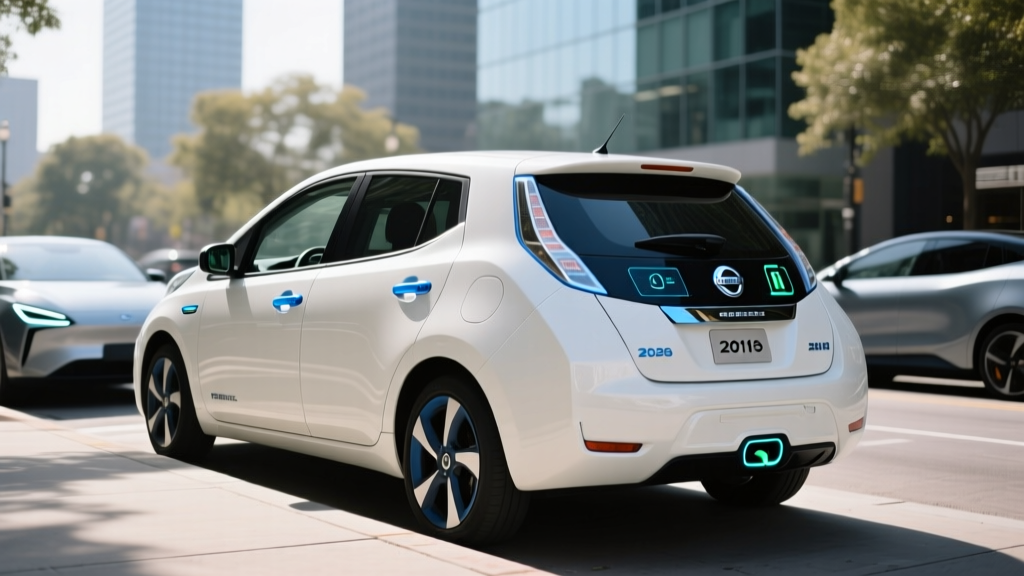
The 2011 Nissan Leaf holds a unique place in automotive history. When it launched in December 2010 as a 2011 model, it became the first mass-produced, fully electric vehicle available to mainstream consumers in the United States. More than a decade later, early Leafs have depreciated into the ultra-budget used-EV segment, often changing hands for $3,000–$7,000. For shoppers searching for a 2011 Nissan Leaf today, the question isn't whether it's a good car by modern standards — it's whether its severely limited range, aged battery, and CHAdeMO charging connector still make it a viable second car, city commuter, or neighborhood runabout in 2026.
This review examines the 2011 Leaf's specs through a modern lens, addresses the critical battery degradation issue that defines ownership of early Leafs, and explains what used buyers need to know about range, charging, and the federal used-EV tax credit before signing any paperwork.
2011 Nissan Leaf Specifications at a Glance
| Specification | 2011 Nissan Leaf (SV) |
|---|---|
| EPA Range | 73 miles |
| Battery Capacity (Original) | 24 kWh (usable ~21.3 kWh) |
| Battery Chemistry | Lithium-ion (NMC — laminated cells, AESC) |
| Motor Output | 80 kW (107 hp), 207 lb-ft torque |
| Drivetrain | Front-wheel drive (FWD) |
| 0–60 mph | ~9.9 seconds |
| Top Speed | ~90 mph (electronically limited) |
| EPA Efficiency | 99 MPGe combined (34 kWh/100 mi) |
| DC Fast Charge (Max) | ~44 kW peak (CHAdeMO) |
| Level 2 Charge Rate | 3.3 kW (J1772) |
| Level 1 Charge Rate | 1.4 kW (120V) |
| Cargo Volume | 14.5 cu ft (rear seats up), 24.0 cu ft (folded) |
| Seating | 5 passengers |
| Original MSRP | $32,780 (SV) / $34,780 (SL) |
| Typical 2026 Used Price | $3,000–$7,000 |
| Original Battery Warranty | 8 years / 100,000 miles (capacity guarantee) |
Range and Efficiency: The 73-Mile Reality
The 2011 Nissan Leaf carries an EPA-estimated range of 73 miles from its 24 kWh battery pack, of which roughly 21.3 kWh was usable when new. Nissan deliberately reserved a large top and bottom buffer to protect the air-cooled battery cells from extreme states of charge — a conservative strategy that helped longevity but limited practical range from day one.
Efficiency was rated at 99 MPGe combined (34 kWh per 100 miles) by the EPA. That figure remains respectable even by 2026 standards — the Leaf's lightweight 3,340-pound curb weight and modest powertrain help it sip electrons. The real limitation is the small battery, not the efficiency.
The Battery Degradation Problem
The single most important factor when evaluating any used 2011 Leaf is battery state of health (SoH). The first-generation Leaf uses passively air-cooled battery cells manufactured by AESC (Automotive Energy Supply Corporation). Unlike modern EVs with active liquid thermal management, the Leaf's battery relies on ambient airflow — a design choice that leads to accelerated degradation, especially in hot climates (Arizona, Texas, the Southeast) or under frequent DC fast-charging use.
Nissan's instrument cluster displays battery health as a series of 12 capacity bars visible to the right of the speedometer. A new Leaf showed all 12 bars. Each lost bar represents roughly a 6–8% reduction in original capacity. By 2026, most 2011 Leafs show between 6 and 9 bars, meaning the battery has lost 25–50% of its original capacity. A Leaf showing 8 bars, for example, likely has only ~15–17 kWh of usable capacity, translating to roughly 45–55 miles of real range.
Buyers should also check the battery using third-party OBD-II tools like Leaf Spy Pro, which reads the actual state of health percentage and individual cell voltages — far more precise than the dashboard bar display. A Leaf with fewer than 8 bars or significant cell imbalance should be avoided or heavily discounted.
Charging: CHAdeMO, 3.3 kW Level 2, and the Connector Problem
Charging infrastructure compatibility is a critical concern for any 2011 Leaf buyer in 2026. The first-generation Leaf uses two connectors:
- J1772 for Level 1 (120V) and Level 2 (240V) AC charging
- CHAdeMO for DC fast charging
| Charging Level | Connector | Max Power | Time (Empty to Full or 80%) | Rate |
|---|---|---|---|---|
| Level 1 (120V) | J1772 | 1.4 kW | ~21 hours (full) | ~4 miles/hour |
| Level 2 (240V) | J1772 | 3.3 kW | ~7 hours (full) | ~10–12 miles/hour |
| DC Fast Charge | CHAdeMO | ~44 kW peak | ~30 min (0–80%) | ~80–100 miles/hour (tapered) |
The 2011 Leaf's onboard charger is limited to 3.3 kW on Level 2. This is a significant bottleneck even for overnight home charging — a full charge from near-empty takes approximately 7 hours. Later Leaf models (2013+) offered an optional 6.6 kW onboard charger that cut this roughly in half.
The CHAdeMO DC fast-charging connector is the more pressing concern. The global EV industry has overwhelmingly standardized on CCS (Combined Charging System) and, increasingly, NACS (North American Charging Standard, Tesla's connector). CHAdeMO infrastructure is shrinking in the United States. Electrify America, the largest DC fast-charging network, never adopted CHAdeMO. EVgo and some ChargePoint stations still carry CHAdeMO connectors, but new installations almost universally favor CCS and NACS. A 2011 Leaf buyer should verify that CHAdeMO chargers exist along their regular routes before relying on DC fast charging.
Peak DC fast-charging power is approximately 44 kW, which sounds modest by 2026 standards (modern EVs charge at 150–350 kW). However, with only 24 kWh to fill, a 44 kW peak rate still delivers a 0–80% charge in roughly 30 minutes — assuming the battery is preconditioned and ambient temperatures are moderate. The charge curve tapers significantly above 80%, as is standard for lithium-ion batteries.
Performance and Driving Dynamics
The 2011 Leaf's 80 kW (107 horsepower) AC synchronous electric motor drives the front wheels through a single-speed reduction gear. The 207 lb-ft of torque is available from zero RPM, giving the Leaf a surprisingly responsive feel around town despite its leisurely 0–60 mph time of approximately 9.9 seconds. Top speed is electronically limited to roughly 90 mph.
Driving dynamics are comfortable and compliant rather than sporty. The Leaf's 3,340-pound curb weight and soft suspension tuning make it a pleasant city car and highway cruiser at moderate speeds. The electrically assisted steering is light and low-effort. Regenerative braking offers two modes: standard "D" drive mode with moderate regen, and "B" mode with stronger regenerative braking for hill descent or stop-and-go traffic. However, the 2011 Leaf does not offer true one-pedal driving — the regen isn't strong enough to bring the car to a complete stop without using the friction brakes.
NVH (noise, vibration, harshness) is a mixed bag. There's no engine noise, of course, but road and wind noise are noticeable at highway speeds, and the low-rolling-resistance tires can feel noisy on coarse pavement. The artificial "pedestrian warning" sound emitted at low speeds (below ~18 mph) is a quirky reminder of the Leaf's early-EV origins.
Interior, Cargo, and Technology
The 2011 Leaf's interior reflects its 2010-vintage design and budget-conscious positioning. Materials are hard plastics throughout, though assembly quality was generally good. The cabin seats five, though rear legroom is tight at 33.3 inches — adequate for children or short trips but cramped for tall adults on longer drives. Front legroom is a generous 42.1 inches.
Cargo space behind the rear seats measures 14.5 cubic feet, which expands to 24.0 cubic feet with the 60/40 split rear seats folded. This is competitive with compact hatchbacks of the era. There is no frunk (front trunk) — the space under the hood is occupied by the power electronics and onboard charger.
Technology was modest even at launch. The SV trim included a basic infotainment system with a 7-inch touchscreen, Bluetooth, USB, and navigation with EV-specific features like charging station locator and range estimation. The SL trim added a rearview camera, solar panel (roof-mounted, powering only the 12V accessory battery), and upgraded interior trim. There is no Apple CarPlay, Android Auto, adaptive cruise control, or any modern ADAS features. The instrument cluster uses a combination of a digital speedometer and the analog capacity-bar display.
Pricing, Used Market Value, and Tax Credit Eligibility
The 2011 Nissan Leaf originally started at $32,780 (SV trim) and $34,780 (SL trim) before any incentives. A $7,500 federal tax credit was available to original buyers, bringing effective pricing below $26,000 for many.
In the 2026 used market, a 2011 Leaf typically sells for $3,000 to $7,000, depending on mileage, condition, and critically, battery health (capacity bars). Examples with 10+ bars command a premium; those with 6 or fewer bars are essentially parts cars or candidates for battery replacement.
Federal Used-EV Tax Credit (§25E)
Under the current IRS §25E used clean vehicle credit, eligible buyers can claim 30% of the sale price, up to a maximum of $4,000, when purchasing a qualifying used EV from a licensed dealer. Key eligibility requirements include:
- The vehicle must be at least two model years old (the 2011 Leaf qualifies)
- Sale price must be $25,000 or less (virtually all 2011 Leafs qualify)
- Buyer income caps: $75,000 single / $112,500 head of household / $150,000 joint (modified AGI)
- The vehicle must be purchased from a licensed dealer (private-party sales do not qualify)
- The credit can only be claimed once per vehicle VIN (check history)
- Buyer must not have claimed a used-EV credit in the prior 3 years
For a $5,000 used 2011 Leaf purchased from a dealer, the credit would be 30% × $5,000 = $1,500. For a $7,000 example, it would be $2,100. This effectively reduces the already-low purchase price, but buyers should weigh the credit against the cost of potential battery replacement.
Battery Warranty, Replacement, and Longevity
Nissan originally warranted the 2011 Leaf's battery for 8 years or 100,000 miles against capacity loss below 9 bars (approximately 70% of original capacity). As of 2026, every 2011 Leaf is well past its original battery warranty expiration. Any battery issues are the owner's responsibility.
Battery replacement options are limited and expensive:
- Nissan OEM replacement battery: Historically priced around $6,500–$8,500 installed, though availability of new 24 kWh packs has been inconsistent. Some dealers may no longer stock them.
- Used/refurbished batteries: Available from salvage yards and specialty EV shops for $2,000–$4,000, but carry unknown remaining life.
- Aftermarket upgrades: Some specialty shops have offered 30 kWh or 40 kWh battery swaps using cells from later Leaf models, but these are custom jobs costing $8,000–$12,000+ and are not widely available.
Given that a battery replacement can cost more than the car's market value, buyers should treat a 2011 Leaf purchase as a "buy it for what the battery has left" proposition. Budget for the possibility that the battery may need replacement within your ownership period.
Pros and Cons of the 2011 Nissan Leaf in 2026
Pros
- Ultra-low purchase price ($3K–$7K used)
- Extremely low operating cost (~3–4¢/mile on residential electricity)
- Federal used-EV tax credit eligible (§25E, up to $4,000)
- Comfortable ride, easy to park, great visibility
- Simple, proven powertrain with minimal maintenance needs
- Decent cargo space for a compact hatchback (14.5 cu ft)
- Zero tailpipe emissions for city commuting
Cons
- Severely limited range (40–55 miles real-world for most surviving examples)
- Significant battery degradation on nearly all surviving units
- CHAdeMO connector — shrinking DC fast-charging network support
- 3.3 kW Level 2 charging is slow by any standard
- No battery warranty remaining; replacement costs $6,500+
- No modern safety tech (no AEB, lane-keep, blind-spot monitoring)
- No Apple CarPlay / Android Auto
- Cold-weather range can drop below 35 miles
Who Should (and Shouldn't) Buy a 2011 Nissan Leaf?
Choose the 2011 Leaf if:
- You need a dirt-cheap second car for short commutes (under 30 miles round-trip)
- You have reliable home Level 2 charging and don't need public DC fast charging
- You live in a mild climate (minimal cold-weather range loss)
- You can verify battery health (8+ bars or 70%+ SoH via Leaf Spy) before purchase
- You want the lowest possible cost-per-mile for local errands
Skip the 2011 Leaf if:
- You need more than 50 miles of reliable daily range
- You live in a hot climate (accelerated degradation) or very cold climate (severe range loss)
- You rely on public DC fast charging (CHAdeMO availability is declining)
- This will be your only vehicle
- You want any modern driver-assistance or infotainment features
- You cannot absorb a $6,500+ battery replacement cost if needed
2011 Nissan Leaf vs. Modern Budget Alternatives
The 2011 Leaf competes in the used market against several alternatives worth considering:
| Vehicle | Typical Used Price (2026) | EPA Range | Key Advantage Over 2011 Leaf |
|---|---|---|---|
| 2013–2015 Nissan Leaf (6.6 kW charger) | $5,000–$10,000 | 75–84 miles | Faster Level 2 charging, less degradation |
| 2016–2017 Nissan Leaf (30 kWh) | $8,000–$13,000 | 107 miles | Larger battery, better range |
| 2017–2018 Chevrolet Bolt EV | $10,000–$15,000 | 238 miles | Massively more range, CCS charging, liquid-cooled battery |
| 2013–2016 Fiat 500e | $5,000–$9,000 | 87 miles | Liquid-cooled battery, fun to drive |
| Used Toyota Prius (HEV) | $6,000–$12,000 | N/A (50+ MPG) | No range anxiety, no battery degradation risk, ubiquitous fueling |
For buyers with any budget flexibility, a 2017+ Chevrolet Bolt EV is a dramatically better choice — its 238-mile EPA range, liquid-cooled 60 kWh battery, CCS fast-charging compatibility, and modern interior make it a genuinely capable daily driver. But at $3,000–$5,000, a well-preserved 2011 Leaf with 9+ bars is hard to beat as a pure neighborhood errand car.
Frequently Asked Questions
What is the real-world range of a 2011 Nissan Leaf?
The EPA rated the 2011 Leaf at 73 miles when new. In 2026, with typical battery degradation (most examples show 6–9 of 12 capacity bars), expect 40–55 miles in moderate conditions. Cold weather and highway driving reduce this further, potentially to 30–45 miles. Always check the battery bars or use Leaf Spy to assess state of health before purchasing.
How fast does the 2011 Leaf charge?
On Level 2 (240V), the 2011 Leaf charges at a maximum of 3.3 kW, adding roughly 10–12 miles of range per hour and requiring about 7 hours for a full charge. On DC fast charge (CHAdeMO), it peaks at approximately 44 kW and can reach 80% in about 30 minutes under ideal conditions. Level 1 (120V) adds only about 4 miles per hour.
Does the 2011 Nissan Leaf qualify for any tax credit?
The original $7,500 federal new-EV credit (§30D) is long expired. However, the §25E used clean vehicle credit offers 30% of the sale price, up to $4,000, for eligible buyers purchasing from a licensed dealer. Income caps apply ($75K single / $150K joint), and the sale price must be $25,000 or less. Consult a tax professional for eligibility confirmation.
Is the 2011 Leaf worth buying in 2026?
It depends entirely on your use case and the specific car's battery health. As a cheap city commuter with home charging and a short daily drive, a 2011 Leaf with 9+ capacity bars can be an excellent value — especially with the used-EV credit. As a primary vehicle or for anyone needing reliable 60+ mile range, it is not recommended. The CHAdeMO connector's declining infrastructure support is also a significant long-term concern.
How much does a replacement battery cost for a 2011 Leaf?
An OEM Nissan replacement 24 kWh battery has historically cost $6,500–$8,500 installed, though availability is inconsistent. Used or refurbished batteries run $2,000–$4,000 but carry unknown remaining life. Given that the car itself may be worth less than the replacement battery, buyers should factor this into their purchase decision.
Can I fast-charge a 2011 Leaf at Tesla Superchargers?
No. Tesla Superchargers use the NACS connector (or CCS with adapter at some locations). The 2011 Leaf uses CHAdeMO, which is not compatible with NACS or CCS. No adapter exists to convert CHAdeMO to NACS or CCS for DC fast charging. You will need to rely on CHAdeMO-equipped stations (EVgo, select ChargePoint locations).
Is the 2011 Leaf safe?
The 2011 Leaf earned a Top Safety Pick rating from the IIHS and a 4-star overall rating from NHTSA. However, it lacks any modern active safety features — no automatic emergency braking, no lane departure warning, no blind-spot monitoring. By 2026 safety standards, it is basic transportation.
The 2011 Nissan Leaf was a pioneer that proved electric vehicles could work for everyday drivers. In 2026, it remains a viable ultra-budget EV for the right buyer — someone with short commutes, home charging, mild weather, and realistic expectations about range and battery life. For everyone else, the rapidly growing used-EV market offers more capable alternatives that have aged far more gracefully.