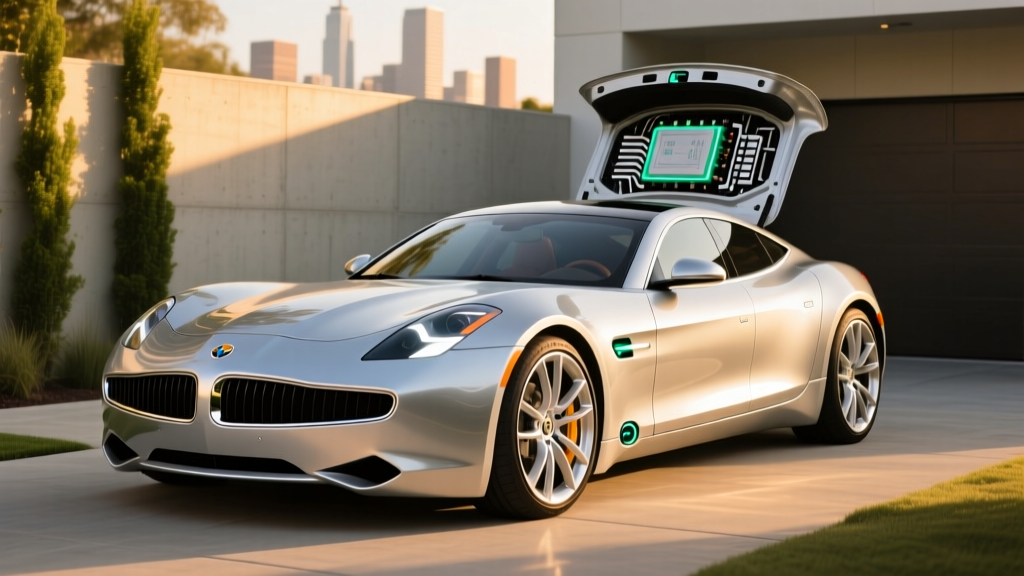
The 2011 Fisker Karma was never a conventional electric car. It was a plug-in hybrid (PHEV) with a series-hybrid powertrain — two electric motors driving the rear wheels and a 2.0-liter turbocharged GM Ecotec gasoline generator that kicked in when the battery depleted. Fisker Automotive collapsed in 2013, and the Karma's successor (the Revero, built by Karma Automotive) didn't arrive until 2017. That makes the 2011–2012 Fisker Karma a discontinued, orphaned vehicle in 2026. This review is written for buyers considering one on the used market or current owners evaluating whether to keep it running.
EPA electric-only range: 32 miles
Real-world expectation (2026): 18–24 miles electric-only on a 15-year-old battery pack. Highway driving at 70+ mph reduces this to 14–18 miles. Cold weather (below 40°F) can push it below 14 miles. Total range with gas generator: EPA rated 230 miles combined (electric + gas), but expect 180–200 miles in real-world mixed driving with a degraded pack.
Powertrain, Battery, and Efficiency Specs
The Karma's powertrain was unconventional for its time. Two rear-mounted electric motors produced a combined 403 horsepower and 959 lb-ft of torque in Sport mode. A 201-hp, 2.0L turbocharged inline-four (sourced from GM's Ecotec family) acted solely as a generator — it never mechanically drove the wheels. This is a series-hybrid (or extended-range EV) layout, similar in concept to the Chevy Volt but far larger and heavier.
| Spec | Value |
|---|---|
| Powertrain type | Series PHEV (EREV) |
| Drivetrain | Rear-wheel drive (dual rear motors) |
| Combined output (Sport mode) | 403 hp / 959 lb-ft torque |
| 0–60 mph | 5.8 seconds (Sport), 7.9 seconds (Stealth/EV-only) |
| Battery capacity (original) | 20.1 kWh gross / ~18 kWh usable |
| Battery chemistry | NMC (nickel-manganese-cobalt), A123 Systems |
| EPA electric range | 32 miles |
| EPA combined MPGe (electric) | 54 MPGe |
| EPA combined MPG (gas-only) | 20 MPG |
| Fuel tank | 9.5 gallons (premium required) |
| Curb weight | 5,300 lbs |
| Length / Width / Height | 196.7" / 78.1" / 52.4" |
The battery pack was manufactured by A123 Systems, which itself filed for bankruptcy in 2012. This is the Karma's single biggest ownership liability in 2026 — replacement packs are scarce, expensive ($8,000–$15,000 from specialty suppliers), and require technicians familiar with the car's high-voltage architecture. The NMC chemistry was standard for the era but has not aged well; most surviving 2011 Karmas show 30–50% capacity loss, which directly erodes the already-modest 32-mile electric range.
Charging: What to Expect from a 2011-Era PHEV
The Karma predates modern DC fast-charging standards entirely. There is no CCS, no CHAdeMO, and certainly no NACS port. Charging is limited to Level 1 (120V) and Level 2 (240V) AC via a J1772 connector — the universal standard for AC charging that persists today.
| Level | Power | Time (0–100%) | Miles Added/Hour |
|---|---|---|---|
| Level 1 (120V / 12A) | ~1.4 kW | ~14 hours | ~2–3 mi/hr |
| Level 2 (240V / 16A) | ~3.3 kW | ~6 hours | ~5–6 mi/hr |
| DC Fast Charge | Not supported | ||
A 3.3 kW onboard charger was modest even in 2011. For context, a modern PHEV like the Toyota RAV4 Prime accepts 6.6 kW on Level 2, cutting charge time in half. With a degraded 18 kWh usable pack, you're still looking at roughly 5–6 hours on a 240V home circuit to reach full charge. Most Karma owners in 2026 charge overnight on a standard 120V outlet, which is sufficient given the small pack — but it means the car is best suited to a home with dedicated parking and a garage outlet.
Important caveat: The Karma's J1772 port and onboard charger are aging components. Failed charge-port door actuators and corroded inlet contacts are documented issues in owner forums. Budget $500–$1,200 for port or OBC (onboard charger) service if the car hasn't had it done.
Interior, Cargo, and Daily Practicality
The Karma was a $96,000+ luxury sedan when new, and its interior reflected that ambition — diamond-stitched leather, reclaimed wood trim, a solar panel roof that trickle-charged the 12V battery, and a minimalist center console with a haptic-touch screen. In 2026, the infotainment system is functionally obsolete: no Apple CarPlay, no Android Auto, no over-the-air updates, and a resistive touchscreen that was criticized at launch for lag and unresponsiveness.
| Dimension | Measurement |
|---|---|
| Front legroom | 42.7 inches |
| Rear legroom | 29.7 inches |
| Front headroom | 38.3 inches |
| Rear headroom | 35.6 inches |
| Trunk volume | 6.9 cu ft |
| Seating capacity | 4 passengers |
The rear seat is the Karma's biggest practical failing. At 29.7 inches of legroom, it is unusable for adults on anything beyond a short trip. The transmission tunnel hump (housing the battery) bisects the rear floor, making the center position nonexistent — this is strictly a four-seater. The 6.9 cu ft trunk is smaller than a Mazda Miata's, making the Karma impractical as a grocery-getter or travel car.
There are no modern driver-assistance features. No adaptive cruise control, no lane-keeping assist, no automatic emergency braking, no blind-spot monitoring. The Karma was designed before the ADAS era. It does include standard stability control, traction control, and front/side airbags, which earned it acceptable crash performance for its era but would not meet 2026 IIHS Top Safety Pick criteria.
Pricing, Used Market Value, and Tax Credit Eligibility
The 2011 Fisker Karma launched with a base MSRP of $96,850 (EcoStandard trim) and climbed to $110,000+ for the EcoSport and EcoChic trims. Depreciation has been severe. As of early 2026, used 2011 Karmas trade between $18,000 and $38,000 depending on mileage, battery state of health, and whether the A123 recall campaign (battery replacement) was completed.
| Category | Amount |
|---|---|
| Original base MSRP (2011) | $96,850 |
| Original as-tested (EcoSport) | $105,000–$110,000 |
| Used market range (2026) | $18,000–$38,000 |
| Federal used-EV tax credit (§25E) | Up to $4,000 (see eligibility below) |
| New-vehicle §30D credit | Not applicable — discontinued model |
Federal tax credit: The new-vehicle §30D credit does not apply — Fisker Automotive ceased production in 2012 and the vehicle is not sold new. However, the IRS §25E used clean vehicle credit may apply if all conditions are met:
- Vehicle price cap: Sale price must be $25,000 or less (from a licensed dealer).
- Buyer income cap: AGI ≤ $75,000 (single) / $112,500 (head of household) / $150,000 (joint).
- Vehicle eligibility: Must be a qualifying clean vehicle (PHEV with ≥4 kWh battery — the Karma's 20.1 kWh pack qualifies).
- Credit amount: 30% of sale price, capped at $4,000.
- Dealer requirement: Must be purchased from a licensed dealer (private-party sales do not qualify).
- One-time use: Buyer can only claim §25E once every three years.
At a $22,000 used Karma purchase from a dealer, the maximum credit would be $4,000 (30% of $22,000 exceeds the cap). At $12,000, the credit would be $3,600. Always confirm eligibility with a tax professional — IRS rules are subject to change and fund exhaustion.
Warranty and Long-Term Reliability
The original factory warranty is long expired. Fisker Automotive offered a 4-year/50,000-mile basic warranty and a 6-year/60,000-mile high-voltage battery warranty (with a capacity retention threshold of 65%). Neither is honored by any successor entity in 2026. Karma Automotive (the Henrik Fisker–founded successor brand that built the Revero) does not support 2011–2012 Karma vehicles.
This means every repair is out-of-pocket. Key reliability concerns for 2026 buyers:
- A123 battery pack: The most expensive single failure point. Replacement packs cost $8,000–$15,000 from third-party suppliers. Some owners have retrofitted modules from other platforms, but this requires specialized high-voltage work.
- GM Ecotec generator: The 2.0L turbo is a known engine with widely available parts, but the integration with the Karma's power electronics is proprietary. Few mechanics outside of specialty EV shops can diagnose generator/inverter faults.
- Power electronics (inverter/charger): Failures have been documented; replacement units are scarce.
- Body and trim: Composite body panels are durable, but replacement glass, lighting assemblies, and interior trim are extremely difficult to source.
- Recall history: NHTSA records show multiple recalls including a 2012 battery-pack fire risk (coolant leak into the battery housing). Confirm via NHTSA's VIN lookup that all recall campaigns were completed.
Who Should (and Shouldn't) Buy a 2011 Fisker Karma in 2026
- Striking design — still one of the most visually distinctive sedans on the road
- 403 hp and 959 lb-ft deliver genuine performance (5.8s 0–60 in Sport mode)
- Solar roof panel is a genuine differentiator (trickle-charges 12V system)
- Series-hybrid layout means you'll never be stranded — gas generator provides backup range
- Collector/conversation value — low production numbers (~2,400 units sold in the US)
- Potential §25E used-EV credit up to $4,000
- Orphaned brand — no dealer network, no factory support, no warranty
- A123 battery replacement costs $8,000–$15,000; most packs are heavily degraded
- 32-mile EPA electric range was short in 2011; 18–24 miles real-world in 2026 is minimal
- No DC fast charging — 6-hour Level 2 charge for a small battery
- 29.7" rear legroom and 6.9 cu ft trunk make it impractical for families or travel
- Zero modern ADAS features (no AEB, no lane-keep, no adaptive cruise)
- Insurance can be difficult and expensive — specialty collector-car policies often required
- Resale value is volatile; further depreciation likely
The Karma suits: Collectors, design enthusiasts, and EV-curious buyers who want a conversation piece and have a second car for daily needs. It can serve as a short-commute PHEV if your round trip is under 20 miles and you have home charging — but the degraded battery means the gas generator will run frequently.
The Karma does not suit: Anyone needing a primary vehicle, a family sedan, a road-trip car, or a reliable daily commuter. The orphan-brand risk, expensive battery replacement, and total lack of modern safety tech make it a poor choice for a sole vehicle.
2011 Fisker Karma vs. Modern Alternatives
For buyers drawn to the Karma's PHEV concept or luxury-sedan positioning, several 2025–2026 alternatives deliver far more practicality, warranty coverage, and electric range:
| Vehicle | EV Range | 0–60 | Battery | DCFC | Used/New Price |
|---|---|---|---|---|---|
| 2011 Fisker Karma | 32 mi (EPA) | 5.8s | 20.1 kWh NMC | No | $18K–$38K (used) |
| 2026 BMW 550e xDrive | ~40 mi (est.) | 4.8s | ~22 kWh NMC | No | ~$72,000 (new) |
| 2026 Toyota Prius Prime | 44 mi (EPA) | 6.6s | 13.6 kWh NMC | No | ~$35,000 (new) |
| 2026 Mercedes S 580e | ~46 mi (EPA) | 5.1s | 28.6 kWh NMC | No | ~$120,000 (new) |
The Prius Prime delivers more electric range, a full warranty, modern ADAS, and a $35,000 price — but it lacks the Karma's drama. The BMW 550e offers comparable luxury and performance with factory backing. The Karma's only advantage is exclusivity and design.
Frequently Asked Questions
What is the real-world electric range of a 2011 Fisker Karma in 2026?
Expect 18–24 miles on a fully charged pack in moderate temperatures with a battery showing typical 15-year degradation. Highway driving and cold weather reduce this to 14–18 miles. The original 32-mile EPA figure assumed a new battery; per fueleconomy.gov, that was the sticker rating when the car was new.
How fast does the 2011 Karma charge at home?
On a 240V Level 2 circuit at 3.3 kW, a full charge takes approximately 6 hours. On a standard 120V outlet, expect roughly 14 hours. There is no DC fast-charging capability.
Does a used 2011 Fisker Karma qualify for any federal tax credit?
It does not qualify for the new-vehicle §30D credit (the car is discontinued). It may qualify for the IRS §25E used clean vehicle credit of up to $4,000, provided the sale price is $25,000 or less, the buyer's AGI falls within income caps, and the purchase is from a licensed dealer. Consult a tax professional for your specific situation.
Is the 2011 Fisker Karma worth buying in 2026?
As a collector piece or secondary car for short commutes, it has appeal — especially at sub-$25,000 prices. As a primary vehicle, no. The orphan-brand status, expensive battery replacement, minimal electric range, and lack of modern safety features make it a high-risk daily driver.
What happens if the A123 battery fails?
Replacement packs from specialty suppliers cost $8,000–$15,000 installed. Some owners have pursued module-level repairs or third-party battery retrofits, but these require high-voltage expertise. Without a functioning traction battery, the car can still operate on the gas generator alone (at 20 MPG combined), but you lose all electric-only driving capability.
Can I still get parts and service for a 2011 Fisker Karma?
The GM Ecotec engine components are widely available. High-voltage components (battery, inverter, onboard charger), body panels, glass, and interior trim are scarce. A small network of independent EV specialists in major metro areas can service Karmas, but Fisker Automotive's dealer network no longer exists. Karma Automotive (the successor brand) does not support 2011–2012 vehicles.