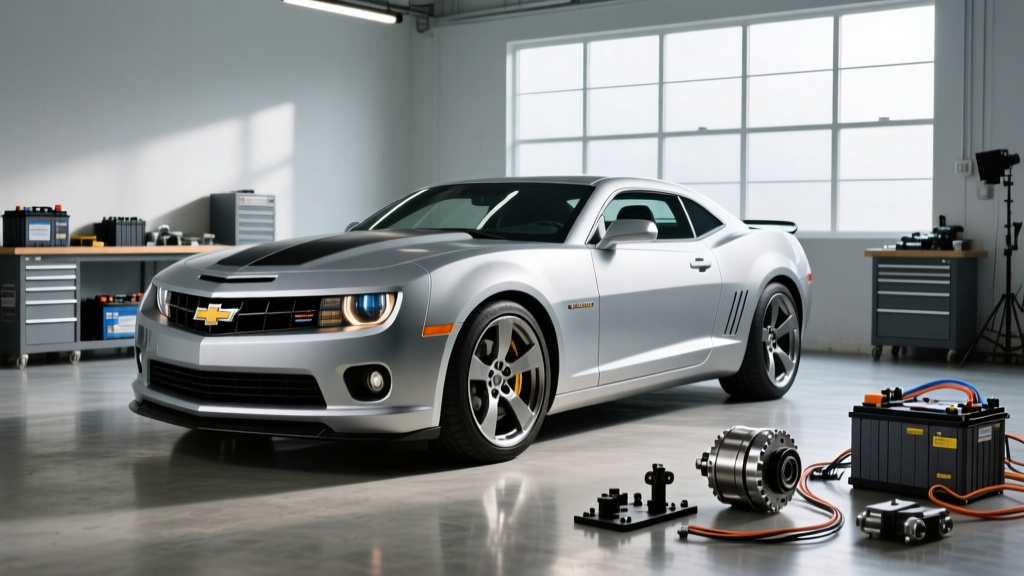
If you own a fifth-generation Chevrolet Camaro and are researching the 2011 Camaro bolt pattern for a wheel upgrade, brake swap, or full electric-vehicle conversion, you need exact fitment data before spending money on parts that won't mount. The 2011 Camaro uses a 5x120mm bolt pattern (also expressed as 5x4.72 inches), a 66.9mm center bore, and M14x1.5 lug nuts — specs it shares with many BMW, Tesla, and other performance platforms.
This guide breaks down the precise wheel-mounting geometry, explains why the bolt pattern matters for EV drivetrain swaps, covers hub-centric ring requirements, and provides a decision framework for anyone using a 2011 Camaro chassis as an EV conversion donor.
2011 Camaro Bolt Pattern: Exact Specifications
The 2011 Chevrolet Camaro (fifth generation, GM Zeta platform) uses the following wheel-mounting specifications across all trims — LS, LT, and SS:
| Specification | Value |
|---|---|
| Bolt Pattern (PCD) | 5x120mm (5x4.72 in) |
| Center Bore | 66.9mm |
| Lug Nut Thread | M14 x 1.5 |
| Lug Nut Torque Spec | 140 lb-ft (190 Nm) |
| Stock Wheel Sizes | 18x8 (LS/LT), 20x8 F / 20x9 R (SS) |
| Stock Offset (ET) | +35 to +40mm (varies by wheel) |
| Stud Type | Lug nut (studs pressed into hub) |
The 5x120mm pattern is critical to get right. Some aftermarket catalogs list the Camaro as 5x4.75 inches (5x120.65mm) — the classic GM bolt circle used on older muscle cars and Corvettes. That is incorrect for the 2011 Camaro. The fifth-gen Zeta platform was engineered by Holden in Australia and uses the metric 5x120mm circle, not the legacy SAE 5x4.75. A 5x4.75 wheel will not seat properly on a 5x120 hub and risks vibration, stud shear, or wheel separation under load.
Vehicles Sharing the 5x120mm Bolt Pattern
The 5x120mm bolt pattern appears across a wide range of performance and EV platforms, which is why the 2011 Camaro has become a popular donor chassis for electric conversions — parts interchangeability is excellent.
| Make / Model | Years | Center Bore | Notes |
|---|---|---|---|
| Chevrolet Camaro (5th/6th gen) | 2010–2024 | 66.9mm | All trims |
| Tesla Model S | 2012–2020 | 64.1mm | Different bore — rings needed |
| BMW 3/4/5 Series (most) | Various | 72.6mm | Different bore — rings needed |
| Pontiac G8 / Chevrolet SS | 2008–2017 | 66.9mm | Same Zeta platform, direct fit |
| Holden Commodore (VE/VF) | 2006–2017 | 66.9mm | Identical platform |
| Cadillac CT4-V / CT5-V Blackwing | 2022+ | 66.9mm | Alpha platform, same PCD |
For EV conversions, the Tesla Model S front and rear subframe assemblies are sometimes adapted to 5x120 hubs using custom adapters, though the center bore difference (64.1mm vs. 66.9mm) requires precision-machined spacers. The Pontiac G8 and Chevrolet SS sedan share the identical 66.9mm bore and 5x120 pattern, making their wheels direct bolt-on replacements.
Why the Bolt Pattern Matters for EV Conversions
The 2011 Camaro has become a popular donor vehicle for EV swaps for several reasons: its rear-wheel-drive layout, strong rear subframe, and the availability of the 5x120mm bolt pattern that crosses over to many EV drivetrain components.
When converting a 2011 Camaro to electric power, builders typically choose between two approaches:
Approach 1: Retain Stock Hubs and Axles
Many conversion shops retain the Camaro's rear differential and half-shafts, coupling an electric motor (commonly a Tesla large drive unit or a NetGain Hyper9) to the existing driveline. This preserves the 5x120mm bolt pattern, 66.9mm bore, and M14x1.5 studs — meaning any wheel that fits a stock 2011 Camaro will fit the conversion.
Approach 2: Full Subframe Swap
Some builders install a complete Tesla rear subframe (from a Model S or Model 3) into the Camaro chassis. The Tesla Model 3 uses a 5x114.3mm bolt pattern, which is incompatible with the Camaro's 5x120 hubs. This approach requires either custom adapter plates or aftermarket wheels drilled for 5x114.3. The Model S rear drive unit retains 5x120mm but with a 64.1mm center bore — again requiring hub-centric adapters.
Wheel Options for the 2011 Camaro (5x120mm)
Whether you're keeping the stock V6/V8 powertrain or planning an EV conversion, here are the main wheel categories that fit the 2011 Camaro bolt pattern:
OEM and Direct-Fit Options
- GM OEM 20-inch SS wheels — 20x8 front, 20x9 rear, +35mm offset, 66.9mm bore. Direct fit, no rings needed.
- Pontiac G8 GXP wheels — 19x8, +40mm offset, 66.9mm bore. Slightly narrower, good for winter tire setups.
- Cadillac CT5-V Blackwing wheels — 19x9.5, +42mm offset, 66.9mm bore. Wider rear for performance applications.
Aftermarket Options (Hub-Centric Rings Required)
- HRE P101 — Forged, custom offset, available in 5x120 with 66.9mm bore option. Premium pricing (~$4,500+ per wheel).
- Forgeline GA1R — Forged monoblock, 5x120 available, custom bore. Motorsport-grade (~$3,200+ per wheel).
- TSW Nurburgring — Flow-formed, 5x120, 73.1mm bore (requires 73.1-to-66.9mm hub rings). Budget-friendly (~$350 per wheel).
- Enkei RPF1 — Lightweight (15.4 lbs for 17x9), 5x120, 73.1mm bore. Track-focused, needs rings.
For EV conversions, wheel weight matters more than with ICE powertrains. Reducing unsprung mass improves regenerative braking efficiency and range. The Enkei RPF1 at 15.4 lbs can save over 30 lbs of unsprung weight compared to the stock 20-inch SS wheels (~27 lbs each), potentially adding 3–5% more range in stop-and-go driving where regen is heavily used.
2011 Camaro EV Conversion: Typical Powertrain Specs
While this isn't a factory EV, builders converting a 2011 Camaro to electric power typically target these performance benchmarks. Here's what a well-executed conversion looks like in 2026:
| Specification | Common Build Target |
|---|---|
| Motor | Tesla Large Drive Unit (rear) or NetGain Hyper9 |
| Battery Capacity | 40–60 kWh usable (LFP or salvaged NMC modules) |
| Estimated Range | 100–150 miles (real-world, mixed driving) |
| Peak Power | 250–400 HP (motor-dependent) |
| 0–60 mph | 4.5–6.5 seconds (varies by battery C-rate) |
| Charging | Level 2 AC (6.6–11 kW); DC fast-charge optional with CCS adapter |
| Drivetrain | RWD (retains stock rear axle or Tesla rear subframe) |
| Curb Weight (est.) | 4,200–4,600 lbs (battery adds 600–1,000 lbs) |
| Bolt Pattern (retained) | 5x120mm with stock hubs; 5x114.3 with Tesla Model 3 subframe swap |
The 5x120mm bolt pattern remains the simplest path for conversions because it preserves the widest selection of aftermarket wheel and tire combinations without custom adapters. Builders who prioritize simplicity and parts availability should retain the stock rear hub assembly.
Common Bolt Pattern Mistakes to Avoid
Whether you're ordering wheels online or sourcing parts from a salvage yard, these errors are costly and potentially dangerous:
- Confusing 5x120mm with 5x4.75 inches. The difference is 0.65mm per stud — enough to prevent proper seating and cause vibration above 60 mph. Always measure with a bolt-pattern gauge, not a tape measure.
- Skipping hub-centric rings. A wheel with a 73.1mm bore on a 66.9mm hub has 3.1mm of play per side. This causes steering wheel shake, premature bearing wear, and uneven tire wear. Rings cost $15–$30 per axle — never skip them.
- Using incorrect lug nuts. The 2011 Camaro uses M14x1.5 lug nuts with a 60-degree conical (acorn) seat. BMW-style ball-seat lug nuts will not contact the wheel properly and risk loosening under load.
- Over-torquing or under-torquing. The factory spec is 140 lb-ft. Use a calibrated torque wrench in a star pattern. Impact guns without torque sticks can stretch studs or leave wheels under-clamped.
- Ignoring offset changes. The stock offset range is +35 to +40mm. Running a +20mm offset wheel pushes the tire 15mm outward, which can cause fender rubbing, increased scrub radius, and accelerated wheel bearing wear — especially with the added weight of an EV conversion battery pack.
Decision Framework: Stock, Aftermarket, or EV Conversion?
Keep stock wheels if: You're running the factory V6 or V8, want zero fitment hassle, and don't need weight savings. OEM 18-inch and 20-inch wheels are engineered for the Camaro's suspension geometry and weight.
Go aftermarket (with rings) if: You need lighter wheels for track use, want a specific aesthetic, or need a size the OEM range doesn't cover (e.g., 17-inch for taller winter tire sidewalls). Budget $1,400–$5,000+ for a set of four plus $30 for hub rings.
Plan an EV conversion if: You want a unique RWD EV with classic muscle-car styling, have a $25,000–$50,000+ conversion budget, and understand that range will be 100–150 miles at best. Retain the 5x120mm hubs for maximum wheel compatibility.
Frequently Asked Questions
What is the bolt pattern on a 2011 Camaro?
The 2011 Camaro uses a 5x120mm bolt pattern (5 lug nuts on a 120mm pitch circle diameter). This is sometimes written as 5x4.72 inches. It is NOT the same as the 5x4.75-inch pattern found on older GM vehicles.
Will BMW wheels fit a 2011 Camaro?
Many BMW wheels share the 5x120mm bolt pattern but have a 72.6mm center bore, which is larger than the Camaro's 66.9mm hub. You would need 72.6mm-to-66.9mm hub-centric rings. Additionally, BMW uses ball-seat lug nuts while the Camaro requires 60-degree conical seat — so you must use Camaro-style lug nuts or wheels with conical seats.
Can I use Tesla Model 3 wheels on a 2011 Camaro?
No, not directly. The Tesla Model 3 uses a 5x114.3mm bolt pattern, which is incompatible with the Camaro's 5x120mm hubs. The Tesla Model S, however, uses 5x120mm but with a 64.1mm center bore (smaller than the Camaro's 66.9mm), so Model S wheels will not center on a Camaro hub without modification.
What size hub-centric rings do I need for a 2011 Camaro?
It depends on the wheel's center bore. The Camaro hub is 66.9mm. If your aftermarket wheel has a 73.1mm bore (the most common universal size), you need 73.1mm-to-66.9mm rings. Measure your wheel's bore before ordering.
How much does an EV conversion cost for a 2011 Camaro?
A professional EV conversion of a 2011 Camaro typically costs $30,000–$55,000 in 2026, depending on battery capacity (40–60 kWh), motor choice (Tesla drive unit vs. aftermarket), and whether the builder retains the stock rear axle or installs a full EV subframe. DIY builds using salvaged Tesla components can reduce cost to $20,000–$30,000 but require significant fabrication and electrical expertise. These conversions do not qualify for the IRS §30D federal EV tax credit, which applies only to new qualifying vehicles purchased from a manufacturer.
Does the 2011 Camaro SS have a different bolt pattern than the V6?
No. All 2011 Camaro trims — LS (V6), LT (V6), and SS (V8) — share the identical 5x120mm bolt pattern and 66.9mm center bore. The SS uses wider wheels (20x8 front, 20x9 rear) and wider tires, but the hub mounting geometry is the same.
Sources: 2011 Chevrolet Camaro Owner's Manual (chevrolet.com); IRS Clean Vehicle Credits (irs.gov).