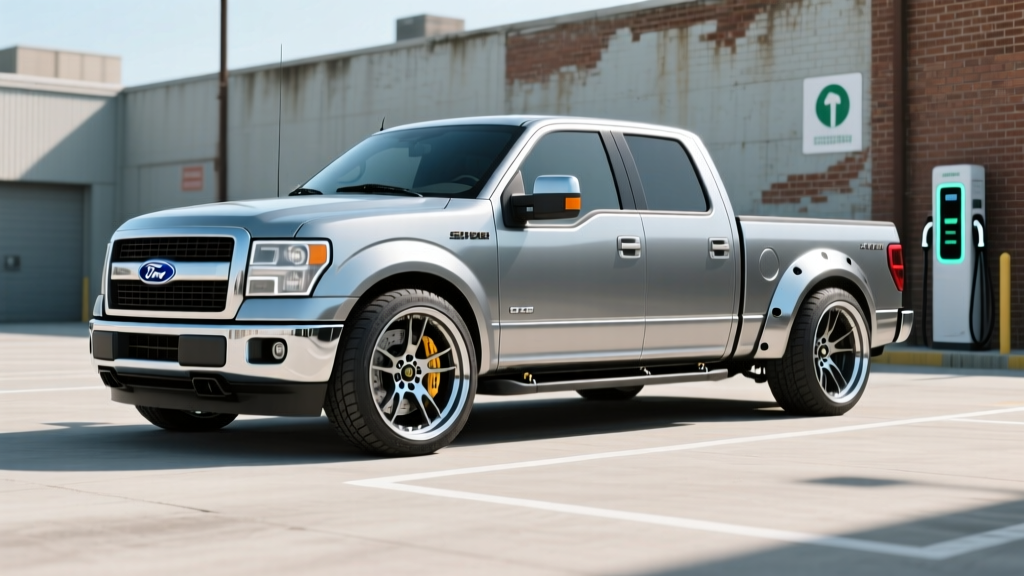
If you're researching the 2006 Ford F-150 bolt pattern — whether you're replacing a damaged wheel, upgrading to lighter alloys, or planning a custom electric-vehicle conversion on a 2004–2008 F-150 chassis — you need precise fitment data before you spend a dollar on wheels. This guide covers the exact bolt pattern, lug specifications, hub bore, and offset ranges for the 2006 F-150, along with practical advice for anyone adapting this platform for an EV powertrain swap.
While AutoEdgeView focuses on production electric vehicles and electrified ownership, we recognize that the F-150 platform is one of the most popular donor trucks for EV conversions. Understanding the 2006 F-150's wheel architecture is critical whether you're keeping the factory 4.6L or 5.4L V8 or replacing it with an electric crate motor.
The 2006 Ford F-150 Bolt Pattern: Exact Specifications
The 2006 Ford F-150 uses a 6-lug bolt pattern measuring 6×135mm (also written as 6×5.3 inches in imperial notation). This pattern has been standard on most F-150 models since the 2004 redesign and continued through subsequent generations. The six lug nuts are arranged on a circle with a 135-millimeter diameter.
| Specification | Value |
|---|---|
| Bolt Pattern | 6×135mm (6×5.3") |
| Lug Nut Thread Size | M14 × 2.0 |
| Lug Nut Torque Spec | 150 lb-ft (203 N·m) |
| Center Bore (Hub Bore) | 87.1mm |
| Stock Wheel Sizes | 17" × 7.5" / 18" × 7.5" / 20" × 8.5" |
| Typical Offset Range | +40mm to +44mm (stock) |
| Stock Tire Sizes | 235/70R17, 255/65R18, 275/55R20 |
The center bore of 87.1mm is hub-centric on the factory wheels, meaning the wheel centers on the hub rather than relying solely on the lug studs for centering. If you install aftermarket wheels with a larger bore, you'll need hub-centric rings (87.1mm outer diameter to the wheel's inner bore diameter) to prevent vibration at highway speeds.
Why the Bolt Pattern Matters for EV Conversions
The 2004–2008 F-150 chassis has become a popular candidate for EV swaps among hobbyists and small shops. The truck's body-on-frame construction makes it relatively straightforward to remove the internal combustion powertrain and install an electric motor, controller, and battery pack. When planning such a build, wheel fitment takes on additional importance:
- Weight considerations: Battery packs add significant mass — often 500–1,500 lbs depending on pack size. Lighter forged aluminum wheels reduce unsprung weight and improve efficiency, which matters even more in an EV where every watt-hour counts.
- Load rating: EV conversions often push gross vehicle weight higher than stock. Ensure any replacement wheel carries an adequate load rating — typically at least 2,500 lbs per wheel for a converted F-150 with a substantial battery pack.
- Regenerative braking compatibility: Heavier EV-converted trucks place more thermal demand on brakes during regen-heavy driving. Proper wheel offset ensures adequate clearance for larger brake calipers if you upgrade the braking system.
- Aerodynamic wheel options: Some EV builders opt for aero-disc or low-drag wheel designs to reduce turbulence and extend range. You'll need to confirm any such wheel is available in 6×135mm.
Lug Nut Torque and Maintenance
Ford specifies 150 lb-ft of torque for the M14×2.0 lug nuts on the 2006 F-150. Always use a calibrated torque wrench — never an impact wrench alone — when installing wheels. Overtightening can stretch or break studs; undertightening risks wheel separation.
After installing new wheels, re-torque the lug nuts after the first 50–100 miles of driving. This is standard practice for any vehicle but is especially important on a truck that may carry heavy loads or tow.
For EV-converted F-150s, the instant torque delivery of electric motors can place different stress patterns on drivetrain and wheel hardware compared to a gasoline engine. Periodic lug torque checks are good practice, particularly in the first several hundred miles after a conversion.
Wheel Compatibility: What Else Fits the 6×135 Pattern?
The 6×135mm bolt pattern is relatively uncommon in the broader automotive world but appears on several Ford trucks and SUVs. Wheels from the following vehicles share the same bolt pattern and may fit, depending on offset, bore, and diameter:
- 2004–2024 Ford F-150 (most trims)
- 2003–2024 Ford Expedition
- 2003–2024 Lincoln Navigator
- 2007–2014 Ford Expedition EL / Max
However, sharing a bolt pattern does not guarantee direct fitment. You must also match or accommodate:
- Center bore: The wheel bore must be 87.1mm or larger (with hub-centric rings).
- Offset: Deviating significantly from the stock +40mm to +44mm range can cause rubbing on suspension components or the fender, and alters scrub radius — affecting steering feel and bearing wear.
- Wheel diameter and width: Ensure adequate clearance for brake calipers, especially if you've upgraded brakes as part of an EV conversion.
- Load rating: Must support the vehicle's gross axle weight rating (GAWR).
For Production EV Buyers: The Ford F-150 Lightning
If your interest in the F-150 platform is production-electric rather than conversion-based, the Ford F-150 Lightning (introduced for the 2022 model year and continuing through 2026) is Ford's factory-built electric pickup. Here are the key specs for the current Lightning lineup:
| Spec | Standard Range | Extended Range |
|---|---|---|
| EPA Range | ~240 miles | ~320 miles |
| Battery Capacity | ~98 kWh (usable) | ~131 kWh (usable) |
| Battery Chemistry | NMC (nickel manganese cobalt) | NMC |
| Max DC Fast Charge | ~150 kW | ~150 kW |
| 10–80% DC Charge Time | ~44 minutes | ~41 minutes |
| Level 2 Home Charging | ~19.2 kW (80A Ford Charge Station Pro) | ~19.2 kW |
| 0–60 mph | ~4.0 seconds | ~3.8 seconds |
| Horsepower | 563 hp (dual-motor AWD) | 563 hp |
| Torque | 775 lb-ft | 775 lb-ft |
| Max Towing | ~7,700 lbs | ~10,000 lbs |
| Starting MSRP | ~$55,000–$97,000+ depending on trim | |
The Lightning uses a 6×135mm bolt pattern as well — same as the 2006 F-150 — though offset, wheel diameter, and load requirements differ significantly. The Lightning's stock wheels are typically 18" or 20" with specific offsets tuned for the EV's heavier curb weight (~6,500 lbs). Do not assume 2006 F-150 wheels will safely fit a Lightning without verifying offset, bore, and load rating.
Frequently Asked Questions
What is the bolt pattern on a 2006 Ford F-150?
The 2006 Ford F-150 uses a 6-lug bolt pattern of 6×135mm (6×5.3 inches). This is measured as the diameter of the circle passing through the center of all six lug holes.
Will wheels from a Chevy or Dodge truck fit my 2006 F-150?
No. Chevrolet/GMC trucks typically use a 6×139.7mm (6×5.5") pattern, and Dodge Ram 1500 trucks use a 5-lug or 6-lug pattern that does not match 6×135mm. The bolt patterns are incompatible without adapters — and adapters introduce safety and liability concerns, especially on heavy vehicles or EV conversions.
What size are the lug nuts on a 2006 F-150?
The lug nuts are M14 × 2.0 thread pitch, torqued to 150 lb-ft per Ford's specification.
Can I use wheel spacers on my 2006 F-150 or EV conversion?
Wheel spacers are available in 6×135mm, but they change the effective offset and increase stress on wheel bearings. On an EV conversion with added battery weight, spacers can accelerate bearing wear. If you need a different offset, it's safer to select wheels with the correct native offset rather than relying on spacers.
Does the Ford F-150 Lightning use the same bolt pattern?
Yes — the F-150 Lightning also uses a 6×135mm bolt pattern. However, the Lightning's significantly heavier curb weight means wheels must carry an appropriate load rating. Always verify offset, center bore, and load capacity before fitting any wheel to a Lightning.
Sources: Ford Motor Company owner's manual specifications; Ford F-150 Lightning official page; fueleconomy.gov for Lightning efficiency data.