Quick Answer: 2006 Chevy Impala Bolt Pattern
The 2006 Chevrolet Impala (ninth generation, W-body platform) uses a 5x115 mm (5x4.53 in) bolt pattern — five lug nuts arranged on a 115 mm circle. This is the GM W-body standard shared with the Chevrolet Monte Carlo, Pontiac Grand Prix, and Buick LaCrosse of the same era. The center bore is 70.3 mm, and the lug thread size is M12 x 1.5.
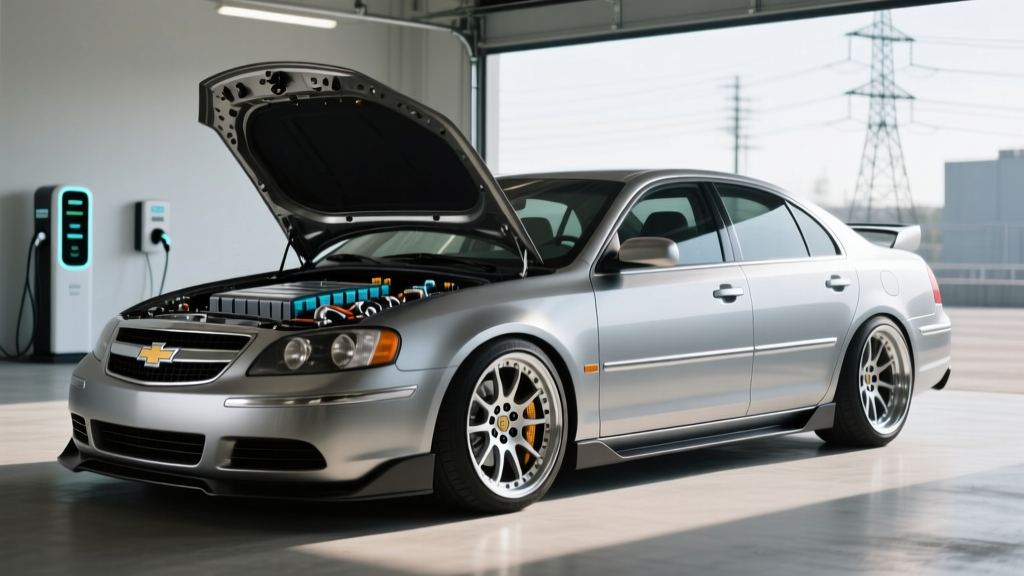
For EV conversion builders, restomod shops, and owners upgrading wheels on a project Impala destined for an electric powertrain swap, understanding these specs is the first step before tackling brake clearance, offset compatibility, and hub-centric fitment.
| Spec | Value |
|---|---|
| Bolt Pattern (PCD) | 5x115 mm (5x4.53 in) |
| Center Bore | 70.3 mm |
| Lug Thread | M12 x 1.5 |
| OEM Wheel Size Range | 16"–18" (depending on trim) |
| OEM Offset (ET) | +38 to +42 mm |
| Stock Tire Sizes | 225/60R16 (LS/LT), 225/55R17 (LTZ), 235/50R18 (SS) |
| Hub-Centric Ring Size (aftermarket) | 73.1 → 70.3 mm (common) |
Why Bolt Pattern Matters for EV Conversions
When converting a 2006 Impala to electric drive — whether using a NetGain Hyper9 motor, a salvaged Tesla drive unit, or a Cascadia Motion kit — the wheel interface must handle significantly different loads than the original 3.5L or 5.3L V8 setup.
EV conversions add weight (battery packs typically add 600–1,200 lbs over the removed ICE components, net gain of 300–800 lbs depending on pack placement). That extra mass increases stress on wheel studs during cornering and braking. The 5x115 pattern is adequate for moderate-power builds under 400 hp, but high-torque dual-motor swaps may require aftermarket stud upgrades or custom hub adapters machined to maintain the 70.3 mm center bore for proper load distribution.
The W-body front suspension uses MacPherson struts with a relatively narrow track width. Choosing wheels with the correct offset (+38 to +42 mm) keeps scrub radius within spec — critical when adding regenerative braking, which applies different torque profiles than friction-only braking.
Compatible Wheels & Cross-Reference Fitment
The 5x115 bolt pattern is shared across many GM vehicles, which opens up sourcing options for EV-swap builders:
- 2005–2009 Buick LaCrosse — 16" and 17" options, +40 mm offset
- 2004–2008 Pontiac Grand Prix — 16"–18" options, GXP 18" wheels fit well
- 2006–2009 Chevrolet Impala SS — factory 18" wheels, +38 mm offset
- 2000–2005 Chevrolet Monte Carlo — earlier W-body, same PCD
- 2006–2011 Chevrolet HHR — some 16" wheels share 5x115 (verify center bore)
Wheels from vehicles with a 5x120 mm pattern (BMW, some newer GM trucks) will not fit without an adapter — and adapters introduce safety concerns for heavier EV builds due to added leverage on studs.
Brake Clearance & Offset Considerations for EV Swaps
EV conversions frequently upgrade braking systems to handle increased vehicle weight and regenerative braking demands. If you're fitting larger rotors or multi-piston calipers, wheel spoke clearance becomes the limiting factor — not just the bolt pattern.
For a typical Impala EV conversion using a Tesla small drive unit or similar:
- Minimum wheel diameter: 16" to clear most aftermarket caliper brackets
- Minimum spoke clearance: 42 mm from hub face to inner spoke edge
- Offset tolerance: Stay within +35 to +45 mm to avoid fender rub or bearing load issues
Hub-centric fitment is non-negotiable for EV builds. Lug-centric wheels (where the lug nuts, not the center bore, carry the load) can develop vibration under the sustained high-torque loads of electric motors. Always use hub-centric rings if aftermarket wheels have a larger center bore than 70.3 mm.
Torque Specs & Stud Safety for Heavier EV Builds
Factory M12 x 1.5 lug nuts on the 2006 Impala torque to 100 lb-ft (135 Nm). For an EV conversion adding 500+ lbs, maintain this spec but consider:
- ARP aftermarket wheel studs (grade 10.9 or higher) for builds exceeding 4,500 lbs curb weight
- Re-torque after the first 50 miles and every 5,000 miles thereafter
- Use a calibrated torque wrench — never impact guns for final tightening on EV-converted vehicles
The increased unsprung weight from battery placement (especially if modules are mounted low or near axles) amplifies the cyclic fatigue on wheel studs. This is a commonly overlooked failure point in DIY EV conversions.
Sourcing Replacement Parts & Adapters
For builders needing hub adapters to fit non-GM wheels (e.g., adapting to a 5x114.3 pattern for access to a wider wheel selection):
- Adapter thickness: Minimum 25 mm to maintain proper thread engagement on M12 studs
- Material: 6061-T6 billet aluminum only — never cast adapters for EV applications
- Center bore: Must match 70.3 mm hub exactly on the vehicle side
Custom machine shops specializing in EV conversions (such as EV West or Zombie Motors) can machine hub adapters that maintain concentricity within 0.001" — critical for high-speed stability with the instant torque delivery of electric motors.
FAQ: 2006 Chevy Impala Bolt Pattern & EV Fitment
Is the 2006 Impala bolt pattern 5x115 or 5x4.5?
It's 5x115 mm, which converts to 5x4.53 inches. While close to the common 5x4.5" (5x114.3 mm) pattern, they are not interchangeable — forcing a 5x114.3 wheel onto a 5x115 hub creates stud misalignment and dangerous stress concentrations. Always match exactly.
Can I put 5x120 wheels on my 2006 Impala?
Not directly. A 5x120 wheel will not align with 5x115 studs. Adapters exist but add complexity and potential failure points — especially inadvisable for heavier EV conversions where wheel loads are elevated.
What size hub-centric rings do I need for aftermarket wheels?
Most aftermarket 5x115 wheels have a 73.1 mm center bore. You'll need 73.1 mm to 70.3 mm hub-centric rings to eliminate vibration. Plastic rings work for street use; aluminum rings are preferred for EV conversions due to higher sustained loads.
Will 2006 Impala SS 18" wheels fit my LS or LT?
Yes — all 2006–2009 Impala trims share the 5x115 bolt pattern and 70.3 mm center bore. The SS 18" wheels (235/50R18) will bolt directly onto LS/LT models, though you may need to verify fender clearance if the car has been lowered for an EV battery pack installation.
How does an EV conversion affect wheel bearing life?
Added weight (typically 300–800 lbs net) and instant torque delivery accelerate wheel bearing wear. Expect bearing service intervals to shorten from the OEM 100,000+ mile expectation to roughly 60,000–80,000 miles in a moderately loaded EV conversion. Using correct offset wheels (+38 to +42 mm) minimizes additional bearing load.
What torque should I use on the lug nuts after an EV swap?
Maintain the factory specification of 100 lb-ft (135 Nm) in a star pattern. If you've upgraded to aftermarket studs, follow the stud manufacturer's spec — ARP typically recommends 90–110 lb-ft depending on stud diameter and lubrication.