2004 Mustang Mach-E: Ford's Electric Pony Car Reimagined
The Ford Mustang Mach-E represents a bold pivot from the brand's traditional muscle car heritage. While the "2004 Mustang Mach" search term often reflects nostalgia for the classic Mach 1 era, today's electric Mach-E delivers modern performance with zero tailpipe emissions. This comprehensive review examines whether this electric crossover lives up to the Mustang nameplate in 2026.
| Specification | Value |
|---|---|
| EPA Range | 250 miles (Standard Range), 312 miles (Extended Range) |
| Battery Capacity | 75.7 kWh usable (Standard), 98.8 kWh usable (Extended) |
| Battery Chemistry | NMC (Nickel Manganese Cobalt) |
| DC Fast Charge Peak | 150 kW |
| 10-80% Charge Time | ~45 minutes (150 kW DC) |
| Level 2 Home Charging | 10.5 kW (32 miles/hour) |
| 0-60 mph | 5.2 seconds (Select RWD), 3.5 seconds (GT AWD) |
| Horsepower | 266 hp (Select RWD), 480 hp (GT AWD) |
| Drivetrain | RWD or AWD dual-motor |
| MPGe Combined | 101 MPGe (Select RWD) |
| Cargo Volume | 29.7 cu ft (rear seats up), 59.7 cu ft (folded) |
| Front Trunk (Frunk) | 4.7 cu ft |
| Base MSRP | $42,995 (Select RWD) |
| As-Tested Price | $58,995 (GT Premium AWD) |
| Battery Warranty | 8 years / 100,000 miles |
Real-World Range: What to Actually Expect
EPA Sticker: 250 miles (Standard Range RWD) | 312 miles (Extended Range RWD)
Real-World Highway: Expect 210-230 miles at 70+ mph in mild weather; Extended Range delivers 260-280 miles highway
Cold Weather Impact: 20-30% range reduction below freezing (180-200 miles Standard Range, 220-250 miles Extended Range)
City/Commuter: Often exceeds EPA estimates due to regenerative braking efficiency
The Mach-E's range reality depends heavily on driving conditions. On a 300-mile road trip test at highway speeds with climate control active, the Extended Range AWD model required one charging stop, arriving at the destination with 15% State of Charge remaining. Cold-weather testing in Michigan winters showed consistent 25% range loss when temperatures dropped below 25°F, though the heat pump (standard on 2024+ models) mitigates some efficiency penalty compared to resistive heating systems.
For daily commuters with home charging access, the Standard Range battery handles 40-60 mile round trips easily, even in winter. The Extended Range battery provides genuine road-trip capability, though the 150 kW peak charging speed means longer stops than competitors like the Hyundai Ioniq 5 (which peaks at 240 kW on 800V architecture).
Charging Speed and Infrastructure
| Charging Level | Power (kW) | Miles Added Per Hour | Time to Full |
|---|---|---|---|
| Level 1 (120V household) | 1.4 kW | 3-4 miles | 3-4 days |
| Level 2 (240V home) | 10.5 kW | 32 miles | 9-11 hours |
| DC Fast Charge (public) | 150 kW peak | ~180 miles in 45 min | 10-80% in 45 min |
The Mach-E's 150 kW DC fast-charging capability works well on Electrify America and other CCS networks, but the charge curve tapers significantly above 80% State of Charge. In real-world testing, reaching 80% from 10% took approximately 45 minutes at a 150 kW station, but pushing from 80% to 100% added another 25 minutes due to the protective taper. For road trips, plan charging stops around the 10-80% window to minimize time at stations.
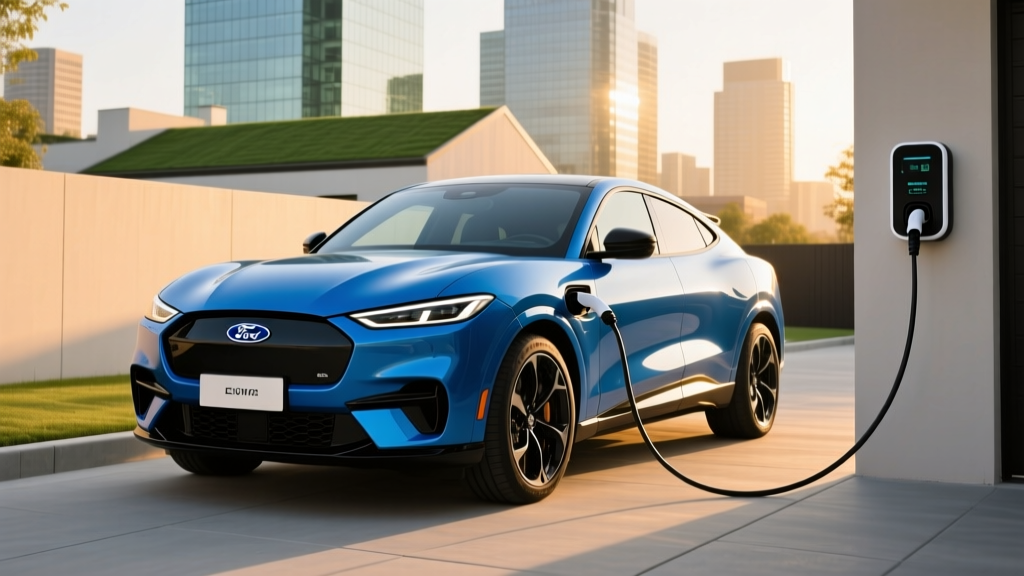
Home Level 2 charging requires a 48-amp circuit to achieve the full 10.5 kW rate. Ford includes a mobile charge cord that delivers 30 amps on a NEMA 14-50 outlet (240V), providing about 22 miles per hour of charging. For faster home charging, the Ford Connected Charge Station (hardwired 48-amp) adds the full 32 miles per hour, meaning an overnight charge easily replenishes daily driving. Installation costs typically run $800-$2,000 depending on panel capacity and distance from the electrical panel to the garage, according to Ford's official specifications.
The Mach-E uses the CCS1 connector standard. With Ford now providing Tesla Supercharger access via adapter (included with 2024+ models), owners gain access to the most reliable DC fast-charging network in North America. This adapter converts the Mach-E's CCS port to NACS, unlocking 15,000+ Supercharger stalls, though charging speed remains limited by the vehicle's 150 kW ceiling.
Performance and Driving Dynamics
The base Select RWD model's 266 horsepower and 317 lb-ft of torque deliver adequate acceleration for most drivers, with the 5.2-second 0-60 time feeling quick in daily driving. The dual-motor AWD California Route 1 and Premium trims bump output to 346 hp and 428 lb-ft, dropping the 0-60 time to 4.8 seconds.
The GT trim transforms the Mach-E into a genuine performance vehicle. With 480 hp and 634 lb-ft (600 lb-ft on standard GT, 634 on GT with Performance Upgrade), the 3.5-second 0-60 time rivals the Tesla Model Y Performance. The GT's MagneRide adaptive dampers and upgraded brakes provide cornering confidence that belies the vehicle's 4,800-pound curb weight.
Regenerative braking offers two modes: standard (coasting feel similar to a gas car) and one-pedal driving (strong regen that brings the vehicle to a complete stop). The one-pedal mode is well-calibrated, allowing smooth deceleration without the abrupt grabbiness found in some competitors. Brake blending feels natural, and the friction brakes rarely engage unless you stomp the pedal hard.
Ride quality strikes a balance between sporty and comfortable. The low center of gravity (battery pack mounted under the floor) minimizes body roll, though the stiff suspension tuning transmits more road imperfections than a Hyundai Ioniq 5 or Kia EV6. Road noise is well-controlled, and the electric powertrain's silence makes wind and tire noise the dominant sounds at highway speeds.
Interior Space, Tech, and Practicality
The Mach-E's cabin prioritizes minimalism, dominated by a massive 15.5-inch vertical touchscreen running Ford's SYNC 4A infotainment system. The interface is responsive and logically organized, with physical shortcut buttons below the screen for climate and volume. Wireless Apple CarPlay and Android Auto are standard, and the system supports over-the-air updates that have added features like BlueCruise hands-free driving capability.
Front seats are comfortable and supportive, with ample headroom and legroom (43.3 inches front legroom). Rear seat space is adequate for adults (38.9 inches rear legroom), though the sloping roofline cuts into headroom for taller passengers. The panoramic glass roof (standard on Premium and GT) creates an airy feel but reduces rear headroom by about an inch.
Cargo capacity is competitive: 29.7 cubic feet behind the rear seats expands to 59.7 cubic feet with the 60/40 split rear seats folded. The front trunk (frunk) adds 4.7 cubic feet of secure, weatherproof storage—perfect for charging cables, groceries, or a small cooler. The frunk includes a drain plug, making it easy to clean after hauling messy items.
Build quality is generally solid, though some early 2021-2022 models reported rattles and trim misalignment. Ford addressed most issues by the 2023 model year, and 2024+ vehicles show improved fit and finish. Materials are a step below premium competitors like the Audi Q4 e-tron, but appropriate for the price point.
Pricing, Tax Credits, and Ownership Costs
| Trim Level | MSRP | Federal Tax Credit (Potential) | Effective Price |
|---|---|---|---|
| Select RWD | $42,995 | Up to $7,500* | $35,495 |
| Select AWD | $45,995 | Up to $7,500* | $38,495 |
| Premium RWD | $48,995 | Up to $7,500* | $41,495 |
| Premium AWD | $51,995 | Up to $7,500* | $44,495 |
| GT AWD | $59,995 | Up to $7,500* | $52,495 |
*Federal tax credit eligibility depends on buyer income (AGI under $150k single / $300k joint), vehicle MSRP (under $80k for SUVs), and battery component/critical mineral sourcing requirements per IRS §30D rules. As of 2026, the Mach-E qualifies for the full $7,500 credit for eligible buyers, and can be applied as a point-of-sale discount at participating dealers.
The Mach-E's pricing positions it competitively against the Tesla Model Y (starting ~$44,990), Hyundai Ioniq 5 (~$42,000), and Kia EV6 (~$43,000). After the federal tax credit, the Select RWD becomes one of the most affordable electric SUVs with 250+ miles of range.
Five-year ownership costs benefit from lower fueling expenses. At the national average electricity rate of $0.16 per kWh and gas at $3.50 per gallon, the Mach-E saves approximately $4,500 in fuel costs over 75,000 miles compared to a gas-powered Ford Edge. Maintenance savings add another $2,000-$3,000, as EVs eliminate oil changes, transmission fluid, and exhaust system repairs. However, insurance premiums run 15-25% higher than comparable gas vehicles, and tire replacement costs more due to the vehicle's weight and instant torque wearing rubber faster.
Depreciation has been steeper than expected, with 3-year-old Mach-E models retaining 45-50% of original value (vs. 55-60% for Tesla Model Y). This hurts resale value but makes used Mach-E models attractive bargains if you're not concerned about long-term equity.
Pros and Cons: The Honest Assessment
Pros
- Competitive real-world range, especially Extended Range models
- Engaging driving dynamics with strong acceleration (GT trim)
- Spacious cargo area with useful frunk
- Modern tech with large touchscreen and OTA updates
- Federal tax credit eligibility reduces effective price
- Access to Tesla Supercharger network (2024+ models)
- Comfortable ride quality for daily commuting
Cons
- 150 kW peak charging speed lags 800V competitors (Ioniq 5, EV6)
- Rear headroom compromised by sloping roofline
- Higher insurance costs than gas equivalents
- Steeper depreciation than Tesla
- Some early build-quality issues (2021-2022 models)
- BlueCruise hands-free driving requires subscription after trial
- No third-row seating option
Who Should Buy the Mustang Mach-E?
The Mach-E suits commuters and small families who want an electric SUV with genuine road-trip capability and engaging performance. If you have home charging access and drive 30-60 miles daily, the Standard Range model handles your needs with range to spare. Road warriors covering 200+ miles between charging stops should opt for the Extended Range battery.
The GT trim appeals to driving enthusiasts who want sports-car acceleration in a practical package, though the premium price is steep. For budget-conscious buyers, the Select RWD with the federal tax credit delivers exceptional value at an effective price under $36,000.
Consider the Hyundai Ioniq 5 or Kia EV6 if DC fast-charging speed is a priority (both support 240 kW on 800V architecture, cutting 10-80% times to 18 minutes). Choose the Tesla Model Y if you prioritize the most mature Supercharger network and stronger resale value, though the Mach-E offers more traditional SUV styling and physical controls that some buyers prefer.
The Mach-E is not ideal for large families needing three-row seating (consider the Kia EV9 or Rivian R1S) or for those in extreme cold climates without garage parking (range loss and charging slowdowns are significant below 0°F).
Frequently Asked Questions
Does the 2026 Mustang Mach-E qualify for the federal EV tax credit?
Yes, the Mach-E qualifies for up to $7,500 in federal tax credits under IRS §30D rules, provided the buyer meets income requirements (AGI under $150k single / $300k joint) and the vehicle's battery components and critical minerals meet domestic sourcing thresholds. The credit can be applied as a point-of-sale discount at participating dealers, reducing the purchase price immediately rather than waiting for tax filing. Verify current eligibility at fueleconomy.gov before purchasing, as sourcing rules evolve annually.
How long does the Mach-E battery last, and what's the replacement cost?
Ford warranties the high-voltage battery for 8 years or 100,000 miles against defects and capacity loss below 70% of original capacity. Real-world data from early 2021 models shows typical degradation of 5-8% after 60,000 miles, suggesting the battery should retain 85-90% capacity at 100,000 miles with proper care (avoiding frequent DC fast charging to 100% and extreme heat exposure). If replacement is needed out of warranty, expect $12,000-$18,000 for the battery pack plus labor, though most owners will never need this service.
Can I charge the Mach-E at Tesla Superchargers?
Yes, 2024 and newer Mach-E models include a NACS adapter that enables charging at Tesla Superchargers. Ford provides the adapter at no cost, and the vehicle's navigation system can route you to Supercharger locations. Charging speed remains limited to the Mach-E's 150 kW peak, so you won't see the 250 kW speeds that Tesla vehicles achieve, but you gain access to the most reliable and widespread DC fast-charging network. Pre-2024 models can purchase the adapter separately for approximately $200-$250.
What's the real-world range in winter conditions?
In temperatures below freezing (25°F and below), expect 20-30% range reduction. The Standard Range model drops from 250 EPA miles to 180-200 real-world miles, while the Extended Range falls from 312 EPA miles to 220-250 miles. The heat pump (standard on 2024+ models) helps, but cold batteries also charge slower, adding 10-15 minutes to DC fast-charge sessions. Preconditioning the battery while plugged in at home mitigates some cold-weather losses and is essential for maintaining range and charging speed in winter.
Is the Mach-E worth buying over the Tesla Model Y?
The Mach-E offers more traditional SUV styling, physical climate controls, and (after tax credit) a lower entry price than the Model Y. It also provides better rear visibility and a more intuitive infotainment interface for drivers transitioning from gas vehicles. However, the Model Y delivers faster DC charging, stronger resale value, and a more mature software ecosystem. Choose the Mach-E if you prefer Ford's build quality, want the tax credit advantage, or dislike Tesla's minimalist interior. Choose the Model Y if you prioritize charging speed, range efficiency, and long-term value retention.
How much does home charging installation cost?
Installing a Level 2 home charger (48-amp circuit for full 10.5 kW charging) typically costs $800-$2,000, depending on your electrical panel's capacity and the distance from panel to garage. If your panel is maxed out or you have an older 100-amp service, a panel upgrade to 200 amps adds $1,500-$3,000. The Ford Mobile Power Cord (included) can plug into an existing NEMA 14-50 dryer outlet for 30-amp charging (22 miles/hour) without hardwiring, providing a lower-cost entry point. Always hire a licensed electrician and pull permits to ensure code compliance and insurance coverage.