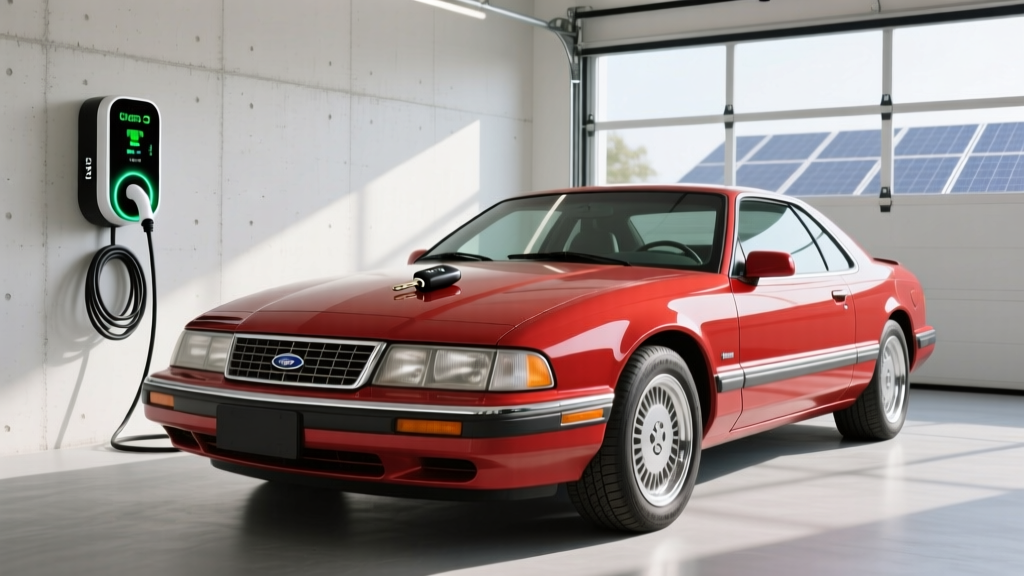
If you've spent years maintaining a 1994 Ford Thunderbird Supercharged — that supercharged 3.8L V6 pushing 230 horsepower and roughly 18 MPG combined — you already know the rhythm of gas station stops, fuel pump replacements, and the creeping cost of premium unleaded. Now you're eyeing an electric vehicle, and the first real question isn't about 0-60 times. It's about charging: Can I plug in at home? What will it cost? Will my garage's electrical panel handle it?
This guide breaks down every layer of EV charging — from Level 1 trickle charging to DC fast charging — with exact kilowatt figures, installation cost ranges, connector compatibility, and per-mile economics compared to filling up that Thunderbird's 18.5-gallon tank.
Charging Levels Explained: kW, Miles Per Hour, and 10–80% Times
The single most important literacy point in EV ownership: kW (kilowatts) measures charging power — how fast energy flows into the battery. kWh (kilowatt-hours) measures battery energy capacity — the size of the tank, in electric terms. Confusing them is like mixing up gallons-per-minute with the total gallons in a fuel tank.
| Level | Voltage | Power (kW) | Miles of Range Added/Hour | Typical Use Case |
|---|---|---|---|---|
| Level 1 | 120V AC | 1.0–1.4 kW | 3–5 mi/hr | Overnight top-ups, PHEVs, low-mileage drivers |
| Level 2 | 240V AC | 3.3–19.2 kW | 12–75 mi/hr | Home garage, workplace, shopping centers |
| DC Fast | 400–800V DC | 50–350 kW | 150–1,200 mi/hr (peak) | Road trips, highway corridors, fleet depots |
Real-world charging time examples (10–80% State of Charge, which is the standard fast-charging window because charging slows dramatically above 80% to protect battery health):
- 60 kWh battery (e.g., Chevrolet Equinox EV): ~18–22 minutes at a 150 kW DC fast charger; ~8–9 hours on a 7.2 kW Level 2 home charger.
- 82 kWh battery (e.g., Volkswagen ID.4): ~24–28 minutes at 170 kW DC; ~11 hours on 7.2 kW Level 2.
- 100 kWh battery (e.g., Tesla Model S, Ford F-150 Lightning Extended Range): ~25–35 minutes at 250 kW DC; ~13–14 hours on 7.2 kW Level 2.
DC fast charging follows a charge curve: a vehicle rated for 250 kW peak may only sustain that rate between 10–40% SoC before tapering to 150 kW, then 80 kW, then 40 kW as it approaches 80%. Peak kW is not sustained kW — a detail that affects road-trip planning more than any spec-sheet number.
Home Charger Installation: Electrical Requirements, Costs, and Panel Gotchas
A Level 2 home charger is the backbone of practical EV ownership. Most EV owners do 80–90% of their charging at home, typically overnight, waking to a full battery every morning — something the 1994 Thunderbird could never offer.
Electrical Requirements
A standard Level 2 home installation requires a 240V dedicated circuit, typically rated at 40A or 50A. The National Electrical Code (NEC) requires that continuous loads (like EV charging, which runs for hours) use no more than 80% of the circuit's rated capacity. So a 50A breaker supports a charger drawing up to 40A (9.6 kW), and a 60A breaker supports 48A (11.5 kW).
Panel upgrade reality: Many older homes — especially those built in the 1980s–1990s with 100A or 150A main service panels — may not have sufficient spare capacity for a 40–50A dedicated circuit once you factor in existing loads (HVAC, electric dryer, range, water heater). A licensed electrician will perform a load calculation per NEC Article 220. If the panel is maxed out, you'll face either:
- A panel upgrade to 200A ($1,500–$3,500), or
- A smart load-management device like the Emporia Smart Load Center or Span panel that dynamically reduces charger amperage when other large appliances kick on ($300–$800 plus install).
| Cost Component | Typical Range | Notes |
|---|---|---|
| Level 2 Charger Equipment | $300–$700 | Smart Wi-Fi-enabled units (ChargePoint, Emporia, Wallbox) |
| Electrician Labor (standard install) | $500–$1,500 | Depends on run length from panel to garage, conduit, drywall work |
| Permit & Inspection | $50–$250 | Required in most jurisdictions; varies by municipality |
| Panel Upgrade (if needed) | $1,500–$3,500 | 200A service upgrade; older homes with 100A panels |
| Total (no panel upgrade) | $850–$2,450 | Most common scenario for homes with 200A panels |
| Total (with panel upgrade) | $2,350–$5,950 | Full worst-case for older homes |
Safety and Code Considerations
- Dedicated circuit: NEC requires a dedicated circuit for EVSE (Electric Vehicle Supply Equipment) — no sharing with other outlets.
- GFCI protection: 2020 NEC (and later) requires GFCI protection for 240V EV outlets (NEMA 14-50). Some chargers have built-in GFCI, which can cause nuisance tripping with panel-level GFCI breakers. Hardwired installations avoid this issue entirely.
- Outdoor rating: If the charger is mounted outside, ensure the unit is NEMA 4 rated (weatherproof) and the conduit/run is rated for wet locations.
- NEMA 14-50 vs. hardwired: A 14-50 outlet gives you portability (take the charger when you move), but hardwired installations allow higher amperage (up to 48A/11.5 kW on a 60A circuit) and avoid GFCI breaker complications.
Connector Compatibility: NACS, CCS1, CHAdeMO, and Adapters
As of 2026, the North American charging connector landscape has consolidated significantly around NACS (North American Charging Standard), the connector Tesla developed and opened to other automakers starting in 2024–2025. Here's where each brand stands:
| Connector | Brands Using It (2026 Models) | Public Network Access |
|---|---|---|
| NACS (native) | Tesla (all), Ford, GM, Rivian, Volvo, Polestar, Mercedes-Benz, Fisker, Nissan (Ariya+) | Tesla Superchargers (16,000+ stalls), Electrify America, EVgo (NACS stalls expanding) |
| CCS1 | Hyundai, Kia, BMW, Stellantis (Chrysler/Jeep/Dodge), VW (remaining models), Honda (Prologue transition) | Electrify America, EVgo, ChargePoint, Ionity (EU) |
| CHAdeMO | Nissan Leaf (legacy only, discontinued 2025 in US), Mitsubishi Outlander PHEV | Declining network; most new DC stations omit CHAdeMO |
Adapter needs: If you buy a CCS1-equipped EV (like a Hyundai Ioniq 5 or Kia EV6), you'll need a CCS-to-NACS adapter (~$150–$250) to access Tesla Superchargers. Ford and GM vehicles with native NACS need a NACS-to-CCS adapter to use Electrify America's CCS-only stalls. Tesla includes a CCS adapter with new vehicles as of 2025.
Cost Per Mile: EV Charging vs. Gassing Up a Supercharged V6
Let's put hard numbers against the 1994 Ford Thunderbird Supercharged. That car's EPA-rated fuel economy was approximately 17 city / 24 highway / 20 combined MPG. At today's national average of roughly $3.40/gallon for regular unleaded (the supercharged 3.8L runs on regular), that's $0.17 per mile in fuel.
| Scenario | Cost per kWh | Efficiency (kWh/100mi) | Cost per Mile |
|---|---|---|---|
| Home charging (off-peak utility rate) | $0.08–$0.12 | 28–32 kWh | $0.025–$0.038 |
| Home charging (average US residential) | $0.16 | 30 kWh | $0.048 |
| Public Level 2 (ChargePoint, etc.) | $0.20–$0.35 | 30 kWh | $0.06–$0.105 |
| DC Fast Charging (Electrify America, EVgo) | $0.35–$0.55 | 30 kWh (with losses) | $0.105–$0.165 |
| Tesla Supercharger (average) | $0.25–$0.36 | 28 kWh | $0.07–$0.10 |
| 1994 Thunderbird SC (gas, $3.40/gal) | — | 20 MPG | $0.17 |
Even at the most expensive DC fast charging rates, most EVs undercut the Thunderbird's per-mile fuel cost. At home on off-peak utility rates, you're paying roughly 75–85% less per mile than gasoline. Over 15,000 miles annually, that's a fuel savings of $1,800–$2,300 compared to the supercharged V6.
Source: US average electricity rates from the EIA Electric Power Monthly and fuel economy baselines from fueleconomy.gov.
Recommended Home Level 2 Chargers: Equipment Picks for 2026
Not all Level 2 chargers are equal. Here are three vetted picks based on power output, connector type, cable length, smart features, and real-world reliability:
Emporia Vue Level 2 EV Charger
- Power: 48A / 11.5 kW (hardwired) or 40A / 9.6 kW (NEMA 14-50)
- Connector: J1772 (CCS1 compatible); NACS version available
- Cable length: 24 ft
- Smart features: Wi-Fi, Emporia app, solar integration, load management, energy tracking
- Price: ~$399 (J1772) / ~$449 (NACS)
- Best for: Budget-conscious buyers who want smart load management and energy monitoring
ChargePoint Home Flex (2nd Gen)
- Power: Up to 50A / 12 kW (adjustable 16–50A via DIP switches)
- Connector: NACS native (2025+ models); J1772 available
- Cable length: 23 ft
- Smart features: Wi-Fi, ChargePoint app, Alexa/Google Home, scheduled charging, utility demand-response programs
- Price: ~$599
- Best for: Flexibility — adjustable amperage means it works on 20A–60A circuits without a new unit
Tesla Wall Connector (Gen 4)
- Power: 48A / 11.5 kW (hardwired on 60A circuit)
- Connector: NACS native; J1772 adapter included for non-Tesla EVs
- Cable length: 24 ft
- Smart features: Wi-Fi, OTA firmware updates, power sharing (link multiple units on one circuit), vehicle-specific charge limits
- Price: ~$450
- Best for: Tesla owners and multi-EV households; excellent build quality and Supercharger ecosystem integration
Federal Tax Credit for Home Charging Equipment (§30C, 2026 Rules)
The IRS §30C Alternative Fuel Vehicle Refueling Property Credit covers 30% of the cost of home EV charger equipment and installation, up to a maximum of $1,000. Key caveats for 2026:
- Income caps: Same as §30D vehicle credit — modified AGI cannot exceed $150,000 (single), $225,000 (head of household), or $300,000 (joint).
- Location requirement: The charger must be installed at your primary residence in the United States.
- Census tract requirement: The property must be located in a qualifying low-income or non-urban census tract (per IRA provisions). The IRS provides a lookup tool on their site.
- Point-of-sale: Unlike §30D, §30C is currently claimed on your tax return (Form 8911) — point-of-sale transfer is not yet available for charger credits as of early 2026.
Consult a tax professional to confirm eligibility, as IRS guidance on census tract qualification has been updated multiple times since the IRA's passage.
Public Charging Networks: What to Expect on Road Trips
While home charging handles daily needs, road trips require DC fast charging infrastructure. Here's a realistic 2026 snapshot of major US networks:
- Tesla Supercharger: ~18,000+ stalls across North America. 150–250 kW typical; V4 stalls reaching 350 kW. Highest reliability (97%+ uptime). Open to non-Tesla EVs via Magic Dock adapter or native NACS.
- Electrify America: ~4,500+ DC stalls. 150–350 kW chargers. CCS1 native; NACS adapters needed for Ford/GM vehicles. Reliability has improved but still trails Tesla (~88–92% uptime per third-party audits).
- EVgo: ~3,500+ DC stalls. 50–350 kW. Mixed connectors. Strong in urban metro areas.
- ChargePoint: Primarily Level 2 (60,000+ ports); limited DC fast footprint. Best for destination and workplace charging.
Road-trip planning tip: Use apps like A Better Routeplanner (ABRP) or PlugShare to pre-plan stops. Arrive at DC chargers with 10–15% SoC for the fastest charge curve, and plan to leave at 80% — charging from 80–100% on DC can take as long as 10–80% due to taper.
EV Charging FAQ: Common Questions for First-Time EV Owners
How much does it cost to install a home EV charger?
A typical Level 2 home installation runs $850–$2,450 total (equipment, electrician labor, permit) if your electrical panel has capacity. If a panel upgrade from 100A to 200A is needed, add $1,500–$3,500. The §30C federal tax credit can offset up to $1,000 (30% of costs) if you meet income and location requirements.
How fast will each charging level add range?
Level 1 (120V) adds 3–5 miles per hour — adequate only for plug-in hybrids with small batteries or very low daily mileage. Level 2 (240V, 40A) adds roughly 30–35 miles per hour for most EVs. DC fast charging can add 150–250+ miles in 15–25 minutes depending on the vehicle's charge curve and battery size.
Which connector and charger is compatible with my EV?
Check your vehicle's charge port. As of 2026, most new EVs from Ford, GM, Rivian, Tesla, and Volvo use NACS. Hyundai, Kia, BMW, and Stellantis brands still use CCS1. CHAdeMO is effectively discontinued for new US-market vehicles. If your EV's connector doesn't match the charging network you use most, budget $150–$250 for an adapter.
How much does EV charging cost per mile compared to gas?
At average US residential electricity rates ($0.16/kWh) and typical EV efficiency (30 kWh/100mi), home charging costs about $0.048/mile. A 1994 Ford Thunderbird Supercharged at 20 MPG and $3.40/gallon costs $0.17/mile — roughly 3.5× more. Even expensive public DC fast charging at $0.48/kWh comes to about $0.144/mile, still below gasoline.
What electrical upgrades might I need for a home charger?
If your home has a 200A main service panel with available breaker slots and headroom on the load calculation, you likely need nothing beyond the dedicated 40–60A circuit. Homes with 100A or 150A panels — common in builds from the 1970s–1990s — often require a panel upgrade to 200A. Alternatives include smart load-management devices that dynamically share amperage between the EV charger and large appliances.
Does cold weather affect charging speed?
Yes, significantly. Lithium-ion batteries charge slower when cold because the electrolyte's ionic conductivity drops and the battery management system limits charge current to prevent lithium plating. In freezing temperatures, expect DC fast charging to take 20–40% longer unless you precondition the battery (most EVs do this automatically when you navigate to a charger). Cold also reduces range by 15–30% depending on temperature and whether you're using cabin heat — a heat pump-equipped EV loses less range than one using resistive heating.
Making the Switch: From Supercharged V6 to Electrified Daily Driving
The 1994 Ford Thunderbird Supercharged was a product of its era — bold styling, a blown V6, and an analog driving experience that enthusiasts still celebrate. But the economics of daily driving have shifted dramatically. A modern EV charged at home on off-peak electricity delivers equivalent (or superior) acceleration, near-zero maintenance costs, and fuel savings exceeding $2,000 annually for average drivers.
The critical first step is understanding your home's electrical capacity, choosing the right Level 2 charger for your vehicle's connector and your circuit's amperage, and knowing the real-world charging speeds you'll experience — not just the peak-kW marketing number. With a proper home setup, you'll wake every morning to a full "tank" and never visit a gas station again.