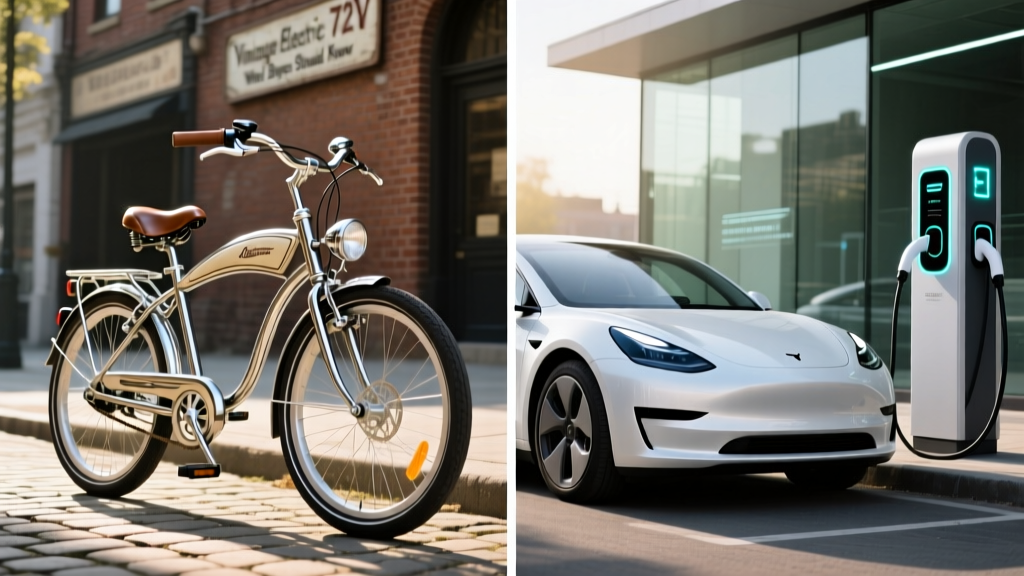
Searches for vintage electric bikes 72v have surged among commuters exploring electric mobility outside the traditional four-wheeled path. A 72-volt vintage-style e-bike typically costs between $2,500 and $5,500, delivers 40 to 80 miles of real-world range per charge, and requires no home electrical upgrades — just a standard 120V outlet. But before you pivot from an electric car purchase to a retro two-wheeler, you need the hard numbers on safety, weather practicality, cargo, insurance, and total cost of ownership.
Quick Answer: Vintage 72V E-Bike or Electric Car?
A 72V vintage electric bike makes sense if your one-way commute is under 30 miles, you live in a mild climate, and you want to avoid a $30,000+ vehicle purchase. An electric car (like the 2026 Chevy Equinox EV at ~$33,600 MSRP, 315 miles EPA range) is the better call if you need year-round weather protection, cargo space, highway capability, and eligibility for the federal §30D tax credit of up to $7,500. Many buyers use both — an EV for long trips and a 72V e-bike for daily errands.
What Exactly Is a Vintage Electric Bike 72V?
The term describes a retro-styled electric bicycle or moped that runs on a 72-volt battery pack — typically lithium-ion (NMC chemistry) or increasingly LFP for cost and longevity. These bikes evoke classic motorcycles (think 1960s café racers or cruiser silhouettes) but are powered by a hub or mid-drive electric motor rated between 1,500W and 5,000W continuous.
At 72V, these systems push more power through smaller wires than a typical 48V e-bike, yielding stronger acceleration and higher top speeds — commonly 35 to 55 mph depending on the motor controller and local speed limiters. Battery capacity ranges from 20 Ah to 40 Ah, translating to roughly 1.4 kWh to 2.9 kWh of usable energy. That's a fraction of even a small EV's battery (the Equinox EV carries 85 kWh usable), but it's also a fraction of the price.
Key players in the vintage 72V space include brands like Super73, Juiced Bikes (now Rad Power Bikes' performance arm), Onyx, and numerous import brands sold direct-to-consumer. Pricing clusters around $3,200 to $4,800 for a quality build with a reputable battery management system (BMS).
Cost Breakdown: 72V E-Bike vs. Entry-Level EV
The purchase price gap is enormous, but total cost of ownership requires looking at energy, maintenance, insurance, and depreciation over a realistic timeframe.
| Category | Vintage 72V E-Bike | 2026 Chevy Equinox EV 2LT |
|---|---|---|
| Purchase Price | $4,000 | $33,600 |
| Federal Tax Credit (§30D) | $0 (not eligible) | Up to $7,500 (income/MSRP/sourcing rules apply) |
| Effective Purchase | $4,000 | ~$26,100 (if full credit applies) |
| Energy Cost (5 yrs, 12k mi/yr equivalent) | ~$300 (electricity) | ~$2,800 (electricity at $0.16/kWh avg) |
| Maintenance (5 yrs) | ~$800 (tires, brakes, chain) | ~$1,200 (tires, cabin filter, fluid top-offs) |
| Insurance (5 yrs) | ~$600 (if insured) | ~$7,500 (avg EV insurance) |
| Depreciation (est.) | ~$2,000 | ~$10,000 |
| Estimated 5-Year Total | ~$7,700 | ~$47,600 |
The e-bike wins on raw cost by a wide margin. But this table doesn't capture the EV's advantages: weather protection, highway speeds, 5-seat capacity, 25+ cu ft of cargo room, NHTSA safety ratings, and year-round usability. The comparison only holds if the e-bike can genuinely replace the car for your daily needs.
Range, Charging, and Real-World Usability
A 72V, 30 Ah battery stores approximately 2.16 kWh of energy. With a 2,000W motor running at mixed city speeds (25-35 mph), expect a real-world range of 45 to 65 miles. Push the throttle hard or ride in cold weather (below 40°F), and that range drops 20-35% — similar percentage losses to what EVs experience in winter, just applied to a much smaller starting number.
| Metric | 72V Vintage E-Bike (30 Ah) | 2026 Equinox EV 2LT | 2026 Toyota Camry (Gas Baseline) |
|---|---|---|---|
| Energy Capacity | 2.16 kWh | 85 kWh (usable) | 13.2 gal (~435 kWh equivalent) |
| EPA / Real-World Range | ~55 mi real-world | 315 mi EPA / ~260 mi highway | ~520 mi (29/39 mpg) |
| Charge Time (0-100%) | 4-6 hrs (120V outlet, ~400W charger) | ~9.5 hrs (Level 2, 11.5 kW) | 5 min (gas station) |
| Fast Charge (10-80%) | N/A (no DC fast charge) | ~20 min (150 kW DC) | N/A |
| Cost Per Mile (Energy) | ~$0.005 | ~$0.04 | ~$0.12 (at $3.50/gal) |
Charging a 72V e-bike is trivially easy — no electrician, no 240V outlet, no panel upgrade. You plug the included charger into any standard household outlet. This is a genuine advantage for apartment dwellers or anyone without garage access, a pain point that blocks many potential EV buyers.
However, the e-bike's range ceiling means you're planning every trip. A 55-mile range works for a 12-mile round-trip commute with margin, but a spontaneous 40-mile detour can leave you stranded. An EV's 260+ real-world miles eliminate that planning overhead entirely.
Real-World Ownership Considerations
Before choosing either path, honestly assess these factors:
Home Charging Access
If you have a garage or dedicated parking with an outlet, both options work. If you park on the street, an EV becomes complicated (relying on public Level 2 or DC fast charging, which adds cost and time). A 72V e-bike's removable battery can be carried inside to charge — a decisive advantage for urban renters.
Climate and Seasonality
Riding a vintage e-bike in Phoenix's 110°F summer or Minneapolis's 10°F winter is uncomfortable and reduces battery range significantly. An EV's climate-controlled cabin and heat pump (standard on many 2026 models) make it a year-round vehicle. If you live in a region with more than 60 days of rain, snow, or extreme heat per year, an EV is the more practical primary vehicle.
Driving Patterns
According to the U.S. Department of Energy, the average American drives roughly 37 miles per day. A 72V e-bike can cover this on a single charge — but only if those miles don't include highways (e-bikes are typically not legal on interstate roads and are unsafe alongside 65 mph traffic). If your route includes any road with a speed limit above 45 mph, an EV is the safer and legal choice.
Safety and Regulation
Federal and state regulations classify 72V e-bikes variously as Class 3 e-bikes, mopeds, or even unregistered motorcycles depending on top speed and motor wattage. Some jurisdictions require a license, registration, or insurance for bikes exceeding 28 mph or 750W. Check your state's DMV rules before purchasing — a $4,000 e-bike that requires motorcycle endorsement and insurance loses much of its simplicity advantage. EVs, by contrast, follow standard vehicle registration and carry full NHTSA crash-test ratings and airbags.
Common Misconceptions About 72V E-Bikes and EVs
| Myth | Fact |
|---|---|
| "A 72V e-bike can replace my car entirely." | It can replace some car trips, but not highway driving, passenger hauling, large cargo, or inclement-weather commuting for most people. |
| "EVs are too expensive for average buyers." | After the §30D tax credit (up to $7,500 via point-of-sale transfer per IRS guidelines), several 2026 EVs net under $28,000 — still far more than an e-bike, but within reach of many budgets. |
| "E-bike batteries degrade fast and cost a fortune to replace." | Quality NMC packs last 800-1,200 full cycles before 80% capacity retention. Replacement runs $400-$900 — not trivial, but far less than an EV battery swap ($8,000-$18,000). |
| "I need a 240V outlet for an EV." | Level 1 (120V) charging works for EVs too — it just adds ~4 miles of range per hour. Sufficient if you drive under 40 miles daily and can charge overnight. Level 2 installation ($500-$2,000) is a convenience upgrade, not a requirement. |
| "72V e-bikes are legal everywhere without a license." | Many states classify e-bikes above 750W or 28 mph as mopeds or motor-driven cycles, requiring registration and sometimes a motorcycle endorsement. |
Tax Credits, Incentives, and Financial Reality
One of the biggest financial differences between a 72V e-bike and an EV is federal incentive eligibility. Under current IRS §30D rules, the clean vehicle credit of up to $7,500 applies to new four-wheeled plug-in vehicles that meet battery sourcing, MSRP caps ($55,000 for cars, $80,000 for SUVs/trucks), and buyer income limits ($150,000 single / $300,000 joint). The credit can now be transferred to the dealer at point of sale, reducing your out-of-pocket cost immediately.
Electric bicycles do not qualify for §30D. Some states and local utilities offer e-bike rebates (Colorado's e-bike rebate program, for example, offers up to $450 for income-qualified residents), but these vary widely by jurisdiction and are not guaranteed. Always check your state energy office or local utility for current programs.
For a buyer on the fence: if your income qualifies and you choose an eligible EV, the $7,500 credit effectively narrows the price gap between a budget EV and a premium e-bike by a meaningful amount.
Decision Framework: Which Should You Choose?
If-Then Guide: 72V E-Bike or Electric Car?
- Choose the vintage 72V e-bike if: Your daily round-trip is under 40 miles, you live in a mild climate, you lack home EV charging access, you want to spend under $5,000, and you already have a gas or hybrid car for longer trips.
- Choose an electric car if: You need highway capability, year-round weather protection, passenger or cargo capacity, you drive more than 50 miles daily, you qualify for the §30D credit, and you want a single vehicle that handles all trips.
- Choose both if: You can afford an EV as your primary vehicle and want the e-bike as a fun, ultra-low-cost commuter for fair-weather days — this is the combination many EV owners actually land on.
What First-Time EV Buyers Should Know
If you're entering the electric mobility space for the first time — whether via a 72V e-bike or a full EV — internalize these fundamentals:
kW vs. kWh: Kilowatts (kW) measure power — how fast energy flows (charge speed or motor output). Kilowatt-hours (kWh) measure energy — how much the battery stores. A 72V e-bike with a 2 kW motor and 2.16 kWh battery is analogous to an EV with a 150 kW motor and 85 kWh battery, just scaled down.
Real-world range is always less than advertised: Cold weather, high speeds, headwinds, and heavy loads reduce range by 15-40% for both e-bikes and EVs. Budget for the worst-case scenario, not the best.
Battery degradation is real but slow: Expect 80% capacity retention after 800-1,200 full charge cycles (NMC) or 2,000-3,000+ cycles (LFP). For most users, the battery will outlast the rest of the vehicle.
Charging speed tapers above 80%: Both e-bikes and EVs slow their charge rate as the battery fills to protect cell health. The "fast charge" spec applies to the 10-80% window — the final 20% can take as long as the first 80%.
Frequently Asked Questions
Is a 72V vintage electric bike street-legal?
It depends on your state. Bikes with motors under 750W and top speeds under 28 mph are typically classified as Class 3 e-bikes and legal on bike paths and roads. Above those thresholds, many states require moped registration, insurance, and a driver's license. Always verify with your state DMV before purchasing.
How long does a 72V e-bike battery last before replacement?
A quality NMC lithium-ion pack at 72V typically delivers 800 to 1,200 full charge cycles before degrading to 80% of original capacity. At one full cycle per day, that's 2-3 years of daily use, or 5-7 years with moderate use. LFP chemistry packs last longer (2,000+ cycles) but are heavier and less common in the vintage e-bike segment.
Can I charge a 72V e-bike from a regular wall outlet?
Yes. Most 72V e-bike chargers draw 300-500W from a standard 120V household outlet and fully charge the battery in 4-6 hours. No electrical upgrades are needed — a major advantage over EV Level 2 charging, which requires a 240V circuit and professional installation ($500-$2,000).
Is an electric car better for the environment than a 72V e-bike?
On a per-mile basis, the e-bike uses far less energy (~0.04 kWh/mile vs. ~0.30 kWh/mile for an efficient EV). However, manufacturing an EV battery (85+ kWh) carries a larger upfront carbon footprint. If the e-bike replaces car trips, it's the greener option. If it replaces walking or pedal biking, the environmental benefit shrinks considerably.
Do I need insurance for a 72V vintage electric bike?
Insurance requirements vary by state and by the bike's classification. If your 72V e-bike is classified as a moped or motor-driven cycle, liability insurance may be legally required. Even where not mandated, theft and liability coverage is wise — these bikes are high-theft items. Expect to pay $10-$25/month for a dedicated e-bike policy.