Quick Answer: Trek Electric Gravel Bike vs. EV Commuting
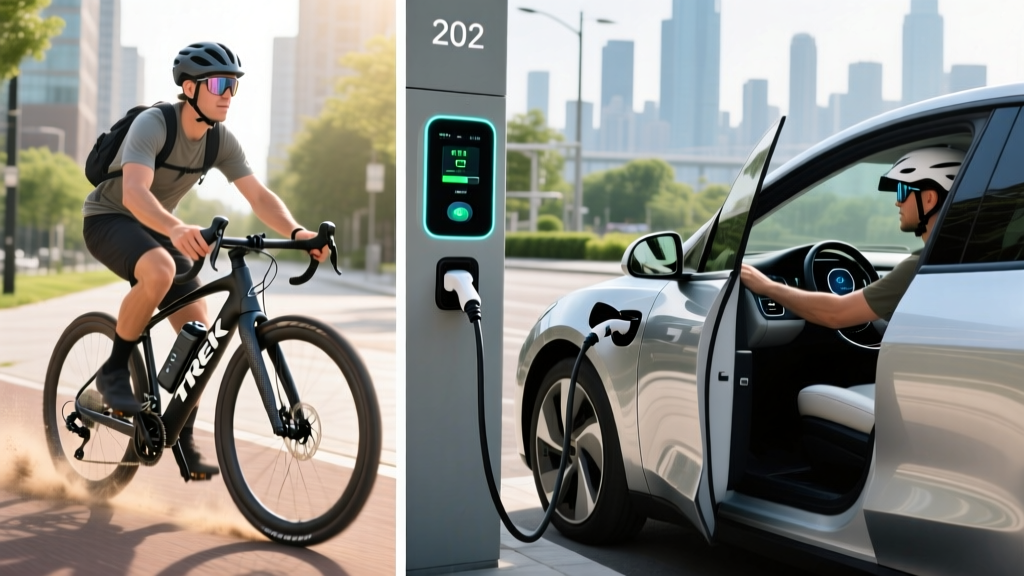
A Trek electric gravel bike (e.g., the Trek Checkpoint+ SL or Allant+ series) costs roughly $4,500–$8,000 upfront, uses about $0.01–$0.02 per mile in electricity, and requires minimal maintenance. A comparable commuter EV like the Chevrolet Equinox EV or Hyundai Kona Electric costs $33,000–$42,000 before incentives, runs $0.04–$0.06 per mile on electricity, but handles highway speeds, cargo, passengers, and all-weather driving. If your one-way commute is under 15 miles on protected bike infrastructure, the e-bike wins on pure economics. If you need range, weather protection, cargo capacity, or highway access, the EV is the practical choice.
What a Trek Electric Gravel Bike Actually Is (and Isn't)
Trek's electric gravel bikes — most notably the Checkpoint+ SL series and the Allant+ commuter line — pair a lightweight carbon or aluminum frame with a mid-drive motor (typically the Bosch Performance Line CX or Speed) and a 400–625 Wh battery. These are Class 1 or Class 3 e-bikes, meaning pedal-assist up to 20 mph or 28 mph respectively, with no throttle.
Key specs for the current-generation Trek Checkpoint+ SL 7 (representative model):
- Motor: Bosch Performance Line Speed, 250W nominal
- Battery: 500 Wh (Bosch PowerTube, integrated)
- Assisted range: 40–75 miles depending on assist level and terrain
- Charge time (0–100%): ~3.5 hours on Bosch standard 4A charger
- Weight: ~36 lbs
- MSRP: ~$6,500–$7,500
This is a bicycle with electric assist — not an electric vehicle in the automotive sense. It doesn't qualify for the federal §30D EV tax credit, cannot be driven on highways, and offers no crash protection comparable to a car. But for the right commute, the per-mile economics are extraordinary.
Cost Comparison: E-Bike vs. EV vs. Gas Car
Let's put hard numbers on a 12-mile round-trip commute, 240 working days per year (2,880 miles annually). We'll compare the Trek Checkpoint+ SL, a 2026 Chevrolet Equinox EV 2LT (a popular commuter EV), and a 2026 Toyota Corolla LE (gas baseline).
| Cost Factor | Trek Checkpoint+ SL (E-Bike) | 2026 Chevy Equinox EV 2LT | 2026 Toyota Corolla LE (Gas) |
|---|---|---|---|
| Purchase Price (MSRP) | $6,850 | $34,900 | $23,500 |
| Federal Tax Credit (§30D) | $0 (not eligible) | Up to $7,500* | $0 |
| Net Purchase Cost | $6,850 | ~$27,400* | $23,500 |
| Energy Cost per Mile | ~$0.015 | ~$0.05 (home L2) | ~$0.14 (gas @ $3.50/gal, 33 MPG) |
| Annual Energy Cost (2,880 mi) | $43 | $144 | $403 |
| Annual Insurance | ~$120 (bicycle policy/rider) | ~$1,400 | ~$1,100 |
| Annual Maintenance | ~$200 (tires, chain, brake pads) | ~$300 (cabin filter, tire rotation, fluid top-off) | ~$500 (oil, filters, brakes) |
| 5-Year Total Operating Cost | ~$1,815 | ~$9,220 | ~$10,015 |
| 5-Year Total Cost (Purchase + Operating) | ~$8,665 | ~$36,620* | ~$33,515 |
*§30D credit eligibility depends on buyer income caps ($150K single / $300K joint), MSRP caps ($55K cars), battery critical-mineral sourcing rules, and point-of-sale transfer. Verify at IRS.gov. The Equinox EV currently qualifies for the full $7,500 when all criteria are met.
Where the EV Wins: Range, Weather, and Real-World Practicality
The economics above favor the e-bike dramatically — but only if you can actually ride it. Here's where the EV's advantages become non-negotiable:
Weather and Climate
Riding an electric gravel bike in January in Minneapolis, through monsoon season in Houston, or during Phoenix's 115°F summer is impractical or dangerous for most commuters. EVs provide climate-controlled, enclosed transportation regardless of conditions. If you live in a region with more than 60 days per year of rain, snow, or extreme heat, an e-bike becomes a fair-weather complement, not a primary vehicle.
Range and Speed
The Equinox EV delivers an EPA-estimated 319 miles of range (FWD, 85 kWh usable battery). Expect ~260–280 miles in real-world highway driving, and ~220–240 miles in freezing temperatures due to battery efficiency loss and cabin heating demand. At DC fast chargers, it peaks at roughly 150 kW, achieving a 10–80% charge in approximately 30 minutes.
The Trek e-bike tops out at 28 mph (Class 3) with a real-world assisted range of 40–60 miles on mixed terrain. For a 12-mile round trip, that's adequate. For a 40-mile round trip with hills, it's marginal — especially in cold weather, where lithium-ion battery performance drops 15–25%.
Cargo, Passengers, and Multi-Use
An e-bike carries you and perhaps a pannier of gear. The Equinox EV offers 26.4 cu ft of cargo space behind the rear seats (57.2 cu ft with seats folded), five seatbelts, and towing capacity up to 1,500 lbs. If your "commute" includes school drop-off, grocery runs, or weekend road trips, the EV handles all of it without a second vehicle.
| Capability | Trek E-Gravel Bike | EV (Equinox EV) | Gas Car (Corolla) |
|---|---|---|---|
| Highway Driving | No | Yes | Yes |
| All-Weather Enclosed | No | Yes | Yes |
| Passengers | 0–1 | 4 | 4 |
| Cargo Capacity | ~1 cu ft (panniers) | 26.4 cu ft | 13.1 cu ft (trunk) |
| Real-World Range | 40–60 mi | 260–319 mi | ~400 mi |
| "Refuel" Time | 3.5 hr (full charge) | ~30 min (10–80% DCFC) | ~5 min (gas station) |
| Home Charging | Any 120V outlet | 240V L2 recommended ($500–$2,000 install) | N/A |
Charging Realities: Home Access Is the Gatekeeper
Both the e-bike and the EV benefit from home charging, but the infrastructure requirements differ enormously.
E-bike charging: Plug the Bosch charger into any standard 120V household outlet. A full 500 Wh charge takes about 3.5 hours and costs roughly $0.06 at the national average electricity rate of $0.17/kWh. No electrician needed. Apartment dwellers can charge a removable battery pack indoors.
EV Level 2 home charging: A dedicated 240V circuit (typically 40A or 48A) delivers 7–11.5 kW, adding roughly 25–40 miles of range per hour. Installation costs vary widely:
- Simple install (panel has capacity, short run to garage): $500–$1,200
- Moderate install (longer wire run, sub-panel): $1,200–$2,500
- Panel upgrade required (older 100A service to 200A): $2,500–$5,000+
If you rent, live in a condo without EV infrastructure, or rely exclusively on street parking, Level 2 home charging may not be available. In those cases, the e-bike's "charge anywhere from a wall outlet" advantage becomes significant. Public DC fast charging an EV exclusively is possible but adds time, cost ($0.30–$0.50/kWh at networks like Electrify America or EVgo), and inconvenience.
Common Misconceptions: Myths vs. Facts
| Myth | Fact |
|---|---|
| "E-bikes qualify for the $7,500 EV tax credit." | False. The §30D credit applies only to four-wheeled vehicles meeting specific battery sourcing, MSRP, and weight requirements. E-bikes are not eligible. Some states and localities offer separate e-bike rebates — check your jurisdiction. |
| "EV batteries need replacing every few years." | Modern EV batteries (NMC and LFP chemistries) are warrantied for 8 years/100,000 miles with a capacity retention threshold of 70%. Real-world degradation data shows most packs retain 85–92% capacity after 100,000 miles. Replacement costs $5,000–$20,000 but is rarely needed within the vehicle's first decade. |
| "An e-bike can fully replace a car." | For a small subset of commuters (short distance, good infrastructure, mild climate, no dependents), yes. For most households, an e-bike replaces car trips partially — studies suggest 20–40% of car trips can be substituted. It's a complement, not a replacement, for most buyers. |
| "EVs are always cheaper to own than gas cars." | Not universally. Higher purchase prices, insurance premiums (typically 15–25% higher for EVs), and potential home charging installation costs offset fuel and maintenance savings. Break-even typically occurs at 3–5 years depending on mileage, electricity rates, and credit eligibility. |
| "E-bike batteries are as expensive to replace as EV batteries." | E-bike battery replacement runs $500–$900 for a Bosch 500 Wh pack — a fraction of EV battery costs. However, e-bike batteries are smaller and may show noticeable range degradation after 3–5 years of daily use. |
First-Time Buyer Checklist: What to Know Before You Decide
If you're weighing a Trek electric gravel bike against purchasing an EV (or adding one to your household), work through these practical considerations:
- Map your actual commute. Use a tool like Google Maps' cycling layer to check for protected bike lanes, multi-use paths, and low-stress routes. A 10-mile commute on a protected trail is a very different experience than 10 miles on a 45 mph arterial road with no shoulder.
- Audit your home charging situation. Do you have a garage or driveway with a 240V outlet (or capacity to install one)? If not, can you charge at work? Your answer determines whether an EV is convenient or a burden.
- Count your weather days. How many days per year would you realistically ride an e-bike? If the answer is fewer than 150, the e-bike's per-mile savings apply to a smaller slice of your transportation needs.
- Factor in insurance. EV insurance averages $1,400–$1,800/year depending on model and state. E-bike insurance (via homeowners/renters riders or specialty providers like Velosurance) runs $100–$300/year. These are real, recurring costs.
- Check state and local incentives. While the §30D federal credit doesn't apply to e-bikes, states like California, Colorado, and Massachusetts have enacted e-bike rebate programs ($300–$1,500). EV incentives also vary by state on top of the federal credit.
- Test-ride before buying. Trek dealers offer demo rides. The geometry, motor engagement feel, and weight of an electric gravel bike differ substantially from a conventional bicycle. Ride one in the assist mode you'd actually commute in.
Decision Framework: E-Bike, EV, or Both?
Choose the Trek Electric Gravel Bike If:
- Your one-way commute is ≤15 miles on low-stress or protected routes
- You live in a mild climate or are willing to ride in fair weather only
- You already own a car (or have access to one) for longer trips, bad weather, and cargo
- You want to minimize annual operating costs to under $400
- You rent or lack Level 2 charging infrastructure but have access to a standard outlet
- You value fitness and outdoor time as part of your daily routine
Choose an EV (Like the Equinox EV or Kona Electric) If:
- Your commute exceeds 15 miles one-way or requires highway driving
- You need all-weather, enclosed transportation year-round
- You regularly carry passengers, child seats, or significant cargo
- You have (or can install) Level 2 home charging
- You qualify for the §30D federal tax credit, bringing net cost significantly below MSRP
- This will be your primary or only vehicle
Choose Both (E-Bike + EV Household) If:
- You have a two-car household and can replace one gas car with an e-bike for short trips
- You want the EV for range and weather days, and the e-bike for fair-weather commuting
- Your household budget accommodates both (~$35,000 net for the EV + ~$6,500 for the e-bike)
Frequently Asked Questions
Can I claim the $7,500 EV tax credit on a Trek electric gravel bike?
No. The IRS §30D Clean Vehicle Credit applies only to qualifying four-wheeled motor vehicles with specific battery sourcing, MSRP limits, and buyer income thresholds. E-bikes do not qualify. Some states and municipalities offer separate e-bike purchase rebates — check AFDC's state incentive database for programs in your area.
How long does a Trek e-bike battery last before needing replacement?
Bosch e-bike batteries are rated for approximately 500 full charge cycles before dropping to 80% of original capacity. With daily commuting use (partial charges), expect 4–6 years of practical service before noticeable range reduction. A replacement Bosch PowerTube 500 Wh battery costs approximately $700–$900.
What's the real-world range of a Trek Checkpoint+ on a single charge?
Trek and Bosch estimate 40–75 miles depending on assist level, rider weight, terrain, and temperature. In real-world commuting at moderate assist (Tour or Sport mode) on mixed pavement and gravel with a 180-lb rider, expect 45–55 miles. In cold weather (below 40°F), reduce that by 15–20% due to lithium-ion efficiency loss — roughly 36–47 miles.
Is an electric gravel bike faster than a regular bike for commuting?
Yes, meaningfully. On a conventional gravel bike, a fit commuter averages 14–17 mph. On a Trek electric gravel bike in Sport or Turbo assist, average speeds of 18–24 mph are typical, with less sweat and fatigue on arrival. For a 10-mile commute, that's the difference between 38 minutes and 26 minutes.
How does EV charging cost compare to e-bike charging cost?
At the national average residential rate of ~$0.17/kWh, charging a 500 Wh e-bike battery costs about $0.09 per full charge. Charging an 85 kWh EV battery (like the Equinox EV) from empty costs about $14.45 at home — or $25–$42 at a public DC fast charger at $0.30–$0.50/kWh. Per mile, the e-bike costs roughly one-third to one-quarter what the EV costs in energy.
Do I need a special electrical outlet for a Trek e-bike?
No. The Bosch charger plugs into a standard 120V household outlet (NEMA 5-15). No electrician or panel upgrade is required. If you're charging in a garage or shed, ensure the outlet is on a circuit that can handle a sustained ~4A draw without tripping — most modern household circuits handle this easily.
Sources: IRS §30D Clean Vehicle Credit rules; EPA Fuel Economy (Equinox EV range and efficiency data); Trek Bicycles official specifications for Checkpoint+ SL series.