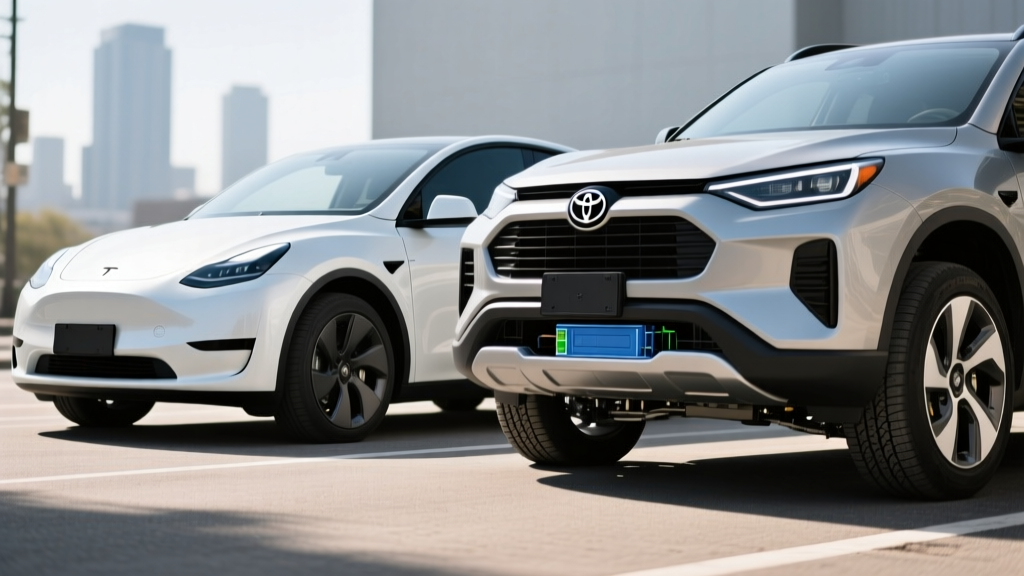
Electric vehicles carry more mass than their gasoline counterparts, and nowhere is this more apparent than when you compare a Tesla to a similarly sized internal combustion engine (ICE) vehicle. But what does that extra weight actually mean for your daily driving, your wallet, and your ownership experience? We put the 2025 Tesla Model Y Long Range head-to-head against the 2025 Toyota RAV4 — one of America's best-selling gas crossovers — to find out exactly how Tesla weight vs regular car differences translate to real-world performance, cost, and practicality.
The physics are straightforward: batteries are heavy. A lithium-ion pack storing 75–80 kWh of energy adds roughly 1,000–1,200 lbs compared to a gas tank and engine. But that mass comes with trade-offs and benefits that most buyers never see on a spec sheet. Let's break it all down with hard numbers.
The Weight Gap: Tesla Model Y vs Toyota RAV4 by the Numbers
Before we judge performance or cost, let's establish the physical reality. The table below compares the 2025 Tesla Model Y Long Range AWD against the 2025 Toyota RAV4 XLE AWD — two midsize crossovers that compete for the same family-car buyers.
| Specification | 2025 Tesla Model Y LR AWD | 2025 Toyota RAV4 XLE AWD |
|---|---|---|
| Curb Weight | 4,398 lbs | 3,615 lbs |
| Weight Difference | Tesla is 783 lbs heavier (+21.7%) | |
| EPA Range / Fuel Economy | 320 mi / 122 MPGe combined | 352 mi (14.5 gal × 28 MPG combined) |
| Battery / Fuel Capacity | 75 kWh usable (NMC) | 14.5-gallon tank |
| DC Fast Charge (10–80%) | ~27 min at 250 kW peak | N/A (gas fill-up: ~5 min) |
| Level 2 Charge Rate | 11.5 kW (44 mi/hr) | N/A |
| Horsepower / Torque | 384 hp / 375 lb-ft | 203 hp / 184 lb-ft |
| 0–60 mph | 4.8 seconds | 8.1 seconds |
| Cargo Volume (rear seats up) | 30.2 cu ft (+ 4.1 cu ft frunk) | 37.5 cu ft |
| Efficiency (kWh/100mi or MPG) | 28 kWh/100 mi | 28 MPG combined |
| Base MSRP | $44,990 | $33,425 |
| Federal Tax Credit (§30D) | Eligible up to $7,500 (see caveats) | None |
| Powertrain Warranty | 8 yr / 120,000 mi (battery & drive unit) | 5 yr / 60,000 mi (powertrain) |
That 783-lb gap is significant — roughly equivalent to carrying four additional adult passengers in the RAV4 at all times. But weight is only a problem if it isn't managed well. Let's see how each vehicle handles it across the categories that matter.
Range and Efficiency: Does Extra Weight Hurt the Tesla?
Mass is the enemy of efficiency — whether you're moving electrons or gasoline. The Model Y's 4,398 lbs requires more energy to accelerate and sustain highway speeds. Yet Tesla's engineering compensates in ways that narrow the gap considerably.
EPA Range vs. Real-World Expectation
Tesla Model Y LR: EPA-rated 320 miles. Expect ~270–290 miles in mixed highway driving at 70–75 mph; ~220–250 miles in sub-freezing winter conditions. Regenerative braking recaptures energy in stop-and-go traffic that the RAV4 loses as heat through friction brakes.
Toyota RAV4 AWD: EPA-rated 352 miles of range on a full tank. Expect ~310–330 miles highway; cold weather has minimal impact (~5% loss). Gas engines waste roughly 60–70% of fuel energy as heat regardless of conditions.
The Tesla's efficiency of 28 kWh/100 miles translates to roughly 3.6 miles per kWh — impressive for a vehicle this heavy. The RAV4's 28 MPG combined is average for its class. On a cost-per-mile basis, the Tesla wins decisively in most states: at the U.S. average electricity rate of ~$0.16/kWh, the Model Y costs about $0.045/mile to fuel, while the RAV4 at $3.30/gallon costs about $0.118/mile.
The weight penalty shows up most on sustained highway climbs and high-speed driving, where aerodynamic drag compounds mass. Around town, regenerative braking largely neutralizes the weight disadvantage — the heavy Tesla recovers kinetic energy that the lighter RAV4 simply burns off as brake heat.
Charging vs. Refueling: The Time Cost of Going Electric
This is where the weight discussion intersects with infrastructure reality. The Tesla's heavy battery takes longer to replenish than the RAV4's gas tank — no way around it. But the gap depends entirely on your charging setup.
| Charging Method | Power (kW) | Miles Added per Hour | Full "Tank" Time (0–100%) |
|---|---|---|---|
| Level 1 (120V household) | ~1.4 kW | ~5 mi/hr | ~64 hours |
| Level 2 (240V home/work) | 11.5 kW | ~44 mi/hr | ~7 hours |
| DC Fast Charge (Tesla Supercharger V3) | 250 kW peak | ~1,000 mi/hr (peak) | 10–80% in ~27 min |
| Gas Station (RAV4) | N/A | ~600 mi in 5 min | ~5 minutes |
For home-charging owners, the weight is irrelevant overnight — you wake up to 320 miles every morning regardless. The 783-lb penalty only becomes a practical issue on road trips, where the Model Y's heavier battery requires longer DC fast charging sessions. Tesla's Supercharger network remains the most reliable in the U.S., with V3 stalls delivering sustained high-power delivery, though the charge curve tapers significantly above 80% State of Charge (SoC) to protect battery longevity.
The RAV4's advantage is unambiguous on road trips: five minutes at any gas station, anywhere, any weather. No apps, no broken chargers, no wait times.
Performance and Driving Dynamics: Weight vs. Torque
Here's where the Tesla's mass meets its electric motors — and the result defies what the curb weight suggests. The Model Y's 384 hp and 375 lb-ft of instant torque propel its 4,398 lbs to 60 mph in 4.8 seconds. The RAV4, despite weighing 783 lbs less, takes 8.1 seconds with its 203-hp four-cylinder engine.
The physics: electric motors deliver maximum torque from zero RPM, eliminating the lag of a gasoline engine building revs and an automatic transmission downshifting. The Tesla's low center of gravity — the battery pack sits under the floor — also gives it sharper handling than its weight alone would predict. Body roll is well-controlled, and the dual-motor AWD system can redistribute torque between axles in milliseconds.
That said, weight does affect braking distances. The Model Y's heavier mass requires more stopping force, though regenerative braking reduces reliance on friction brakes in everyday driving. In emergency braking tests, the difference is typically 5–10 feet longer for the Tesla from 60 mph — a meaningful but not dramatic gap.
Tire Wear, Maintenance, and the Hidden Costs of EV Weight
This is where the Tesla weight vs regular car question has real financial consequences that most buyers overlook. Heavier vehicles wear tires faster — and EVs compound this with instant torque that scrubs rubber at every acceleration event.
According to industry data, EV tires typically last 20–30% fewer miles than tires on comparable ICE vehicles. For the Model Y, expect tire replacement every 25,000–35,000 miles versus 40,000–55,000 miles for the RAV4. At $200–$300 per tire for EV-rated rubber (the Model Y uses foam-lined tires for noise reduction), that's an additional $400–$800 in tire costs over a 5-year ownership period.
However, the Tesla eliminates maintenance costs the RAV4 incurs: no oil changes ($40–$80 each, 2–3 times per year), no transmission fluid, no spark plugs, no air filters, and dramatically reduced brake pad wear thanks to regenerative braking. Most Model Y owners report brake pad life exceeding 100,000 miles under normal driving conditions.
Price, Tax Credits, and Total Cost of Ownership
The sticker price gap is substantial: $44,990 for the Model Y versus $33,425 for the RAV4. But the federal §30D clean vehicle credit can narrow that gap significantly — if you qualify.
2025/2026 §30D Federal EV Tax Credit Requirements:
- Vehicle MSRP must be ≤ $80,000 for SUVs/pickups/vans (Model Y qualifies)
- Buyer modified AGI must not exceed $300,000 (joint) / $225,000 (head of household) / $150,000 (single)
- Battery components must meet North American manufacturing thresholds (increasing yearly)
- Critical minerals must meet sourcing requirements from U.S. or FTA partners
- Credit can be transferred to the dealer at point of sale as an upfront price reduction
- Consult a tax professional — eligibility depends on your specific tax situation and the vehicle's build date
| Cost Factor (5-Year / 75,000 Miles) | Tesla Model Y LR AWD | Toyota RAV4 XLE AWD |
|---|---|---|
| Base MSRP | $44,990 | $33,425 |
| Estimated Federal Tax Credit | −$7,500 (if eligible) | $0 |
| Effective Purchase Price | $37,490 | $33,425 |
| Fuel/Energy Cost (5 yr) | ~$3,375 (home charging avg) | ~$8,839 (gas at $3.30/gal) |
| Maintenance (5 yr) | ~$1,200 (tires, cabin filter, fluid top-offs) | ~$3,500 (oil, brakes, filters, fluids) |
| Insurance (5 yr avg) | ~$12,500 (EVs cost ~15–25% more to insure) | ~$9,500 |
| Estimated 5-Year Depreciation | ~$18,000 | ~$13,000 |
| Total 5-Year Cost of Ownership | ~$72,565 | ~$68,264 |
After five years and 75,000 miles, the gap narrows from $11,565 at purchase to roughly $4,300 in total cost of ownership — and that's before accounting for potential state incentives, HOV lane access, or employer-subsidized charging that could tip the scales further. Insurance is the Tesla's Achilles heel: EV premiums run 15–25% higher on average due to repair costs and parts pricing.
For buyers who plan to keep the vehicle 8–10 years, the Tesla's lower operating costs and superior warranty coverage (8-year/120,000-mile battery and drive unit vs. Toyota's 5-year/60,000-mile powertrain) make the economics increasingly favorable over time.
Why Does Tesla Weight Matter for Everyday Ownership?
Beyond the spec sheet, the weight difference between a Tesla and a regular car surfaces in several practical ways that affect your ownership experience:
Parking structures and garages: Some older parking garages have weight limits per axle or per bay. The Model Y's 4,398 lbs is within normal limits for virtually all modern structures, but it's worth noting for owners of older residential parking lifts or car stackers rated below 4,500 lbs.
Ferry and bridge tolls: A small number of toll roads and ferries charge by weight class. The Model Y falls into standard passenger-vehicle categories, so this rarely affects cost — but it's a consideration for heavier EVs like the Cybertruck or Rivian R1T.
Suspension and component wear: Heavier vehicles place more stress on suspension bushings, ball joints, and wheel bearings over time. Tesla's components are engineered for the mass, but expect higher replacement costs when these parts eventually wear — EV-specific suspension components tend to cost 20–40% more than ICE equivalents.
Towing and payload: The Model Y's towing capacity is 3,500 lbs, while the RAV4 can tow up to 3,500 lbs with the Adventure trim. However, towing significantly reduces the Tesla's range (expect 30–50% loss depending on trailer weight and speed), while the RAV4's range impact is more moderate at 20–30%.
Safety: Does More Mass Make the Tesla Safer?
In multi-vehicle collisions, heavier vehicles have a physics advantage — they transfer less energy to their occupants and more to the lighter vehicle. The Model Y's 783-lb weight advantage over the RAV4 is a meaningful safety margin in a crash between the two.
Both vehicles earn top marks from the Insurance Institute for Highway Safety (IIHS) and 5-star overall ratings from NHTSA. The Tesla adds standard automatic emergency braking, lane-keeping assist, and its Autopilot system (SAE Level 2 driver assistance — not self-driving; the driver must remain fully engaged). The RAV4 includes Toyota Safety Sense 2.5+ with comparable active safety features.
One safety consideration unique to EVs: the battery pack's placement creates an extremely low center of gravity, dramatically reducing rollover risk. The Model Y's rollover resistance rating is among the best of any SUV ever tested by NHTSA.
The Decision Framework: Which Should You Choose?
Choose the Tesla Model Y if:
- You have reliable home charging (Level 2 installation) and rarely drive more than 250 miles in a single day
- You want sports-sedan acceleration (4.8s 0–60) in a practical family crossover
- You qualify for the §30D federal tax credit and potentially state incentives
- You plan to own the vehicle 7+ years, where lower operating costs offset the higher purchase price
- You value over-the-air updates, the Supercharger network, and minimal scheduled maintenance
- You prioritize low rollover risk and top-tier crash safety
Choose the Toyota RAV4 if:
- You lack access to home or workplace charging and rely on public infrastructure
- You frequently take road trips exceeding 300+ miles where 5-minute gas stops matter
- Upfront purchase price is your primary constraint — the RAV4 saves $4,065+ even after credits
- You live in an area with extreme cold where EV range loss (20–30%) is a regular concern
- You want lower insurance premiums and widely available, affordable repair shops
- You tow frequently and need maximum range retention under load
Frequently Asked Questions
Why is a Tesla so much heavier than a regular car?
The battery pack is the primary driver. The Model Y's 75 kWh NMC battery weighs roughly 1,000–1,100 lbs. While electric motors are lighter than internal combustion engines and transmissions, the battery mass far exceeds the weight of a gas tank, exhaust system, and ICE drivetrain combined. The net result is typically 500–1,000 lbs of additional curb weight for an EV versus a comparable ICE vehicle.
Does Tesla's extra weight affect tire costs?
Yes. Expect to replace tires every 25,000–35,000 miles on a Model Y versus 40,000–55,000 miles on a RAV4. The combination of higher vehicle mass and instant electric torque accelerates tread wear. Budget an extra $400–$800 in tire costs over 5 years compared to a gas crossover.
Is the Tesla Model Y eligible for the $7,500 federal tax credit in 2025/2026?
The Model Y qualifies for up to $7,500 under §30D, but eligibility depends on your income (≤$300,000 joint AGI), the vehicle's battery sourcing compliance for the specific build date, and the SUV MSRP cap of $80,000. The credit can be applied at point of sale as an upfront price reduction. Always verify current eligibility on IRS.gov and consult a tax professional before purchasing.
Does the weight make the Tesla less safe in a crash?
No — in fact, the opposite. In collisions between vehicles of different masses, the heavier vehicle's occupants experience less force. The Model Y's low center of gravity also gives it exceptional rollover resistance. Both the Model Y and RAV4 earn top safety ratings from IIHS and NHTSA.
How does cold weather affect the Tesla vs. the RAV4?
Cold weather reduces the Model Y's range by 20–30% due to battery chemistry limitations and cabin heating demands. The RAV4 loses roughly 5–10% fuel economy in cold conditions. If you live in a region with sustained sub-freezing winters and lack a garage for preconditioning, the RAV4's consistency is a genuine advantage.
Can the weight difference affect my home charging setup?
Not directly. Home charging requirements depend on the vehicle's onboard charger capacity (11.5 kW for the Model Y) and your electrical panel's capacity, not the vehicle's weight. However, if you're installing a wall connector in a garage with a car lift or stacker, verify the lift's weight rating exceeds the Model Y's 4,398 lbs.
Final Verdict: Weight Is a Trade-Off, Not a Dealbreaker
The Tesla weight vs regular car comparison reveals a nuanced picture. Yes, the Model Y carries 783 lbs more than the RAV4 — and that mass affects tire wear, braking distances, and cold-weather range. But Tesla compensates with instant torque that defies the curb weight, a low center of gravity that enhances safety, and operating costs that erode the price gap year after year.
The right choice depends entirely on your charging access, driving patterns, ownership timeline, and budget priorities. If you can charge at home and keep the vehicle long enough to recoup the higher purchase price through fuel and maintenance savings, the Tesla's weight becomes a non-issue — you simply stop noticing it. If road trips, cold weather, and upfront cost dominate your decision, the RAV4's lighter, simpler, and cheaper formula remains compelling.
Neither vehicle is universally better. Both are excellent at what they do. The key is knowing which trade-offs matter most to you.