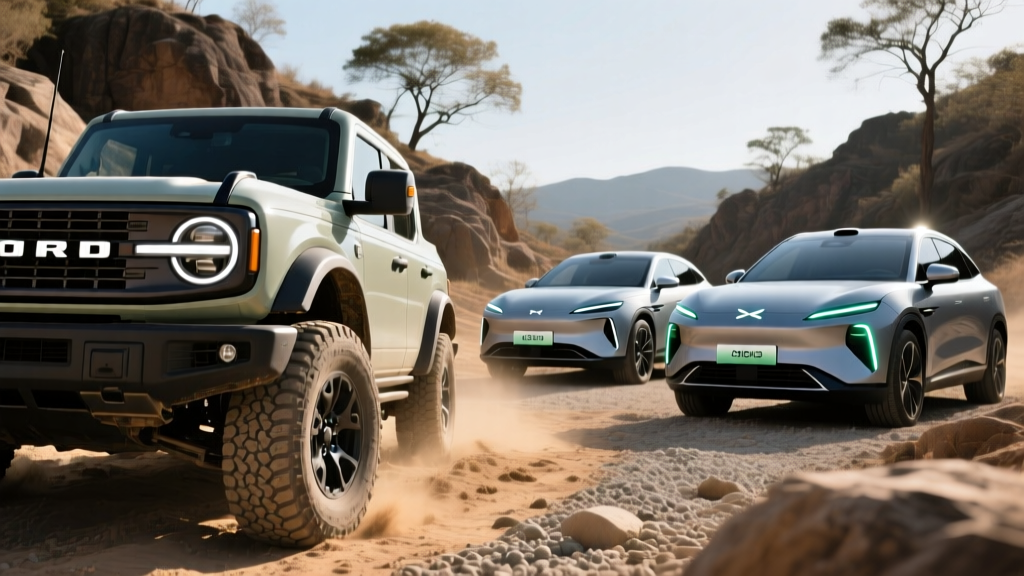
If you've been searching for a ford bronco chinese ev suv comparison, you're likely weighing two very different approaches to off-road adventure: the proven, gas-powered Ford Bronco against a wave of electrified Chinese SUVs making global headlines. Here's the direct answer: as of 2026, no Chinese EV SUV is officially sold in the United States, making the Ford Bronco (and its plug-in hybrid variant expected for the 2027 model year) the only practical purchase for US buyers. However, models like the BYD Yangwang U8, iCar 03, and Deepal G318 demonstrate where the segment is heading — and they raise important questions about cost, capability, and whether an electrified off-roader makes sense for your garage.
Quick Verdict
US buyers in 2026: The Ford Bronco (gas) remains your only showroom option. The Bronco PHEV is announced for 2027. Chinese EV SUVs like the BYD Yangwang U8 are not DOT/EPA-certified for US sale and have no confirmed US launch timeline. If you need an electrified off-roader today, look at the Jeep Wrangler 4xe or wait for the Bronco PHEV.
The Contenders: What We're Actually Comparing
The Ford Bronco needs no introduction — a body-on-frame, removable-top off-roader with a 2.3L EcoBoost (300 hp) or 2.7L EcoBoost (330 hp) engine, available in 2-door and 4-door configurations. For 2026, pricing starts at $39,995 for the Big Bend 4-door and climbs to $90,000+ for the Raptor.
The Chinese EV SUV side is more fragmented. The most relevant models making international news include:
- BYD Yangwang U8: A 1,180-hp extended-range EV (EREV) with a 49.05 kWh LFP battery and a 2.0L turbo range-extender. Priced at ~$157,000 in China.
- Chery iCar 03: A compact electric off-roader with a 69.77 kWh NMC battery, 181-mile WLTP range, and a starting price around $17,000 in China.
- Deepal G318: An EREV off-roader from Changan with a 35.07 kWh LFP battery and approximately 118 miles of electric-only range, priced around $25,000 in China.
Critical context: None of these vehicles are available for purchase in the US. Chinese-market pricing does not translate to US MSRP due to tariffs (currently 100% on Chinese EVs under 2024 tariff rules), DOT safety certification, and EPA compliance requirements.
Range, Efficiency, and Real-World Off-Road Capability
Off-road driving is inherently inefficient — low speeds, high torque demands, and accessory loads (winches, lights) drain energy fast. Here's how the platforms compare:
| Spec | 2026 Ford Bronco 4dr (2.7L) | BYD Yangwang U8 (EREV) | Chery iCar 03 (BEV) |
|---|---|---|---|
| Powertrain | 2.7L Turbo V6, 10-spd auto | Quad-motor EREV, 2.0L range-extender | Dual-motor AWD BEV |
| Horsepower | 330 hp | 1,180 hp | 268 hp |
| Fuel/Energy Capacity | 16.9 gal fuel tank | 49.05 kWh + 21.3 gal fuel | 69.77 kWh battery |
| Total Range | ~340 mi (EPA est. 20 MPG combined) | ~620 mi combined (CLTC) | ~181 mi (WLTP) / ~150 mi real-world |
| Off-Road Range (est.) | ~220 mi at 13 MPG trail avg | ~350 mi combined EREV trail avg | ~90-100 mi heavy trail use |
| Ground Clearance | 11.6 in (Badlands) | 7.9 in (adjustable air suspension) | 8.3 in |
| Water Fording | 33.5 in (Badlands) | 39.4 in (wading mode) | 23.6 in |
Real-World Range Reality Check
The iCar 03's 181-mile WLTP range drops to roughly 150 miles in mixed US-style driving and as low as 90-100 miles in sustained off-road conditions with HVAC and accessory loads. The Yangwang U8's 620-mile CLTC figure is tested under China's more generous cycle; expect ~450-500 miles in real-world combined use, and significantly less in cold weather. The Bronco's gas tank remains the most predictable energy source for remote trail use — refueling takes 3 minutes at any gas station, while DC fast-charging infrastructure at trailheads is essentially nonexistent.
Charging and Refueling: The Infrastructure Gap
This is where the ford bronco chinese ev suv debate gets practical. The Bronco refuels anywhere in minutes. Chinese EV SUVs rely on charging infrastructure that simply doesn't exist near most US off-road destinations.
| Charging Level | BYD Yangwang U8 | Chery iCar 03 |
|---|---|---|
| Level 1 (120V, 1.4 kW) | ~3 mi/hr added | ~4 mi/hr added |
| Level 2 (240V, 7.7 kW) | ~20 mi/hr added | ~25 mi/hr added |
| DC Fast Charge (peak kW) | 110 kW peak (CCS/GB/T) | 90 kW peak (CCS/GB/T) |
| 10-80% DCFC Time | ~28 min (est.) | ~35 min (est.) |
Home charging reality: If you have a Level 2 home charger (240V, 32-48A), either vehicle charges overnight without issue. Installation costs average $1,200-$2,800 including a quality Level 2 unit (ChargePoint Home Flex or Wallbox Pulsar Plus), electrician labor, and permits — assuming your electrical panel has capacity. A 200-amp panel upgrade adds $1,500-$3,500.
Trail charging reality: Most popular US off-road areas (Moab, Rubicon Trail, Ouray) have minimal to zero DC fast-charging infrastructure within 30 miles of trailheads. This makes pure EVs like the iCar 03 impractical for serious remote trail use without a generator or tow-behind charger. EREVs like the Yangwang U8 solve this with their gas range-extender — but at a steep price premium.
Total Cost of Ownership: 5-Year Breakdown
Let's put real numbers to the ford bronco chinese ev suv cost comparison. Since Chinese EV SUVs aren't US-available, I'm modeling the Yangwang U8 at an estimated US-equivalent price (accounting for tariffs and import costs) and the Bronco Big Bend 4-door.
| Cost Category | 2026 Bronco Big Bend 4dr | BYD Yangwang U8 (est. US import) |
|---|---|---|
| Purchase Price | $42,495 MSRP | ~$314,000 (est. w/ 100% tariff) |
| Federal Tax Credit (§30D) | $0 (ICE vehicle) | $0 (not US-certified / Chinese-sourced battery) |
| Fuel/Energy (5 yr, 75K mi) | $12,375 (20 MPG avg, $3.30/gal) | $4,200 (est. blended EREV use) |
| Maintenance (5 yr) | $3,800 (oil, filters, brakes, fluids) | $2,100 (no oil changes; regen saves brakes) |
| Insurance (5 yr avg) | $9,500 ($1,900/yr avg) | $18,000+ (est. high-value specialty) |
| Depreciation (5 yr) | ~$18,000 (42% est.) | ~$120,000+ (est. steep luxury depreciation) |
| 5-Year Total | ~$86,170 | ~$458,300+ |
The numbers are stark. Even setting aside the Yangwang U8's extreme price, the Bronco's fuel cost premium (~$8,175 more over 5 years) is dwarfed by the EV's purchase price difference. For the iCar 03, the math would be more favorable at its China price — but at an estimated $34,000+ US import price (after tariffs), it competes directly with the Bronco on purchase price while offering less range and no US dealer support.
What First-Time EV Buyers Should Know
If the Chinese EV SUV concept appeals to you and you're considering an electrified off-roader that IS available in the US — such as the Jeep Wrangler 4xe (PHEV) or the upcoming Ford Bronco PHEV (announced for 2027) — here's what matters:
| Myth | Fact |
|---|---|
| "EVs can't handle off-road torque demands" | Electric motors deliver instant torque from 0 RPM. The Rivian R1T and Hummer EV have proven EV off-road capability. Quad-motor setups like the Yangwang U8 offer superior traction control. |
| "Batteries are fragile on trails" | Modern EV battery packs use structural skid plates and are mounted within the frame rails. The Rivian R1S has completed the Rubicon Trail. However, a punctured battery is a $15,000-$30,000 replacement vs. a $200 gas tank. |
| "I'll charge at trailheads" | DC fast-charging infrastructure at US off-road destinations is nearly zero as of 2026. Plan for home charging and gas backup (EREV/PHEV) for remote use. |
| "Chinese EVs will be here soon and cheap" | The 100% US tariff on Chinese EVs, combined with DOT/EPA certification requirements, means no Chinese EV SUV is likely to reach US showrooms before 2029 at the earliest — and at significantly higher prices than China MSRP. |
Home Charging Access Is Non-Negotiable
Before buying any electrified off-roader, confirm you can install a Level 2 home charger. Roughly 30% of US households lack dedicated off-street parking, making home charging impossible. If you're in an apartment, condo, or street-parking situation, a PHEV (which can run on gas alone) is far more practical than a pure EV for off-road use.
Cold Weather Hits Range Hard
LFP batteries (used in the Yangwang U8 and Deepal G318) lose 25-40% of range below freezing. NMC batteries fare slightly better at 20-30% loss. If you off-road in Colorado, Montana, or the Sierras in winter, plan your energy budget accordingly. The Bronco's gas engine is unaffected by cold.
The Decision Framework: What Should You Actually Buy?
Choose Based on Your Situation
Choose the 2026 Ford Bronco (gas) if:
- You frequently off-road in remote areas far from charging infrastructure
- You need a vehicle today and want full US dealer support and warranty
- You tow heavy (Bronco rated up to 3,500 lbs with the Sasquatch package)
- You lack home Level 2 charging access
- Your budget is under $60,000
Wait for the 2027 Ford Bronco PHEV if:
- You want electric-only commuting (est. 30-40 mi EV range) with gas trail capability
- You have home Level 2 charging and a predictable daily commute
- You want to reduce fuel costs without range anxiety on remote trails
- You can wait 12-18 months for availability and real-world reviews
Consider the Jeep Wrangler 4xe (PHEV) today if:
- You want an electrified off-roader available NOW with US dealer support
- 25 miles of EPA electric-only range covers your daily needs
- You qualify for the §30D federal tax credit (up to $3,750 for the 4xe depending on battery sourcing and your income)
- You accept the 4xe's known reliability concerns (Stellantis has issued multiple TSBs for battery and electrical issues)
Do NOT wait for a Chinese EV SUV if:
- You need a vehicle within the next 3 years
- You want warranty service, parts availability, and resale value predictability
- You're counting on China-market pricing — US tariffs and compliance costs will at minimum double the price
Tax Credits and Incentives: What Actually Applies
Under current IRS §30D rules, the federal clean vehicle credit offers up to $7,500 for qualifying new EVs and PHEVs. However, eligibility requires:
- MSRP caps: $80,000 for SUVs, $55,000 for sedans
- Buyer income caps: $150K single / $300K joint AGI
- Battery sourcing: Critical minerals and battery components must meet phased-in domestic/free-trade-partner requirements
- Assembly: Final assembly must be in North America
The Ford Bronco (gas) qualifies for $0 in EV credits. The future Bronco PHEV may qualify depending on battery sourcing and MSRP at launch. Chinese-market EVs fail the North American assembly requirement entirely, and their batteries rely on Chinese-sourced critical minerals that are specifically excluded under the Foreign Entity of Concern (FEOC) rules.
Always verify your personal eligibility with a tax professional — these rules change annually and have complex phase-out and transfer provisions.
Frequently Asked Questions
Can I import a Chinese EV SUV like the BYD Yangwang U8 to the US?
Technically, you can begin the import process, but the vehicle must meet NHTSA safety standards and EPA emissions requirements. Chinese-market vehicles are not built to US FMVSS standards, and the conversion process costs $50,000-$100,000+ with no guarantee of approval. Combined with the 100% tariff, it's financially impractical for any vehicle under $300,000 China MSRP.
When will the Ford Bronco PHEV be available?
Ford has confirmed a plug-in hybrid Bronco for the 2027 model year, expected to arrive in showrooms by late 2026 or early 2027. Official EPA range, battery size, and pricing have not been released. Based on the Escape PHEV platform, expect a 14-18 kWh battery and approximately 30-40 miles of electric-only range.
Are EVs actually good off-road vehicles?
Yes, with caveats. Electric motors provide instant, precise torque at zero RPM — superior to gas engines for technical rock crawling. Quad-motor and dual-motor setups offer independent wheel torque control that surpasses traditional locking differentials. The Rivian R1T, GMC Hummer EV, and Mercedes G580 EQ have proven this. The limitations are range (high energy consumption on trails), charging infrastructure (nonexistent at most trailheads), and battery vulnerability (a punctured pack is a catastrophic expense).
How does the iCar 03 compare to the Ford Bronco Sport?
The iCar 03 is a compact, boxy electric SUV roughly the size of the Bronco Sport, but with significantly less power (268 hp vs. 250 hp for the Bronco Sport's 2.0L), shorter real-world range (~150 mi vs. ~370 mi for the gas Bronco Sport), and no US availability. At its China price (~$17,000), it's a compelling urban EV. At a hypothetical US tariff-adjusted price (~$34,000+), it would compete with the much more capable and practical Bronco Sport ($33,995 base).
What's the best electrified off-roader I can buy in the US right now?
The Jeep Wrangler 4xe remains the only electrified dedicated off-roader available in 2026, offering 25 miles of EPA electric range, 49 MPGe, and full Rubicon capability. The Rivian R1S (starting at $79,900) is a capable electric 3-row SUV with up to 410 miles of EPA range and proven off-road chops, but at a premium price. The Ford Bronco PHEV will join this list in 2027.