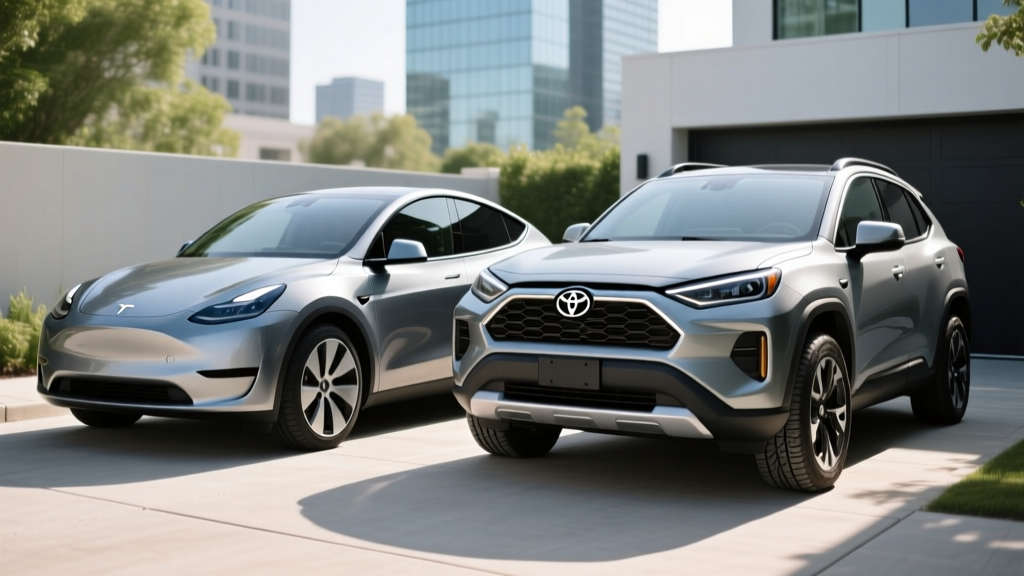
The battle between pure electric and plug-in hybrid ownership rarely comes down to a single sticker number. Buyers cross-shopping a Tesla Model Y and a Toyota RAV4 Prime aren't just choosing a powertrain — they're choosing a fueling strategy, a charging routine, and a five-year cost trajectory. This head-to-head breaks down the real Tesla vs Toyota fuel costs for 2026, using EPA data, current electricity and gasoline prices, and the latest §30D federal tax credit rules to show which powertrain actually saves you more.
Quick Verdict
Choose the Tesla Model Y if you have reliable home Level 2 charging, drive mostly in urban/suburban corridors, and want the lowest per-mile energy cost. Choose the Toyota RAV4 Prime if you lack consistent charging access, take frequent long road trips, or want a vehicle that never depends on a plug to function.
Side-by-Side Specs: 2026 Model Y vs RAV4 Prime
Before we crunch the fuel-cost math, here's how these two stack up on paper. The Model Y is a battery-electric vehicle (BEV) — no gas tank, no engine. The RAV4 Prime is a plug-in hybrid (PHEV) with a 14.5-gallon gas tank and an 18.1 kWh battery that delivers an EPA-rated 42 miles of electric-only range.
| Spec | 2026 Tesla Model Y Long Range AWD | 2026 Toyota RAV4 Prime XSE AWD |
|---|---|---|
| Powertrain | BEV (Dual Motor) | PHEV (2.5L I4 + Electric Motors) |
| EPA Range (Electric) | 320 miles | 42 miles EV / 600+ mi total |
| Usable Battery (kWh) | ~75 kWh (NMC) | 18.1 kWh (NMC) |
| Combined Efficiency | 122 MPGe (28 kWh/100mi) | 94 MPGe (EV) / 38 MPG (gas) |
| Peak DC Fast Charge | 250 kW | 6.6 kW (Level 2 only — no DCFC) |
| 10–80% Charge Time | ~25 min (DCFC) | ~2.5 hrs (240V Level 2) |
| 0–60 mph | 4.8 seconds | 5.7 seconds |
| Horsepower (combined) | 384 hp | 302 hp |
| Cargo Volume | 76 cu ft (rear seats folded) | 63 cu ft (rear seats folded) |
| Base MSRP | $46,630 | $47,395 |
| Battery/Powertrain Warranty | 8 yr / 120,000 mi | 10 yr / 150,000 mi (hybrid battery) |
Energy Costs: The Real Tesla vs Toyota Fuel Costs
This is where the comparison gets interesting — and where most online calculators oversimplify. We'll model three scenarios using the U.S. national average electricity rate of $0.17/kWh (EIA, early 2026) and the national average regular unleaded price of $3.35/gallon (AAA, Q1 2026). Your local rates will shift these numbers, but the relative gap holds in most markets.
Scenario 1: 15,000 Miles/Year, 80% Home Charging
This is the most common suburban-owner pattern: daily commuting and errands, charged overnight at home, with occasional DC fast charging on road trips.
| Cost Factor | Model Y (BEV) | RAV4 Prime (PHEV) |
|---|---|---|
| Miles driven on electricity | 15,000 (100%) | ~9,500 (63%) |
| Miles driven on gasoline | 0 | ~5,500 (37%) |
| Electricity cost (home, $0.17/kWh) | $714/yr | $452/yr |
| DCFC cost (road trips, ~$0.40/kWh) | $168/yr | $0 (no DCFC) |
| Gasoline cost ($3.35/gal) | $0 | $485/yr |
| Total Annual Fuel/Energy | $882 | $937 |
Scenario 2: 15,000 Miles/Year, 100% Home Charging (PHEV Advantage)
If you have a short commute (under 40 miles round-trip) and charge every night, the RAV4 Prime can run almost entirely on electricity — and you'll rarely visit a gas station.
| Cost Factor | Model Y | RAV4 Prime |
|---|---|---|
| Miles on electricity | 15,000 | ~13,500 (90%) |
| Miles on gasoline | 0 | ~1,500 (10%) |
| Total Annual Fuel/Energy | $882 | $753 |
At this usage pattern, the RAV4 Prime actually edges out the Model Y on annual energy cost — but only because its smaller battery means less electricity per mile in EV mode. The gap is roughly $130/year, or about $11/month.
Scenario 3: 15,000 Miles/Year, No Home Charging
This is the scenario where PHEVs shine and BEVs struggle. If you rely entirely on public DC fast charging for the Model Y and simply drive the RAV4 Prime as a conventional hybrid:
| Cost Factor | Model Y | RAV4 Prime (hybrid mode) |
|---|---|---|
| DCFC/public charging ($0.40/kWh avg) | $2,100/yr | $0 |
| Gasoline (hybrid, 38 MPG) | — | $1,322/yr |
| Total Annual Fuel/Energy | $2,100 | $1,322 |
Without home charging, the Model Y costs roughly $780 more per year to fuel than the RAV4 Prime driven as a hybrid. This is the single biggest variable in the Tesla vs Toyota fuel costs equation.
Price and Tax Credit: What You Actually Pay
Sticker price is only the starting point. The federal §30D tax credit can shift the value equation dramatically, but eligibility rules — income caps, MSRP limits, and critical-mineral sourcing requirements — determine whether you actually qualify. Always verify your personal eligibility against the latest IRS §30D guidelines and consult a tax professional.
| Factor | 2026 Model Y LR AWD | 2026 RAV4 Prime XSE AWD |
|---|---|---|
| Base MSRP | $46,630 | $47,395 |
| Federal §30D Credit (max) | Up to $7,500* | Up to $7,500* |
| MSRP Cap Eligible? (SUV: $80K) | Yes | Yes |
| Battery Sourcing Requirement | Varies by build date; check VIN at IRS | Varies; Toyota sources some cells from Japan |
| Buyer Income Cap (MFJ: $300K) | Must meet | Must meet |
| Point-of-Sale Transfer Available? | Yes (if eligible) | Yes (if eligible) |
| Effective Price (full credit) | ~$39,130 | ~$39,895 |
*Credit amount depends on critical-mineral and battery-component sourcing percentages, which change annually. For 2026, the sourcing thresholds are stricter than prior years. Some builds may qualify for $3,750 (half credit) or $0. Check the DOE's qualified vehicle list before purchasing.
Charging and Fueling Reality: Networks vs Gas Stations
The Tesla Supercharger network remains the gold standard for DC fast charging reliability — over 28,000 stalls in North America with consistent uptime. The Model Y peaks at 250 kW and can add ~200 miles in 15 minutes on a V3 stall. Non-Tesla chargers (Electrify America, EVgo) have improved, but Tesla's integrated navigation and preconditioning still deliver the most frictionless road-trip experience.
The RAV4 Prime refuels in 3 minutes at any of the 145,000+ gas stations in the U.S. It never requires a plug to function. For apartment dwellers, rural drivers, or anyone without a dedicated 240V circuit, this is a decisive practical advantage. The tradeoff: its 6.6 kW onboard charger means no DC fast charging capability — a full Level 2 charge takes about 2.5 hours.
5-Year Ownership Cost Breakdown
Beyond fuel, ownership costs include insurance, maintenance, and depreciation. Here's a realistic 5-year/75,000-mile projection for both vehicles, assuming the 80%-home-charging scenario and full §30D credit.
| 5-Year Cost Category | Model Y LR AWD | RAV4 Prime XSE AWD |
|---|---|---|
| Effective Purchase Price (after credit) | $39,130 | $39,895 |
| Energy/Fuel (5 years) | $4,410 | $4,685 |
| Insurance (avg, 5 years) | $10,200 | $8,100 |
| Maintenance (5 years) | $1,500 | $3,200 |
| Estimated Depreciation (5 yr) | $17,500 | $14,000 |
| Total 5-Year Cost | $72,740 | $69,880 |
Key takeaways from this breakdown:
- Insurance: Tesla insurance premiums remain 15–25% higher than the RAV4 Prime, driven by higher collision-repair costs and Tesla's direct insurance pricing model. Source: IIHS data and carrier averages.
- Maintenance: The Model Y has no engine oil, spark plugs, or exhaust system — but tire wear is heavier due to instant torque and vehicle weight. The RAV4 Prime requires periodic engine oil changes, but Toyota's hybrid system has proven remarkably durable with minimal added maintenance.
- Depreciation: The RAV4 Prime has held value exceptionally well — strong demand and limited supply keep resale high. The Model Y's depreciation has steepened as Tesla cut MSRPs multiple times since 2023, compressing used values.
Category Winners: Where Each Vehicle Excels
320 EPA miles vs 42 EV miles is not a contest. Even accounting for real-world highway losses, the Model Y delivers 250+ miles per charge. The RAV4 Prime's total range (EV + gas) exceeds 600 miles, but only by burning gasoline.
At 28 kWh/100mi (122 MPGe), the Model Y converts electricity to miles more efficiently than the RAV4 Prime's EV mode (~36 kWh/100mi equivalent in EV). Tesla's heat pump, thermal management, and aero advantage explain the gap.
Drive 40 miles on electricity Monday through Friday, then take a 500-mile road trip Saturday with zero charging stops. The PHEV eliminates range anxiety entirely while still offering daily EV commuting.
Tesla's software stack, over-the-air updates, and Autopilot (SAE Level 2 — driver supervision required at all times) remain ahead of Toyota Safety Sense in capability. The RAV4 Prime's infotainment and driver assists are competent but conventional.
Both vehicles land near $39,000–$40,000 after the full §30D credit. The Model Y is marginally cheaper at base, but the RAV4 Prime's lower insurance and depreciation narrow the 5-year gap.
With home charging, the Model Y wins by a slim margin ($55/yr). Without home charging, the RAV4 Prime wins decisively ($780/yr advantage). Your situation determines the winner.
Decision Framework: Which Should You Choose?
Choose the Tesla Model Y if:
- You have a garage or driveway with a 240V Level 2 charger (or can install one for $500–$1,500)
- Your daily commute is under 200 miles round-trip
- You want the lowest per-mile energy cost when charging at home
- You value Tesla's Supercharger network for road trips
- You prefer a full-electric driving experience with strong acceleration (4.8s 0–60)
- You want cutting-edge ADAS and OTA software updates
Choose the Toyota RAV4 Prime if:
- You live in an apartment or lack reliable home charging access
- You take frequent long road trips and don't want to plan around chargers
- You want a vehicle that works identically whether or not you plug it in
- You prioritize lower insurance costs and strong resale value
- You want Toyota's proven hybrid reliability and 10-year/150,000-mile hybrid battery warranty
- You live in a cold climate where EV range loss is a concern and the gas backup eliminates risk
Frequently Asked Questions
Is the Tesla Model Y cheaper to fuel than the RAV4 Prime?
It depends entirely on how you charge. With consistent home Level 2 charging at $0.17/kWh, the Model Y costs roughly $882/year in electricity vs the RAV4 Prime's $937/year in combined electricity and gasoline (80% home-charging scenario). Without home charging, the Model Y's public-charging costs jump to ~$2,100/year, making the RAV4 Prime significantly cheaper to fuel at ~$1,322/year.
Do both vehicles qualify for the $7,500 federal tax credit?
Both can qualify, but actual credit amount depends on battery-sourcing and critical-mineral requirements that change annually under §30D rules. Buyer income caps ($300K MFJ, $150K single) and MSRP caps ($80K for SUVs) also apply. Always verify on the IRS clean vehicle credits page and confirm with a tax professional before purchasing.
How much does home charging installation cost for the Model Y?
A typical Level 2 home installation (240V, 48-amp circuit with a Wall Connector or equivalent) costs $500–$1,500 if your electrical panel has sufficient capacity. If a panel upgrade from 100A to 200A is needed, add $1,500–$3,000. The RAV4 Prime can charge on a standard 120V outlet (Level 1) in about 12 hours, though a 240V setup is recommended for daily use.
Does the RAV4 Prime have DC fast charging?
No. The RAV4 Prime is limited to 6.6 kW Level 2 charging. A full charge from empty takes approximately 2.5 hours on a 240V circuit. This is a deliberate Toyota design choice — most PHEV owners charge at home overnight, and adding DCFC hardware would increase cost and weight. If you need fast public charging, the Model Y's 250 kW capability is a fundamental advantage.
Which vehicle is better in cold weather?
The RAV4 Prime has a clear cold-weather advantage. The Model Y's battery loses roughly 20–30% of its range in sustained sub-freezing temperatures, dropping real-world range to 180–220 miles. The RAV4 Prime's engine provides cabin heat without draining the battery, and you always have the gas engine as a range safety net. Tesla's heat pump helps, but physics favors the hybrid in extreme cold.
What about maintenance costs over 5 years?
The Model Y requires less routine maintenance — no oil changes, no transmission fluid, no spark plugs. Expect to spend roughly $1,500 over 5 years on cabin air filters, wiper fluid, brake fluid checks, and tire rotations/replacements (EV tires wear faster due to torque and weight). The RAV4 Prime needs standard engine maintenance plus hybrid-system checks, totaling roughly $3,200 over 5 years. However, Toyota's hybrid drivetrain has a well-documented reliability record.
Final Recommendation
The Tesla vs Toyota fuel costs debate doesn't have a single answer — it has a personal one. If your daily life includes a home charger and mostly predictable driving, the Model Y delivers lower per-mile energy costs, a superior charging network, and a more advanced tech experience. If your life includes an apartment, frequent long drives, or a cold climate, the RAV4 Prime gives you electric commuting without the charging dependency — and its 5-year total cost of ownership often comes out ahead once insurance and depreciation are factored in.
Both are excellent vehicles. The right choice is the one that fits your charging situation, not just your budget.