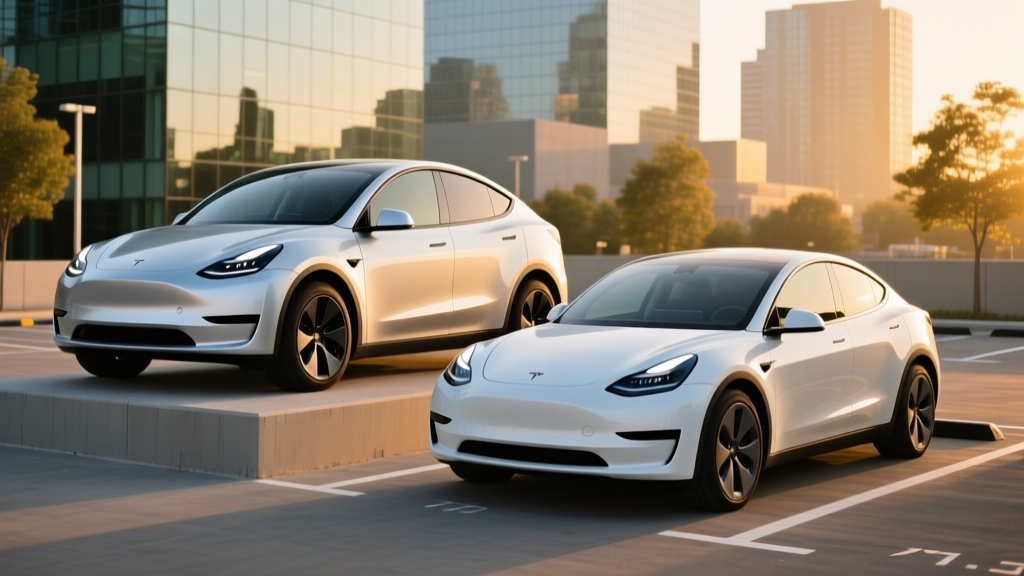
If you're narrowing your EV shortlist to Tesla's two best-sellers, you're not alone. The Model Y crossover and Model 3 sedan account for the vast majority of Tesla's US deliveries, and on paper they look nearly identical: similar powertrains, shared software, overlapping price brackets. But the difference between Model Y and Model 3 becomes stark once you factor in cargo utility, real-world highway range, charging curves, insurance premiums, and how the federal §30D tax credit applies differently to each body style.
This head-to-head uses 2026 model-year Long Range AWD trims as the baseline — the volume sellers for both nameplates. We'll cut through the marketing and give you exact EPA figures, real-world range expectations, sustained charging speeds, and a five-year ownership cost breakdown so you can pick the right Tesla for your driveway.
Side-by-Side Spec Table: 2026 Model Y vs Model 3 Long Range AWD
| Spec | 2026 Tesla Model Y LR AWD | 2026 Tesla Model 3 LR AWD |
|---|---|---|
| EPA Range | 320 miles | 341 miles |
| Usable Battery | ~75 kWh (NMC) | ~75 kWh (NMC) |
| Efficiency (MPGe) | 111 MPGe (29 kWh/100mi) | 125 MPGe (26 kWh/100mi) |
| Peak DC Fast Charge | 250 kW | 250 kW |
| 10–80% DC Charge Time | ~27 min | ~25 min |
| Level 2 Charge Rate | 11.5 kW (44 mi/hr) | 11.5 kW (48 mi/hr) |
| 0–60 mph | 4.8 sec | 4.2 sec |
| Horsepower | 384 hp | 384 hp |
| Cargo Volume (rear seats up) | 30.2 cu ft (+ 4.1 cu ft frunk) | 21.0 cu ft (+ 3.1 cu ft frunk) |
| Cargo Volume (rear seats folded) | 72.0 cu ft | N/A (sedan trunk) |
| Base MSRP | $46,630 | $42,630 |
| Battery/Drive Unit Warranty | 8 yr / 120,000 mi | 8 yr / 120,000 mi |
Sources: EPA / fueleconomy.gov, Tesla.com spec sheets. Real-world range and sustained charging speeds vary by temperature, terrain, and state of charge.
Range and Efficiency: Sedan Aerodynamics Win on the Highway
The Model 3's lower, sleeker sedan profile gives it a measurable efficiency edge. At 125 MPGe combined versus the Model Y's 111 MPGe, the Model 3 sips roughly 3 kWh less per 100 miles. Over a 15,000-mile driving year, that translates to about 450 fewer kWh consumed — roughly $60–$75 in electricity savings at the US average residential rate of $0.16/kWh.
Model 3 LR AWD: EPA 341 mi. Expect ~280–300 mi on sustained 75 mph highway driving; ~240–260 mi in freezing temps with cabin heat.
Model Y LR AWD: EPA 320 mi. Expect ~260–280 mi highway; ~220–240 mi in freezing conditions. The crossover's taller frontal area and heavier curb weight (~400 lb more) compound losses at speed and in cold weather.
Both vehicles use Tesla's heat pump, which mitigates cold-weather range loss better than resistive heating, but physics is physics — the Model Y pushes more air and carries more mass. If your commute is 90% suburban at under 45 mph, the gap narrows. If you regularly drive interstate at 75–80 mph, the Model 3's efficiency advantage is the single biggest differentiator.
Charging Speed and Network: Nearly Identical, With a Small Edge
Both vehicles peak at 250 kW on DC fast chargers and share the same NACS connector native to the Tesla Supercharger network. However, the Model 3's slightly smaller energy consumption per mile means each minute of charging yields marginally more range.
At a V3 Supercharger (250 kW capable), both vehicles follow a similar charge curve: peak power is sustained from roughly 10% to 35% SoC, then tapers progressively. The Model 3 hits 80% in approximately 25 minutes; the Model Y takes about 27 minutes. Above 80%, both taper sharply — charging from 80% to 100% adds another 25+ minutes and is best reserved for overnight Level 2 sessions.
On Level 2 (240V / 48A home charger), both accept 11.5 kW. The Model 3 adds about 48 miles of range per hour of charging; the Model Y adds about 44 miles per hour. For home charging, this difference is negligible since both will fully replenish overnight.
Network advantage: Both have unrestricted access to the Supercharger network, which remains the most reliable and geographically complete DC fast-charging network in the US. Neither vehicle needs an adapter for Superchargers. For non-Tesla networks (Electrify America, EVgo), both use the native NACS plug, which is now the industry standard.
Performance and Driving Dynamics
Both share Tesla's dual-motor AWD powertrain producing 384 hp, but the Model 3's lighter curb weight (~3,890 lb vs ~4,290 lb) gives it a 0.6-second advantage to 60 mph (4.2 vs 4.8 seconds). In practice, both are genuinely quick — the difference is most noticeable during highway merging and spirited back-road driving.
The Model 3's lower center of gravity and lighter mass also translate to sharper cornering and more communicative steering. The Model Y rides higher, which helps with ingress/egress and visibility, but exhibits more body roll in curves. If driving engagement matters to you, the Model 3 is the clearer choice. If you prioritize a commanding seating position and easier loading of cargo, the Model Y's crossover stance wins.
Interior, Cargo, and Practicality: Where the Body Styles Diverge
This is where the difference between Model Y and Model 3 stops being subtle. The Model Y offers 30.2 cubic feet behind the second row — and a massive 72.0 cubic feet with seats folded. The hatchback design accommodates furniture, bicycles (with front wheels removed), and large dogs in a way the Model 3's traditional trunk simply cannot.
The Model 3 provides 21.0 cubic feet of trunk space — adequate for groceries, luggage for two, and daily hauling, but limited by its sedan trunk opening. If you regularly carry bulky items, a stroller, or camp gear, the Model Y's cargo advantage is decisive.
Interior design is nearly identical between the two (Tesla's minimalist, screen-centric cabin), though the refreshed Model 3 "Highland" interior added ventilated front seats, ambient lighting, rear-seat ventilation, and improved sound insulation. The 2025-refreshed Model Y "Juniper" has adopted similar upgrades, largely closing the cabin-quality gap.
Price, Tax Credits, and Five-Year Ownership Cost
The Model 3 LR AWD starts at $42,630; the Model Y LR AWD starts at $46,630 — a $4,000 gap before incentives. Both vehicles are assembled at Tesla's Fremont, CA plant with battery cells that have historically met the critical-mineral and battery-component sourcing requirements of the IRS §30D federal tax credit, but eligibility can shift based on supply-chain changes.
- MSRP cap: $55,000 for sedans (Model 3), $80,000 for SUVs/trucks (Model Y) — both qualify
- Buyer income cap: $150,000 single / $300,000 joint (modified AGI)
- Battery sourcing: critical minerals and components must meet phased-in percentage thresholds
- Point-of-sale transfer available — apply the credit as a down payment reduction at purchase
- Always verify current eligibility on fueleconomy.gov before purchasing
| Cost Factor (5-Year Estimate) | Model 3 LR AWD | Model Y LR AWD |
|---|---|---|
| Base MSRP | $42,630 | $46,630 |
| Est. §30D Credit | $7,500* | $7,500* |
| Effective Purchase Price | ~$35,130 | ~$39,130 |
| Electricity (15k mi/yr, $0.16/kWh) | $3,900 | $4,350 |
| Insurance (avg annual) | $2,400/yr | $2,600/yr |
| Maintenance (5-yr total) | ~$1,800 | ~$1,800 |
| Est. 5-Year Total Cost of Ownership | ~$59,730 | ~$65,080 |
*Tax credit eligibility depends on buyer income, battery sourcing compliance, and IRS rules at time of purchase. Consult a tax professional. Insurance averages from industry data; individual quotes vary significantly by state, age, and driving record.
The Model 3 saves roughly $5,350 over five years in this comparison, driven by its lower purchase price, better efficiency, and slightly lower insurance premiums. The Model Y's cost premium is the price you pay for cargo versatility and crossover ride height.
Category Winners: Where Each Vehicle Excels
341 mi EPA, 125 MPGe. The sedan's aerodynamics and lighter weight deliver measurably more miles per kWh.
72 cu ft with seats folded, hatchback access. No contest for families, movers, and adventurers.
4.2 sec 0–60, lower center of gravity, sharper handling. The driver's choice.
$4,000 less at MSRP, lower electricity and insurance costs, ~$5,350 savings over 5 years.
Both peak at 250 kW with nearly identical 10–80% times (~25–27 min). Model 3 gains a trivial edge in miles-per-minute.
Identical Tesla OS, Autopilot hardware, FSD (Supervised) availability, and OTA update cadence.
Driver Assistance and Autonomous Capability
Both vehicles ship with Tesla's latest Hardware 4 (HW4) suite and include basic Autopilot (traffic-aware cruise control and lane centering) as standard. Full Self-Driving (Supervised) is an optional add-on that enables automatic lane changes, navigation-based on/off-ramp handling, and city-street traffic-light recognition.
Tesla Autopilot and FSD (Supervised) are SAE Level 2 driver-assist systems. The driver must remain fully engaged, hands on or near the wheel, and eyes on the road at all times. These are not self-driving systems. Only Level 4 services like Waymo operate without a human driver — and those are limited to geo-fenced robotaxi zones.
Because both vehicles use identical sensor suites and software, there is zero difference in driver-assistance capability between the Model Y and Model 3. Your choice here should not influence the buy decision.
Decision Framework: Which Tesla Should You Buy?
Choose the Tesla Model 3 if:
- You prioritize maximum range and efficiency (341 mi EPA, 125 MPGe)
- You want the lowest purchase price and five-year cost of ownership
- You enjoy sportier driving dynamics and quicker acceleration
- Your cargo needs fit a sedan trunk (groceries, luggage, daily commuting)
- You drive long highway commutes where the efficiency gap compounds
Choose the Tesla Model Y if:
- You need hatchback cargo space for kids' gear, bikes, furniture, or dogs
- You prefer a higher seating position and easier ingress/egress
- You regularly carry rear-seat passengers who benefit from more headroom
- You want optional third-row seating (available on select trims, adds +2 seats for small children)
- The $4,000 price premium is acceptable for the utility gain
Frequently Asked Questions
Is the Model Y just a bigger Model 3?
Structurally, they share the same platform and powertrain architecture, but the Model Y is roughly 220 lb heavier (in Long Range AWD trim), sits higher, and has a completely different rear body structure to accommodate the hatchback and optional third row. The driving experience, efficiency, and cargo capability are meaningfully different despite the shared DNA.
Do both qualify for the $7,500 federal tax credit?
Both have historically qualified for the full §30D credit, but eligibility depends on current battery-sourcing compliance, your income (capped at $150K single / $300K joint), and the vehicle's MSRP falling under the cap ($55K sedan for Model 3, $80K SUV for Model Y — both well under). The point-of-sale transfer option lets you apply the credit as a price reduction at purchase. Always verify on fueleconomy.gov and consult a tax professional before buying.
Which is cheaper to insure?
The Model 3 tends to carry slightly lower insurance premiums — roughly $200/year less on average — due to its lower MSRP and repair-cost profile. However, Tesla insurance varies significantly by state, driver age, and record. Get quotes for both models before deciding; the gap may be negligible for your profile.
Can I tow with either vehicle?
The Model Y is rated to tow up to 3,500 lb (with the tow hitch accessory). The Model 3 is not rated for towing in the US market. If you need to pull a small trailer, bike rack, or light camper, the Model Y is the only option.
Which holds its value better?
Historically, the Model Y has shown slightly stronger resale demand due to the US market's preference for crossovers over sedans. However, Tesla's frequent price adjustments on new vehicles can compress used values for both. Depreciation for either model will likely exceed that of a Toyota RAV4 Hybrid or similar mainstream competitor — factor in roughly 45–55% depreciation over five years for both.