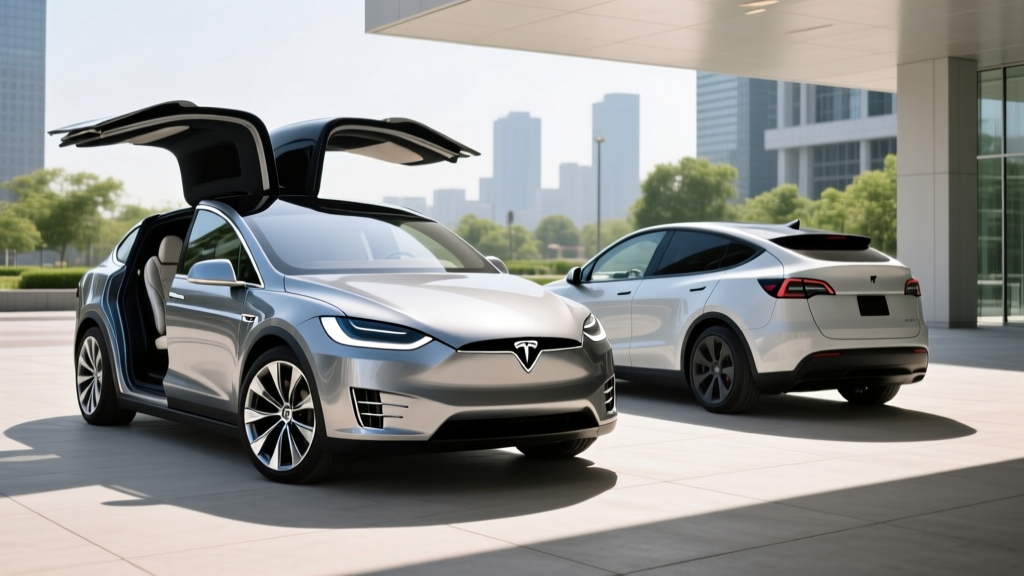
If you're cross-shopping Tesla's lineup, the Model X vs Model Y decision usually comes down to three questions: Do you need three rows? How much range matters per dollar? And are you willing to pay a $35,000+ premium for falcon-wing doors and air suspension? Both are built on related architectures, share Tesla's Supercharger network, and qualify for varying degrees of federal incentive — but they serve fundamentally different buyers.
This comparison uses current 2026 model-year EPA data, Tesla's published specs, and real-world ownership variables to break down exactly where each SUV wins — and where the math doesn't support the upgrade.
Side-by-Side Specs: Model X vs Model Y at a Glance
| Specification | 2026 Tesla Model X (Long Range) | 2026 Tesla Model Y (Long Range AWD) |
|---|---|---|
| EPA Range | 335 miles | 320 miles |
| Real-World Highway Range (est.) | ~275–295 mi | ~265–285 mi |
| Battery (usable) | ~100 kWh (NMC) | ~78.1 kWh (NMC) |
| Peak DC Fast Charge | 250 kW | 250 kW |
| 10–80% DC Charge Time | ~32 min | ~27 min |
| Level 2 Charge Rate | 11.5 kW (44 mi/hr) | 11.5 kW (44 mi/hr) |
| 0–60 mph | 3.8 sec | 4.8 sec |
| Horsepower | 670 hp | 384 hp |
| Efficiency (MPGe combined) | 102 MPGe | 122 MPGe |
| Cargo Volume (behind 2nd row) | 42.5 cu ft (75.4 max) | 30.2 cu ft (76.2 max) |
| Seating | 5, 6, or 7 passengers | 5 or 7 (optional 3rd row) |
| Base MSRP | $79,990 | $44,990 |
| Battery & Drive Unit Warranty | 8 yr / 150,000 mi | 8 yr / 120,000 mi |
Sources: EPA fueleconomy.gov, Tesla specifications. Real-world highway range estimates reflect 70–80 mph driving at moderate temperatures; expect 15–30% loss in sub-freezing conditions.
Range and Efficiency: The Real-World Picture
On paper, the Model X Long Range holds a 15-mile EPA advantage at 335 miles versus the Model Y's 320. But the more telling metric is efficiency: the Model Y achieves 122 MPGe combined, while the Model X returns 102 MPGe. That 20 MPGe gap means the Model Y extracts more distance from every kWh — a direct result of its lighter curb weight (~4,400 lbs vs. ~5,200 lbs) and lower aerodynamic drag profile.
Model X: EPA 335 mi → Expect ~275–295 mi at highway speed; ~240–260 mi in winter (20°F).
Model Y: EPA 320 mi → Expect ~265–285 mi at highway speed; ~230–250 mi in winter (20°F).
Both vehicles use heat pumps, reducing cold-weather losses compared to older resistive-heating EVs. However, the Model X's larger battery buffer means it still arrives with more absolute range in cold conditions.
For daily commuting under 60 miles round-trip, both vehicles are effectively equal — you'll charge at home every 3–4 days regardless. The gap widens on road trips, where the Model X's 100 kWh battery provides a meaningful cushion when chargers are sparse.
Charging Speed and Network Access
Both SUVs peak at 250 kW on V3 Superchargers and use the NACS (North American Charging Standard) connector natively — no adapter needed at Tesla stations. However, the charging experience differs in practice due to battery size and charge-curve behavior.
| Charging Level | Model X | Model Y |
|---|---|---|
| Level 1 (120V, 1.4 kW) | ~4 mi/hr | ~4 mi/hr |
| Level 2 (240V, 11.5 kW) | 44 mi/hr | 44 mi/hr |
| DC Fast (250 kW peak) | ~175 mi in 15 min | ~162 mi in 15 min |
| 10–80% DC Time | ~32 min | ~27 min |
The Model Y charges from 10–80% roughly 5 minutes faster because its 78.1 kWh battery has less total energy to fill, even though both peak at the same 250 kW. Both vehicles exhibit significant charge-curve taper above 80% — a 90% SoC can add 8–12 additional minutes. For road trips, plan your stops around the 10–80% window to minimize downtime.
On the public network front, Tesla's Supercharger network remains the most reliable DC fast-charging ecosystem in the U.S., with over 6,500 V3/V4 stalls nationwide. Both vehicles can also use Electrify America, EVgo, and other CCS-equipped networks via Tesla's CCS adapter (sold separately, ~$175), though real-world CCS charging speeds may vary.
335 mi EPA vs. 320 mi, plus a larger battery buffer for cold weather and mountain driving.
10–80% in ~27 min vs. ~32 min; smaller battery fills faster on identical hardware.
Performance, Ride, and Practicality
The Model X Long Range hits 0–60 mph in 3.8 seconds with 670 hp from its dual-motor setup. The Model Y Long Range AWD delivers 384 hp and a 4.8-second sprint. Both are genuinely quick by any standard — the Model X simply defies physics for a 5,200-pound SUV.
Where the Model X differentiates is ride quality. Standard adaptive air suspension smooths out rough pavement and allows adjustable ride height — useful for steep driveways or light off-road use. The Model Y uses a conventional coil-spring setup that Tesla has retuned for the Juniper refresh, improving compliance, but it can't match the air-suspension isolation of the X.
Cargo practicality is closer than the spec sheet suggests. With the second row up, the Model X offers 42.5 cu ft to the Model Y's 30.2 cu ft. But fold both rows and the Model Y nearly catches up at 76.2 cu ft vs. 75.4 cu ft. The Model Y also offers a slightly larger frunk. If you need genuine three-row seating for adults, only the Model X delivers usable third-row space — the Model Y's optional third row is strictly for small children on short trips.
670 hp, 3.8-sec 0–60, and air suspension give it the edge in power and ride refinement.
Model X for three-row families; Model Y for couples/small families wanting max cargo flexibility per dollar.
Pricing, Tax Credits, and Total Cost to Buy
This is where the comparison gets decisive. The 2026 Model X Long Range starts at $79,990 (including destination). The Model Y Long Range AWD starts at $44,990 — a $35,000 gap before incentives.
- MSRP Cap: SUVs must be ≤$80,000. Model X at $79,990 qualifies; adding options (e.g., 6-seat config at +$6,500) pushes it over the cap and eliminates eligibility.
- Income Cap: Buyer AGI must not exceed $150K single / $300K joint.
- Battery Sourcing: Critical minerals and battery component requirements apply; Tesla's supply chain has progressively met these thresholds, but verify current-year compliance at IRS.gov.
- Point-of-Sale Transfer: Both models can apply the credit as an instant rebate at purchase, reducing your out-of-pocket cost immediately.
Always confirm eligibility with a tax professional — rules change annually and depend on your specific situation.
| Cost Factor | Model X LR | Model Y LR AWD |
|---|---|---|
| Base MSRP | $79,990 | $44,990 |
| Max §30D Credit (if eligible) | −$7,500 | −$7,500 |
| Effective Price (w/ full credit) | $72,490 | $37,490 |
| Est. Annual Insurance | $2,800–$3,400 | $1,800–$2,400 |
| Annual Electricity (12K mi/yr) | ~$660 | ~$550 |
The Model X sits at the razor's edge of the $80,000 SUV MSRP cap. If you add any meaningful options — the six-seat interior, tow package, or premium paint — you'll exceed the cap and forfeit the $7,500 credit entirely. The Model Y, at $44,990, can be loaded with FSD, premium wheels, and paint while remaining well under the cap. This makes the Model Y's effective price advantage even larger in real-world configurations.
$35K cheaper base, easier to keep under MSRP cap, lower insurance and energy costs.
Identical hardware (HW4), identical Autopilot/FSD (Supervised) availability. Both are SAE Level 2.
Ownership Costs Over 5 Years
| 5-Year Cost Category | Model X LR | Model Y LR AWD |
|---|---|---|
| Purchase (after $7,500 credit) | $72,490 | $37,490 |
| Electricity (60K mi total) | $3,300 | $2,750 |
| Insurance (5 yr est.) | $15,500 | $10,500 |
| Maintenance (tires, wipers, cabin filter) | $2,200 | $1,800 |
| Est. Depreciation (5 yr) | ~$32,000 | ~$16,000 |
| Estimated 5-Year Total Cost | ~$125,490 | ~$68,540 |
The 5-year cost gap is roughly $57,000. The Model X depreciates more in absolute dollars due to its higher starting price, and its insurance premiums run 40–50% higher — a reflection of repair costs for its aluminum body, air suspension, and falcon-wing door mechanisms. The Model Y's simpler construction and lower replacement-part costs translate directly into cheaper premiums.
Both vehicles benefit from Tesla's over-the-air updates, Sentry Mode, and the Supercharger network. Neither requires routine fluid changes beyond washer fluid. Tire rotation every 6,250 miles and cabin air filter replacement every 2–3 years are the primary maintenance items.
ADAS and Autonomous Driving: What Both Offer
Both the Model X and Model Y come with Tesla's Autopilot (basic) and offer Full Self-Driving (Supervised) as an $8,000 add-on or $99/month subscription. Despite the "FSD" branding, this is an SAE Level 2 driver-assistance system. You must keep your hands on the wheel and eyes on the road at all times. Neither vehicle is self-driving.
Hardware is identical: Tesla HW4 (AI4) with high-resolution cameras and enhanced processing. Features like Navigate on Autopilot, Auto Lane Change, Smart Summon, and traffic-light recognition perform the same across both models. The Model X does not get any exclusive ADAS capabilities despite its higher price.
The Decision Framework: Which Tesla SUV Is Right for You?
Choose the Model X if:
- You regularly carry 5+ passengers and need a usable third row for adults
- You want air suspension for ride comfort and adjustable ground clearance
- You frequently tow (5,000 lb capacity vs. Model Y's 3,500 lb)
- You prioritize maximum absolute range for remote-area road trips
- The $72K+ effective price fits your budget without strain
Choose the Model Y if:
- You want the best range-per-dollar in Tesla's lineup
- You're a 1–4 person household with occasional cargo needs
- Lower insurance and maintenance costs matter to your budget
- You want to stay well under the $80K MSRP cap while adding options
- Charging speed matters — 10–80% in 27 min vs. 32 min adds up on road trips
Frequently Asked Questions
Is the Model X worth $35,000 more than the Model Y?
Only if you need three adult-sized rows, air suspension, or 5,000-lb towing. For 90% of buyers, the Model Y delivers nearly identical range, the same tech, and dramatically lower ownership costs. The Model X is a niche premium product; the Model Y is the volume value play.
Do both qualify for the $7,500 federal tax credit?
Both can qualify, but the Model X is dangerously close to the $80,000 SUV MSRP cap. Adding options like the six-seat configuration or certain paint colors pushes it over, eliminating eligibility. The Model Y has $35,000 of headroom and will virtually always qualify if you meet the income and sourcing requirements. Verify at IRS.gov.
Which is cheaper to charge at home?
The Model Y, marginally. Its higher efficiency (122 MPGe vs. 102 MPGe) means it uses fewer kWh per mile. At the U.S. average residential rate of ~$0.16/kWh, the Model Y costs roughly $550/year for 12,000 miles vs. ~$660/year for the Model X. Both charge at 11.5 kW on Level 2, so a full overnight charge refills either battery by morning.
Can the Model Y really seat seven?
Tesla offers an optional third row on the Model Y, but it's only practical for children under ~5'2" on short trips. Legroom and headroom are severely compromised. If you need genuine seven-passenger capability, the Model X is the correct choice.
How do battery warranties compare?
The Model X covers its battery and drive unit for 8 years/150,000 miles. The Model Y covers 8 years/120,000 miles. Both guarantee at least 70% capacity retention during the warranty period. Tesla's NMC batteries have demonstrated strong longevity, with fleet data showing ~10–12% degradation at 100,000 miles on average.
Which holds resale value better?
Historically, the Model Y has shown stronger percentage-based resale retention because of its broader market appeal and lower entry price. The Model X depreciates more in absolute dollars. However, both benefit from Tesla's OTA updates and Supercharger network, which support long-term desirability relative to EVs from less-established brands.
Final Verdict
The Model Y is the rational choice for most buyers. It delivers 95% of the Model X's range at 56% of the price, with lower insurance, lower energy costs, and fewer tax-credit complications. It's the best-selling vehicle in the world for good reason — it solves the electric-SUV equation more cleanly than anything else in its class.
The Model X exists for buyers who've already decided that three-row luxury, air suspension, and falcon-wing drama are non-negotiable. If that's you, it's a genuinely capable vehicle with class-leading range and performance. Just know that you're paying a steep premium for features the Model Y either matches or approaches closely enough that the savings could fund a decade of Supercharging.
Data current as of 2026 model year. Verify all pricing, incentives, and specifications at Tesla.com and fueleconomy.gov before purchasing. Tax credit eligibility depends on individual circumstances — consult a tax professional.