Quick Answer: Which Hyundai EV Is Right for You?
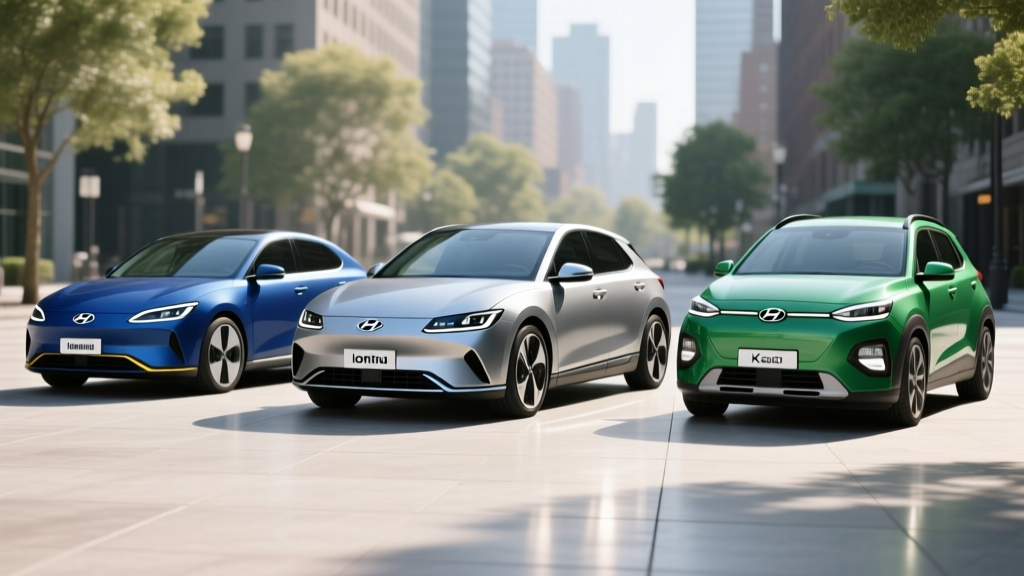
Hyundai sells three battery-electric vehicles in the U.S. for 2026. The Kona Electric (EPA range up to 261 miles, starting ~$32,975) is the budget-friendly subcompact crossover. The Ioniq 5 (EPA range up to 303 miles, starting ~$42,900) is the midsize crossover with the fastest charging in the lineup. The Ioniq 6 (EPA range up to 361 miles, starting ~$38,650) is the sleek sedan with the longest range and best efficiency. All three use Hyundai's E-GMP platform with 800V architecture (Ioniq 5/6) or 400V (Kona), support NACS connectors, and qualify for varying levels of the §30D federal tax credit depending on battery sourcing and your income. If you need maximum cargo space and DC fast-charging speed, pick the Ioniq 5. If highway commuting range is your priority, the Ioniq 6 wins. If you want the lowest entry price for city and suburban driving, the Kona Electric delivers.
Hyundai EV Lineup at a Glance: 2026 Specs
Before diving into ownership costs and real-world performance, here is the full spec comparison across all three models. All figures reflect current 2026 model-year data from Hyundai and the EPA.
| Spec | 2026 Kona Electric | 2026 Ioniq 5 | 2026 Ioniq 6 |
|---|---|---|---|
| Body Style | Subcompact Crossover | Midsize Crossover | Midsize Sedan |
| EPA Range (max config) | 261 mi | 303 mi | 361 mi |
| Battery (usable, chemistry) | 64.8 kWh, NMC | 77.4 kWh, NMC | 77.4 kWh, NMC |
| Drivetrain (best range trim) | FWD, 201 hp | RWD, 225 hp | RWD, 225 hp |
| AWD Available? | No | Yes (320 hp) | Yes (320 hp) |
| 0–60 mph | ~7.6 sec | ~7.0 sec (RWD); ~4.5 sec (AWD) | ~6.9 sec (RWD); ~4.5 sec (AWD) |
| Peak DC Fast Charge | ~100 kW (400V) | ~240 kW (800V) | ~240 kW (800V) |
| 10–80% DCFC Time | ~43 min | ~18 min | ~18 min |
| Level 2 Charge Rate | 10.9 kW | 10.9 kW | 10.9 kW |
| Connector (2026) | NACS (native) | NACS (native) | NACS (native) |
| MPGe (combined, max) | 129 MPGe | 114 MPGe | 140 MPGe |
| Cargo Volume (rear seats up) | 25.8 cu ft | 27.2 cu ft | 12.3 cu ft |
| Starting MSRP | ~$32,975 | ~$42,900 | ~$38,650 |
| Battery/Powertrain Warranty | 10 yr / 100,000 mi | 10 yr / 100,000 mi | 10 yr / 100,000 mi |
Real-World Range: What the EPA Sticker Doesn't Tell You
EPA range estimates assume a mix of city and highway driving at moderate temperatures. In practice, your results will vary based on speed, climate, and terrain.
Ioniq 6 SE Long Range (EPA 361 mi): Expect ~300–320 mi on a flat highway at 70 mph in mild weather. In freezing temperatures (below 32°F), plan for ~250–280 mi due to cabin heating demands and increased battery resistance. The Ioniq 6's low drag coefficient (0.21 Cd) gives it a real-world highway advantage over the boxier Ioniq 5.
Ioniq 5 SEL AWD (EPA 290 mi): Highway real-world drops to ~240–260 mi at 75 mph. Cold weather further reduces this to ~210–230 mi. The AWD system adds weight and rolling resistance.
Kona Electric SEL (EPA 261 mi): City-heavy commutes can match or exceed the EPA figure thanks to regen braking. Sustained highway driving at 70+ mph yields ~210–230 mi, and cold weather can push that below 190 mi.
Hyundai's battery thermal management system preconditioning (activated via the navigation-linked "battery conditioning" feature) mitigates cold-weather losses when you navigate to a DC fast charger. Use it — skipping preconditioning in winter can add 10–15 minutes to your charging stop.
Charging Speed and the 800V Advantage
This is where Hyundai's E-GMP platform separates the Ioniq 5 and Ioniq 6 from the Kona Electric — and from most competitors in their price brackets.
| Charging Level | Power / Voltage | Kona Electric | Ioniq 5 / Ioniq 6 |
|---|---|---|---|
| Level 1 (120V household) | ~1.4 kW | ~4 mi/hr added | ~5 mi/hr added |
| Level 2 (240V home/public) | 10.9 kW | ~33 mi/hr added | ~36 mi/hr added |
| DC Fast Charge (peak) | Varies | 100 kW (400V) | 240 kW (800V) |
| 10–80% DCFC (ideal) | — | ~43 min | ~18 min |
The Ioniq 5 and Ioniq 6 use an 800-volt architecture, allowing them to accept up to ~240 kW at compatible DC fast chargers (such as Electrify America's 350 kW stalls). This means a 10–80% charge in roughly 18 minutes under ideal conditions. However, note the charging curve reality: peak 240 kW is only sustained between roughly 10–55% state of charge. Above 60%, the rate tapers significantly, dropping to ~100 kW by 75% and ~50 kW by 85%. This is normal lithium-ion behavior to protect cell health, but it means charging from 80–100% takes nearly as long as 10–80%.
The Kona Electric uses a conventional 400V system limited to ~100 kW peak. On a road trip, plan for charging stops roughly twice as long as the Ioniq models. For a 200-mile highway leg, the Kona needs ~40–45 minutes at a DC fast charger; the Ioniq 5/6 needs ~20 minutes.
For 2026, all three models ship with a native NACS (North American Charging Standard) port, giving direct access to Tesla Supercharger stations alongside CCS networks. This dramatically expands the available charging footprint, particularly on rural corridors.
Hyundai EV vs Gas Car vs Hybrid: Cost Comparison
Let's compare the Ioniq 5 SEL (a popular mid-trim) against a comparable gas crossover (Hyundai Tucson AWD) and the Hyundai Tucson Hybrid to quantify the real savings.
| Factor | 2026 Ioniq 5 SEL RWD | 2026 Tucson SEL AWD (Gas) | 2026 Tucson Hybrid SEL |
|---|---|---|---|
| MSRP (before incentives) | ~$45,400 | ~$33,500 | ~$37,000 |
| Federal Tax Credit (§30D) | Up to $7,500* | $0 | $0 |
| Effective Price (after credit) | ~$37,900 | $33,500 | $37,000 |
| Fuel/Energy Cost per Mile | ~$0.04 (home charging)** | ~$0.14 (gas at $3.50/gal, 28 MPG) | ~$0.09 (gas at $3.50/gal, 38 MPG) |
| Annual Fuel/Energy (12,000 mi) | ~$480 | ~$1,680 | ~$1,105 |
| 5-Year Fuel/Energy Total | ~$2,400 | ~$8,400 | ~$5,525 |
| Maintenance (5-yr est.) | ~$1,500 | ~$3,500 | ~$3,200 |
| 5-Year Total (purchase + fuel + maint.) | ~$41,800 | ~$45,400 | ~$45,725 |
* §30D credit eligibility depends on battery critical-mineral sourcing, buyer income caps ($150K single / $300K joint), and MSRP caps ($55K for SUVs). Confirm via IRS.gov §30D rules and your tax professional. Point-of-sale transfer is available at participating dealers.
** Based on U.S. average residential electricity rate of ~$0.16/kWh and Ioniq 5 efficiency of ~3.5 mi/kWh. Public DC fast charging costs significantly more — typically $0.35–$0.55/kWh, raising per-mile cost to ~$0.10–$0.16.
The Ioniq 5 closes the price gap with the Tucson gas model almost entirely when the federal credit applies, and then saves roughly $1,200/year in fuel and maintenance. Over five years, the EV comes out ahead by ~$3,600. Against the Tucson Hybrid, the EV saves ~$3,925 over five years, though the hybrid has no range or charging-infrastructure concerns.
Real Ownership Costs: Insurance, Depreciation, and Home Charging
Purchase price and fuel savings are only part of the equation. Here's what first-time Hyundai EV buyers often overlook:
Insurance
EV insurance premiums run 15–25% higher than equivalent gas vehicles due to higher repair costs and battery replacement risk. Expect annual premiums of $1,800–$2,400 for an Ioniq 5 depending on your state, driving record, and coverage level. The Kona Electric, with its lower MSRP, typically insures closer to $1,500–$1,900/year.
Home Charging Setup
Most Hyundai EV owners charge at home overnight on Level 2. Budget for the following:
- Level 2 charger (hardware): $350–$700 (e.g., ChargePoint Home Flex, Emporia Vue, or Tesla Universal Wall Connector)
- Electrician install (240V/50A circuit): $500–$2,000 depending on panel proximity and local code
- Electrical panel upgrade (if needed): $1,500–$3,500 if your home has a 100A panel that needs upgrading to 200A
- Permit fees: $50–$200 depending on municipality
Total home charging install: $900–$2,900 for most homes without a panel upgrade; up to $6,400 if a panel upgrade is required. Always get a quote from a licensed electrician before committing.
Depreciation
EV depreciation has been steeper than gas cars in recent years, driven by rapid price cuts and technology improvements. The Ioniq 5 and Ioniq 6 have held value better than most non-Tesla EVs, but expect 40–50% depreciation over 5 years vs ~35% for a Tucson gas model. The EPA's EV range and efficiency data can help you compare long-term value across models.
Tires
EVs are heavier and produce instant torque, wearing tires 20–30% faster than gas equivalents. Budget $800–$1,200 for a set of four replacement tires every 30,000–40,000 miles on the Ioniq 5/6.
§30D Federal Tax Credit: What Hyundai EV Buyers Need to Know
The federal clean vehicle credit under IRS §30D can reduce your effective purchase price by up to $7,500, but eligibility is not guaranteed. Here's the checklist:
- MSRP Cap: SUVs (Ioniq 5, Kona Electric) must be ≤$80,000 MSRP; sedans (Ioniq 6) must be ≤$55,000. All current Hyundai EV trims qualify on MSRP.
- Buyer Income Cap: Modified AGI ≤$150,000 (single), ≤$225,000 (head of household), ≤$300,000 (joint). If your income exceeds these, you are ineligible.
- Battery Sourcing: The credit splits into two halves — $3,750 for critical-minerals sourcing and $3,750 for battery-component assembly. Hyundai has been working to shift battery supply chains to North America, but the exact credit amount ($3,750 or $7,500) varies by model year and production batch. Check the fueleconomy.gov tax credit lookup for your specific VIN.
- Point-of-Sale Transfer: You can transfer the credit to the dealer at purchase, reducing your out-of-pocket cost immediately rather than waiting for tax filing.
- Final Assembly: Vehicle must undergo final assembly in North America. The Ioniq 5 for the U.S. market is assembled at Hyundai's Metaplant in Ellabell, Georgia. The Kona Electric is assembled in South Korea, which may affect eligibility — verify before purchasing.
Common Hyundai EV Misconceptions — Addressed with Facts
| Myth | Fact |
|---|---|
| "The battery will need replacing in 5 years and cost $20,000." | Hyundai's battery warranty covers 10 years / 100,000 miles with a capacity retention threshold of 70%. Real-world data from E-GMP vehicles shows ~5–8% degradation at 60,000 miles. Full battery replacements are rare and covered under warranty within the term. |
| "Hyundai EVs can't use Tesla Superchargers." | 2026 Hyundai EVs ship with native NACS ports and can access Tesla Supercharger V3 and V4 stalls directly, adding 17,000+ charging locations nationwide. |
| "Charging takes too long for road trips." | The Ioniq 5 and Ioniq 6 charge from 10–80% in ~18 minutes at a 250+ kW charger. That's a restroom break and coffee. The Kona Electric is slower (~43 min), making it better suited for daily commuting than frequent long-distance travel. |
| "EVs don't work in cold climates." | Cold weather reduces range 15–30% — a real but manageable impact. The Ioniq 6 with its 361-mi EPA range still delivers ~250+ mi in freezing temps, which covers most daily needs. Preconditioning and a heat pump (standard on Ioniq 5/6) mitigate losses. |
| "I need to charge every day." | The average American drives ~37 miles/day (FHWA data). Even the Kona Electric's 261-mi range covers nearly a full week of average driving between charges. |
Decision Framework: Which Hyundai EV Should You Buy?
Choose the Kona Electric if:
- Your budget is under $35,000 (before incentives)
- You primarily drive in-city or suburban commutes under 50 miles/day
- You rarely take road trips over 200 miles
- You want the lowest insurance and maintenance costs in the lineup
Choose the Ioniq 5 if:
- You need cargo space (27.2 cu ft, expandable to 59.3 cu ft with seats folded)
- You take regular road trips and want the fastest possible DC charging (~18 min, 10–80%)
- You want AWD availability for snow or mountain driving
- You value V2L (vehicle-to-load) capability for camping or backup power
Choose the Ioniq 6 if:
- Maximum range is your top priority (361 mi EPA, ~300+ mi real-world highway)
- You commute long distances at highway speeds (the sedan's low drag coefficient pays off)
- You prefer a sedan driving position and don't need large cargo capacity
- You want the highest MPGe (140 combined) for the lowest per-mile energy cost
First-Time EV Buyer Checklist
If this is your first electric vehicle, work through these steps before signing:
- Audit your daily driving: Track your miles for two weeks. If 95% of your days fall under 80 miles, any Hyundai EV covers you easily.
- Confirm home charging feasibility: Do you have a garage or driveway with access to a 240V outlet or the ability to install one? Get an electrician quote before buying.
- Check your electrical panel: A 200A panel typically supports a 50A EV circuit. A 100A panel may need upgrading — factor $1,500–$3,500 into your budget.
- Verify tax credit eligibility: Use the IRS rules and fueleconomy.gov to confirm your specific model, income, and filing status qualify.
- Map your road-trip corridors: Use PlugShare or the Hyundai Bluelink app to confirm DC fast-charger coverage on your most common long routes.
- Test drive in your conditions: Drive the EV on your actual commute, including highway on-ramps and hills. Pay attention to regen braking feel — Hyundai offers adjustable regen levels and an i-Pedal (one-pedal driving) mode.
Frequently Asked Questions
Does Hyundai offer an LFP battery option?
As of the 2026 model year, all U.S.-spec Hyundai EVs (Kona Electric, Ioniq 5, Ioniq 6) use NMC (nickel-manganese-cobalt) lithium-ion cells. LFP (lithium iron phosphate) batteries offer longer cycle life and lower cost but have lower energy density and worse cold-weather performance. Hyundai has announced plans to adopt LFP in future entry-level models, but it is not currently available in the U.S. lineup.
Can I tow with a Hyundai EV?
The Ioniq 5 AWD is rated for up to 2,300 lbs of towing capacity — enough for a small utility trailer or a pair of jet skis. The Ioniq 6 and Kona Electric are not rated for towing. Note that towing reduces range by 30–50% depending on trailer weight and aerodynamics.
What happens if the battery degrades past 70%?
If your Hyundai EV's battery capacity drops below 70% of original within the 10-year / 100,000-mile warranty period, Hyundai will repair or replace the battery at no cost. Out-of-warranty replacement costs vary but are estimated at $8,000–$15,000 depending on the model and labor. Based on current degradation data from E-GMP vehicles, reaching that threshold before 150,000 miles is unlikely under normal use.
How does Hyundai's Bluelink connected service help EV owners?
Bluelink provides remote charge monitoring, scheduled charging (to take advantage of off-peak electricity rates), remote climate preconditioning, and charging-station navigation with automatic battery preconditioning. The service is complimentary for the first 3 years on most trims, then ~$99–$199/year.
Is the Ioniq 5 N worth the premium?
The Ioniq 5 N (640 hp, 0–60 in ~3.4 sec, 84 kWh battery, EPA range ~221 mi, starting ~$67,500) is a performance variant aimed at driving enthusiasts. It sacrifices ~80 miles of range vs the standard Ioniq 5 and costs ~$24,000 more. It's ineligible for the §30D credit due to its MSRP exceeding the $80,000 SUV cap on some configurations. If you want a track-capable EV and don't mind the range trade-off, it's genuinely thrilling. For daily commuting and value, the SEL or Limited trims are more practical.