The Short Answer
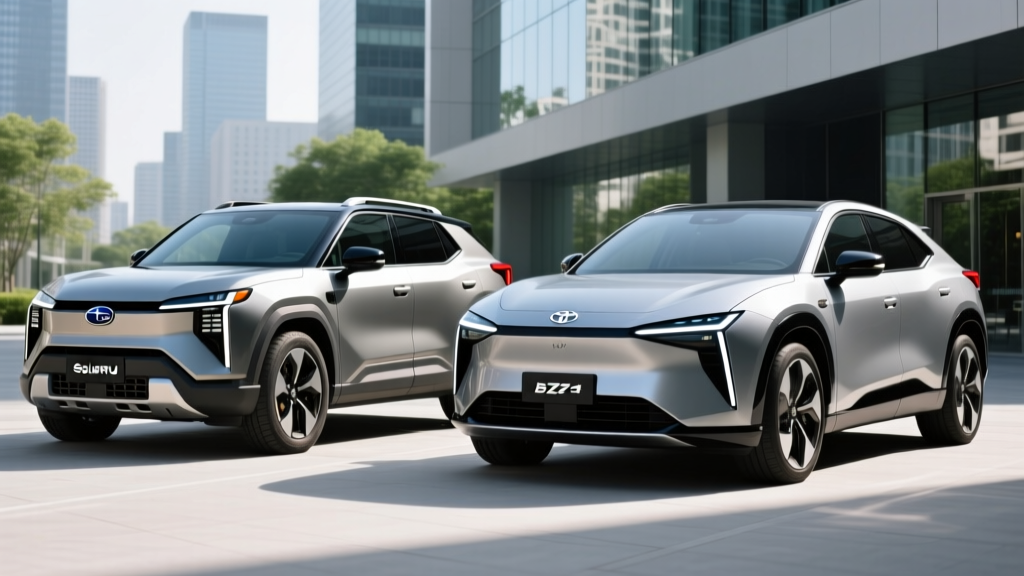
The Subaru Solterra and Toyota bZ4X are mechanically identical twins built on the shared e-TNGA platform — same 72.8 kWh (usable ~64 kWh) lithium-ion NMC battery pack, same dual-motor AWD powertrain, and same 215 hp output. The differences come down to tuning and branding: the Solterra leans into off-road capability with X-MODE and 8.3 inches of ground clearance, while the bZ4X emphasizes on-road comfort and slightly better efficiency. EPA range tops out around 228 miles for the bZ4X and 227 miles for the Solterra (2025–2026 model years, depending on trim and wheel size). Both start in the mid-$38,000s before incentives. If you regularly drive on unpaved roads or in deep snow, the Solterra's off-road software gives it an edge. If you want marginally better highway range and a lower starting price on certain trims, the bZ4X wins by a thin margin.
Shared Platform, Different Personalities
Toyota and Subaru co-developed the e-TNGA architecture, meaning the Solterra and bZ4X share far more than a passing resemblance. Under the skin, they use the same battery pack, the same front and rear electric motors (80 kW front, 40 kW rear for a combined 215 hp and 249 lb-ft of torque), and the same 150 kW peak DC fast-charge capability via CCS1 connector. The wheelbase is identical at 112.2 inches, and both seat five passengers in a compact crossover form factor.
Where they diverge is in software and suspension tuning. Subaru equips every Solterra with its X-MODE traction management system, hill descent control, and a slight suspension lift that yields 8.3 inches of ground clearance — a meaningful advantage on forest service roads or unplowed driveways. Toyota tunes the bZ4X for ride comfort and efficiency, resulting in a slightly lower MPGe rating on the EPA cycle for the Subaru.
| Specification | Subaru Solterra (AWD) | Toyota bZ4X (AWD) |
|---|---|---|
| EPA Range | 222–227 mi (trim dependent) | 222–228 mi (trim dependent) |
| Battery (Usable) | ~64 kWh NMC (72.8 gross) | ~64 kWh NMC (72.8 gross) |
| Powertrain | Dual-motor AWD, 215 hp | Dual-motor AWD, 215 hp |
| 0–60 mph | ~6.5 sec | ~6.5 sec |
| DC Fast Charge Peak | 150 kW (CCS1) | 150 kW (CCS1) |
| 10–80% DC Charge | ~30 min | ~30 min |
| Level 2 Charge Rate | 6.6 kW (J1772) | 6.6 kW (J1772) |
| Ground Clearance | 8.3 in | 8.1 in |
| Off-Road Mode | X-MODE + Hill Descent | Not equipped |
| MPGe (Combined) | 102–104 MPGe | 102–106 MPGe |
| Starting MSRP (2025) | ~$38,495 | ~$37,070 |
| Battery Warranty | 8 yr / 100,000 mi | 8 yr / 100,000 mi |
Real-World Range: What the EPA Sticker Doesn't Tell You
The EPA estimates are useful for comparison shopping, but real-world range in these vehicles requires context. Both the Solterra and bZ4X carry a relatively small usable battery (~64 kWh) for their weight class, which makes them more sensitive to driving conditions than longer-range competitors.
Range Reality Check
EPA Sticker: 222–228 miles
Highway driving (70–75 mph, 65°F): Expect ~185–200 miles
Cold weather (20°F, city/highway mix): Expect ~150–170 miles
Cold weather highway: Expect ~130–150 miles
The NMC chemistry in these packs loses roughly 20–30% of usable range in freezing temperatures, and highway speeds above 70 mph cut efficiency significantly due to aerodynamic drag. Neither vehicle uses a heat pump as standard on all trims (Toyota added one on 2025+ models; Subaru's availability varies by trim year), which affects cabin heating efficiency in winter.
If your daily commute is under 60 miles round-trip and you can charge at home, either vehicle will serve you well without range anxiety. However, if you regularly drive 200+ mile routes — especially in winter or at highway speeds — you'll need to plan DC fast-charging stops, and the 150 kW peak rate (which tapers significantly above 80% state of charge) means a 10–80% top-up takes roughly 30 minutes under ideal conditions.
Charging Speed and Infrastructure
Both vehicles use the CCS1 connector for DC fast charging and the J1772 connector for Level 2 AC charging. As of 2025–2026, neither has adopted the Tesla NACS connector natively, though adapters may become available as the industry transitions.
| Level | Power | Miles Added per Hour | Notes |
|---|---|---|---|
| Level 1 (120V) | ~1.4 kW | ~4–5 mi/hr | Emergency/trickle only |
| Level 2 (240V, 32A) | 6.6 kW | ~22–25 mi/hr | Full charge in ~10 hours |
| DC Fast (Peak) | 150 kW | ~10 mi/min at peak | 10–80% in ~30 min; tapers above 80% |
The 150 kW peak DC charge rate is competitive but not class-leading. Hyundai/Kia's E-GMP platform (Ioniq 5, EV6) peaks at 240 kW on 800V architecture and achieves 10–80% in roughly 18 minutes. The Solterra and bZ4X charge curve holds near peak rate until approximately 55–60% state of charge, then tapers progressively — a common NMC battery management strategy to preserve long-term battery health, but it means the second half of a charging session takes noticeably longer.
Cost of Ownership: EV vs Gas vs Hybrid
The purchase price is only one input. Total cost of ownership over five years reveals whether the electric powertrain saves money compared to a gas-powered Subaru Outback or Toyota RAV4 Hybrid.
| Cost Category | Solterra / bZ4X (EV) | RAV4 Hybrid (AWD) | Subaru Outback (Gas AWD) |
|---|---|---|---|
| Purchase Price (base) | $38,000 | $33,000 | $32,000 |
| Federal Tax Credit (§30D)* | Up to $7,500 | None | None |
| Effective Purchase | ~$30,500 | $33,000 | $32,000 |
| Fuel/Energy (5 yr) | $2,800–$4,500 | $5,500 | $7,800 |
| Maintenance (5 yr) | $800–$1,200 | $2,500 | $3,200 |
| Insurance (5 yr est.) | $9,000–$11,000 | $7,500 | $7,200 |
| 5-Year Total (est.) | $43,100–$47,200 | $48,500 | $50,200 |
*Federal §30D tax credit eligibility depends on your income, the vehicle's MSRP cap compliance, battery component sourcing, and critical mineral requirements. Check current rules at IRS.gov before purchasing. The credit may be transferred to the dealer as a point-of-sale discount under 2024+ rules.
The EV wins on fuel and maintenance costs decisively — home charging at $0.14/kWh costs roughly $0.04/mile versus $0.10–$0.12/mile for gas. EVs eliminate oil changes, transmission fluid, and exhaust system maintenance. However, insurance premiums for EVs run 15–25% higher on average due to repair costs and battery replacement exposure, which narrows the savings gap.
Tax Credit Eligibility and Incentives
Both the Solterra and bZ4X have historically qualified for portions of the §30D federal tax credit, but eligibility is not guaranteed for every buyer or every model year. The current rules impose:
- MSRP Cap: SUVs must have an MSRP under $80,000 (both vehicles clear this easily)
- Buyer Income Cap: AGI under $150,000 (single) or $300,000 (joint filing)
- Battery Sourcing: Critical minerals and battery components must meet phased-in thresholds from qualified trade partners — this requirement tightens annually and can disqualify vehicles mid-year
- Point-of-Sale Transfer: As of 2024, you can transfer the credit to the dealer for an upfront price reduction rather than waiting for tax filing
Always verify current eligibility with your dealer and cross-reference the fueleconomy.gov tax credit database before signing a purchase agreement. State and utility incentives may stack on top — check AFDC's state incentive lookup for your jurisdiction.
Common Misconceptions Addressed
| Myth | Fact |
|---|---|
| "They have 250+ miles of range" | EPA-rated at 222–228 mi max; real-world highway is ~185–200 mi |
| "They charge as fast as a Tesla" | Peak 150 kW (CCS1); Tesla Model Y on V3 Supercharger peaks at 250 kW |
| "The battery will need replacing in 5 years" | NMC packs typically retain 85–90% capacity after 100,000 mi; warranty covers 8 yr/100,000 mi at 70%+ retention |
| "You can't drive them in winter" | AWD with traction control performs well; range drops 20–30% in freezing temps, so plan accordingly |
| "They qualify for the full $7,500 credit automatically" | Credit depends on your income, battery sourcing compliance, and model-year rules — verify before purchase |
| "Level 2 charging at home requires a panel upgrade" | Most homes with a 200A panel can add a 40A/6.6 kW Level 2 circuit without upgrade; older 100A panels may need one (~$1,500–$3,000) |
Home Charging: What First-Time Buyers Need to Know
If you have access to a garage or driveway where a 240V Level 2 charger can be installed, daily EV ownership is straightforward: plug in at night, wake up to a full battery. A typical Level 2 home installation for a 48A charger (hardwired, NEMA 14-50 or direct-wire) costs between $500 and $2,000 depending on the distance from your electrical panel and whether a permit is required. Expect to pay $400–$700 for a quality Level 2 EVSE (ChargePoint Home Flex, Emporia Vue, or Wallbox Pulsar Plus) plus $300–$1,500 for electrician labor and permits.
If you live in an apartment or lack dedicated parking, public charging becomes your primary refueling method. At current Electrify America and EVgo pricing (~$0.40–$0.55/kWh for DC fast charging), your "fuel" cost rises to roughly $0.07–$0.09/mile — still cheaper than gas, but the convenience gap widens. Plan whether your lifestyle supports exclusive public charging before committing to an EV purchase.
Decision Framework: Which Should You Choose?
Choose the Subaru Solterra if:
- You regularly drive on unpaved roads, forest service roads, or steep gravel driveways
- You live in a region with heavy snowfall and want X-MODE traction management
- You value Subaru's reputation for all-weather capability and plan to keep the vehicle 8+ years
- Ground clearance (8.3 in) matters for your driving routes
Choose the Toyota bZ4X if:
- You prioritize slightly better on-road efficiency and MPGe
- You want access to Toyota's larger dealer network for service
- On-road ride comfort is more important than off-road capability
- You find a better deal at your local Toyota dealer (pricing varies by region)
Consider a different EV entirely if:
- You need 300+ miles of EPA range (look at Hyundai Ioniq 5, Tesla Model Y, or Chevrolet Equinox EV)
- You regularly tow — neither is rated for more than light-duty towing
- You need DC fast charging above 200 kW for frequent long road trips
- You want NACS native compatibility for Tesla Supercharger access without an adapter
Frequently Asked Questions
Are the Solterra and bZ4X the same car?
Mechanically, yes — they share the e-TNGA platform, battery pack, motors, and most hardware. The differences are in software (Subaru's X-MODE), suspension tuning, exterior styling, and interior trim materials. Think of them as the same vehicle with different brand calibration.
How long does the battery last?
Both vehicles carry an 8-year/100,000-mile battery warranty guaranteeing at least 70% capacity retention. Real-world data from similar NMC packs suggests 85–92% retention at 100,000 miles under normal use. Full battery replacement costs are estimated at $12,000–$18,000 out of warranty, though most owners will sell or trade before needing one.
Can I use Tesla Superchargers with these vehicles?
Not natively. Both use CCS1 connectors. As the North American charging standard transitions to NACS, some third-party adapters may become available, but as of 2025–2026, you'll rely on CCS networks like Electrify America, EVgo, and ChargePoint for DC fast charging.
Is a hybrid a better choice than these EVs?
If you lack home charging access, frequently drive 300+ mile routes in rural areas, or live in extreme cold where range loss is a concern, a Toyota RAV4 Hybrid (39 MPG combined) or Subaru Crosstrek Hybrid may better suit your needs. The EV wins on per-mile fuel cost and maintenance, but only if your driving pattern and charging access align.
What does it cost to charge at home versus fueling a gas car?
At the US average electricity rate of $0.16/kWh, fully charging the ~64 kWh usable battery costs about $10.24, yielding roughly $0.045/mile. A comparable gas AWD crossover at 28 MPG combined with gas at $3.40/gallon costs about $0.12/mile — nearly 3x more per mile. Over 15,000 miles/year, that's a savings of roughly $1,100–$1,300 annually on fuel alone.