The Quick Answer: What Makes an Electric Golf Cart Street Legal?
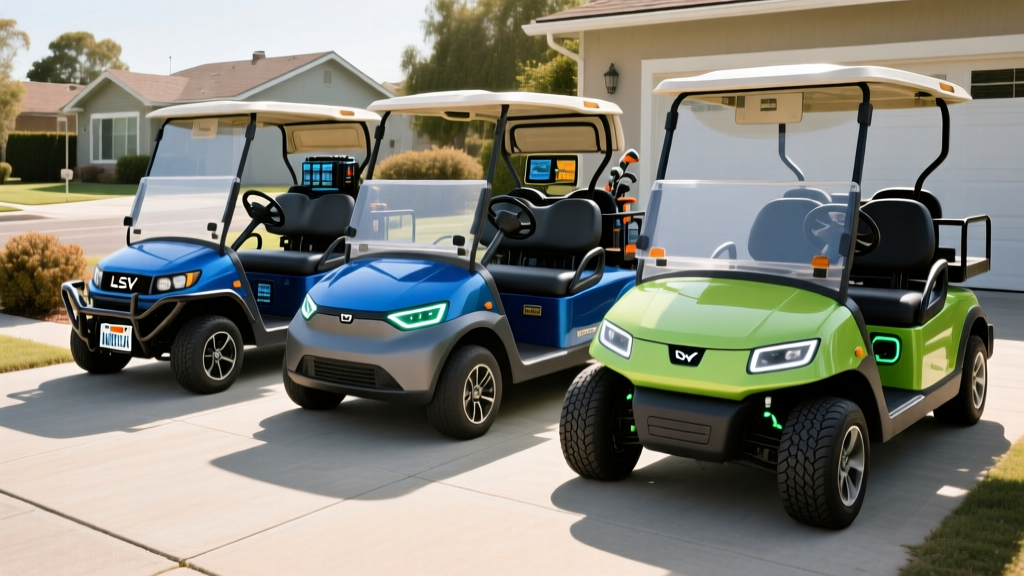
Short answer: A "street legal electric golf cart" is almost always a Low-Speed Vehicle (LSV) — also called a Neighborhood Electric Vehicle (NEV) — that meets the U.S. DOT's FMVSS 500 federal standard. To qualify, it must have a top speed between 20 and 25 mph, be equipped with headlights, taillights, turn signals, mirrors, a windshield, parking brake, and VIN, and it may only be driven on roads with posted speed limits of 35 mph or less (states may allow up to 45 mph with local approval). Standard golf carts used on a course are not automatically street legal — they must be upgraded or sold as an LSV from the factory.
In 2026, expect to pay $8,500–$22,000 for a new street-legal electric LSV, with most mainstream 4-seat models (Club Car Onward, E-Z-GO Liberty, Polaris GEM e2/e4, Tomberlin E-Merge) landing between $11,000 and $16,500 before state tax and dealer fees.
LSV vs Golf Cart vs NEV: The Legal Distinction That Matters
Buyers use these terms interchangeably, but they describe different legal categories. A golf cart is a vehicle designed for golf course use; most states restrict unmodified carts to private property or designated paths. An LSV is a federally regulated class defined by NHTSA under FMVSS 500 — it must carry specific safety equipment and a 17-character VIN to be titled and registered. NEV is largely a marketing synonym for LSV. When a dealer says "street legal golf cart," verify that the vehicle carries an LSV-class VIN and FMVSS 500 compliance label — otherwise you're buying a modified cart that may not be insurable or registrable in your state.
Key federal requirements for an LSV:
- Top speed: 20–25 mph (electronically governed)
- Headlamps, front/rear turn signals, tail lamps, stop lamps, reflex reflectors
- Exterior mirrors (driver-side and passenger-side or interior)
- Parking brake
- Windshield (laminated safety glass or polycarbonate meeting ANSI Z26.1)
- VIN assigned per 49 CFR Part 565
LSVs are not required to have airbags, crash-test structures, or electronic stability control — which is why they are restricted to low-speed roads. Treat them as neighborhood transport, not highway commuters.
Real-World Range, Battery Chemistry, and Charging Times
Most 2026 LSVs use either lead-acid (flooded or AGM) or lithium iron phosphate (LFP) battery packs. The choice drives price, range, weight, and long-term ownership cost.
| Spec | Lead-Acid (48V–72V) | LFP Lithium (48V–72V) |
|---|---|---|
| Usable pack capacity | 5–7 kWh | 7–12 kWh |
| EPA-style rated range | 25–35 miles | 45–70 miles |
| Real-world range (hills, A/C, 4 passengers) | 15–25 miles | 30–55 miles |
| Cold-weather loss (32°F) | -30% to -40% | -15% to -25% |
| Level 1 charge (120V, 1.5 kW) | 6–8 hours (0–100%) | 6–10 hours (0–100%) |
| Level 2 option (240V, 3.3 kW) | Rare / aftermarket | 2.5–4 hours (some OEM) |
| Expected pack life | 3–5 years / 500–800 cycles | 8–12 years / 2,000+ cycles |
| Replacement cost | $1,200–$2,200 | $2,800–$5,500 |
Range reality check: A Club Car Onward LSV with the optional lithium pack is rated at roughly 50 miles on flat terrain at 15 mph with one occupant. Load four adults, climb a 5% grade, and run in 90°F heat with the canopy open — expect closer to 30–35 miles. Plan your daily loop around the worst-case number, not the brochure.
Charging is almost universally Level 1 (standard 120V household outlet) via an onboard charger. A few 2026 lithium models — notably some Tomberlin and GEM trims — offer a 240V Level 2 option that cuts charge time roughly in half. DC fast charging is not offered on any production LSV as of 2026; the pack sizes are simply too small to justify the hardware cost.
Cost Breakdown: Purchase, Fueling, Maintenance, and Insurance
The economics of an LSV look compelling only when you compare them against the right alternative. Here's a 5-year total-cost-of-ownership (TCO) look at a typical lithium LSV versus a comparable small gas car (e.g., a 2026 Mitsubishi Mirage or base Nissan Versa) and a small PHEV (e.g., Toyota Prius Prime), assuming 20 miles/day, 250 days/year (5,000 miles/year), and $0.16/kWh residential electricity.
| Cost Category | Lithium LSV (~$14K) | Small Gas Car (~$19K) | Small PHEV (~$33K) |
|---|---|---|---|
| Purchase (pre-incentive) | $14,000 | $19,000 | $33,000 |
| Federal §30D tax credit | $0 (not eligible) | $0 | Up to $7,500* |
| Energy cost (5 yrs) | $560 (800 kWh/yr) | $4,800 (gas @ $3.60/gal, 32 MPG) | $1,200 (mix of electric + gas) |
| Maintenance (5 yrs) | $600 (tires, brakes, water/top-up) | $3,200 (oil, filters, brakes, tires) | $2,400 |
| Insurance (5 yrs) | $2,400 ($480/yr avg) | $6,500 ($1,300/yr avg) | $7,200 |
| Estimated 5-yr resale | -$5,500 | -$9,500 | -$15,000 |
| Net 5-year cost | ~$12,060 | ~$24,000 | ~$21,300 |
*§30D credit eligibility depends on MSRP caps, buyer AGI limits, and battery critical-mineral sourcing rules per IRS guidance. LSVs generally do not qualify because most fail the battery-component and critical-mineral sourcing requirements and many manufacturers do not certify them.
The LSV wins on operating cost — electricity at $0.16/kWh works out to roughly $0.02–$0.03 per mile versus $0.11/mile for a 32-MPG gas car. Where the LSV loses is in versatility: it cannot legally or safely replace a car for highway trips, winter commuting in most climates, or passenger/cargo hauling beyond the neighborhood.
Street Legal Electric Golf Carts vs Gas Cars: A Data Comparison
| Attribute | 2026 LSV (Lithium) | 2026 Small Gas Car |
|---|---|---|
| Top speed | 25 mph (governed) | 110+ mph |
| Range per fill/charge | 30–55 miles | 350–450 miles |
| Energy cost per mile | $0.02–$0.03 | $0.10–$0.13 |
| 0–20 mph | ~5–7 sec | ~3–4 sec |
| Cargo (rear seat folded) | 8–12 cu ft | 14–18 cu ft |
| Safety (NHTSA/IIHS rated?) | No — minimal crash structure | Yes — 5-star common |
| Climate control | Optional enclosure/heater | Standard HVAC |
| Where it can drive | ≤35 mph posted (some states 45) | Any public road |
Real-World Ownership: What First-Time LSV Buyers Get Wrong
Talk to LSV owners in Sun City, The Villages, Peachtree City, or any master-planned community and you'll hear the same recurring lessons. Here are the misconceptions we hear most often, corrected with data:
| Myth | Fact |
|---|---|
| "Any golf cart can be made street legal with a $200 kit." | FMVSS 500 compliance requires a manufacturer-issued VIN and specific safety equipment. Retrofits may pass in a few lenient states but will fail inspection in most. |
| "LSVs qualify for the $7,500 federal tax credit." | Most LSVs do not meet §30D battery-sourcing or MSRP-certification requirements. Verify with the manufacturer's IRS certification letter before counting on it. |
| "Lithium and lead-acid batteries are interchangeable." | They're not. LFP packs weigh 40–60% less, last 3× longer, and hold voltage under load — but cost 2–3× more upfront and require a compatible BMS and charger. |
| "I can drive my LSV on any road." | Federal law caps LSV operation at 35 mph posted (states may extend to 45 mph with restrictions). Crossing a 45+ mph road is often illegal and always dangerous. |
| "Range ratings are accurate." | LSV range is typically quoted at 15 mph on flat ground, one occupant, 70°F. Real-world loaded range drops 30–50%. |
Home Charging and Climate Realities
LSVs do not need a dedicated 240V circuit — a standard 120V/15A garage outlet on a dedicated breaker is sufficient. Budget $0 for electrical work if you already have a garage outlet; budget $300–$800 if you need a new outdoor-rated GFCI receptacle installed. Do not share the circuit with a refrigerator or freezer; tripped breakers mid-charge are a common owner complaint.
Climate matters more than most buyers expect. Lead-acid packs lose 30–40% of their capacity below freezing, and repeated deep discharges in cold weather accelerate sulfation. If you live north of the I-40 corridor and plan to drive year-round, lithium is not optional — it's essential. In hot climates (Arizona, Florida), UV exposure degrades polycarbonate windshields within 3–5 years; budget $250–$400 for a replacement or choose a laminated-glass model.
Decision Framework: Should You Buy an LSV, a PHEV, or a Regular EV?
Choose a street legal electric golf cart (LSV) if:
- Your daily trips are under 20 miles round-trip on roads posted ≤35 mph
- You live in a master-planned community, retirement community, barrier island, or small town with low-speed infrastructure
- You already own a highway-capable car for longer trips
- Your climate is mild (or you'll commit to lithium and an enclosed cab)
- Your budget is $10K–$18K and you want near-zero fuel/maintenance cost
Choose a PHEV (Prius Prime, RAV4 Prime, etc.) if:
- You need one vehicle for both neighborhood errands and highway commuting
- You want 30–45 miles of electric-only range for daily driving plus gas backup
- You want NHTSA crash-tested safety and full HVAC
Choose a full BEV (Bolt EV, Model 3, Ioniq 5) if:
- Your daily driving exceeds 25 miles or includes roads above 35 mph
- You need year-round climate-controlled comfort and crash protection
- You have access to home Level 2 charging and can absorb a $28K–$45K purchase
Tax, Title, and Insurance: The Paperwork Most Buyers Skip
Before you sign, confirm four things in writing:
- VIN class: The vehicle's 17-character VIN must decode to an LSV / FMVSS 500 body type. Your DMV will check this at title time.
- State legality: A handful of states (notably New York within NYC limits) restrict LSV registration or road access. Check your state DMV's LSV/NEV page before purchasing.
- Insurance: Standard auto insurers (Progressive, GEICO, State Farm) write LSV policies, typically $350–$650/year for liability + comprehensive. Specialty golf-cart insurers (e.g., Progressive's golf cart program) often bundle roadside and accessory coverage.
- Sales tax and local fees: LSVs are titled as motor vehicles in most states, meaning full sales tax applies. A $14,000 LSV in a 7% tax state adds $980 at registration.
Frequently Asked Questions
Do I need a driver's license to operate a street legal electric golf cart?
Yes, in nearly every state. An LSV is a titled motor vehicle; the operator must hold a valid driver's license, and the vehicle must be registered, plated, and insured. A few states allow restricted permits for 14–16-year-olds on specific roads — check your state DMV.
Can I drive an LSV at night or in the rain?
Yes, provided the LSV has functioning headlamps, taillamps, turn signals, and a windshield — all FMVSS 500 requirements. Enclosed-cab models with wipers and heaters are strongly recommended for rainy or cold climates; open models become impractical below ~50°F.
How long does an LSV battery last, and what does replacement cost?
Lead-acid packs typically last 3–5 years and cost $1,200–$2,200 to replace. LFP lithium packs last 8–12 years and cost $2,800–$5,500. Over a 10-year ownership period, lithium is usually cheaper on a cost-per-mile basis despite the higher upfront price.
Are street legal electric golf carts eligible for the federal EV tax credit?
Generally no. Under current IRS §30D rules, most LSVs fail the battery critical-mineral and component sourcing requirements, and many manufacturers do not submit the required certification letters. A few commercial-class NEVs from Polaris (GEM line) have historically qualified for the commercial §45W credit — consult a tax professional before assuming eligibility.
What's the safest street legal electric golf cart for a family?
Prioritize models with four-wheel hydraulic disc brakes, a steel roll cage (ROPS-certified where available), three-point seat belts on every seat, and laminated-glass windshields. The Polaris GEM e4 and Tomberlin E-Merge E4 are among the most robustly built 4-seat LSVs as of 2026. Remember: no LSV is crash-tested to passenger-car standards — never use one as a child's primary school transport on high-speed roads.
How fast can a street legal electric golf cart go?
Federal law caps LSV top speed at 25 mph. Some states allow "medium-speed vehicles" up to 35 mph under separate rules, but these are rare and require additional equipment. Any cart advertised above 25 mph as "street legal" should be verified against your state's specific statute.