Quick Answer: Which Volvo Electric SUV Fits You?
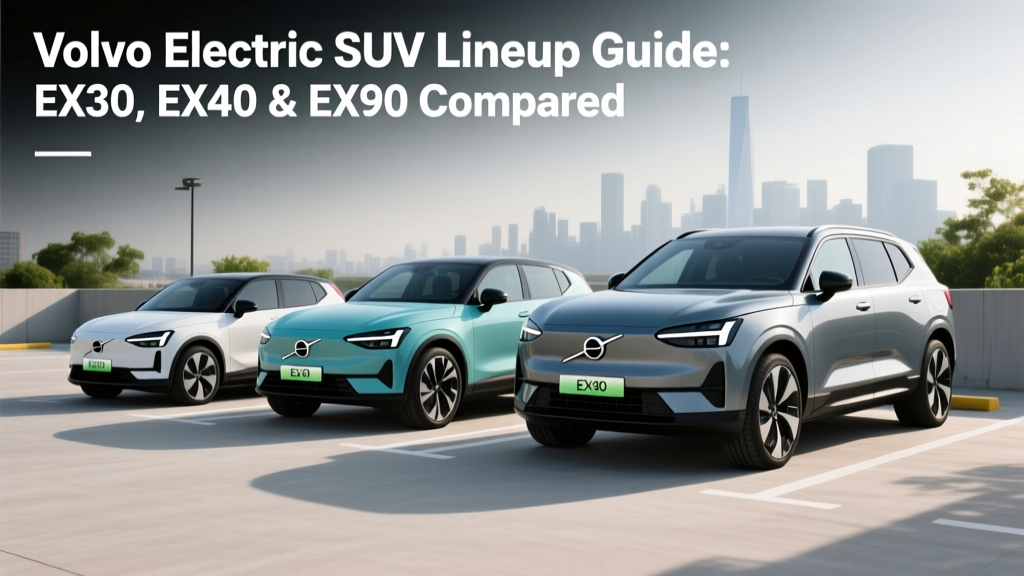
If you're researching a Volvo electric SUV in 2026, you have three options: the compact EX30 (EPA 265 mi, starting ~$36,350), the midsize EX40 (EPA 300 mi, starting ~$54,950), and the three-row flagship EX90 (EPA 300–310 mi, starting ~$79,990). The EX30 suits urban commuters who want a premium subcompact with fast 153 kW DC charging. The EX40 (formerly C40 Recharge) is the practical sweet spot for couples and small families needing AWD and solid highway range. The EX90 targets large families who want three rows, advanced ADAS, and don't mind a premium price tag.
Volvo's transition to a fully electric lineup has produced three distinct SUVs, each aimed at a different buyer. But EPA stickers and press-release specs don't tell the whole story. This guide breaks down real-world range expectations, charging realities, federal tax credit eligibility under current IRS §30D rules, and total ownership costs — so you can decide which Volvo electric SUV actually earns a spot in your driveway.
The 2026 Volvo Electric SUV Lineup at a Glance
| Spec | EX30 (Single Motor Plus) | EX40 Twin Motor Ultra | EX90 Twin Motor Performance |
|---|---|---|---|
| Base MSRP | $36,350 | $54,950 | $79,990 |
| EPA Range | 265 mi | 300 mi | 300–310 mi |
| Battery (usable) | 69 kWh (NMC) | 82 kWh (NMC) | 111 kWh (NMC) |
| Drivetrain | RWD | AWD (Twin Motor) | AWD (Twin Motor) |
| Horsepower | 272 hp | 402 hp | 503 hp |
| 0–60 mph | 5.1 sec | 4.5 sec | 4.2 sec |
| Max DC Fast Charge | 153 kW | 200 kW | 250 kW |
| 10–80% DCFC Time | ~26 min | ~28 min | ~30 min |
| Level 2 (AC) Rate | 11 kW | 11 kW | 11 kW |
| MPGe (Combined) | 114 MPGe | 95 MPGe | 84 MPGe |
| Battery/Powertrain Warranty | 8 yr / 100,000 mi | 8 yr / 100,000 mi | 8 yr / 100,000 mi |
Sources: fueleconomy.gov, Volvo Cars USA specifications. Real-world range may vary based on temperature, terrain, and driving style.
Real-World Range Reality Check
EX30: EPA 265 mi. Expect ~215–235 mi on sustained highway driving at 70+ mph. In freezing temperatures (below 32°F), plan for 175–200 mi of usable range without preconditioning.
EX40: EPA 300 mi. Real-world highway: ~250–270 mi. Cold-weather drop brings this to ~210–230 mi.
EX90: EPA 300–310 mi. Highway reality: ~255–275 mi. Cold weather: ~220–240 mi. The EX90's large 111 kWh pack helps mitigate losses, but its 5,900+ lb curb weight demands more energy per mile.
Volvo Electric SUV vs. Gas and Hybrid Alternatives
Before committing to a Volvo EV, it's worth comparing the ownership math against the gas and plug-in hybrid alternatives Volvo and its competitors offer.
| Metric | EX40 Twin Motor (EV) | Volvo XC60 T8 PHEV | BMW X3 xDrive30 (Gas) |
|---|---|---|---|
| MSRP (approx.) | $54,950 | $57,350 | $49,700 |
| Powertrain | Full EV (AWD) | Plug-in Hybrid (AWD) | Turbo Gas (AWD) |
| EPA Efficiency | 95 MPGe | 63 MPGe / 28 MPG (gas-only) | 25 MPG combined |
| Electric-Only Range | 300 mi | 35 mi | N/A |
| Annual Fuel/Energy Cost* | ~$680 | ~$1,150 | ~$2,100 |
| 5-Year Fuel/Energy Cost | ~$3,400 | ~$5,750 | ~$10,500 |
| 5-Year Maint. Estimate | ~$1,800 | ~$3,200 | ~$3,800 |
*Annual fuel/energy cost based on 12,000 mi/year, $0.16/kWh national average for home charging, $3.50/gal gas. Public DC fast charging costs significantly more (~$0.35–$0.48/kWh). Source: fueleconomy.gov.
The EX40's higher upfront price is partially offset by dramatically lower energy and maintenance costs over five years. However, the XC60 T8 PHEV remains compelling for buyers who can't install a home charger or frequently drive 400+ mile routes where DC charging infrastructure is sparse. The PHEV eliminates range anxiety while still providing 35 miles of electric-only commuting.
Federal Tax Credits and Purchase Incentives
Federal EV tax credits under IRS §30D are nuanced in 2026. Not every Volvo electric SUV qualifies for the full $7,500 credit, and eligibility depends on battery mineral sourcing, your income, and the vehicle's MSRP.
- MSRP Cap: SUVs must be priced at or below $80,000 to qualify. The EX30 and EX40 are well under this limit. The EX90's base price of $79,990 barely qualifies, but adding packages can push it over.
- Buyer Income Cap: Modified AGI must not exceed $150,000 (single), $225,000 (head of household), or $300,000 (joint filers).
- Battery Sourcing Requirements: Critical minerals and battery component sourcing rules tighten annually. The EX30's battery supply chain has faced scrutiny due to CATL cell sourcing — check the latest DOE eligible vehicle list before purchasing, as partial ($3,750) or full ($7,500) credit status can change.
- Point-of-Sale Transfer: You can now transfer the credit to the dealer at purchase, reducing your out-of-pocket cost immediately rather than waiting for a tax refund.
Bottom line: The EX40 Twin Motor is the most credit-friendly option for most buyers. The EX90's borderline MSRP means trim selection directly impacts credit eligibility. Always verify current eligibility on fueleconomy.gov before signing.
Charging at Home and on the Road
Charging infrastructure is the single biggest ownership variable for any Volvo electric SUV.
| Level | Power | EX30 (mi/hr) | EX40 (mi/hr) | EX90 (mi/hr) | Use Case |
|---|---|---|---|---|---|
| Level 1 (120V) | ~1.4 kW | ~4 mi/hr | ~3.5 mi/hr | ~3 mi/hr | Overnight top-up only |
| Level 2 (240V, 48A) | 11.5 kW | ~33 mi/hr | ~30 mi/hr | ~28 mi/hr | Daily home charging |
| DC Fast Charge | 153–250 kW | ~500 mi/hr peak | ~550 mi/hr peak | ~600 mi/hr peak | Road trips |
Home Charging Setup
All three Volvo EVs accept 11 kW AC charging on Level 2, which means a full overnight charge from 10% to 100% takes roughly 7–10 hours depending on pack size. A Level 2 home charger (like a ChargePoint Home Flex or Wallbox Pulsar Plus) on a 240V/48A circuit is essential for practical daily ownership.
Install cost reality: Expect $500–$1,500 for the charger hardware and $800–$2,500 for electrician labor and permitting if your panel has capacity. A 200A panel upgrade adds $1,500–$3,500. Total home setup: $1,300–$7,500 depending on your electrical infrastructure.
Public DC Fast Charging
Volvo EVs use the CCS1 connector natively. With Tesla's Supercharger network now open to non-Tesla vehicles via NACS adapters (included or available from Volvo), your route options have expanded significantly. The EX90's 250 kW peak rate is impressive, but real-world charging curves taper substantially above 80% — a 10–80% session takes ~30 minutes, but 80–100% can add another 25–30 minutes. Plan road-trip stops around the 10–80% window.
Ownership Costs Over 5 Years
| Cost Category | EX30 | EX40 | EX90 |
|---|---|---|---|
| MSRP (base) | $36,350 | $54,950 | $79,990 |
| Est. Federal Tax Credit | $3,750–$7,500 | $7,500 | $0–$7,500 |
| Effective Purchase Price | $28,850–$32,600 | $47,450 | $72,490–$79,990 |
| 5-Year Energy Cost | ~$2,700 | ~$3,400 | ~$4,100 |
| 5-Year Maintenance | ~$1,500 | ~$1,800 | ~$2,200 |
| 5-Year Insurance (est.) | ~$8,500 | ~$10,200 | ~$13,500 |
| Est. 5-Year Depreciation | ~$12,000 | ~$18,000 | ~$28,000 |
| 5-Year Total Cost of Ownership | ~$53,550–$57,300 | ~$80,850 | ~$120,290–$127,790 |
Insurance estimates based on national averages for premium EVs. Depreciation estimates based on current EV resale trends. Actual costs vary by state, driving record, and market conditions.
The EX30 stands out as one of the most affordable premium EVs to own over five years when it qualifies for the full credit. The EX90's total cost is steep — buyers at this price point should also consider whether a fully loaded Tesla Model X or Rivian R1S better serves their needs.
Common Misconceptions About Volvo EVs
| Myth | Fact |
|---|---|
| "Volvo EVs can't handle cold weather." | All three models include a battery heat pump (standard on EX40/EX90, available on EX30). Cold-weather range loss of 15–30% is real but manageable with preconditioning. A garage-kept EX40 in Minnesota will outperform expectations. |
| "The battery will need replacing in 5 years." | Volvo's NMC batteries carry an 8-year/100,000-mile warranty against degradation below 70% capacity. Industry data shows modern NMC packs typically retain 85–90% capacity at 100,000 miles with proper charging habits (avoiding frequent 100% charges and deep discharges). |
| "I need a Tesla to use Superchargers." | Since 2024, Volvo EVs can access Tesla Superchargers using a NACS adapter. Volvo has also committed to transitioning to the NACS port natively on future models, expanding your DC fast-charging options. |
| "EVs cost more to insure than gas cars." | Partially true. EV insurance premiums average 15–25% higher than comparable gas vehicles due to repair costs and battery replacement risk. The EX40's premium is typically $150–$200/month depending on your state and profile. |
| "Level 1 charging is fine for daily use." | Level 1 adds only 3–4 miles per hour of charging. If you drive 40+ miles daily, Level 1 will not replenish your battery overnight. Level 2 is a practical necessity for most EV owners. |
Decision Framework: Which Volvo Electric SUV Should You Buy?
Choose the EX30 if:
- You commute under 60 miles daily and primarily drive in urban/suburban areas
- You want a premium badge under $35,000 (after credits)
- You don't regularly carry more than one passenger or need significant cargo space (15.3 cu ft behind rear seats)
- You have reliable home Level 2 charging
Choose the EX40 if:
- You need a practical daily driver for a small family with 300 mi of EPA range
- You take 2–4 road trips per year and want AWD for snow/rain
- You value the strongest federal tax credit eligibility in the lineup
- You want 402 hp of effortless passing power without stepping into six-figure territory
Choose the EX90 if:
- You need three usable rows for a family of 5–7
- You want Volvo's most advanced ADAS suite with LiDAR-equipped Pilot Assist
- Budget is flexible and you accept the MSRP cap risk for tax credits
- You want 111 kWh of battery capacity for maximum range confidence on long hauls
Skip the Volvo EV lineup and consider a PHEV if:
- You lack home charging access and rely on street parking
- You regularly drive 500+ mile routes through areas with sparse DC charging
- Your budget is under $35,000 and you need more space than the EX30 offers
Frequently Asked Questions
Does any Volvo electric SUV qualify for the full $7,500 federal tax credit?
The EX40 Twin Motor currently has the strongest eligibility for the full $7,500 credit under IRS §30D, assuming your income falls within the caps ($300,000 joint / $150,000 single). The EX30 may qualify for a partial $3,750 credit depending on battery mineral sourcing requirements. The EX90's eligibility is trim-dependent due to the $80,000 SUV MSRP cap. Always check the current DOE/Fueleconomy.gov eligible vehicle list before purchasing.
How long does it take to charge a Volvo electric SUV at home?
On a Level 2 (240V, 48A) home charger delivering 11 kW, the EX30 charges from 10–100% in about 6.5 hours, the EX40 in about 7.5 hours, and the EX90 in about 10 hours. All three will fully replenish overnight. On a standard 120V Level 1 outlet, expect 40–70+ hours for a full charge — impractical for anything beyond emergency trickle charging.
Can I tow with a Volvo electric SUV?
The EX40 is rated for up to 2,000 lbs of towing capacity. The EX90 can tow up to 5,000 lbs when properly equipped. The EX30 is rated for 2,000 lbs. Keep in mind that towing significantly reduces range — expect a 30–50% range reduction depending on trailer weight and aerodynamics.
What happens if the battery degrades out of warranty?
Volvo's battery warranty guarantees at least 70% capacity retention for 8 years or 100,000 miles. Out-of-warranty battery replacement costs are estimated at $12,000–$18,000 depending on the model, though prices are expected to decline as the battery supply chain matures. Most modern NMC packs show 10–15% degradation at 100,000 miles based on fleet data, meaning many will remain functional well beyond the warranty period.
Is the Volvo EX90's LiDAR system actually self-driving?
No. The EX90's LiDAR-enhanced Pilot Assist is a SAE Level 2 driver-assistance system. It provides hands-on-wheel steering assist, adaptive cruise, and enhanced obstacle detection — but the driver must remain fully engaged and responsible at all times. True Level 4 autonomous driving (no driver needed) is currently limited to geofenced robotaxi services like Waymo, not consumer vehicles.
How does a Volvo electric SUV handle in winter?
Volvo's Swedish engineering heritage shows in cold-weather capability. The EX40 and EX90 include a heat pump that efficiently warms the cabin and battery without the massive energy drain of resistive heating. Expect 15–30% range loss in sub-freezing temperatures, depending on trip length (short trips in extreme cold are worst). Preconditioning the battery while plugged in — using the Volvo Cars app — mitigates both range loss and DC fast-charge speed reduction.