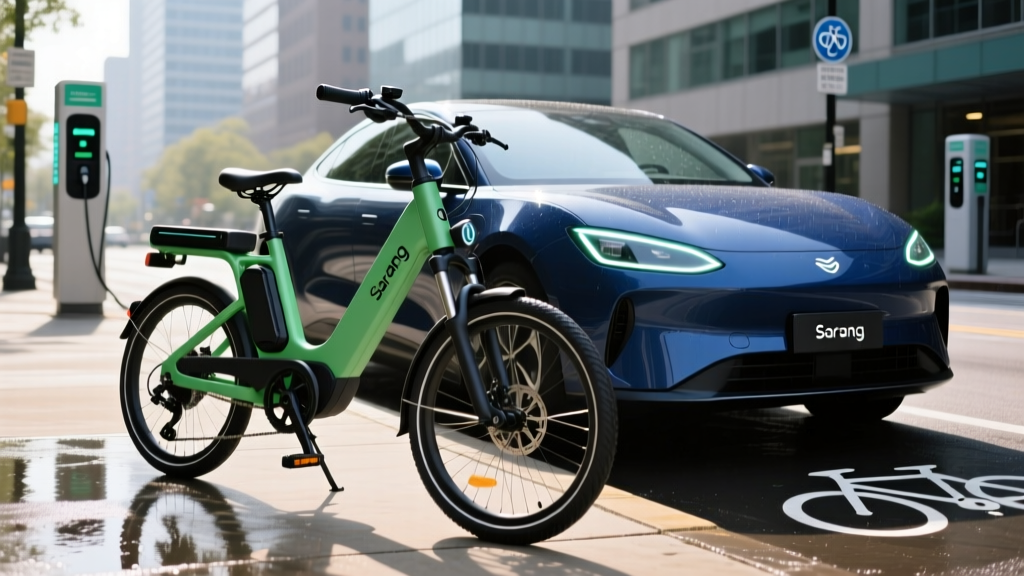
Searching for Sarang electric bikes and wondering how they stack up against a full electric car for your daily commute? You're not alone. With e-bike brands like Sarang gaining attention for affordable urban mobility, many buyers are weighing whether a lightweight electric two-wheeler or a four-wheeled EV is the smarter investment. Here's the direct answer: if your commute is under 15 miles round-trip, you don't need to carry passengers or cargo regularly, and your climate allows two-wheeled riding most of the year, an e-bike like those from Sarang can cost as little as $1,500–$3,000 upfront with pennies-per-charge energy costs. But if you need year-round weather protection, highway capability, passenger space, or cargo capacity, a compact EV like the 2026 Nissan Leaf or Chevrolet Bolt EV delivers 200+ miles of EPA range starting around $28,000 (before potential federal tax credits). This guide breaks down the real numbers so you can decide.
What Are Sarang Electric Bikes and Where Do They Fit?
Sarang electric bikes fall into the broader category of light electric vehicles (LEVs) — pedal-assist or throttle-operated bicycles and scooters with hub motors typically ranging from 250W to 750W and lithium-ion battery packs between 0.4 kWh and 1.0 kWh. They're designed for last-mile commuting, campus travel, and short urban errands.
Typical Sarang e-bike specifications you'll encounter:
- Motor: 250W–500W rear hub motor
- Battery: 0.4–0.7 kWh lithium-ion (36V or 48V)
- Range: 20–45 miles per charge (pedal-assist dependent)
- Top speed: 15–20 mph (Class 1/2 e-bike federal limits)
- Charge time: 3–5 hours on a standard 120V outlet
- Price: $1,200–$3,500 depending on model and battery capacity
These specs are relevant because they define the use-case boundary. A 0.5 kWh battery is roughly 1/120th the size of a 60 kWh EV battery pack. That's the fundamental physics difference between an e-bike and a car — and it drives every downstream comparison in cost, range, and capability.
E-Bike vs. Electric Car: The Numbers Side by Side
Let's put a representative Sarang-class e-bike against two popular entry-level electric cars — the 2026 Nissan Leaf S and the 2026 Chevrolet Bolt EV — across the metrics that actually matter for ownership decisions.
| Metric | Sarang-Class E-Bike | 2026 Nissan Leaf S | 2026 Chevrolet Bolt EV |
|---|---|---|---|
| Purchase Price | $1,500–$3,000 | ~$28,140 MSRP | ~$28,785 MSRP |
| Battery Capacity | 0.4–0.7 kWh | 40 kWh (NMC) | 65 kWh (NMC) |
| EPA/Real Range | 20–45 mi (varies by assist) | 149 mi EPA (fueleconomy.gov) | 259 mi EPA (fueleconomy.gov) |
| Charge Time (0–100%) | 3–5 hrs (120V) | ~7.5 hrs (Level 2, 6.6 kW) | ~9.5 hrs (Level 2, 7.2 kW) |
| DC Fast Charge | Not available | CHAdeMO, ~50 kW peak | CCS, ~55 kW peak |
| Energy Cost per Mile | ~$0.002–$0.005 | ~$0.03–$0.05 | ~$0.03–$0.05 |
| Annual Insurance | $0–$150 (optional) | $1,400–$2,200 | $1,300–$2,100 |
| Maintenance/Year | $50–$150 | $300–$500 | $300–$500 |
| Federal Tax Credit | None (not eligible under §30D) | Up to $3,750–$7,500 (see IRS §30D) | Up to $7,500 (see IRS §30D) |
| Weather Protection | None | Full enclosure, HVAC | Full enclosure, HVAC |
The table makes the trade-off clear: e-bikes win on upfront cost and per-mile energy, while EVs deliver range, speed, weather protection, cargo, and safety. The question is which set of capabilities you actually need.
The Real Cost of Ownership: 5-Year Breakdown
Purchase price alone doesn't tell the full story. Let's model five years of ownership for both options, assuming a 10-mile round-trip commute, 250 workdays per year (2,500 miles annually), and average U.S. electricity rates of $0.16/kWh.
| 5-Year Cost Category | Sarang E-Bike ($2,000) | Bolt EV ($28,785, $7,500 credit) |
|---|---|---|
| Net Purchase Price | $2,000 | $21,285 (after §30D credit) |
| 5-Year Energy Cost | ~$40 | ~$1,620 |
| 5-Year Insurance | $500 (optional coverage) | $8,500 |
| 5-Year Maintenance | $500 (tires, brake pads, chain) | $2,000 (tires, cabin filter, fluid top-offs) |
| Battery Replacement Reserve | $300–$600 (likely needed by year 4–5) | $0 (covered under 8-yr/100k-mi warranty) |
| 5-Year Total | ~$3,340–$3,640 | ~$33,405 |
| Cost Per Mile | $0.27–$0.29 | $0.97 (or $0.46 excluding insurance) |
The e-bike wins on pure economics by a massive margin — roughly 10x cheaper over five years. But this comparison only holds if the e-bike can actually replace your car trips. If you still need a vehicle for groceries, family rides, road trips, or rainy-day commuting, the e-bike becomes an addition rather than a replacement, and the total household transportation cost changes.
Common Misconceptions About E-Bikes vs. EVs
| Myth | Fact |
|---|---|
| "An e-bike can replace my car entirely" | Only if your trips are short, solo, and weather-permitting. NHTSA data shows most American households need a vehicle capable of highway speeds, cargo, and all-weather operation for at least some trips. |
| "E-bikes qualify for the $7,500 federal EV tax credit" | They do not. The IRS §30D credit applies to four-wheeled vehicles with a GVWR under 14,000 lbs and specific battery-sourcing requirements. Some local utility rebates may apply to e-bikes, but check your municipality. |
| "E-bikes don't need charging infrastructure" | They need a standard 120V outlet and 3–5 hours. Apartment dwellers without ground-floor outlet access face the same charging-access problem as EV owners without home charging. |
| "Electric cars are too expensive for commuters" | After the federal credit, state incentives, and fuel savings, a Bolt EV can cost $0.10–$0.15/mile to operate (excluding insurance), competitive with many gas cars on total cost. |
| "E-bike batteries last forever" | Most e-bike batteries are rated for 500–800 charge cycles before significant degradation. At daily charging, expect a replacement at year 3–5, costing $300–$600. |
Real-World Ownership Considerations
Home Charging Access
Both e-bikes and EVs depend on charging access, but the stakes differ. An e-bike battery weighs 5–8 lbs and can be carried indoors to charge at any standard outlet. An EV requires either a dedicated Level 2 (240V) home charger — installation typically runs $500–$2,000 depending on panel capacity and wiring distance — or reliable public charging. If you live in an apartment without a garage outlet, the e-bike has a massive practical advantage here.
Climate and Seasonality
This is where e-bikes hit their hardest limitation. Riding in rain, snow, extreme heat, or sub-freezing temperatures is uncomfortable at best and dangerous at worst. E-bike batteries also lose 20–30% of their range in cold weather (below 40°F), the same physics affecting EV lithium-ion packs — but EVs have active thermal management and heated cabins. If you live in Phoenix, Miami, or San Diego, an e-bike is viable year-round. In Minneapolis, Boston, or Seattle, expect 4–6 months of car dependency regardless.
Safety
E-bikes expose riders to traffic directly. NHTSA reports that cyclist fatalities have risen over 50% in the past decade, and e-bike riders travel at speeds that put them in the same risk category as moped riders. A car's steel cage, airbags, crumple zones, and ADAS features (automatic emergency braking, lane-keeping assist) provide protection an e-bike simply cannot match. Factor this into your risk assessment honestly.
Decision Framework: E-Bike, EV, or Both?
Choose a Sarang e-bike (or similar) if:
- Your round-trip commute is under 15 miles on roads with bike infrastructure
- You live in a mild climate with 8+ rideable months per year
- You have secure storage at home and work (theft is a major e-bike issue)
- You already own or have access to a car for longer trips, bad weather, and cargo
- Your budget is under $3,500 and you want to eliminate fuel costs for local trips
Choose an electric car (Leaf, Bolt, Equinox EV) if:
- Your commute exceeds 20 miles one-way or involves highways
- You regularly carry passengers or cargo
- You live in a climate with harsh winters or frequent rain
- You need a single vehicle to handle all transportation needs
- You qualify for the federal §30D tax credit (income caps: $150K single / $300K joint; vehicle MSRP caps: $55K cars / $80K SUVs) — see IRS rules
Choose both if:
- You want to maximize savings — use the e-bike for 70% of short solo trips and the EV for everything else
- You have a two-car household and can replace one gas car with an EV while adding an e-bike
- You want to reduce EV battery wear by keeping short-trip mileage off the car
Federal Tax Credits: What Applies to What
A frequent source of confusion is whether e-bikes qualify for EV incentives. Here's the breakdown under current 2026 IRS rules:
- §30D New Clean Vehicle Credit (up to $7,500): Applies only to four-wheeled plug-in vehicles meeting battery-sourcing and critical-mineral requirements. E-bikes are excluded. The credit can be transferred to the dealer at point of sale for an immediate price reduction. Income caps apply: modified AGI cannot exceed $150,000 (single) or $300,000 (joint). Vehicle MSRP must be under $55,000 for sedans or $80,000 for SUVs/trucks.
- §25E Used Clean Vehicle Credit (up to $4,000): 30% of the sale price of a qualifying used EV, capped at $4,000. Income caps are lower: $75,000 single / $150,000 joint. E-bikes excluded.
- E-bike incentives: Some states and utilities offer rebates for e-bikes (typically $200–$500), but there is no federal e-bike tax credit as of 2026. Check your local utility and state energy office.
Frequently Asked Questions
Can I commute 20 miles one-way on a Sarang electric bike?
Technically yes — some models with 0.7 kWh batteries and pedal-assist can cover 40+ miles. But real-world range drops significantly with hills, headwinds, cold weather, and heavier riders. Expect 25–35 miles in practice on a full charge with moderate assist. A 40-mile round trip on an e-bike leaves zero margin and requires daily charging.
Do e-bikes need insurance?
Most states don't require insurance for Class 1 and Class 2 e-bikes (under 20 mph motor-assisted). However, homeowner's or renter's insurance may not cover e-bike theft or crash liability without a specific rider. Dedicated e-bike insurance from providers like Velosurance or Markel runs $100–$300/year.
How long do e-bike batteries last vs. EV batteries?
E-bike batteries typically last 500–800 full charge cycles, which translates to 2–4 years of daily use before noticeable range loss. Replacement costs $300–$600. EV batteries are warranted for 8 years/100,000 miles (federally mandated minimum) and real-world data from sources like Recurrent shows most modern NMC and LFP packs retain 90%+ capacity at 100,000 miles. The chemistry and thermal management in EVs is far more durable.
Is a Sarang e-bike or an EV better for the environment?
On a per-mile basis, an e-bike uses roughly 1–2% of the energy an EV uses. However, the total environmental impact depends on what trips you're replacing. If an e-bike replaces car trips, it's the greenest option. If you buy an e-bike in addition to keeping your gas car and still drive for most trips, the net environmental benefit is minimal.
Can I charge an e-bike at public EV charging stations?
No. EV charging stations use NACS, CCS, or CHAdeMO connectors delivering 240V–800V DC. E-bikes charge from standard 120V AC outlets with proprietary barrel or XT connectors. There is no cross-compatibility. Some bike shops and cafes offer e-bike charging, but infrastructure is nowhere near as standardized as public EV networks like Electrify America or Tesla Superchargers.