Quick Verdict: Two Very Different Rivians
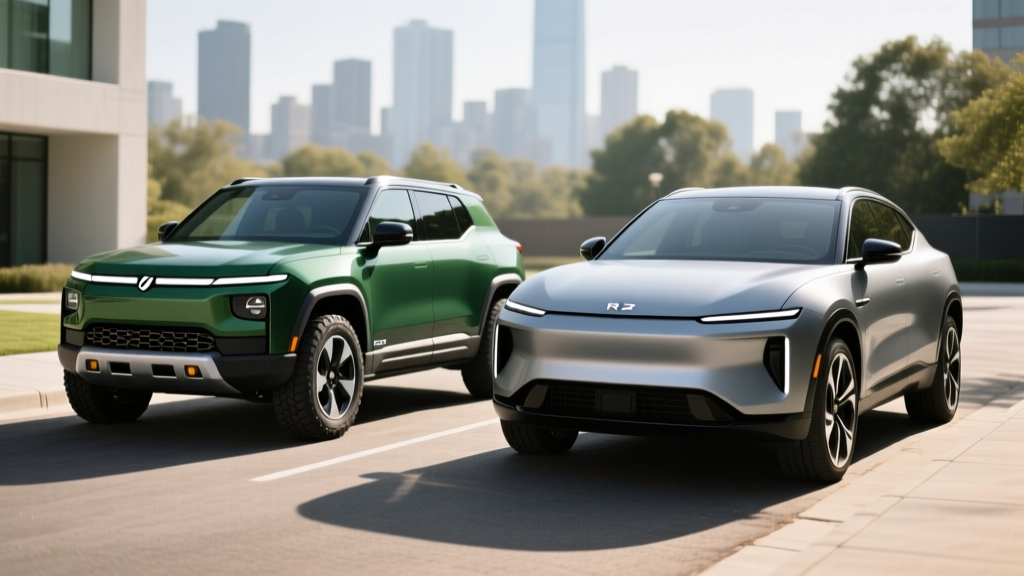
The Rivian R1 (the refreshed R1S SUV and R1T truck platform) and the newer, smaller Rivian R2 represent two distinct philosophies from the same automaker. The R1 is a premium, body-on-frame adventure vehicle with up to three motor configurations and serious off-road chops. The R2 is a unibody compact SUV designed for mainstream affordability, daily commuting, and family duty at roughly half the starting price. Neither is universally "better" — the right choice depends entirely on your budget, space needs, and how you plan to use the vehicle.
Below, we break down every major category with exact 2026 model-year numbers — EPA range, battery capacity, charging curves, pricing, and federal tax credit eligibility — so you can make a data-driven decision.
Rivian R1 vs R2: Side-by-Side Specifications
All figures reflect the latest available 2026 model-year data. R2 specs are based on Rivian's most recent published preliminary figures, as the vehicle enters its first full production year. R1 figures reflect the Gen 2 platform refresh.
| Specification | Rivian R1S (Dual-Motor Max) | Rivian R2 (Dual-Motor Std) |
|---|---|---|
| EPA Range (est.) | 410 miles | 330 miles |
| Battery Capacity (usable) | ~149 kWh (NMC) | ~92 kWh (NMC) |
| Battery Chemistry | NMC (nickel manganese cobalt) | NMC (2170 cells, new pack architecture) |
| Peak DC Fast Charge Rate | 220 kW | ~175 kW (est.) |
| 10–80% DC Fast Charge Time | ~36 minutes | ~30 minutes (est.) |
| Level 2 Charging (max AC kW) | 11.5 kW | 11.5 kW |
| Horsepower | 665 hp | ~450 hp (est.) |
| 0–60 mph | 3.5 seconds | ~5.0 seconds (est.) |
| Cargo Volume (rear seats up) | 46.7 cu ft | ~28 cu ft (est.) |
| Frunk Volume | 11.1 cu ft | ~8 cu ft (est.) |
| Towing Capacity | 7,700 lbs | ~3,500 lbs (est.) |
| Ground Clearance | 14.9 in (max, air suspension) | ~8.5 in (est.) |
| EPA Efficiency (MPGe) | ~70 MPGe combined | ~105 MPGe combined (est.) |
| Base MSRP | $89,900 (Dual-Motor Max) | $49,900 (est.) |
| Battery Warranty | 8 years / 175,000 miles | 8 years / 175,000 miles (expected) |
| Vehicle Warranty | 5 years / 60,000 miles | 5 years / 60,000 miles (expected) |
Sources: Rivian R1S specifications, Rivian R2 preview, fueleconomy.gov. R2 figures marked (est.) are preliminary and subject to EPA certification.
Range and Efficiency: Real-World Expectations
On paper, the R1S Max Pack's 410-mile EPA rating dwarfs the R2's estimated 330 miles. But raw range numbers only tell part of the story.
R1S Max Pack: EPA 410 mi. Expect ~330–360 mi on sustained highway driving at 70+ mph. In cold weather (below 32°F), plan for ~280–310 mi due to battery heating demands and cabin climate load. The R1S's boxy aerodynamics and 6,800+ lb curb weight work against highway efficiency.
R2 Dual-Motor: EPA ~330 mi (est.). Expect ~270–295 mi highway. Cold-weather range: ~230–260 mi. The R2's smaller, lighter unibody platform and lower frontal area give it a meaningful efficiency advantage per mile driven.
The R2's estimated 105 MPGe combined versus the R1S's roughly 70 MPGe means the R2 consumes about 33% less electricity per mile. Over 15,000 annual miles, that translates to roughly $150–$250 less in home-charging electricity costs per year (at the national average of ~$0.16/kWh), depending on your local utility rates.
Range winner: R1S for total miles. Efficiency winner: R2 by a significant margin.
Charging Speed and Network Access
Both vehicles use the NACS (North American Charging Standard) connector natively, granting full access to Tesla's Supercharger network — currently the most reliable and expansive DC fast-charging network in the U.S. with over 25,000 stalls.
| Level | R1S Max Pack | R2 (est.) | Miles Added per Hour |
|---|---|---|---|
| Level 1 (120V / 12A) | 1.4 kW | 1.4 kW | ~3–4 mi/hr |
| Level 2 (240V / 48A) | 11.5 kW | 11.5 kW | ~28–35 mi/hr |
| DC Fast Charge (peak) | 220 kW | ~175 kW | N/A (session-based) |
Charging curve reality: The R1S Max Pack peaks at 220 kW but sustains that rate only between roughly 10–35% State of Charge (SoC). Above 50%, the curve tapers significantly, dropping below 100 kW past 70%. The full 10–80% session takes about 36 minutes. The R2's smaller ~92 kWh battery charges at a lower peak rate (~175 kW) but has less total energy to replenish, resulting in a comparable or slightly faster 10–80% time of roughly 30 minutes.
For road-trip charging, the R2's smaller battery actually means shorter stops if you're charging to 80% — an advantage that partially offsets the R1S's higher peak kW rate. However, the R1S's larger battery means fewer total stops on a long trip.
For CCS-network chargers (Electrify America, EVgo), both Rivians will need a NACS-to-CCS adapter, which Rivian provides. Charging speeds on CCS stations will be limited by the station's output and adapter throughput.
Charging winner: Tie — R1S charges faster in absolute kW, but R2 completes sessions quicker due to smaller battery capacity.
Price, Tax Credits, and Total Ownership Cost
This is where the two vehicles diverge most dramatically — and where federal tax credit eligibility can flip the value calculus.
- MSRP Cap: SUVs must be priced at or below $80,000 to qualify. The R1S Dual-Motor Max at $89,900 exceeds this cap. Lower R1S trims (Dual-Motor Standard at ~$75,900) may qualify if other requirements are met.
- Buyer Income Cap: Modified AGI must not exceed $150,000 (single) / $300,000 (joint filing).
- Battery Sourcing: Critical minerals and battery components must meet escalating domestic-content thresholds per IRS §30D rules. Rivian has been working to qualify its supply chain — check the IRS's current eligible vehicle list before purchasing.
- Point-of-Sale Transfer: Eligible buyers can apply the credit as an immediate price reduction at the dealer rather than waiting for tax filing.
Tax credit eligibility is complex and changes frequently. Consult a tax professional and verify current status on irs.gov before making a purchase decision.
| Cost Factor | Rivian R1S (Dual-Motor Std) | Rivian R1S (Dual-Motor Max) | Rivian R2 (Dual-Motor) |
|---|---|---|---|
| Base MSRP | $75,900 | $89,900 | ~$49,900 |
| §30D Credit Eligible? | Potentially (under $80K cap) | No (exceeds $80K cap) | Potentially (under $80K cap) |
| Effective Price (with max credit) | ~$68,400 | $89,900 | ~$42,400 |
| Annual Insurance (est.) | $2,400–$3,000/yr | $2,600–$3,200/yr | $1,600–$2,100/yr |
| Annual Charging Cost (15K mi, home) | ~$870 | ~$870 | ~$620 |
| Est. 5-Year Total Cost | ~$105,000–$115,000 | ~$125,000–$135,000 | ~$65,000–$75,000 |
The R2's ~$49,900 starting price puts it squarely in the mainstream SUV market, competing with the Tesla Model Y, Hyundai Ioniq 5, and Ford Mustang Mach-E. When the §30D credit applies, the effective price drops to the low $40,000s — a compelling entry point for an all-electric, dual-motor AWD SUV.
The R1S occupies premium territory. Even the base Dual-Motor Standard trim at $75,900 pushes toward luxury pricing, and the Max Pack's $89,900 MSRP eliminates it from federal credit eligibility entirely. You're paying for capability, space, and off-road prowess that the R2 simply doesn't offer.
Insurance costs are notably higher on the R1 platform — roughly 30–40% more annually — driven by higher repair costs, heavier vehicle weight, and the premium price of replacement body panels and suspension components.
Value winner: R2, decisively — both on purchase price and ongoing ownership costs.
Category-by-Category Verdicts
Rivian R1S Max Pack — 410 mi EPA
For cross-country road trips with fewer stops
Rivian R2 — ~105 MPGe combined
Lower cost per mile, less energy consumed
Rivian R2 — ~30 min 10–80% (est.)
Smaller battery = shorter stops
Rivian R1S — 665 hp, 0–60 in 3.5s
Sports-car acceleration in a full-size SUV
Rivian R1S — 14.9 in ground clearance
Air suspension, tank turns, wading mode
Rivian R1S — 46.7 cu ft + 11.1 cu ft frunk
Three rows, 7,700-lb towing
Rivian R2 — ~$49,900, credit-eligible
~$42,400 effective with §30D credit
Rivian R2 — lower insurance, electricity
~$65K–$75K five-year total vs $105K+ for R1S
Rivian R2 — smaller footprint, better MPGe
Easier to park, cheaper to fuel
Technology, ADAS, and Interior
Both vehicles run Rivian's in-house software stack with over-the-air updates, but there are generational differences worth noting.
R1S (Gen 2 refresh): Features Rivian's latest ADAS suite with enhanced highway assist (Level 2 SAE automation — driver must remain engaged and hands on or near the wheel at all times). The Gen 2 platform introduced an upgraded ECU architecture, faster processors, and a redesigned center console with a 15.6-inch display. The gear tunnel (R1T) and camp kitchen accessories remain R1-exclusive lifestyle features.
R2: Debuts Rivian's next-generation electrical architecture with a zone-based controller design that reduces wiring harness weight by roughly 40%. The interior is simpler and more minimalist — a single 15-inch center display and a compact digital cluster. ADAS capabilities are expected to match or slightly exceed the R1's Gen 2 system at launch, benefiting from newer sensor hardware. However, the R2 lacks the R1's air suspension, adjustable ride height, and dedicated off-road drive modes.
Tech winner: R2 for architecture freshness; R1S for feature breadth and lifestyle accessories.
Decision Framework: Which Rivian Is Right for You?
Choose the Rivian R1S if:
- You need three-row seating for 6–7 passengers or regularly haul large cargo loads
- You tow a trailer, boat, or camper (7,700-lb capacity vs ~3,500 lb for R2)
- Off-road driving is a priority — rock crawling, forest roads, deep snow with adjustable air suspension
- You take frequent cross-country road trips and want 410-mile range to minimize stops
- Budget is flexible and you're comfortable spending $75,000–$100,000+ before incentives
- You value the R1 lifestyle ecosystem: camp kitchen, gear tunnel, rooftop tent integration
Choose the Rivian R2 if:
- You want an electric SUV in the $42,000–$55,000 effective price range (after potential tax credits)
- Your primary use is daily commuting, school runs, and weekend trips — not overlanding
- Lower ongoing costs matter: cheaper insurance, less electricity per mile, lower tire replacement cost
- You want a compact footprint that's easy to park in urban environments
- Two rows of seating and ~28 cu ft of cargo space meet your needs
- You want Rivian's software and charging-network access without the R1's premium price tag
Frequently Asked Questions
Is the Rivian R2 just a smaller R1S?
No. While both share the Rivian brand and software ecosystem, they are fundamentally different vehicles. The R1S uses a body-on-frame skateboard platform with available air suspension and up to quad-motor configurations. The R2 uses a unibody architecture with a new, more cost-effective battery pack design and is engineered specifically for high-volume manufacturing at Rivian's new Georgia production facility. The driving experience, capability envelope, and cost structure are substantially different.
Can the Rivian R2 go off-road?
The R2 will offer all-wheel drive and reasonable ground clearance for light-duty trails, snow, and gravel roads. However, it lacks the R1S's air suspension (which can raise to 14.9 inches), dedicated off-road drive modes, and underbody protection. Think Subaru Forester-level capability, not Jeep Wrangler-level. If serious off-roading is on your agenda, the R1S is the clear choice.
Will the R2 qualify for the full $7,500 federal tax credit?
The R2's ~$49,900 MSRP falls well under the §30D $80,000 SUV cap, which is a positive. However, full credit eligibility depends on battery component sourcing and critical mineral requirements that tighten each year. Rivian has been actively qualifying its supply chain, but you should verify the R2's current status on the IRS eligible vehicle list and confirm your income eligibility before relying on the credit in your budget. Point-of-sale transfer is available if all criteria are met.
Which Rivian holds its value better?
Long-term depreciation data for the R2 doesn't yet exist given its recent launch. The R1S has experienced depreciation typical of premium EVs — roughly 35–45% over three years according to industry trackers, though this varies by trim and market conditions. The R2's lower starting price and mainstream positioning may give it stronger residual value as a percentage of MSRP, but confirmed data will take 2–3 years to establish.
Can I charge a Rivian R1 or R2 at Tesla Superchargers?
Yes. Both the R1S and R2 use the NACS connector natively and are approved for use at Tesla Supercharger stations. This is one of Rivian's strongest ownership advantages, as the Supercharger network consistently outperforms other public DC fast-charging networks in uptime and reliability.
What's the real-world cold-weather range penalty?
Expect a 20–30% range reduction in sustained sub-freezing temperatures for both vehicles. The R1S Max Pack drops from 410 to roughly 280–310 miles. The R2 drops from ~330 to roughly 230–260 miles. Both vehicles use heat pump systems to mitigate cabin heating losses, but battery chemistry and physics impose unavoidable penalties in cold weather. Preconditioning the battery while plugged in (using grid power rather than battery energy) is the most effective way to minimize this loss.