The Short Answer
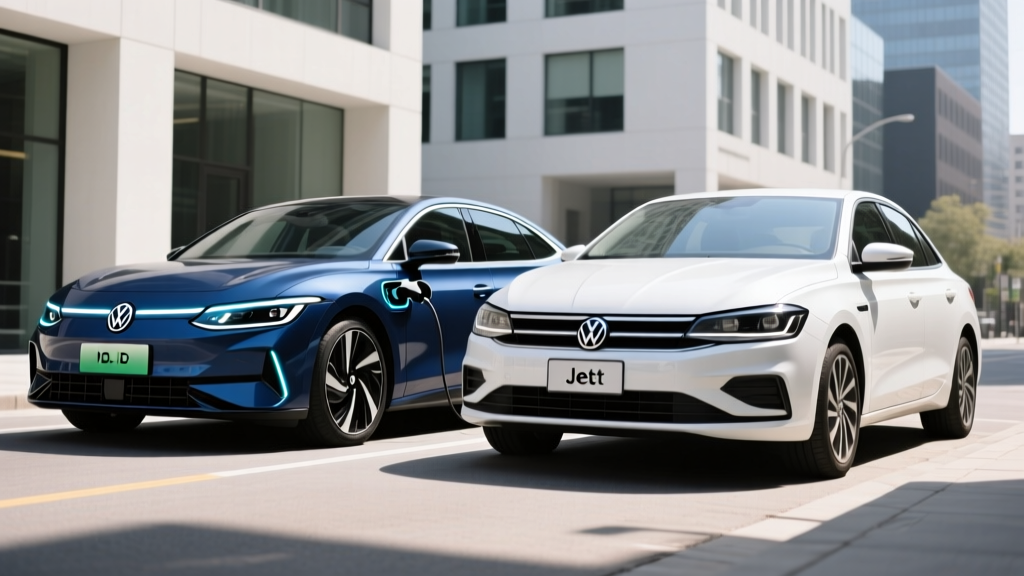
There is no vehicle officially badged "Electric Jetta." Volkswagen's closest equivalent is the 2026 VW ID.7, an all-electric midsize sedan positioned above the gas Jetta in size and price. The ID.7 starts around $52,795 (MSRP before incentives), delivers an EPA-estimated 342 miles of range (Pro S trim, RWD), and charges at up to 200 kW DC (10–80% in ~26 minutes). By contrast, the 2026 gas Jetta starts near $22,595 and achieves 34 MPG combined. The ID.7 costs roughly $30,000 more upfront but saves $1,200–$1,800 annually on fuel and maintenance for a typical driver. If you need a compact, affordable VW sedan, the gas Jetta (or a used ID.4) is the practical choice. If you want an electrified VW sedan with premium space and range, the ID.7 is the real "electric Jetta."
What VW Buyers Actually Mean by "Electric Jetta"
Search interest in "electric Jetta" reflects a genuine gap in Volkswagen's US lineup: a battery-electric sedan at the Jetta's price point. VW discontinued the e-Golf in 2019 and has not released a compact electric sedan for the American market. The 2026 ID.7 is VW's only electric sedan sold in the US, and it competes more directly with the Tesla Model 3, Hyundai Ioniq 6, and BMW i4 than with the compact Jetta.
For buyers loyal to VW's sedan formula — practical trunk, comfortable ride, efficient commuting — the ID.7 is the spiritual successor, just at a higher tier. Below, we break down exactly how it compares to the gas Jetta on every metric that matters to ownership.
2026 VW ID.7 vs Gas Jetta: Full Spec Comparison
| Specification | 2026 VW ID.7 Pro S (RWD) | 2026 VW Jetta SE (1.5T) |
|---|---|---|
| Powertrain | Single motor BEV, 86 kWh usable (NMC) | 1.5L turbo I-4, 8-speed auto |
| Horsepower | 282 hp | 158 hp |
| 0–60 mph | ~6.5 sec | ~7.7 sec |
| EPA Range / MPG | 342 mi (116 MPGe combined) | 34 MPG combined (30 city / 40 hwy) |
| Real-World Range Note | Expect ~280–300 mi highway; ~240 mi in freezing weather | ~425 mi per 12.4-gal tank |
| Max DC Fast Charge | 200 kW peak (CCS1); ~26 min 10–80% | N/A (gas station ~5 min) |
| Level 2 Charge Rate | 11 kW (AC); ~9 hrs 0–100% | N/A |
| Base MSRP | $52,795 | $22,595 |
| Federal Tax Credit (§30D) | Up to $7,500 (point-of-sale); subject to sourcing & income rules | $0 |
| Battery / Powertrain Warranty | 8 yr / 100,000 mi (battery ≥70% capacity) | 4 yr / 50,000 mi basic; 6 yr / 70,000 mi powertrain |
| Cargo Volume | ~17.4 cu ft (trunk) | 14.1 cu ft (trunk) |
Sources: fueleconomy.gov, VW ID.7 official specs, IRS §30D clean vehicle credit.
Real Cost of Ownership: 5-Year Breakdown
Upfront price tells only part of the story. Below is a five-year cost projection assuming 15,000 miles/year, $0.14/kWh home electricity, $3.40/gallon regular gas, and no major repairs under warranty.
| Cost Category (5 Years) | VW ID.7 Pro S | VW Jetta SE |
|---|---|---|
| Purchase Price (MSRP) | $52,795 | $22,595 |
| Federal Tax Credit (§30D) | −$7,500 (if eligible) | $0 |
| Effective Purchase Price | $45,295 | $22,595 |
| Fuel / Electricity (75,000 mi) | $3,150 (home charging) | $7,425 (gas) |
| Maintenance (oil, filters, brakes) | ~$600 (cabin filter, wipers, tire rotation) | ~$2,800 (oil changes, brake pads, filters) |
| Insurance (avg. estimate) | ~$9,500 ($1,900/yr) | ~$7,000 ($1,400/yr) |
| Estimated Depreciation | ~$18,000 (EV depreciation remains elevated) | ~$9,000 |
| Total 5-Year Cost | ~$60,545 | ~$41,820 |
| Cost Per Mile | ~$0.81 | ~$0.56 |
Key takeaway: The ID.7 saves roughly $6,475 in fuel and maintenance over five years, but the higher purchase price, insurance premiums, and steeper depreciation leave it approximately $18,700 more expensive overall. The gap narrows if you qualify for state incentives (e.g., California's CVRP, Colorado's $5,000 credit) or if gas prices rise significantly. For a cost-neutral switch, you'd need to own the ID.7 for roughly 12+ years or drive 25,000+ miles/year.
Charging Reality: What "Electric Jetta" Owners Need to Know
If you're considering the ID.7 as your "electric Jetta," charging logistics will determine whether ownership is convenient or frustrating.
Home Charging (Where 80%+ of Charging Happens)
The ID.7 accepts 11 kW on Level 2 AC, meaning a full 0–100% charge takes roughly 9 hours on a 48-amp Level 2 home station. Most owners charge overnight, waking to a full battery. A Level 2 installation (e.g., ChargePoint Home Flex or Emporia V2) typically costs:
- Equipment: $400–$700
- Electrician labor: $600–$2,000 (depends on panel proximity and conduit run)
- Panel upgrade (if needed): $1,500–$3,500 for a 200-amp service upgrade
- Permit & inspection: $100–$400
If you live in an apartment, condo, or street-parking situation without dedicated charging access, the ID.7 becomes significantly less practical. Public DC fast charging is viable for road trips but costs 2–3× more per kWh than home electricity and adds 25–35 minutes to stops.
DC Fast Charging & the Curve Taper
The ID.7's 200 kW peak rate is competitive but not class-leading. Here's what the actual charging session looks like on a 350 kW Electrify America or CCS-compatible station:
- 10–30% SoC: Near-peak ~190–200 kW (~12 minutes)
- 30–60% SoC: Sustains ~150–170 kW (~10 minutes)
- 60–80% SoC: Tapers to ~80–100 kW (~8 minutes)
- 80–100% SoC: Drops sharply to ~20–40 kW (avoid unless necessary)
Total 10–80% time: ~26–30 minutes. Always precondition the battery (the ID.7 does this automatically when a charger is set in the navigation) to achieve these speeds, especially in cold weather where charge rates can drop 30–50% without preconditioning.
Common Misconceptions About VW's Electric Sedan
| Myth | Fact |
|---|---|
| "VW makes an electric Jetta." | No compact VW electric sedan exists in the US. The ID.7 is a midsize, premium-priced BEV — closer to a Passat successor than a Jetta. |
| "The ID.7 qualifies for the full $7,500 tax credit automatically." | Eligibility depends on battery critical-mineral sourcing, buyer income caps ($150K single / $300K joint), and MSRP caps ($55K for sedans). Confirm on IRS.gov before purchase. |
| "342 miles of range means I'll always get 342 miles." | EPA estimates assume mixed driving at moderate temperatures. Highway driving at 75 mph reduces range ~15%; freezing temperatures with cabin heat can cut it 25–30%. Plan for 240–300 real-world miles. |
| "EVs cost more to insure because of battery fires." | EV insurance premiums are higher primarily due to repair costs after collisions (specialized labor, battery-pack replacement), not fire risk. EV fire rates are actually lower than ICE vehicles per NHTSA data. |
| "I can charge on any public charger." | The ID.7 uses the CCS1 connector. VW has announced future NACS adoption, but 2026 ID.7 models still ship with CCS1. Adapters exist but add cost and a point of failure. |
Real-World Ownership: Climate, Commute, and Lifestyle Fit
Whether the ID.7 — or any EV — works as your daily sedan depends on three factors most buyers underestimate:
Climate Impact on Range
The ID.7 uses a liquid-cooled NMC battery with a heat pump (standard on Pro S), which helps but doesn't eliminate cold-weather range loss. Owners in northern states (Minnesota, Maine, Colorado) report 25–30% range reduction in sustained sub-freezing driving. A 342-mile EPA rating becomes roughly 240–260 miles in January. If your commute is under 60 miles round-trip, this is manageable. If you regularly drive 200+ miles in winter, plan charging stops accordingly.
Driving Pattern Match
EVs deliver maximum efficiency in stop-and-go city driving thanks to regenerative braking. The ID.7 achieves its best MPGe figures in urban use. Highway-only commuters at 75–80 mph will see efficiency closer to 2.8–3.0 kWh/mile (vs. the EPA-rated 2.5 kWh/mile), meaning fewer real-world miles per charge.
Home Charging Access Is Non-Negotiable
Owning an EV without reliable home or workplace Level 2 charging is possible but expensive and time-consuming. Public DC fast charging costs $0.35–$0.55/kWh (vs. $0.10–$0.18/kWh at home), effectively doubling your "fuel" cost and erasing the operating-cost advantage over the gas Jetta. If you cannot install a Level 2 charger, a PHEV or conventional hybrid may be the smarter electrified choice.
Decision Framework: Should You Buy the ID.7 or Stick With Gas?
Choose the VW ID.7 (Electric Jetta Alternative) If:
- You have reliable home or workplace Level 2 charging access
- Your daily driving is under 200 miles (round-trip commute + errands)
- You qualify for the §30D federal tax credit (reducing effective price to ~$45K)
- You value instant torque, quiet operation, and zero tailpipe emissions
- You plan to keep the vehicle 7+ years (amortizing the higher upfront cost)
- You live in a state with additional EV rebates (CA, CO, NY, MA, etc.)
Choose the Gas Jetta (or a Hybrid Alternative) If:
- Your budget is under $30,000
- You lack home charging access (apartment, street parking, condo restrictions)
- You regularly drive 300+ miles in a single day or live in a charging-desert region
- You live in extreme cold climates and need maximum range predictability
- You want minimal ownership complexity and widespread service infrastructure
- You plan to sell or trade within 3–4 years (higher EV depreciation hurts)
What First-Time EV Buyers Must Know Before Switching
If the ID.7 is your first EV, prepare for these ownership realities:
- Plan charging like you plan fuel stops. Apps like PlugShare and A Better Routeplanner become essential for road trips. The Electrify America network (which VW has a stake in) is improving but still has reliability gaps in rural areas.
- Understand kW vs. kWh. kW is the charge rate (how fast energy flows — like water pressure); kWh is battery capacity (how much energy is stored — like tank size). The ID.7 has an 86 kWh battery and charges at up to 200 kW.
- Don't charge to 100% daily. NMC batteries last longest when kept between 20–80% SoC for daily use. Reserve 100% charges for road-trip departures. The ID.7's software lets you set a charge limit.
- Tire wear is higher on EVs. The ID.7's 4,600+ lb curb weight and instant torque wear tires 20–30% faster than a gas Jetta. Budget for tire replacement every 25,000–35,000 miles.
- Regenerative braking changes your driving. The ID.7 offers adjustable regen but not true one-pedal driving like some competitors. Expect a week of adaptation.
Frequently Asked Questions
Will VW ever release a compact electric sedan priced like the Jetta?
VW has not announced a US-market compact electric sedan. The ID.2 (a small hatchback sold in Europe) could theoretically become a sedan, but VW's US strategy currently focuses on SUVs (ID.4, ID.7 wagon variant). A true "electric Jetta" at $25,000–$30,000 is unlikely before 2028 at the earliest.
Does the 2026 VW ID.7 qualify for the $7,500 federal tax credit?
Potentially, but eligibility is not guaranteed. The §30D credit requires the vehicle to meet critical-mineral and battery-component sourcing thresholds (which tighten annually), the buyer must fall under income caps ($150,000 single / $300,000 joint modified AGI), and the sedan MSRP must not exceed $55,000. The ID.7 Pro S at $52,795 clears the MSRP cap. Verify your specific eligibility on IRS.gov or consult a tax professional. The credit can be transferred to the dealer at point-of-sale as a price reduction.
How does the ID.7 compare to the Tesla Model 3?
The 2026 Model 3 Long Range (RWD) starts around $42,490, offers ~363 miles EPA range, charges at up to 250 kW (NACS), and has access to the Supercharger network. The ID.7 offers more interior space (especially rear legroom and trunk volume), a quieter ride, and VW's dealer service network. The Model 3 wins on price, charging infrastructure, and efficiency. It's a genuine cross-shopping decision.
What happens if the ID.7's battery degrades?
VW warranties the ID.7 battery for 8 years / 100,000 miles against dropping below 70% of original capacity. Industry data from similar NMC packs (Hyundai, Kia, older VW ID.4) shows typical degradation of 8–12% over 100,000 miles with normal charging habits. A full battery replacement out of warranty would cost an estimated $15,000–$20,000, though module-level repair may be possible for less.
Can I tow with the VW ID.7?
The 2026 ID.7 is not rated for towing in the US market. If you need towing capacity, the ID.4 (up to 2,700 lbs with factory hitch) or a PHEV SUV is a better fit.