Quick Answer: The 2026 Nissan Leaf starts around $28,140 with up to 212 miles of EPA range and is best for budget-conscious commuters with home charging. The 2026 Nissan Ariya starts near $39,590, delivers up to 304 miles of range, DC fast-charges at up to 130 kW, and suits road-trippers and families needing more space. If your daily drive is under 40 miles and you can charge at home, the Leaf saves thousands. If you need highway range, faster charging, and AWD capability, the Ariya is the stronger buy.
Why Compare These Two Nissan EVs?
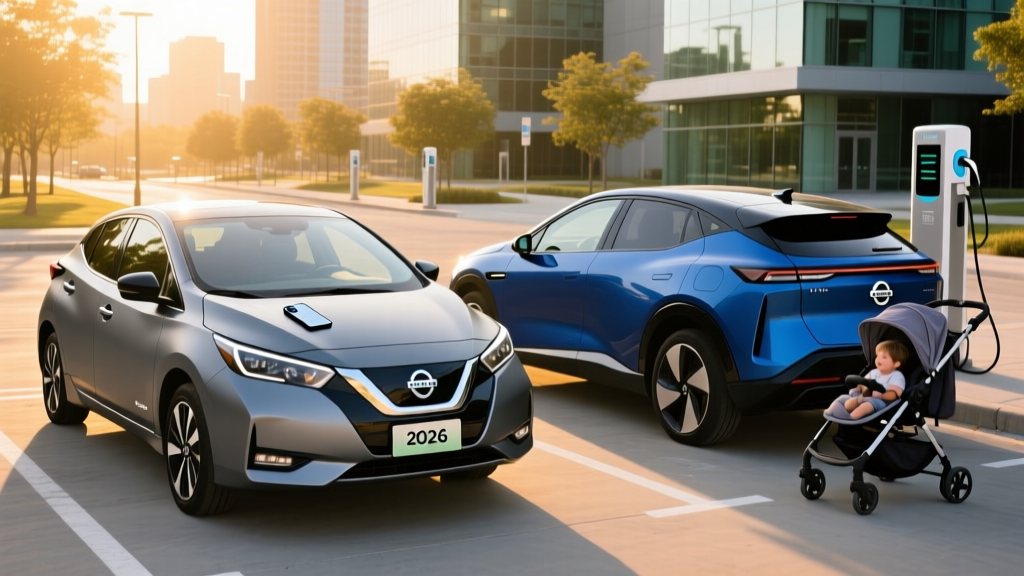
Nissan occupies a rare position in the EV market: it sells both one of the most affordable new electric cars available (the Leaf) and a competitive mainstream crossover (the Ariya). For buyers searching for an "electric Nissan" in 2026, the choice almost always narrows to these two models. They share a brand and dealership network but target fundamentally different use cases.
The Leaf is a compact hatchback with a CHAdeMO connector and front-wheel drive — a pragmatic, low-cost commuter. The Ariya is a midsize crossover with CCS charging, available e-4ORCE all-wheel drive, and a larger battery. Let's break down the numbers that matter.
Specs That Actually Matter: Leaf vs Ariya Side by Side
| Spec | 2026 Nissan Leaf (SV Plus) | 2026 Nissan Ariya (Engage+ / Empower+) |
|---|---|---|
| Base MSRP | $28,140 | $39,590 |
| EPA Range | 212 mi (SV Plus) | 289–304 mi (depending on trim) |
| Battery (usable) | ~60 kWh, LMO/NMC | ~63 kWh (standard) / ~91 kWh (extended), NMC |
| Peak DC Fast Charge | ~50 kW (CHAdeMO) | ~130 kW (CCS) |
| 10–80% DC Charge Time | ~60 min | ~35 min (extended range) |
| Level 2 Onboard Charger | 6.6 kW | 7.2 kW |
| Motor Output | 214 hp / 250 lb-ft | 238 hp (FWD) / 389 hp (e-4ORCE AWD) |
| 0–60 mph | ~6.9 sec | ~7.5 sec (FWD) / ~5.1 sec (AWD) |
| MPGe (combined) | 114 MPGe | 97–109 MPGe |
| Cargo Volume | 23.6 cu ft (rear seats up) | 22.8 cu ft (FWD) / 18.9 cu ft (AWD) |
| Battery Warranty | 8 yr / 100,000 mi | 8 yr / 100,000 mi |
Sources: fueleconomy.gov, Nissan USA specifications. Real-world highway range typically runs 15–20% below EPA combined estimates. Cold-weather losses (below 32°F) can reduce range by 20–30% in either vehicle.
Real Costs and Savings: Purchase, Charging, and Maintenance
Sticker price is only the starting point. Here's a realistic five-year ownership comparison, assuming 12,000 miles per year and a national-average electricity rate of $0.16/kWh versus $3.50/gallon for regular unleaded.
| Cost Category (5 Years) | 2026 Leaf SV Plus | 2026 Ariya Engage+ (FWD) | 2026 Nissan Rogue (Gas Baseline) |
|---|---|---|---|
| Base MSRP | $28,140 | $39,590 | $28,850 |
| Est. Federal Tax Credit (§30D)* | Up to $3,750 | Up to $7,500 | $0 |
| Effective Purchase Price | ~$24,390 | ~$32,090 | $28,850 |
| Fuel / Electricity (60k mi) | ~$2,400 | ~$2,900 | ~$7,500 |
| Maintenance (5 yr) | ~$1,500 | ~$1,500 | ~$3,800 |
| Insurance (5 yr avg) | ~$8,500 | ~$9,200 | ~$7,500 |
| 5-Year Total | ~$36,790 | ~$45,690 | ~$47,650 |
*Federal §30D tax credit eligibility depends on buyer income caps (AGI ≤$150k single / $300k joint), vehicle MSRP caps ($55k for cars, $80k for SUVs/vans), and battery component/critical-mineral sourcing requirements that shift annually. The Leaf's credit has historically been lower due to battery sourcing rules. Verify current-year eligibility at IRS.gov or consult a tax professional. Point-of-sale transfer is available at participating dealers.
Charging Reality: Connector Differences That Matter
This is the single biggest practical difference between the two vehicles, and it's one many first-time buyers overlook.
The Leaf uses CHAdeMO — a DC fast-charging connector that Electrify America has largely abandoned in favor of CCS. While you can still find CHAdeMO stations, the network is shrinking. This means road-tripping in a Leaf requires more planning and patience. If your EV life is 95% home charging and short commutes, this is manageable. If you road-trip regularly, it's a genuine limitation.
The Ariya uses CCS, the dominant DC fast-charging standard among non-Tesla networks. Electrify America, EVgo, and most other major providers support CCS natively. With the Ariya's 130 kW peak charge rate, you'll add roughly 150–170 miles in a 30-minute session — practical enough for highway stops.
Neither vehicle ships with a NACS (Tesla) port as of the 2026 model year, but CCS-to-NACS adapters are widely available, granting access to Tesla Supercharger V3 stations (150 kW CCS-compatible stalls).
Who Should Buy Which? A Decision Framework
Choose the Nissan Leaf if:
- Your daily round-trip commute is under 80 miles
- You have reliable Level 2 home charging (a 6.6 kW charger adds ~25 miles per hour)
- You rarely drive more than 150 miles in a single day
- You want the lowest possible purchase price for a new EV
- You live in a mild climate where cold-weather range loss is moderate
Choose the Nissan Ariya if:
- You need 250+ miles of real-world highway range
- You take road trips of 200+ miles more than a few times per year
- You need AWD for snow or mountain driving (e-4ORCE trims)
- You want faster DC charging on CCS networks
- You need a midsize crossover footprint for family cargo and passengers
Common Misconceptions About Electric Nissans
| Myth | Fact |
|---|---|
| "The Leaf's battery will degrade to useless in 5 years." | Nissan's liquid-cooled battery packs (on the Plus trim) show moderate degradation. Most 2019–2023 Leaf Plus owners report 8–12% capacity loss over 5 years — well within the 8-year/100,000-mile warranty that guarantees ≥66% capacity retention. Early Leafs (2011–2017) with passively cooled 24/30 kWh packs degraded faster; the current 60 kWh pack is far more durable. |
| "EVs cost more to own than gas cars." | As shown in the cost table above, the Leaf undercuts a comparable gas Rogue by nearly $11,000 over five years when you factor in fuel savings, lower maintenance, and the tax credit — even with slightly higher insurance premiums. |
| "You can't road-trip in an EV." | The Ariya can. With 304 miles of EPA range and 130 kW DC charging, a 600-mile trip requires two 30-minute stops. The Leaf is less suited to frequent long trips due to its CHAdeMO connector and slower charge rate, but occasional 200-mile trips are feasible with planning. |
| "Home charging installation is always expensive." | A basic Level 2 installation on an existing 240V circuit (like a dryer outlet) can cost $300–$800. A full panel-to-outlet run with a dedicated 40A circuit averages $1,200–$2,500 depending on your home's layout. Always get a quote from a licensed electrician — some homes need a panel upgrade ($2,000–$4,000) if you're already near capacity. |
Real-World Ownership Considerations Most Guides Skip
Cold-weather range loss is real and significant. In sustained temperatures below 32°F, expect the Leaf's 212-mile EPA range to drop to roughly 150–170 miles. The Ariya, with its available heat pump (standard on higher trims), fares better — expect 220–250 miles from its 304-mile EPA figure. If you live in the upper Midwest or Northeast, plan your purchase around the worst-case winter range, not the EPA sticker.
Highway efficiency drops at speed. Both vehicles are most efficient at 55–65 mph. Sustained 75–80 mph driving reduces range by roughly 10–15% versus the EPA combined figure. The Ariya's larger battery gives it more absolute buffer, but neither vehicle is a hypermiler at interstate speeds.
Insurance costs more. EV insurance premiums run 10–20% higher than comparable gas vehicles, driven by higher repair costs for battery and sensor-laden body panels. Get quotes before purchasing — the difference can be $150–$300/year depending on your profile and state.
Home charging access isn't universal. If you live in an apartment or park on the street, relying on public charging changes the economics. DC fast charging at $0.35–$0.48/kWh costs roughly $0.10–$0.14 per mile — closer to (though still below) a 30 MPG gas car. The Leaf's CHAdeMO limitation makes apartment-dweller ownership especially difficult. The Ariya's CCS compatibility is far more practical for public-charging-dependent owners.
Frequently Asked Questions
Is the Nissan Leaf being discontinued?
As of 2026, Nissan continues to sell the Leaf in the US market, though it has not announced a next-generation model. Industry reports suggest Nissan may replace the Leaf with a new compact EV on a shared platform within the next few years. If you're considering a Leaf, current models remain supported under Nissan's full warranty and dealer network.
Does either Nissan EV qualify for the full $7,500 federal tax credit?
The Ariya has historically qualified for up to $7,500 under §30D, depending on battery sourcing requirements that tighten each year. The Leaf has qualified for a reduced credit (often $3,750) due to critical-mineral sourcing rules. Eligibility also depends on your adjusted gross income and the vehicle's MSRP relative to statutory caps. Always verify at IRS.gov before relying on the credit in your budget.
Can I charge a Nissan Leaf at a Tesla Supercharger?
Not directly. The Leaf uses CHAdeMO, and no widely available CHAdeMO-to-NACS adapter exists as of 2026. The Ariya (CCS) can use Tesla Supercharger V3 stations with a CCS-to-NACS adapter from an authorized manufacturer. This is a meaningful advantage for the Ariya if Tesla's network is your preferred road-trip option.
What happens if the battery fails out of warranty?
Out-of-warranty battery replacement for the Leaf runs approximately $9,000–$12,000; for the Ariya (extended-range pack), $14,000–$18,000. However, modern NMC packs with active thermal management rarely fail catastrophically — degradation is gradual. Most EVs retain 70–85% of original capacity at 150,000 miles based on fleet data. Nissan's 8-year/100,000-mile warranty covers capacity below 66% of original, which provides substantial protection.
Which Nissan EV has lower maintenance costs?
Both are nearly identical. EVs eliminate oil changes, transmission fluid, spark plugs, and exhaust repairs. The main recurring costs are tire rotation/replacement (EVs are heavier and wear tires slightly faster), cabin air filter, brake fluid, and windshield washer fluid. Budget roughly $250–$350/year for either vehicle — about 40–50% less than a comparable gas car.